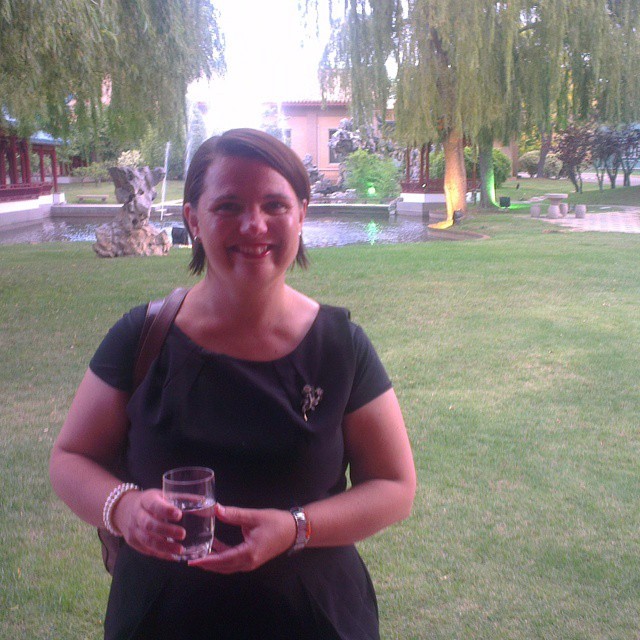
As I was reading her article, I suddenly realized that I too had a pre-China backstory worth sharing – one of relationships that never came to be, and what ifs that point to my own prejudices. So here goes:
—–
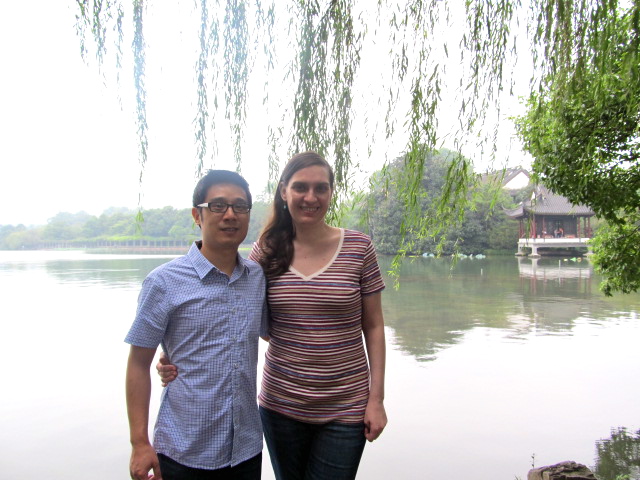
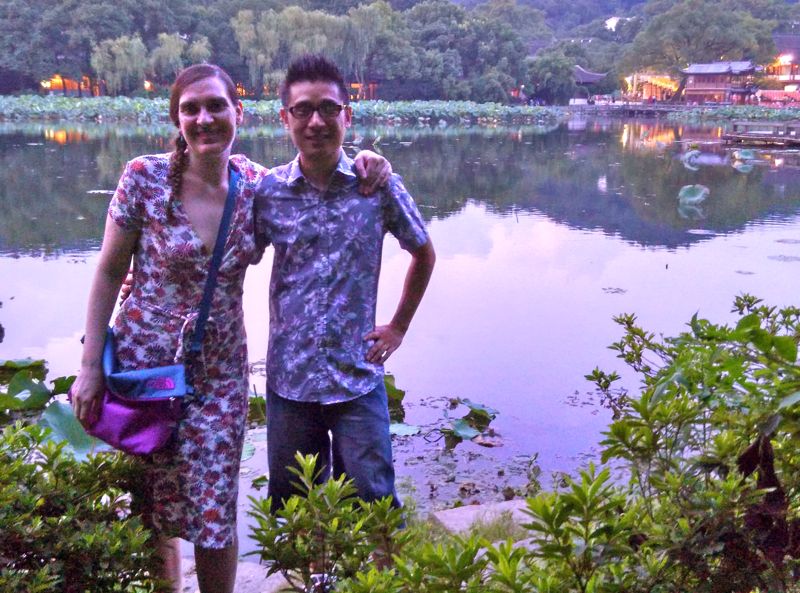
In coming to China, the last thing I expected was to end up dating a local guy, let alone marrying one (as I ended up doing with John, pictured here with me). Why?
“You don’t have to worry about the students falling in love with you.”
Before I embarked on my first trip to China, where I would teach English at a college, I met up with one of the former teachers several times for dinner or drinks. And when the subject of student crushes came up – something he had been forced to navigate very delicately – he negated the possibility of anything similar happening to me.
Of course I didn’t question his words. Hadn’t I already envisioned my year-long assignment much like a vow of chastity? I spoke to friends of my interest in studying Tai Chi over there and visiting some local temples, as if I were about to spend my months as a nun instead of an English teacher. It was an opportunity to travel to a new country, a way to postpone my post-graduate dilemma regarding career decisions, and nothing more than that.
Or so I thought.
Then I moved to Zhengzhou, China – and found myself with a crush on one of the first guys I met there, a former student from the program I would teach for. Over a month later, he introduced me to his friend, a guy who was also a former student – and would become so much more to me in the weeks that followed:
Yao came into my life, in all of his sleek, sexy and sullen James Dean perfection, dressed in a black leather jacket as dark as his mysterious melancholy. When my heart raced after our first dinner together, I thought it was just another adolescent crush. Embarrassed, I wanted to just box my feelings away like all of the Barbie Dolls and little girl hairclips of my past.
Then he took me to that teahouse one Sunday afternoon. Over two Taiwanese bubble teas, the truth bubbled through to the surface of my own heart — I loved him with an uncontrollable depth that plunged far beyond the bottom of my tea cup. And, I began to realize, so did he, because he overflowed with confessionals that he had never before poured over with anyone else.
Not long after, our our passions percolated over into romance — a real boyfriend/girlfriend love that translated into steamy weekends at his apartment, hand-in-hand walks around the gardens of Zhengzhou University, and the occasional afternoon out at the Taiwanese teahouse, his favorite in the city. Bubble tea never tasted so sweet.
In his arms, it was so easy for me to forget that I had once secretly declared this year a lonely one without a single chance for dating. And it was also very easy for me to turn a disdainful eye to my female coworkers at the school, all Americans who had no interest in the local men.
I couldn’t help but wonder, why did I assume that I would be single in China? Why did I think I would never date Chinese men? Was it merely that I grew up in an incredibly white middle-class suburb (I could count on one hand the Asian men I knew from kindergarten to high school graduation)? Was it the overwhelming absence of positive images of Asian men in the whitewashed world of American popular culture?
I think back to my college years, a time when I met many foreign Asian men – including Japanese and Cambodian. I called many of them close friends, yet why did I never let them get any closer to me? Why did I always immediately relegate them to the “friend zone” and nothing more? Why did my white girlfriends and I only giggle over white celebrity heartthrobs in high school, like Tom Cruise?
It’s just not right.
All I know is this — in China, I found the sexiest and most amazing men that I had ever known. I ended up marrying one and I’m still crazy in love with him. (Thank you, John!) It took crossing an entire ocean and time zones to realize that my assumptions about dating in China were a lie.
Every year, there’s always a new bunch of Western women married to Chinese men who announce their plans to move to her country. But what happens after the plane ride is over, the luggage unpacked, and the honeymoon excitement of the move a distant memory?
White American Marissa, the writer and blogger behind Xiananigans, (you might remember her from her Double Happiness story published last year on this blog, How An American Woman Fell In Love With Xi’an (And One Special Guy)) moved back to her country over a year ago with her husband in tow. Here’s what she’s learned since then.
“Why ever did you move home?” said a doctor I saw at a clinic last October. It is a question I am still grappling to answer.
I repatriated just over a year ago, saddling my husband into the whole affair.
Much has not changed since divulging our Double Happiness story. We live with my parents and youngest sister, both working in retail.
I also freelance write for an online hyperlocal, and do a particularly terrible job of keeping up on Xiananigans.
With the cons, come pros. Partaking in road trips, day trips to the beach, exploring New York City, Jersey City where a good friend lives, brunching, driving two hours for the sole purpose of purchasing ingredients for a home-cooked Chinese meal, pestering my father during his weekly grocery shopping trips, hiking and basking in summer’s glorious weather in local parks, a 散步 in the evenings, indulging in ice cream on a far too regular basis, getting outdoors by playing basketball, badminton, bike riding, going to the gym and building tolerance for intolerance.
So if you repatriated or plan to do so in the immediate future, I advise:
Starting your search before arriving, line up a job or consider industries outside your field. There are industries experiencing growth, particularly healthcare, education, and retail. There is a need for postsecondary teachers, office clerks, registered nurses, personal care aids, and customer service representatives, to name a few. I can say most, if not all, do not appeal to me, in the slightest, yet I am currently employed in one of the previously mentioned fields, freeing you to pursue other career interests, think moonlighting or freelance gigs, or perhaps work on your side hustle.
Living with your family, for the interim. If at all possible to reside with your parents, or extended family members, as my husband and I have done, then do so. Although not always ideal, we spend less, share evening meals, and cooking responsibilities, whether we put together Chinese or Western dinners, several times a week. Those who did not cook, help out by cleaning up. In hindsight, I suggest creating a written agreement of duties, including both parties’ expectations.
Staying connected to China, however you see fit. I read Chinese several times a week, picking up children’s books, written in Chinese, from the public library. The librarian bequeathed a stack of books to me, saying the library had no room or real need for them. Among them was Eric CarIe’s The Very Hungry Caterpillar, a children’s story I had a copy of and had my sister purchased for one of my nephews. I also read literature by Chinese authors, in translation of course, or books, fiction and nonfiction alike, interweaving China into their narratives. Keeping up with your spoken Chinese, even if, like me, you are merely conversational, proves as yet another way to stay connected. Talk to your in-laws, even if saying hello, how are you, and wishing them good health is all you can muster. Nag your husband to keep in touch with his family, friends, and acquaintances; it is easy and free to connect on WeChat. Watch Chinese films and TV shows together (we fawned over Jia Zhangke films and Hunan TV’s 爸爸去哪儿第三季…kudos to readers who uncover why 😉 ), partake in Chinese chess 象棋, mahjong 麻将, and Chinese card games. Find your area’s most authentic Chinese restaurant, frequent it, making sure to use the visit as a chance to practice Chinese with people other than your spouse.
Making new friends, but reconnecting with the “old.” Reach out to people you have not heard from in ages, believe me, they will be happy to hear from you. Finding new friends, particularly other repatriated individuals, helps build a stronger support system where you have those you can share your overseas experience with, and not nag the friends who do not wish to hear every minute detail recounted to them for the third time.
Be prepared to discuss politics, the weather, and make small talk. No one will ask you have you eaten “你吃了没有?/你吃了吗?” when you run into them, instead asking after your day, discussing the latest in political affairs, and complaining about today’s humidity, or lack thereof, peppers conversations here.
Ensure you can defend China, or deal with the inaccurate ramblings and representations smattered in the American media. China is a hot topic as of late in the American media (when is it not?), covering the explosion in Tianjin, the devaluing of the renminbi, the fluctuating stock markets in Shanghai, Shenzhen, and Hong Kong, and President Xi Jinping’s visit to the US slated for September. Inaccuracies, biases regarding China are too easy to find in print and online, leading even the most informed of Americans to rattle off their “informed” thoughts, telling you what China is like, even though they never lived, let alone visited there. When words like “backwards,” “Communist” accompany the phrases “I know, I read” there is no hope for that conversation to progress. Resort to jumping ship, neutralizing the topic, and return to domestic politics, where they can rant up a storm, and you can pretend to listen intently.
Patience, patience, and more patience. Embracing the mantra “Good things come to those who wait” will serve you well. Similarly, remaining optimistic in your search for a career and supporting each other, in all your endeavors, helps envisioning the light at the end of that proverbial tunnel. Do not forget to exude patience with your partner, as acculturating is far harder for them. In my case, ZJ proves thick skinned and unphased by intolerance. Stick up for your partner, regardless if the hate comes from relatives or strangers. And, slightly unrelated, be patient with your spouse’s language acquisition. I lucked out, as ZJ has very few language-related barriers, flaunting a unique blend of dry humor laced with sarcasm, snide (yet always polite!) commentary in the face of rude, intolerant, or unsavory proclamations. He does pick up some rather intriguing phrases from coworkers, “Oh my ‘lanta” replacing “OMG” until, thankfully, he retired it! 😉
And apologies for sounding too positive…let me return to my good old chastising self in the final piece of advice.
If you managed to internalize the friendly, complimentary offerings Chinese friends, students, and maybe even strangers bequeathed on you, perhaps commenting on your impeccable Chinese langauge skills, appearance, personality or competencies, then brace yourself to be labeled as “too sensitive.” Simply put, you may have received compliments, flattery of some kind, or even the opposite. Chinese people told you exactly how it is, as was the case with students who did not shy away from telling me I was a little fat, but not as fat as most Americans! I disliked this approach at first but eventually learned to appreciate this type of honesty. Americans tend to speak ill of an individual behind their back, and provide empty means of flattery when facing the person. Although well aware the compliments and flattery I received in China may have been as equally fake, the honesty I received from students, friends and acquaintances helped me project and blame others less, giving me a thick skin, but one thick enough for dealing with the Chinese way of bluntness. This so-called “thick skin” is thin here, where relatives perceived me as such. Moving back to America means readjusting the way you internalize the comments others make, so reinvest in learning to not care what people think. Easier said than done, but you can do it (is better said in Chinese 加油!)!
Marissa Kluger married her Chinese husband ZJ almost two years ago. They live in New Jersey. She occasionally reminisces about Xi’an and muses about life in the US at Xiananigans.
—–
Initially, not knowing Chinese at all created some stressful and even embarrassing situations for me when I first arrived in China. I hated going out to run even the simplest errands, like mailing a letter, because I’d have to spend an hour trying to memorize a few phrases and then still end up understanding almost nothing they would say to me. Or I’d have these moments in small stores where I would turn as red as the little Chinese dictionary in my hands, paging through it in an often futile effort to express myself. I’m confident I entertained quite a few shopkeepers during my first few months in China.
Years ago, a fellow blogger with a Chinese husband wrote to me, “I follow some blogs by Western women married to Japanese men. You’d probably like them too.” It was the kind of friendly recommendation that you often get from other bloggers – except it came with a warning. “But shhh, don’t tell our husbands!”
Why did a suggestion to read someone’s blog suddenly get slapped with a cautionary note, as if all blogs written by Western women with Japanese husbands might be hazardous to our health? Simple. Like most Chinese men, her husband didn’t care for Japan – and neither did mine:
“Japan? I never want to visit Japan,”[John] hissed. “I’m anti-Japanese.” He launched into a brief history of Japanese aggression in China, from the first territorial swipes at China during the Sino-Japanese War, to the Second Sino-Japanese War, with Holocaust-like atrocities that Japan had yet to acknowledge publicly.
Yes, my marriage to a Chinese man has taught me a valuable lesson — that Asia is not the great, united, happy family (as some Americans might believe). That “Asians” don’t necessarily like being lumped together.
I didn’t realize the extent to our cultural amnesia about the true state of affairs in Asia until I met and married a man from China. A self-proclaimed “military fan” whose interest went deeper than tanks, submarines and aircraft carriers. A husband who schooled me in the many disagreements, wars and massacres between China and its Asian neighbors.
I’ve learned that Japan has yet to fully acknowledge the “Asian holocaust” it perpetrated against China and others, from the gruesome horrors of Unit 731 to the “comfort women” forced into prostitution. I’ve learned of the skirmish between Vietnam and China that led to a short war. I’ve learned about the border disputes between China and India, serious enough to lead my Lonely Planet guidebooks to print “The external boundaries of India on this map have not been authenticated and may not be correct” on their maps. And now I’ve learned everything there is to know about the emerging military alliance between Japan and the Philippines, especially how it affects China.
In America, we speak of “Asian” cuisine like it’s all the same – as if you could substitute one country for another – never realizing the countries here wouldn’t agree. That the Thai restaurant down the street from my father’s home serving Chinese delicacies alongside a sushi menu would look totally blasphemous to people in China, who still haven’t forgotten what Japan did to them.
I’m reminded of what Alex Tizon wrote about in his memoir Big Little Man:
As a journalist in my twenties and thirties, I wrote extensively about these [Asian] communities. No surprise, I found each group exuberantly complex and instinct, and perceiving themselves as separate from — and often antipathetic to — other Asian ethnicities. The parents and grandparents clove to their countrymen, the Vietnamese with other Vietnamese, Koreans with Koreans, Cambodians with Cambodians.
It was the children and grandchildren, the ones growing up in America, who would find — or be coerced into — common ground. Years of checking “Asian” on countless forms, of being subjected to the same epithets and compliments, of living in the same neighborhoods and housing projects, and sharing similar challenges and aspirations — the most important to become Americanized — all of these would compel young Vietnamese, Cambodians, and Filipinos to accept their belonging to the category known as Asians.
Perhaps the most unifying force was the perception that everyday Americans saw them as the same, and what made them the same was their “racial uniform,” to use a term coined by sociologist Robert Park. The uniform was thought to consist of a certain eye and nose shape, hair and skin color, and body type, usually shorter and skinnier — identifiers of the Yellow or Mongoloid or Oriental and finally now the Asian race.
…We Asians were now in the same boat. Our uniform did not lie. Like Lisa said on the Grand Concourse: Japanese, Chinese, Filipino — same thing!
Yep, this is what happened in America – we just clustered everything from Asia together, and assumed that it was one great unified map. Never realizing that it was one great lie.
Asia isn’t that great, united land where countries always peacefully coexist. But that doesn’t mean friendships don’t happen to cross unlikely borders. After all, even if he still dislikes Japan’s government, my husband has actually changed his feelings towards the country as a whole. He has Japanese friends. Still, there is one thing though:
“So, does this mean I can buy you a Toshiba someday?” I prodded him, with a grin.
“Not really. I still have standards, you know,” he smiled.
Why did I assume I’d never find a man to date in China? It’s a question that haunted white American Rosalie Zhao (who blogs at Rosie in BJ), surprised to find the love of her life in the Middle Kingdom (she shared her unforgettable love story here in the post “Enter Zhao Ming…China’s Answer to Arnold Schwarzenegger”). She writes, “With rising tensions and deepening talks surrounding issues of race in the US, I’ve been doing a lot of reflecting on my own prejudices.”
It’s been a couple years since my first guest post on Speaking of China. I wrote of how, against my initial expectations, I found love with a local man in China. Since that post, there’s been a rise of AMWF relationships in the media as well as a growing number of Asian men (and the western women who love them) speaking up and speaking out. With rising tensions and deepening talks surrounding issues of race in the US, I’ve been doing a lot of reflecting on my own prejudices. I’ve also given some thought as to why I assumed I’d never find a man to date in China, an assumption that many western women living in Asia seem to make. Then, the reason finally came to me—a man that was such a small part of my past but who I’ve come to realize had a seemingly profound impact on how I viewed Asian men and perhaps even how I saw myself.
It was freshman year of college and I was in a dating slump. The good news was that I got along fabulously with the other girls I lived with in my dormitory suite. There were five of us in total; I was the only one without a boyfriend. The two girls in the room next door, Laura and Erin, each were dating guys who attended a university on the other side of our state, which meant they were away most weekends visiting their beaus. I don’t know whose idea it was, theirs or mine, but somehow we came up with the idea of me having a blind date with one of their boyfriends’ friends. They quickly ran through their mental rolladexes (this was, of course, pre-Facebook). Who among these friends would be a good match? Laura looked up suddenly. “We should set you up with Johnny!” she exclaimed. “Yeah, he’s really cute!” Erin assured me. They shuffled through all the junk in their dorm room, eventually scrounging up a photo. Laura showed me his picture.
For a second, I was taken aback. I assumed he would be white, but he was in fact East Asian. I quickly admonished myself—what did it matter? He looked fairly cute from the photo and they eagerly sang his other praises: he was kind, smart, and 21 (old enough to buy us beer!). I decided to throw caution to the wind and join them on their next road trip across state, in hopes Johnny might be the man of my dreams. Or maybe someone fun to make-out with for the weekend. Whatever. When you’re 19 and in college, it hardly matters.
As fate would have it, Johnny was neither my future husband or make-out partner. The second I laid eyes on him I knew it wasn’t going to happen. I’m short. This guy? He was barely taller than me. He also weighed about 30 pounds less than me. The chemistry wasn’t there. I wanted a man who eclipsed me in size and strength, a man who would wrap me up into his arms and protect me from all danger. If Johnny was a little bigger and I a little smaller, maybe something could be there, I thought. Johnny, however, didn’t share my sentiments. He seemed very much into the idea of us becoming an item. He was smart enough to read my signals and not push me too hard, but he subtly pursued me that weekend and later, online.
I felt bad initially and even worse as time wore on. Johnny and I became closer friends while talking on MSN messenger and it became clear to me that he was suffering from a far worse dating slump than I was. He had been rejected over and over, to the point where he felt his efforts were futile. He was never going to find a girlfriend. I wanted to assure him that the right girl was out there, but I didn’t know how to do that without returning to an awkward conversation in which he asked why I didn’t like him. Eventually, our chats online became less frequent and I guiltily sighed with relief.
After that, I fell for my own perception bias. I viewed all Asian men as being smaller than me and therefore undatable. I assumed I could never again be attracted to them because I’d feel like an ogre in their presence. But then I came to China and discovered that Asian men come in all sizes and shapes. I also realized something else—a man’s true strength isn’t determined by his height in inches or weight in pounds; in the years since coming to China, I have found men attractive who had physiques similar to that of Johnny’s. And I have also realized that my own self-worth cannot be calculated by how small my jean size is. I don’t have to be thin for a man to find me beautiful.
I see now that I never gave Johnny a fair chance. Perhaps a romance could have blossomed and chemistry forged if I had had an open mind. Was I racist? Sizist? Self-loathing? I don’t know. But I don’t want to judge my 19-year-old self too harshly. I’m just glad that in time I was able to open myself up to the possibilities of dating cross-culturally and the idea of dating in China. I’m not sure where in the world I’d be today if I hadn’t.
Rosalie Zhao resides with her family in Hebei, China, where she writes a blog called Rosie in BJ.
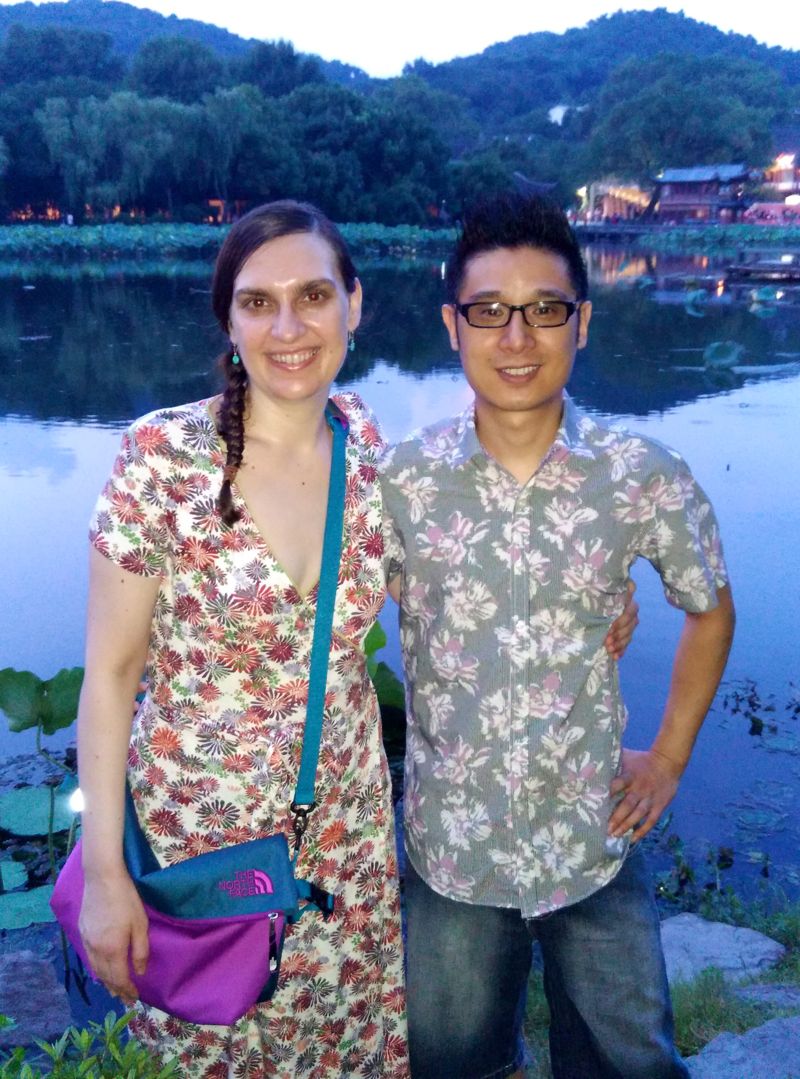
John still loves coming up with what he calls “birthday programs” for my special day and this year was no exception. First, he declared the day a vacation day for us — no work under any circumstances! — and shelved my laptop away. But with the oppressive sunshine burning up the city streets, it was also no time to be outdoors; instead we decided to watch movies on demand at home. We just pulled the curtains, cuddled up in bed, and pretended we were at the movie theater. Simple but fun!
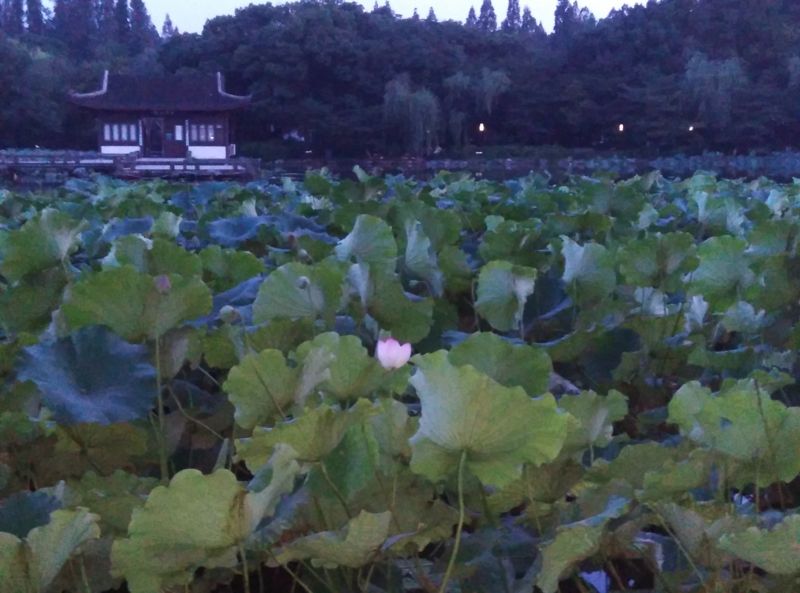
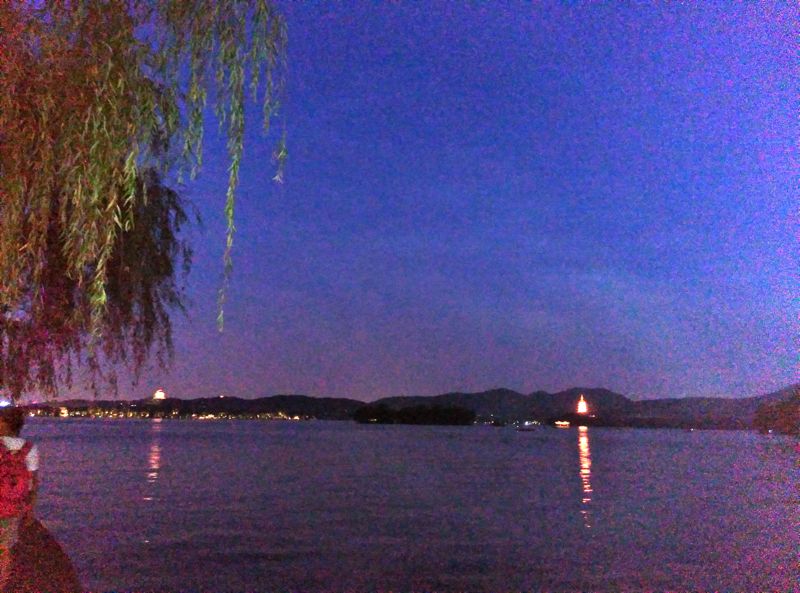
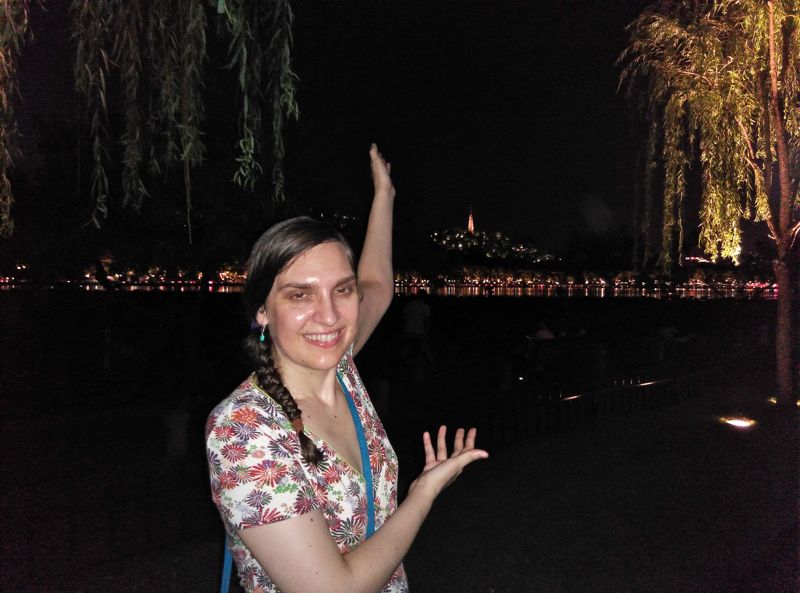
Come evening, however, John and I dressed up to step out into town — or rather, step out beside the West Lake to marvel in the lotus leaves dappling the lake’s surface as well as the dazzling show of lights from the city.
When July rolls around, I’m guaranteed two things – plenty of sultry summer weather (especially here in Hangzhou, considered one of China’s “furnace” cities) and the yearly round of congratulations from American friends and family on another wedding anniversary with Jun. Nowadays it comes virtually through e-mails and Facebook messages; when we used to live in the US, it would arrive via greeting cards with silver-embossed print and sentimental prose neatly tucked into pale pink envelopes.
As a child and adolescent, I watched my parents mark their yearly wedding anniversaries with the appropriate festivities – fancy dinners out, weekend getaways, and of course gifts like jewelry. I also grew up in a culture so invested in the idea of celebrating wedding anniversaries that there’s an entire etiquette surrounding the appropriate gifts to mark wedding anniversaries. (Did you know, for example, that you’re supposed to give silverware on your fifth wedding anniversary?)
So it might surprise you to learn that whenever someone congratulations me on our wedding anniversary, sometimes it feels strange.
Why would something I was raised on now seem foreign to me? Well, there’s a personal reason for that – namely, my Chinese husband John. He doesn’t celebrate wedding anniversaries, which is how people are in China. And after years of being married to him, the idea that wedding anniversaries demand celebrations has fallen off my radar.
Why is it that people here don’t celebrate wedding anniversaries? Well, given that people in China hardly celebrate their own birthdays (or, for that matter, birthdays of family/friends), is it any shock that wedding anniversaries don’t count as a significant event? I wonder if it has to do with attitudes towards love and marriage here. In China, love is something implied, inherent in any marital relationship. It doesn’t need to be restated again and again (the way Americans and other Westerners can’t stop saying “I love you” to their spouses or partners). By that rationale, maybe it doesn’t need to be celebrated in some obvious, Hallmark kind of way either.
The thing is, as blasphemous as it might sound, I like the simplicity of this all. I like the fact that a wedding anniversary doesn’t require the cards, dinners out, getaways or gifts. I like knowing that, here in China, my anniversary isn’t something in the spotlight. It’s something that’s private and personal. Something that John and I can celebrate however we want to.
John and I may never mark our anniversary the same way my parents used to – and that’s okay in my book. The most important thing is that we’re still together as a couple, still married for over 11 years (yes!) and still crazy in love.
While I’m married without children in China, many foreigners — like American Charlotte, a freelance writer in small town China who blogs at Chinese Potpourri — have chosen to start a family here. (Longtime readers might remember Charlotte from her unforgettable love story titled “I Want To Be Your Slave For The Rest of My Life”.) But as Charlotte has learned, having kids in China with your Chinese spouse involves a lot more than just “basics like a starry night themed nursery versus a jungle one.”
Would you like to share your wisdom with the readers of Speaking of China through a personal guest post? Check out the submit a post page to learn more about how to have your writing featured here.
—–
(Photo by Andre Laubner via Flickr.com)
Most Chinese couples want a child, if only to make their parents happy. My husband was no exception, though he was in more of a hurry than I was due to his old-by-Chinese-standards age of 32 at the time of our marriage. And he did truly want kids. It shouldn’t come as a surprise that our son was born just four days after we celebrated our first anniversary.
One thing I didn’t anticipate is all of the decisions that we’d have to make. I’m not talking basics like a starry night themed nursery versus a jungle one. That’s ridiculous, Chinese typically co-sleep with the baby. Nor am I talking about the never ending debate of breast feeding versus formula (news of the formula scandal broke when my son was less than a week old and I was glad that I’d chosen to breastfeed; for those who choose formula, please do due diligence and find a reputable brand).
No, these questions are a bit more serious than that. Once you and your Chinese husband decide to start a family, a few more things need to be discussed. In a perfect world, you’d sort out all these questions as you dated. In reality, we rarely get past the decision to have or not have children before we say “I do.” Here are six questions that are worthy of some serious talk time as you ponder the joys and challenges of parenthood:
1. Which maternity and post-partum customs will you follow?
This goes from quitting your job and not having sex once you know you’re pregnant (first and third trimesters are a “no-no” when it comes to being intimate) to wearing a radiation smock for the duration of the pregnancy and eating dumplings made from insects your mother-in-law picked out of a pile of manure from a farmer’s barnyard to improve your milk production. Nope, not kidding on that. Luckily it was my sister-in-law that got those delicacies; I’m quite the milk producer.
Sometimes it pays to insist on your traditions. But sometimes you need to know when to give in to win. I’ve finally figured out that sometimes I just have to humor my Chinese family. They don’t have as much knowledge about the world as I do and just aren’t capable of understanding some things. Like the fact that rollerskating did not cause my miscarriage. Really, they simply don’t get it. I also assured them that I will not blame them for any ailments I have in old age. Once I came to the realization that I can’t change what my mother-in-law knows and understands, life became easier.
2. Which nationality will the kids be?
I attended school with several military kids and they’d talk about their dual citizenship because they were born abroad and when they were 18 they could choose which nationality to keep. This was interesting to me, and when I found out we were expecting, I looked up the requirements of getting that for our kids. The friendly person at the American embassy informed me that China doesn’t recognize dual citizenship and that all babies born here are Chinese citizens. So these half-Chinese kids are in a sort of nationality purgatory; they can get a passport from their own country but China will still want to count them as one of their own.
3. Who and how will you name the baby?
When I taught English at a local college I always did a unit on names with the students. It was a chance for me to learn more characters and for them to explain something pretty basic in English. I was surprised to find that most students were not named by their parents. Grandparents seemed to be the most common person giving names, but fortune tellers and aunts and uncles were also named as the origin of their moniker.
Once we decided that our kids would get American citizenship, we felt it best that they had a Western sounding name as their given name, their Chinese name makes up their middle and family names. So their names are something like this: Andrew Lingfeng Wang. It helps that both sides of the family can call the kids by names that they understand, even if their Chinese birth certificates are quite a mess due to their strange names. Fortunately, when it was time to get their citizenship changed at the embassy, I wrote up an explanation of why my son’s name is partially illegible and tried to offer some reasoning as to why my daughter’s names start with lowercase letters and have periods at the end of each one and their paperwork was processed easily.
4. How many kids will we have?
Coming from three-child families, my husband and I knew that we wanted more than one. But there are so many questions that come up when having a second child while the one-child policy is still in place for the majority of the population. The authorities consider my son Chinese, so we went to the other hospital (only two hospitals, of a dozen, in our town have maternity departments). Technically it’s illegal, though I was told that giving birth in a foreign hospital is never a problem for couples having subsequent children in big cities like Beijing and Shanghai. Actually, any child born in China is Chinese regardless of whether one or both parents are Chinese or not.
5. Will you return to work or will one parent stay home with the child?
I returned to work when my son was 34 days old. The basic laws for foreigners don’t allow for maternity leave like our Chinese counterparts, but I have heard of foreign women successfully negotiating maternity leave into their contracts if they’re planning to have kids. Chinese women get six months to three years, depending on their job and desire to take advantage of it. I wanted to stay home, but as in many situations, we needed both incomes. My in-laws are very traditional and watched my son on days that I worked.
Since my last job ended, I’m home everyday. I frequently hear comments about how I’m lazy and don’t work or don’t care about my family enough to go find a job. That seems to be the general consensus about women in my town who don’t work: they’re lazy, they don’t care or they’re rich. It’s true I won’t move to a bigger city to find foreigner-friendly job, but they don’t see that I’m up at the crack of dawn and burning the midnight oil freelancing.
6. Where will they go to school?
I can count on one hand the number of Western families, whom I know personally or through someone, whose kids go to Chinese schools. The easiest way to explain it is that Chinese schools produce robots who aim to be number-one. Everything, starting from first grade, is about being the top student. Parents go to school on weekends to clean to earn points for their kids which puts them in better standing with the teachers. Teachers teach to the top of the class and shame the parents of kids who are at the bottom, since their salary is in jeopardy if the class scores aren’t high enough.
I’m not implying that other types of education are flawless, and the Chinese style of education does have it’s good points, but kids in Chinese school have little free time. Every weekend and holiday is packed with extra homework to “make up” for the days away from school. Overseeing nightly homework is like a part-time job.
What other questions would you add to the list?
Charlotte — a wife, mom and freelance writer in small town China — blogs about her life at Chinese Potpourri.
—– Speaking of China is always on the lookout for outstanding guest posts! If you have something you’d like us to feature, visit the submit a post page for details — and then submit yours today.
When an intercultural relationship ends – a relationship that deeply impacted who you are – what does it mean for your identity?
Serina Huang (a fantastic writer, blogger, mother and frugalista many of us know as the Taiwanxifu) writes, “Now that I am no longer with my Taiwanese husband, I am beginning to rediscover and question who I am. Will I keep my Asian surname? Am I Asian? Am I Western?”
Do you have a story you’d like to share on Speaking of China? Have a look at the submit a post page to learn more about how to become a guest poster.
—–
“Is he Australian?” my friend Rose asked.
I knew what she meant, but still the question surprised me. I paused for a minute, before replying, “no, actually, he’s English.”
Her eyebrows went up slightly, and she gave a slight giggle. “Oh, Serina!”
For seventeen years I had shared my life with a Taiwanese man, with whom I bore two dual-cultural children. We were introduced while I was studying Mandarin Chinese at University: he had been my language partner, and – quite unexpectedly to all concerned, myself included – morphed into my partner with whom I hoped I would spend my life.
I have spent over twenty years being immersed in Chinese (and Taiwanese) culture. This isn’t something faddish, but rather something was essential in my role as a Taiwanese xifu or daughter-in-law. Before we were married, my Taiwanese mother-in-law told me that once I became a xifu I must become Taiwanese rather than a foreigner. (She also made it clear she expected to live with us and for me to care for her in her old age.) I laughed a little about this as it seemed absurd not to live like an Australian in my own country.
But somehow, bit by bit, I changed. I became an egg: outwardly white, yet inwardly Asian yellow. I would go to work and act out my work existence, but somehow felt different and apart, unsure about how to behave in the oddly open Australian office environment. I didn’t spend my evenings and weekends the way that other people seemed to; I rarely went out for after work drinks, rarely went to the movies, hardly ever watched commercial TV.
Instead I went home to cook for a house full of Asian people – for six years we had home-stay students and invariably they were Chinese, broken up occasionally by Japanese or Korean students. I bought rice in 10kg bags (only ever high-grade Japonica rice, which I cooked in a special Ta-tung electric cooker we had imported from Taiwan). I only purchased the proper brand of naturally brewed soy sauce. I learned through trial and error to cook meals that tasted the way a Chinese mother would have made them. I still remember the night my husband nodded with appreciation because I had stir-fried a simple meal of Hokkien chicken noodles just right “That tastes like it was cooked by someone Chinese, not like a lao wai,” he said, scooping up mouthfuls of the noodles with relish in his shiny metal chopsticks.
We were always saving money to invest in properties that would help build a better future for us and for the children I eventually produced. One of my work colleagues laughed at this and told me I was ‘so boring and so Chinese.’ Unlike him, I didn’t have cool or expensive hobbies, and we rarely travelled. When we were invited to noisy dinner gatherings with Chinese friends, invariably the discussion would drift to money and investing in property. Even people who were not working had investments. We were held up as models of the successful Taiwanese immigrant life. My husband was an investment guru and financial star and held court dispensing advice for those looking to emulate our experience.
We rarely dined out and instead spent evenings sitting on the sofa watching Japanese soap-operas with Chinese subtitles. My favourite mega-series, which I have watched at least four times, is called ‘Diamond Girl’. Kind of like a Japanese version of Legally Blonde, it follows the journey of a privileged and spoiled young woman (with her endless wardrobe of brand name clothing) who worked as a secretary in law firm in an impossible quest to win back her fiancé. In the beginning of the series she studies (or rather socializes) in Sydney, and I loved seeing my own country through the eyes of a Japanese fashion princess. I so wanted to be Diamond Girl: she was cute and sassy, and I aspired to wear her bright and sexy clothes.
Later, I became madly addicted to a Taiwanese soap Inborn Pair. It is an odd title, and a better translation is Love Looking for Trouble. I lusted over the clean-cut Burberry overcoat clad actor who played the lead in the series, Chris Wang. I discovered that he spent his early years studying/working in Australia, and I used to daydream about meeting him and casually asking about his experiences Downunder. I imagined him as a younger and more romantic version of my husband. In my dreams I was transported back to an idealized vision of when we first met, before xifu responsibilities and cross-cultural misunderstandings got in the way.
Of course these were hardly tales that you could talk about in the kitchenette at work while filling up my thermos to make a cup of Taiwanese gaoshan high mountain green tea.
“You know, last night I cooked Chinese kongxincai greens with fermented beancurd, stewed fatty pork belly with star anise and hard boiled eggs, and served it over perfectly steamed rice. And then I watched Diamond Girl pretend to be a hostess in a bar in order to win back a client whom she accidentally insulted at the law firm she worked at. Oh, and her boss really likes the tea that she makes for him – you can tell because he grunted.” This wasn’t something most ‘Aussies’ could relate to.
Now that I am no longer with my Taiwanese husband, I am beginning to rediscover and question who I am. Will I keep my Asian surname? Am I Asian? Am I Western? What does the ‘West’ even mean? What bits of my ‘egg’ identity to I want to keep? Are there bits that I want to separate out, like a yolk being separated from the whites?
Above all, how to explain to New Man, whom I started dating in a strange yuan fen coincidence of destiny that only Chinese people could fully understand, that I might look like outwardly a plump middle-aged Anglo-Saxon mother, but my head and my heart operate quite differently.
Some things are easy: I tell him my favourite band is the Taiwanese rock group Mayday (aka wu yue tian), and I love singing karaoke classics by Teresa Teng and Ah-mei, and more recent songs by the lovely Della Ting and breathless Jia Jia. He nods but I know that Mando-pop will probably never appeal. At least my Taiwanese-Australian girlfriend gets it; over Easter we spend an afternoon belting out karaoke classics on my computer while my kids are with their father. She introduces me to Leehom and Kimberly; I fall in love with Leehom youtube videos and he becomes my new Asian pin-up model.
I talk about my student days in Beijing, with toilets that stank so much I could smell them from my room down the hallway. About my first frightened night in student accommodation and the drunken Kazakhstanis who kick-boxed down the door opposite mine in a quest for beer from the xiaomaibu store. Surviving that to spend a year partying and flirting with abandon. Naively backpacking through China. About living in Taiwan, about the dumplings, vegetarian buffets with fake meat and vegetables grown in the mountains, hidden hipster cafes in the back laneways and how sad I was to say goodbye to the royal blue LED-lit tiers of Taipei 101 as our chauffeured car swung past it in the light winter rain. I joke about travelling back to Taiwan with my mother-in-law on my honeymoon, and (having left her in Taipei) reminisce about clutching my new husband on a scooter while we travelled along the fiercely beautiful coastal region near Taitung. I tell New Man that Taiwan is a clean, green city in Asia, that the subways (jieyun) and High Speed Rail (gaotie) are amazing. I get excited about the emerging art scene in Taiwan, the way that ancient and modern cultures are converging to form a new identity.
He has been to Hong Kong but never really travelled through Asia; Asia to him is a night at a Thai restaurant eating laksa. (That prompted a whole explanation of Singapore’s nyonya cuisine, and regional differences in Chinese cuisines, which I think again went over his head.)
I tell him I can speak Mandarin. “You clever thing,” he says. He starts sending me sexy messages on Facebook messenger with the help of Google Translate. They make me laugh.
But it is difficult to explain that my brain doesn’t just translate from English into Mandarin, like a tap that I can turn on and off. I might not be a native speaker, but I think, I live, I dream in Chinese. I am often at my happiest prattling on in imperfect Mandarin, so happy to meet Taiwanese Mums on a playdate and to bitch light-heartedly about the frustrations of navigating the Australian dream – many are married to Australian men and experience what I did in reverse. My children’s English is littered with Chinglish phrases. “Mummy, bao bao,” my toddler pleads when he wants a cuddle. My preschooler, who seems to perpetually have his hands in his undies, refers to his genitalia as ‘xiao niaoniao’ and this seems an easier term to use when chiding him about it in public.
In the early days of dating, I had to stop myself from speaking to New Man in Chinese. “Ni xian shuo ba! – you speak first,” I have nearly said on the phone countless times. Chinese was the secret language of courtship and intimacy with my husband, a language I intuitively retreat to when thinking emotively. “Talking about love – tan lian ai’ , is how they refer to this stage of dating someone in Chinese.
I argue best in Chinese. It is only in Mandarin that I feel that I can truly express my anger, my indignation about things, especially injustices right or wrong in my marriage. When I get truly worked up, I make my point more shrilly and cruelly than in English. Perhaps it is best that I am not able to tap into this, as it would probably tear New Man’s soft vulnerability to shreds.
I explain to New Man that I feel uncomfortable when people split bills. (Thankfully that has never come up on a date.) I talk a bit about the importance of face (mianzi), and gloss over the importance of cultivating networks or guanxi. I explain about how I plan to help my kids maintain their Chinese language skills. We take our children out together to a Chinese lantern festival. He likes the lion dance and tells me it is fun but that he doesn’t like yum cha (yuk cha, he calls it).
How to explain the deep yearning within me to return to Asia, how I constantly miss living in Taiwan? How a part of me feels this quest to explore, to discover, to connect with Chinese culture as if I was born into it in a past life? That despite my Caucasian appearance, that I feel a sense of belonging and normalcy when I glance out the taxi window and read glaring neon signs in Chinese? That sometimes I feel lost and lonely just being normal in suburban Canberra? How I am a temple junkie, and pray with unadvisable regularity to Guanyin for relationships, Matsu for safe passage, Guan Gong for courage and wisdom, Cai Shen for money and Wen Chang for a promotion in my public service career? What it truly means to express gan en – appreciation – when you receive your hearts desire? How feng shui matters to my life and defines where and how I live? How my children’s Chinese names were chosen by a fortune teller, and mine has layers of meaning that takes five minutes to explain?
“But you are not even Chinese,” I tell New Man on a picnic date shortly after meeting him, as we discuss how inexplicable that it was that we should have hooked up.
With his blond hair and blue eyes, this is fairly obvious. Nor do I wish he was anything other than what he is. The attraction took me by surprise, powerful and unexpected, making me as giddy as a teenager. He is unaware how very English he is. I went to Beijing rather than do the usual pulling a beer in a pub gap year that many Aussies do and so I know nothing about England, nothing about his culture or the landscape that shaped him. To me, being with him is the new foreign, the new exotic.
And through it I am inventing my new life as a mixed-up scrambled egg, choosing how I want to flavour my omelette.
Serina Huang is a writer, blogger, mother and frugalista. She blogs about Taiwanese culture and food at www.taiwanxifu.com, and about parenting and being frugal at www.weekendparent.co. She is currently working on a book about her experiences of doing Chinese postpartum confinement (zuo yuezi).
—– Speaking of China is always on the lookout for outstanding guest posts! If you have something you’d like us to feature, visit the submit a post page for details — and then submit yours today.
Journalist Huan Hsu has one of the most original reasons for going to China that I’ve ever heard – to find buried treasure. Or, more specifically, buried porcelain.
A visit to the porcelain collection at the Seattle Art Museum leads him to a conversation with his mother, who explains that Huan’s great-great grandfather Liu left a cache of highly valuable china buried deep in the ground decades ago in Xingang, Jiangxi. That ultimately inspires Huan to journey to China to discover more about this buried treasure by talking to family there. Starting with his grandmother in Shanghai, Huan meets more relatives and sees more of China than he ever expected – and in the process, collects valuable family stories and learns more about himself. Read all about it in his new memoir The Porcelain Thief.
The Porcelain Thief deftly combines Huan Hsu’s personal experiences, the family stories (which span the late Qing Dynasty up through the Chairman Mao era), and his quest for buried porcelain into one incredibly enlightening book. You’ll learn about Chinese history and culture, porcelain, and what it’s like to be Chinese American in China (one of my favorite quotes is “ABCs [American Born Chinese] got the Chinese treatment at foreigner prices.”), making this an exceptional and much-needed entry among China books.
I’m honored to feature Huan Hsu and The Porcelain Thief on Speaking of China through this interview.
Huan Hsu (Photo credit: Martijn Van Nieuwenhuyzen)
HUAN HSU, born in the Bay Area and raised in Salt Lake City, is a former staff writer for the Washington City Paper in Washington, DC, and the Seattle Weekly. He is the recipient of two Society of Professional Journalists awards and has received recognition from the Casey Foundation for Meritorious Journalism. His essays and fiction have also appeared in Slate, The Literary Review, and Center: A Journal of the Literary Arts. He currently lives in Amsterdam and teaches creative writing at Amsterdam University College.
I asked Huan about what it takes to gather family stories, his experiences as a Chinese American in China, why there are so few Chinese Americans (and other overseas Chinese) writing about China, and more about The Porcelain Thief.
—–
Your search for buried treasure ends up taking you not only to Shanghai, but also Taiwan as well as Beijing, Shandong and Jiangxi. Did you ever expect to cover so much territory in a quest for family stories and porcelain?
I did and I didn’t. I was extremely naïve about what my so-called quest would entail, but that was also somewhat by design, so that it could remain open-ended. I wanted to be able to indulge curiosities and get sidetracked and wander around and experience an authentic sense of discovery. When I first arrived in Shanghai, I didn’t even have a grasp of how many members of my grandmother’s generation there were, who was still alive, or where they lived. So other than Shanghai and Jiangxi, I had no idea where I would be going. And of course once I began to find my footing in China, I wanted to go everywhere. As I like to tell people, there is nothing not interesting about China. Every place in China seemed to promise a fascinating local history or connection to my family or porcelain. This was both reassuring, in that once I got a basic understanding of Chinese history and my family history, it provided an entry point into me to orient myself and contextualize new places (as well as a way of interacting with both the place and its people–I could just play the curious, amateur historian American-born Chinese, which is a pretty unimpeachable character for local Chinese), and also extremely frustrating. As an obsessive collector and a maximalist, I still feel that not being able to go everywhere, talk to everyone, and learn everything is something of a failure on my part. Anyway, I’m glad I was able to cover as much territory as I did, which offered a glimpse of China that, while terribly incomplete, was still more thorough and more unalloyed than many people get, even those who do visit China.
While you’re ostensibly searching for the family’s porcelain in your book, some of the greatest treasures you uncover are your family’s stories, which span the Qing Dynasty, Republican-era China, and Chairman Mao’s reign. I was impressed by how you managed to get so many of the family elders to share their experiences with you; I haven’t had much success coaxing my husband’s relatives to speak about the past and I speak fluent Chinese myself! Besides learning the language, what do you think was the key to getting family members to talk to you?
Haha, well, I’m pretty sure your Chinese is better than mine ever was. I’d like to think that my family members spoke freely with me (well, most of them–my grandmother remained reticent to the end) thanks to my skills as an interviewer. But it was probably mostly timing, both where they were in their lives and also where China was in its history. For example, my father helped transcribe most of my interviews with Fang Zhen Zhi. Though they had met in Beijing in the early 1990s, and despite being a fellow physicist and materials scientist, my father and Fang Zhen Zhi had never spoken about Fang’s work on the nuclear program or his persecution during the Cultural Revolution. My father remarked to me that even if he had asked, he doubted Fang would have talked about it because of the cultural and political climate in China at the time.
It also probably helped that I was often the first of my generation to pay them a visit, a demonstration of filial piety that was probably appreciated by these relatives. Of course, I couldn’t just show up and immediately ask them about the porcelain right away, so I naturally had to first get to know them. Once they got going about their lives, I often got so wrapped up in those stories that the porcelain seemed kind of inconsequential, and there wasn’t always a convenient way to slip questions about it into the conversation. But I did always ask, and made sure to bring it more than once to see what I might elicit.
Other than felicitous timing and a degree of persistence, I don’t know if there was any trick to getting family members to talk. I showed up for the porcelain, so learning about their experiences was already somewhat ancillary, and maybe that created an atmosphere where those ancillary experiences could be shared. And as I said, much of the family history was just part of the warm-up–my priority wasn’t what they talked about, just that they kept talking and got comfortable with me listening. And maybe because I was ostensibly pursuing the porcelain and also my grandmother’s story, who was a well-respected figure in the family, they felt that their stories weren’t the center of the conversation and those things could come up more naturally and by the time I pressed them about those stories it would have felt odd not to share. But in the end, they were the ones who had to decide they wanted to talk, and I don’t know their motivations. Maybe because they were all well advanced in age, and no one in the family had ever tried to get these family stories, they felt an urge to have them recorded. As Fang Zhen Zhi said, they had suffered but had lived honorable lives. They had little more to strive for, nothing to fear, and had accepted their histories. They were content. So why hold back?
One of the fascinating things about your story is it offers readers insight into the experience of being Chinese American in China. What surprised you most about your own experience as an American-born Chinese in China?
Probably how angry it could make me! I think of myself as a pretty relaxed person, and I think most people who meet me perceive me that way, but there was something about China that could just get under my skin so quickly. China can be confrontational no matter where you’re from, but with overseas Chinese it can feel very personal. Intellectually, I knew that it wasn’t personal, but it wasn’t until the end of my stay in China that I really accepted it. Until then, I found myself acting far more pugnacious than I ever thought I could be.
Maybe this is just how we deal with the dysphoria of being in a place that is at once very familiar and extremely foreign, hostile even. I think for me, I had spent basically my entire life establishing my American-ness and assimilating to a degree that my parents never did. I didn’t just think of myself as American, or feel American, I was American, plain and simple. And to my frustration, that was completely unacknowledged in China because of the way I looked–the Chinese still think of American as an ethnicity, not a nationality. That double standard drove me crazy. For a while, I seemed to be trying to civilize China one pedestrian or driver at a time and would almost go out of my way to create these confrontations.
I expended so much psychic energy trying not to get swallowed up or lost in the sea of other black-haired people. I didn’t even realize how much of a burden that was on me until I didn’t have to deal with it anymore. Many of my ABC friends have also since returned to the States, and I think they leave China with a similar sense of relief.
I guess there aren’t a lot of analogues for this situation in the United States. Maybe children of overseas missionaries who move back after many years abroad? I got to know an older guy in Shanghai who was born in China to missionary parents, then grew up in Taiwan after the civil war. He went back to the States as an adolescent and found it bizarre. He went to college in America, but for the past few decades has been back in China. That might not be an accident.
There was a soccer player here in the Netherlands recently, his parents are Dutch but he was born in Japan and grew up there. He’s a Japanese citizen, his friends are all Japanese, he plays for the Japanese national team. Dutch is his third language. His mannerisms are completely Japanese. He prefers Japanese food and Japanese women; his wife is Japanese. He even looks Japanese. You get the idea. After spending his whole life in Japan, he was signed by a Dutch team in 2011, when he was 24. Most of the news stories around that time covered the culture shock he experienced: how disrespectful and brash Dutch players were to coaches and each other, things like that. He recalled thinking these people–technically his people–were all crazy. He lasted three seasons in the Netherlands before going to a team in Portugal, where, I suppose, he could just be a regular expat.
(I’ve since heard from other expats that I was not the only one who used his umbrella as an excuse to “accidentally” hit people in China.)
I loved that one of your great-great-grandfather’s best legacies is educating women in the family (starting with his granddaughters, who he sent to Western schools) and ultimately being ahead of the times. One of your relatives in Jiangxi even owed their good fortune (they always received the latest appliances before everyone else) to this legacy, passed down to them through Si Yi Po, one of these educated granddaughters of Liu Fengshu. How did it feel to discover this about your family?
My great-great-grandfather sending his youngest daugther and then my grandmother’s generation to Western schools really resonated with me. But I think much of that resonance stemmed from some latent chong yang mei wai on my part. It initially mattered to me that my grandmother attended a sister school of Smith College not because it meant she was the rare Chinese woman with a college education, but because she had an American college education supervised by Americans, which, of course, meant she was properly schooled and civilized. I probably would not felt the same way if she had attended an all-Chinese institution. I know I was more impressed with my great grand uncle who graduated from St. John’s University in Shanghai than his brothers who graduated from some Chinese railroad school in Jiangxi.
Once I had a little distance, I appreciated my great-great-grandfather’s progressivism more on its own terms. It served to bridge the past in a way that made it feel much closer and comprehensible. But I’m not sure how progressive my great-great-grandfather really was about educating women at the moment my grandmother was going to school. I feel like that iconoclasm is largely appended in hindsight, a narrative propagated by my living relatives. My sense is that it was actually my great grandfather, Liu Ting Zan, who felt strongly about educating women, and that my great-great-grandfather was mostly an agnostic. It probably wasn’t until the war, during which he and his family depended on my grandmother and San Gu for financial and material support, that he gained an appreciation for educated women and women in general. But this might also be a narrative of my creation.
(Not that it matters, but the relative who talked about getting the latest appliances was in Shandong.)
You’ve written that few China books are authored by Chinese Americans. Why do you think this is the case? And what do you think it will take to get more books published about China from Chinese American (or other Overseas Chinese) authors?
I’m not sure, but it continues to puzzle me. You might have seen this story in the Washington Post recently. My first reaction was: yes, so true. My second reaction was: why didn’t a Chinese American write this? Why is China still usually interpreted through a white guy’s perspective (and it’s usually a guy)?
I should probably point out that there are Chinese Americans and overseas Chinese writing about China. If you look at the acknowledgments page of Evan Osnos’ new book, for example, you see plenty of overseas Chinese writers that he thanks. But of course these names are vastly outnumbered by non-Chinese writers. Much of it is probably due to raw numbers–Chinese Americans are still a fairly small minority, after all. It’s also hard to speculate on possible reasons without trafficking in stereotypes, but Chinese parents tend not to encourage their kids to pursue writing. (Chinese parents are not the only ones.)
Most of the ABCs I know are the children of the wave of immigration from Taiwan in the 60s and 70s, often with Kuomintang family ties and often with Christian backgrounds. So the parents already had an estrangement with the mainland, and while I think they valued staying connected to Chinese culture, that didn’t necessarily mean staying connected to China the country. The way da lu ren was used around me made me think the term referred to some lower caste of Chinese people, and it must have been somewhat bewildering when my generation of ABCs told our parents that we were moving to China. Like, wait a minute, we spent our whole lives working and saving and eating bitter so you wouldn’t have to live there! The religiosity might also mean they’re too preoccupied with the afterlife to give much weight to earthly pursuits like writing. Plus, America’s a big place and China’s far away and it’s probably natural that Chinese Americans are more concerned with issues closer to home.
Even without the religious component, it takes a certain degree of individualism (and narcissism, and probably stupidity) to believe you have something to say about something and to want to share it with strangers. And this is not a very Chinese impulse, nor is it in line with the expectations put on model minorities in America. My mother has a Chinese friend who married a Jewish guy, and this friend often ponders her identity vis a vis her husband’s and their son’s. After she read The Porcelain Thief, she remarked to my mother that the book highlighted just how American her son will be, because she could not fathom writing about family members with such honesty for public consumption. And China as a subject for writing might be considered familiar enough be be influenced by that cultural attitude.
I also have to acknowledge my own disinterest in China before starting on The Porcelain Thief. I know that for a long time, I would have aggressively rejected any insinuations to write about China. I would have thought, why should I write about China any more than any other person? There’s a certain level of denial that comes with believing in (or wanting to believe in) a post-racial world.
I have no idea what it will take to get more Chinese American voices in books about China. A friend of mine in the foreign service pointed out to me that the absence applies to foreign policy, too. The discussion of Chinese geopolitics is almost always the same cast of white guys commenting, and he thinks it’s a major reason why U.S. foreign policy towards China tends to be confrontational–there remains an inability to view China as a collection of individuals with varying motivations. The lack of empathy creates a simplistic understanding of “the other”–classic Ed Said-style Orientalism. And I think that strain of Orientalism is to some degree present in many stories about China that don’t come from people with Chinese ancestry, however enlightened and well-intentioned they might be. Maybe more Chinese Americans have to first come to see, as I did, that their hyphenated identity is a privilege rather than a burden.
In general, probably the same thing that I hope to come away with when I read a book: some combination of being informed, entertained, and transported. Specifically, maybe to have gained a better understanding of a country that everyone knows about but remains something of a mystery for many, and the diversity of its people and history. China is a huge, complex, and real place made up of real individuals who all have his and her own desires and dreams and beliefs. I also hope readers laugh at the funny parts. And that they don’t fixate too much on the treasure. From the beginning, I intended this book to be a journey, so I hope people find a way to enjoy that part of it, too.
—–
Thank you so much to Huan Hsu for this interview! You can find The Porcelain Thief on Amazon.com, where your purchase helps support this blog.
This website uses cookies to improve your experience. We'll assume you're ok with this, but you can opt-out if you wish.AcceptRejectRead More
Privacy & Cookies Policy
Privacy Overview
This website uses cookies to improve your experience while you navigate through the website. Out of these cookies, the cookies that are categorized as necessary are stored on your browser as they are essential for the working of basic functionalities of the website. We also use third-party cookies that help us analyze and understand how you use this website. These cookies will be stored in your browser only with your consent. You also have the option to opt-out of these cookies. But opting out of some of these cookies may have an effect on your browsing experience.
Necessary cookies are absolutely essential for the website to function properly. This category only includes cookies that ensures basic functionalities and security features of the website. These cookies do not store any personal information.
Any cookies that may not be particularly necessary for the website to function and is used specifically to collect user personal data via analytics, ads, other embedded contents are termed as non-necessary cookies. It is mandatory to procure user consent prior to running these cookies on your website.