Advice to help you make friends with, date, or marry Chinese men. Stories about knowing, loving and marrying Chinese men. All from one Western woman with a Chinese husband.
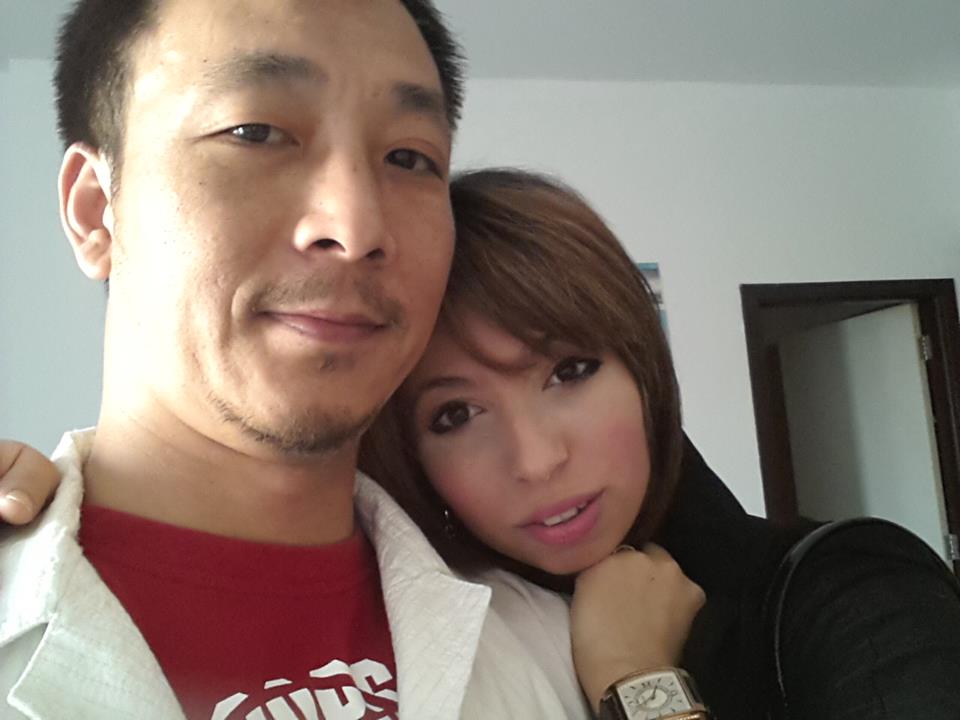
Sabine and her husband, who live happily ever after in Dubai.
It’s always a thrill to hear from yangxifu around the world, especially countries outside the usual Anglosphere (Australia, North America, the UK). So when Sabine, a woman from Tunisia, sent me a lovely photo of her with her Shanghainese husband, I leapt at the opportunity to share the story of how they met in Tunisia, married, and moved to Dubai.
Wishing this beautiful couple success in the year of the horse!
—–
I am a Tunisian woman. Seven months ago, I married a man from Shanghai.
The first time we met was in 2012. He came to Tunisia for a business meeting. At that time I was a student and the company that happened to host him was also training me.
While he was visiting the company, we had some conversations. He said he wanted to know more about Tunisia and visit our tourist attractions. We exchanged e-mails. Then we met up a couple of times, where we had coffee together and enjoyed a nice Tunisian lunch. Before he left Tunisia he gave me his phone number in Dubai and his Facebook ID so we could keep in touch.
Within three months, our relationship evolved from normal friends to “shy lovers”. I became so attached to him and found myself falling in love with him. He is always nice, tender, understanding and wise. These qualities are very hard to find nowadays in Tunisian men.
Eventually we decided to get engaged after my graduation. Initially, my family was very surprised with my choice. After they met him, they liked his personality and realized that his values were the same as ours.
We married in Spring 2013. His family couldn’t attend the wedding because of distance and the cost of airplane tickets, but they offered us their blessings. His best friend, however, was able to partake in the celebrations. One month after our wedding, I followed him to Dubai, where we now live together. Next year we hope to visit his family in China.
I would like to encourage single women out there to give Chinese men a chance. While I’ve only dated a few men, I never met a man as honest, committed and affectionate as my husband.
Sabine and her husband are enjoying their happily ever after together in Dubai.
Yesterday, I received an e-mail from a friend who urged me to read an essay by Virginia Proud of Tales of Expatria. She dubbed the essay “controversial” but then again, as she put it “blogs thrive on controversy” and encouraged me to introduce the topic. Well, she said the magic word — “controversy” — so of course, I immediately clicked on the link and dove into the first paragraph.
But when I finished the essay, a feeling of dread settled over me…which had nothing to do with Virginia’s essay per se.
First off, let me say that I thoroughly enjoyed the essay. The writing was exceptional — humorous, thoughtful and self-reflective — and you could clearly tell that Virginia has, as you might say, “been around the global block” in her own experiences as an expat.
If you spend enough time in Expatria you’ll meet this chap, we affectionately call him the LBH. The Loser Back Home. Best described as someone you wouldn’t normally touch with a barge pole, but transplanted to foreign soil, is suddenly hot property, especially with attractive, young local women….
The LBH has always been with us and probably always will be. I remember my first LBH encounters as a teenager, when my family lived in Hong Kong. I couldn’t understand these corpulent old buggers with their gorgeous Chinese wives, until my mother pointed out their diamonds. It was the glory days of British rule and massive salaries and no one cared if the men were boring, ugly, stupid, or even mean. But then again, money and power has always been enough to make men wildly attractive, even back home….
Yes, the LBH — or, as people call him here in China, the Loser Laowai. Or for the purposes of this blog, the white Loser Laowai who only dates local Chinese women.
To me, this topic feels like the “skeleton in the closet” in the realm of cross-cultural and interracial dating in China — a topic so icky I’ve wanted to stay far, far away from it. And in the few times I’ve gathered the gumption to attempt a blog post on it in the past, invariably I abandoned my drafts and turned my attention to other topics.
Yet Virginia was able to produce a splendid essay that, to an extent, dealt with this topic, and I can’t help but wonder if it’s a matter of perspective. After all, Virginia, who is originally from Australia, currently calls Budapest, Hungary home and referred to this LBH in a more universal sense. She doesn’t have to address the proverbial “panda in the room” that immediately comes to mind once you move the topic to China — yellow fever. And for the purposes of this blog post, I’m referring to those white Laowai men who prefer Asians and potentially have highly racialized notions about Asian women.
See what I mean? Loaded stuff.
In my opinion the majority of white men with Chinese women do NOT fall into this “Loser Laowai” category. But still, we all know there are white loser laowai out there hooking up with Chinese women. And like the yellow fever phenomenon, their existence does have ramifications for couples of white men and Chinese women around the world. As Christine Tan of Shanghai Shiok wrote:
The problem, to me, is that shallow, superficial relationships between white men and Asian women vastly outnumber the same sort of suspicious pairings between Asian men and white women. And sadly, these types of WM/AF pairings are the most visible ones, because they often create spectacles of themselves….They are the Douchebags, the Jerks, and the Ambitious who think dating a white man or Asian woman betters them, financially or socially….those are the types of WM/AF pairings we remember, because they were too in-your-face to forget.
Which unfortunately could lead to the wrong assumptions when you see a white man and an Chinese woman walking down the street. Again, as Christine wrote:
I know that the white male/Asian female pairing has numerous negative associations attached to it. Words that immediately come to mind: Opportunistic. Gold-digger. Fetish. Sexualization. White-worship. Money. Exploitation. Lust. Pinkerton Syndrome. ‘Sarong Party Girl’ behavior was something I was warned against growing up.
I think a lot about why those associations exist. There are poorer women in China and the rest of Asia who view a foreign man as a meal ticket. There are Asian women who only date white men because most of the men they meet are white, and/or they find them more culturally/sexually appealing. There are white men who only date Asian women because of the society they live in — where the women are mostly Asian — or yes, they do find Asian women more culturally/sexually appealing. There are white men who come to Asia to hook up with local women in certain seedier places. There are local women who go to these places to hook up with the white men who come to Asia.
But then there are cases like mine — a mutual friend introduces a man and a woman and they get along, they like each other, they both like eating, and books, and the Barbie store. And oh, by the way, they happen to be white and Asian, respectively.
Enough said.
There’s another side to this topic of white Loser Laowai who only date Chinese women — when the men justify their dating choices by insulting the women back home, which Virginia alludes to in her essay. I’ve addressed this before and find it abhorrent that anyone would defend their relationship in such a hateful way. But it happens, most often in anonymous online forums. And because the expat gender balance is so skewed — far more expat men, who are overwhelming white, than women — well, let’s say if you’re a woman like me, you need a lot of courage to speak up about it in public.
Additionally, let’s not forget what Virginia mentioned near the end of the post: “And the fall out of all this, of course, lands on the head of the single expat women, who need to keep adjusting their ideas of ‘attractive’ as their dating pool starts to feel more like a puddle.” Or in other words, it’s the China Daily article published a few years back titled Foreign women label [China] a dating wasteland. This is also thorny territory…because then the question comes, why aren’t they interested in dating Chinese men? Some women have understandable reservations (for example, they’re not interested in marriage or getting too serious in a relationship) but others exclude locals for completely superficial reasons, often based on stereotypes.
Ugh.
In the end, I’ll never be able to write something like Virginia, not with all the baggage that accompanies this idea of white Laowai Losers with Chinese women. Still, I believe the subject deserves a conclusion. So, as someone who writes about relationships, perhaps it’s fitting that I sum this up with a phrase used on dating sites around the world: it’s complicated.
P.S.: For further reading on this “thorny topic”, I recommend They’re So Beautiful, the companion website to the compelling documentary Seeking Asian Female.
One villager in John’s hometown in China couldn’t believe we were married
As the wife of a Chinese man, I’m used to attracting attention when I’m out and about in China. The stares, the questions about where I’m from, the way cars slow down to gawk at us — it’s all par for the course.
So during one of our evening walks in the village, I wasn’t surprised when an elderly woman walking in the opposite direction suddenly began asking my husband questions.
“Where are you from?” she inquired in the local dialect.
John mentioned the name of his village, nestled right in the heart of the valley.
“Where is she from?”
“America. She’s my wife.”
The woman grimaced at him in disbelief. “That’s nonsense!” Yes, she refused to believe that someone from John’s little mountain village could have possibly married a woman from America. And she walked away, not to be bamboozled by us.
When John translated the whole conversation for me (I’m still working on my local dialect) I nearly doubled over in laughter. “Are you kidding? She thought you were lying about me?”
Hiking the mountains in John’s hometown
It was the first time anyone in China doubted the authenticity of our relationship. But as strange as it sounded, I could understand why. In John’s hometown, it’s not uncommon to meet people who have spent their entire lives, knowing little else beyond these mountains thick with hardy bamboo and fragrant Chinese red pines, and the rice paddies and terraced gardens sculpted into the hillsides. Who could imagine that one of their hometown sons would meet and marry a foreigner, let alone spend years in her country? As rare as it is to find Chinese men and Western women together in China’s urban playgrounds, out here in the Zhejiang countryside such a coupling sounds impossible and even ridiculous.
The Chinese government advises foreigners to carry their passports with them at all times in China. I have to wonder, should I also carry around my Chinese marriage license so I’m prepared for the next time someone calls my marriage “nonsense”?
Nicki and Eugene (photo from http://nickichenwrites.com/)
American writer Nicki Chen, who blogs at Behind the Story, has lived one fascinating life. She married her late husband Eugene (who grew up in China) in 1967, the same year that the US Supreme Court made interracial marriages like theirs legal in every state in the country. Nicki also spent 15 years in the Philippines with her family as an “expat wife” and traveled to China in the 1980s. It’s no wonder, then, that her experiences have inspired much of her writing and blogging.
In this guest post, she writes, “Before I decided to marry my husband, I remember thinking: We complement each other, and that’s a good thing. We had a lot in common, too, enough to make our marriage work. But the fact that we were so dissimilar meant we had a lot to learn from each other.” I could have easily written the same about my own marriage. Chances are, many of you will relate to the “whole new world” Nicki captures in her post.
Thanks so much to Nicki for this fantastic essay! If you love her writing, you can subscribe to her blog and follow her on Facebook.
—–
Bruce Lee vs. Mary Poppins
(photo courtesy of Broadway Tour)
My first martial arts movie was The Big Boss starring Bruce Lee. It was 1971. We’d recently moved to the Philippines, and though Bruce Lee was already well known for his role as Kato in The Green Hornet, I’d never heard of him. My taste in movies ran in a different direction. I’d seen every musical that came to the Dream Theater in my hometown: Oklahoma, South Pacific, West Side Story, My Fair Lady, The King and I, The Sound of Music, Mary Poppins, Camelot … I’d seen them all and memorized most of the songs. What did I know about kung fu movies?
My husband was Chinese however. In his childhood, while I was in the United States reading fairy tales and Little Women and Little House on the Prairie, he was in China living under occupation and reading Romance of the Three Kingdoms, which is not a romance at all. It’s a four volume Chinese classic written in the fourteenth century, a non-stop account of the historical and fabled battles and intrigues that took place between 169 AD and 280 AD when three kingdoms were struggling for dominance in China.
Pompoms and judo
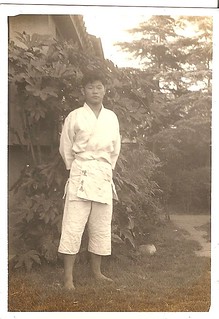
Eugene after judo class (photo courtesy of Nicki Chen)
In our teenage years, while I was taking ballroom dancing classes and shaking pompoms at basketball games, my future husband was in Japan, studying judo and kendo after school.
So now, here I was, expanding my horizons as I accompanied my husband to the little theater in Binondo, Manila’s Chinatown. The Hong Kong version of The Big Boss was definitely more violent than I was used to. It showed, for example, Bruce Lee’s fingers piercing the rib cage of the villain, a scene that was partially cut to get an R rating in the United States. And yet, Lee was a sympathetic hero. And though the evening was punctuated with the sound of our fellow moviegoers cracking melon seeds between their teeth and throwing them on the floor, the movie intrigued me. I could conceive of liking martial arts movies.
Enter the Dragon
Nicki in her dancing shoes in 9th grade (photo courtesy of Nicki Chen)
The following year Fist of Fury and The Way of the Dragon came out. I liked them … and sometimes I didn’t. In 1973 we saw Enter the Dragon, Bruce Lee’s last movie before his tragic death. This time it was playing in the big modern theater in Makati. We brought our oldest daughter, who was five years old by then, old enough we thought to be introduced to a kung fu movie.
I suppose I’ll never be the biggest fan of martial arts movies. I still prefer a film in which dialog and meaning trump violent action. And yet, I have to admit, a good fighting scene is a pleasure to watch. I’m glad my husband helped me expand my horizons.
The Promise of an Interracial Relationship
Before I decided to marry my husband, I remember thinking: We complement each other, and that’s a good thing. We had a lot in common, too, enough to make our marriage work. But the fact that we were so dissimilar meant we had a lot to learn from each other.
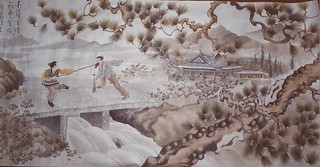
Kung fu painting
Every relationship provides opportunities to learn and grow, to share ideas and enthusiasms, hobbies and histories. But in an intercultural or interracial relationship, those opportunities are enormous. If both people are open to new ideas and experiences, their worlds can double in size.
Nicki Chen blogs at Behind the Story and is the author of the forthcoming novel Tiger Tail Soup.
“You should check out this website.” That’s what I’ve been telling a number of readers who send me Ask the Yangxifu questions — I refer them to some of the fantastic sites that I follow and admire. So I thought, maybe it’s time to do a brief post and spotlight some of my favorites?
Western Wives, Chinese Husbands. I’ve dubbed this article, which I compiled together with the generous help of three other yangxifu (including Melanie Gao and Jessica Larson-Wang), “everything you wanted to know about dating Chinese men but were afraid to ask.” Whenever I hear from a woman new to the dating scene in China looking for comprehensive advice, I always send this along.
The Love Life of an Asian Guy. Ranier Maningding dishes out some of the funniest advice around, and speaks to both Asian men and the non-Asian women who love them.
My New Chinese Love. Whether you’re a Western woman dating Chinese men or a Western man dating Chinese women, you’ll find friendly advice from Jeff Cappleman and his Chinese wife that covers everything from courtship to weddings.
Candle for Love. This forum was created to help Americans bring their Chinese loved ones over to the US (and navigate the whole visa process). But it’s also a good sounding board for anyone grappling with cultural conundrums in their relationships — especially Western men dating Chinese women.
Asian Man White Woman Magazine. Founded by JT Tran, the Asian Playboy, this magazine bills itself as the lifestyle and dating site for AMWF relationships — and offers advice written by JT and white female bloggers. I also interviewed JT, and I frequently send this interview to Chinese men seeking advice on dating Western women. (Disclosure: I’ve written for his site, and JT is one of my advertisers).
What sites or articles would you recommend? Sound off in the comments!
That hard-to-buy-for person? To my parents, that could have been John’s father — given the conversation we had yesterday about what to give him for the holidays.
“Wouldn’t he like, say, one of those pocket knives?” my dad asked. “Or a letter opener? Or even a tool kit?”
But John shook his head “no” at every suggestion, leaving my dad surprised and even laughing. After all, we essentially vetoed what he considered the top three must-have gifts for the average American guy his age.
While John’s dad was only a few years younger than my dad, he was a world away when it came to interests and needs. Unlike my dad, John’s dad wasn’t one of these handyman types who liked tinkering around the house, and would never have imagined that anyone needed a special tool to do something as simple as opening a letter. He cultivates bonsai in the garden, dabbles in painting and calligraphy, pens his own articles and self-published books, and reads the newspaper from front to back everyday. And while I’m sure some American men out there must share his passions, I’ve yet to meet him.
It’s no wonder, then, that cross-cultural gift-giving challenges so many of us — enough to keep a steady stream of “what should I buy him/her in China” e-mails flowing into my inbox.
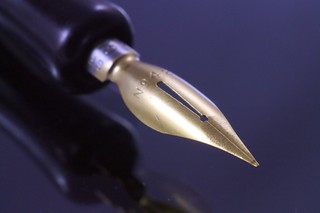
In the end, my parents settled on an engraved pen — sure to please a certain “cultured” retiree in Zhejiang with a penchant for writing.
When I usually share stories about couples of Chinese men and Western women, they usually fall into two camps: the “happily-ever-after” couples and the couples that once were.
And then there’s the story I’m about to share — about a couple fighting for their marriage. Petya reached out to me recently to ask that I publish her tale on my blog, hoping that readers could also weigh in with advice on how to save her marriage and family. So please, don’t be shy in the comments! If you have any ideas, Petya would love to hear them.
Petya, thanks so much for your courage to share this publicly.
—–
I’m Bulgarian. My childhood passed under Communism in the Eastern Block. When I went to study in Western Europe, I got on very well with my Chinese colleagues. There was something deeply similar in the education and behavior that made contact very easy.
Years later I went to study Japanese in Tokyo. The second time I went to Japan, in my class I met a Chinese man who was interested in me. He was working in a big multinational Japanese company and they took him in Japan and payed for his Japanese lessons because they were preparing him to become their Marketing Director for China. I didn’t return his interest, even though we were getting along well. I knew we lived in different worlds — I would go back to Europe and he had brilliant career prospects in Asia.
But one day, we had a debate in class about love and he said in front of everybody that the perfect person to be his girlfriend exists and it was me. Of course it was very flattering for me, but most importantly, I found this very brave and I decided this guy is exactly like me — a fighter — so I gave him a chance.
We started a beautiful relationship. I had to go back to Europe to work. As I have a flexible and well paying job, I was traveling every month to Japan for approximately 10 days to be with him. We got engaged and continued like this. He came two or three times to Europe. We also went to China and he introduced me to his family. His mother passed away a long time ago, and his father is remarried. He has an elder brother who is married with one child.
This situation could have continued for years. He had business trips everywhere in Asia and if I could, I joined him in exotic destinations. Then the big earthquake and the tsunami hit Japan. He was in Tokyo and I was deadly worried. Then Fukushima happened too. It was horrible to be so far away. And suddenly, even though I always said I didn’t want to hurry to have children, I changed. I thought life is so short and we are so vulnerable. I could lose the love of my life and will have nothing left except some beautiful memories. Then I decided I’m ready for a family. We married one month later. A few months later I got pregnant. The big surprise was I was pregnant with twins. We decided it’s better for me to stay and give birth in Europe, because of the radiation in Tokyo. So we did. Meanwhile he moved back to China for the new position. I travelled two times during my pregnancy to China The twins were born in Europe, but he couldn’t be here to see their birth.
My life changed completely. Before I knew I was pregnant with twins, I was still planning to travel. I overestimated myself. With the two newborns and no family to help me, only a full-time nanny, I was crazy tired here. And I had to resume working on the third month after the birth, because we went through all our savings. It was impossible to travel. I thought going to Shanghai to live there, but my husband’s job, even as Marketing Director didn’t pay well enough to allow him to support our big family. I had to take care of the two babies. And I don’t speak Chinese. How could I bring the babies to a doctor without speaking the language if my husband is on business trip? I couldn’t even order a taxi. He said he would send the babies to his family, but I doubted his step-mother would take care of the babies of somebody else’s son. I went to visit him with the babies and the nanny, a long and difficult flight from Brussels to Shanghai. His father didn’t even come to see the boys in Shanghai. Only the wife of his brother came and she helped me a lot.
If we move to Shanghai, we don’t have enough money to live normally, I don’t speak Chinese, and the only solution is we hire an English-Chinese speaking nanny and I still have to travel to Europe to work for at least one or two weeks every month in order to contribute to the family budget and eventually pay my loan for the apartment I’ve bought in Brussels.
If I quit completely my job, I have to sell the flat in Brussels, abandon everything, and become a housewife and somehow live there. I’m not the housewife type. I’m conference interpreter, working for Heads of States and Governments, the European Commission and Parliament. But my main language, Bulgarian, is too small to be interesting for somebody in China.
The third solution was for him to abandon everything, but I didn’t want this. I know how difficult is to make a career from a scratch because I did it too. I could not destroy his career. And as a Bulgarian from the former Soviet Block, I know what discrimination means in Western Europe. I lived as a second category citizen in France during all my studies there, even if I had more diplomas and better notes than most of the French people. I know what humiliation means. I didn’t want him to experience the same as a Chinese.
I was getting more and more tired, depressed, and even crazy. I had also some health problems resulting from complications of giving birth, so I had surgery.
I started asking him to come. We fought, we argued. Then I asked for a divorce. He realized it was serious and quit his job. He came here. Was I happy? No, I was crying over his destroyed career. I was feeling guilty. He came here broken. I think unconsciously he was hating me because I destroyed his career. He hated also to be dependent on me. I tried to find him something to do while we were searching for a job. I registered him to study French and to go to driving school. He refused to finish the classes. He said he will decide when to go to classes and what to do. We argued about how could I help him. He said my job-hunting assistance wasn’t helpful and he doesn’t need my help.
I was nervous, often crying and shouting. He said he hated this kind of woman and if he knew I was like this, he would never marry me. He accused me of using the boys as a tool to make him come here. We fought for half a year. Although I found him a job as a shipment manager, and not a bad one, he wasn’t satisfied and hated it. The atmosphere in the company was bad, he said. Because of the family reunion law, he couldn’t leave the country for 6 months. He felt even worse – like my hostage.
And one day he saw me completely broken, crying and telling him that I made a mistake to ask him come here, that all I did was stupid and I’m ready to quit my job and Europe and go to China. The colleague who replaced him as Marketing director in China had left, so his position was free and he could have gone back. He refused.
So this is our story until now. We stopped arguing and I don’t ask anything from him. I just try to stay calm and he also seemed to calm down recently. But I don’t know what will happen.
What do you think? What advice do you have for Petya?
I am a single [Western] girl living in Shanghai, just turned 30. From what I’ve noticed most chinese guys around that age are already married. Is there any chance of meeting a single guy in China?
But maybe the more important question is — how to meet single men in Shanghai? The more single men you meet, the more chances you have of finding that one special guy.
Since I haven’t lived in Shanghai for a decade, I decided to reach out to a friend of mine — a Chinese fellow who met his Western fiancee in Shanghai — for some ideas. Here’s what he had to say:
Meeting guys through friends is a good way. Don’t make the meetings like blind dates. It could be just a group of friends going out for a drink or going to sing at KTV or having a house party. So the guy you meet through a friend is like someone with a reference or recommendation, more reliable than the random guy you bumped into at the bar.
Speaking of bars, for sure they are venues to meet up new people. Many guys would only go for the bars they like, so you would see them over one certain bar at most of the weekends or even weekdays. The point is, choose the bars carefully, since one kind of people would only go to their kind of bar.
Clubs would always be the worst place to look for a relationship.
Cafes, gyms and artsy places (Red Town, Ke Center and Et Cetera) would also be good places to meet up with people.
Avoid places that dominated by foreigners (if you intend to find someone Chinese). Also don’t go to places where you only see Chinese (if you are not prepared/intend to know someone very Chinese).
I know many of you out there live in Shanghai too. What suggestions would you have for meeting single Chinese men in Shanghai? Sound off in the comments!
—–
Do you have a question about life, dating, marriage and family in China/Chinese culture or Western culture? Send me yours today.
Almost two months ago, while scanning through my inbox, I came across a post called How to be Mistaken for a Prostitute in China. What a title — and what dazzling writing. I devoured the entire post, right down to the byline introducing the author and her forthcoming memoir about her experiences in China.
That’s how I first discovered Dorcas Cheng-Tozun, and I’m thrilled to be sharing her essay with you, titled “Three Words From a Chinese Father”.
Dorcas’ story revolves around something I’ve touched upon in the past — how Chinese families show their love through actions, not words. She explores this as she looks back on her relationship with her late father, a man who had never told her “I love you”.
Thanks so much to Dorcas for contributing her work!
—–
“I miss you,” my father said to me over the phone.
I hadn’t seen him for four days. He had been in the hospital for more weeks than I could keep track of, and had recently been transferred to a specialist hospital about an hour away from home. I was only a freshman in high school at the time, so I had to attend school during the week and could only visit him on weekends. My mom spent most nights at the hospital with him while I stayed home alone.
My surprise lasted only a couple seconds, during which I became very still and swallowed hard. “I miss you too,” I choked out, holding back tears. They were the three most significant words my father had ever said to me.
When he passed away less than a month later, they became the most significant words he would ever say to me. He had never said “I love you” to me. That night was the first and only time he ever told me he missed me.
My father had never been a man of many words. He left that to my mother, the chatty, extroverted half of the pair. For years I barely understood what he did for a living. All I knew was that he was an engineer, which in my young mind meant one thing: trains. I imagined my dad driving steam engines across the back roads of America, always somehow returning home in time for dinner. (He was, in fact, an electrical engineer.) I certainly knew nothing about his childhood in Guangdong Province in China, the few years he spent there before the realities of the new Communist regime prompted his family to send him away to Hong Kong.
I’m sure being the only male in a family with three women—his wife and two daughters—didn’t help. My father would often escape to the garage to tinker with small pieces of technology—a circuit board, a watch, a cassette player. He would take a Chinese-language novel with him to the bathroom or bedroom and remain out of sight for hours. Or he would park himself in front of the television to watch a San Francisco 49ers football game.
By the time I was ten, I had become an obsessive 49ers fan. It had started from curiosity, from a young girl’s intangible desire to connect with her father, but it soon became my own passion. I would pepper my dad with questions about the rules, about certain plays, about this player or that coach. He didn’t seem to mind having his younger daughter impose upon his weekly ritual; I suspect he secretly relished it. We fueled one another’s passions for the sport to the point where we drove my mother and sister a little nuts with our single-minded devotion. I promised my dad that as soon as I was old enough to work and earn money, I would take him to a 49ers game.
I began following my father into other arenas of his life. When my mom and sister went shopping for clothes at the mall, I would go with my dad to the bookstore. I watched with awe as he practiced his pseudo kung fu moves with a wooden rod from a closet. I often stood behind his chair with my chin resting on his head as he and my mom lingered after a meal.
He enjoyed telling corny jokes at the dinner table, jokes that often made my mom groan and roll her eyes. I would always laugh loudly at his jokes, even when I didn’t understand them, and was rewarded by a knowing, just-between-us grin that my dad would send across the table. In those fleeting moments, I may not have understood what he meant, but I felt like I understood him.
It’s hard for me to explain why I felt this way. In many regards my dad was the stereotypical Chinese father. He didn’t trouble himself with the day-to-day details of raising two daughters. He wasn’t the type to shower us with hugs or kisses. He wasn’t the one we went to when we were in need of parental advice. Looking back, I can’t remember a single conversation of deep significance that I had with my father.
But this is what he did do: on one of the rare occasions he cooked dinner for the family, he made salt-and-pepper prawns with so much salt and pepper that my sister and I were raving about it for weeks. (My mother promptly scolded him and switched us back to bland, low-salt food the following day.) He sincerely thanked my sister and me every time we gave him yet another striped tie for Christmas. He watched Beauty and the Beast and other Disney movies with me. He let me into his world and the things he loved on a regular basis. But he just didn’t let me in; he welcomed me and let me know—somehow, without words—that he was delighted to be sharing these things with me.
And finally, just weeks before we had to say goodbye forever, he overcame thousands of years of cultural norms and said aloud what he actually felt: “I miss you.” At the time none of us thought he wouldn’t make it; we were convinced that a cure or a miracle was just around the corner. I wonder, though, if my dad knew he was running out of time, which is why he chose to give me what remains one of my most precious memories of him all these years later.
Those are not the three words that we typically think of in American culture. “I love you” has taken on the status of myth and legend, three tiny words with the power of giants to slay or fairy godmothers to bring enchanted happy endings. We wonder if any relationship can ever feel authentic or complete without these words. Even I have occasionally fallen into this trap.
My dad never told me he loved me—at least, not in words. In the end, that doesn’t matter. What matters is that I knew he loved me. And with each passing year that he’s not in my life, I know it with even more certainty.
I miss you too, Daddy.
—–
Dorcas Cheng-Tozun is a writer and editor who lives in the San Francisco Bay Area. She is currently writing a memoir about her experience as a Chinese American living in Shenzhen, China. Learn more at www.transformativewords.com or follow her on Twitter: @dorcas_ct.
My wife is German, blonde hair blue eyed, but I think I’m very ordinary and it was just fate. Actually, I think Western women apart from being a bit more independent-minded, they’re [also] much more virtuous/chaste than Chinese women, are kind-hearted, aren’t vain, are frugal, emphasize love and family on a spiritual level, and these alone totally blow modern Chinese young women away. I’m currently constantly introducing German girlfriends to my brothers [fellow male friends], exhorting them to not seek Chinese women. Oh yeah, Western women don’t demand that you have a house.
Chinese women on the other hand are beautiful, intelligent, happy, and just plain pleasant to be with. They don’t have the associated emotional fluctuations Western women have and they are not demanding. They are serious about love and marriage and use common sense…. Single western women cannot compete with Chinese women and you can see it in their faces when you walk happily by with your Chinese girlfriend while they grimace and pretend to not notice.
(NOTE — that’s just one commenter in a thread that overwhelmingly criticizes Western women while commending the virtues of Chinese women. Read at your own risk.)
This website uses cookies to improve your experience. We'll assume you're ok with this, but you can opt-out if you wish.AcceptRejectRead More
Privacy & Cookies Policy
Privacy Overview
This website uses cookies to improve your experience while you navigate through the website. Out of these cookies, the cookies that are categorized as necessary are stored on your browser as they are essential for the working of basic functionalities of the website. We also use third-party cookies that help us analyze and understand how you use this website. These cookies will be stored in your browser only with your consent. You also have the option to opt-out of these cookies. But opting out of some of these cookies may have an effect on your browsing experience.
Necessary cookies are absolutely essential for the website to function properly. This category only includes cookies that ensures basic functionalities and security features of the website. These cookies do not store any personal information.
Any cookies that may not be particularly necessary for the website to function and is used specifically to collect user personal data via analytics, ads, other embedded contents are termed as non-necessary cookies. It is mandatory to procure user consent prior to running these cookies on your website.








 “You should check out this website.” That’s what I’ve been telling a number of readers who send me