Interview with Sonali Dev on her book “A Bollywood Affair”

Here’s a shocking confession for you – until very recently, I had never picked up a romance novel in my entire life. That’s right. Even though “love” is a huge part of my blog (including a whole series of real-life love stories), I was a complete virgin to the world of romance literature. You could blame it on those used book sales at the library I helped with as a child, where a sizable portion of the abandoned paperbacks up for grabs were romance novels. Really bad ones. You know, the kind of “doctor and nurse” or “bodice-stripping” stories you’d never want to be caught dead with.

But then late last year, I heard about A Bollywood Affair, a debut romance novel by Sonali Dev. It features a cast of fascinating Indian characters – especially the leads, Mili (married off as a child bride in India at four years of age, she marches off 20 years later to study abroad in America, determined to become the perfect, educated wife for a husband she’s never met in her entire life) and Samir Rathod (a famous Bollywood director and “ladies’ man” who is sent to America to get Mili to sign off on a divorce from said husband). And it was named one of 2014’s Great Reads by NPR and received a rave review in USA Today. Even though it meant breaking my “no romance genre” rule, I just knew I had to pick up A Bollywood Affair.
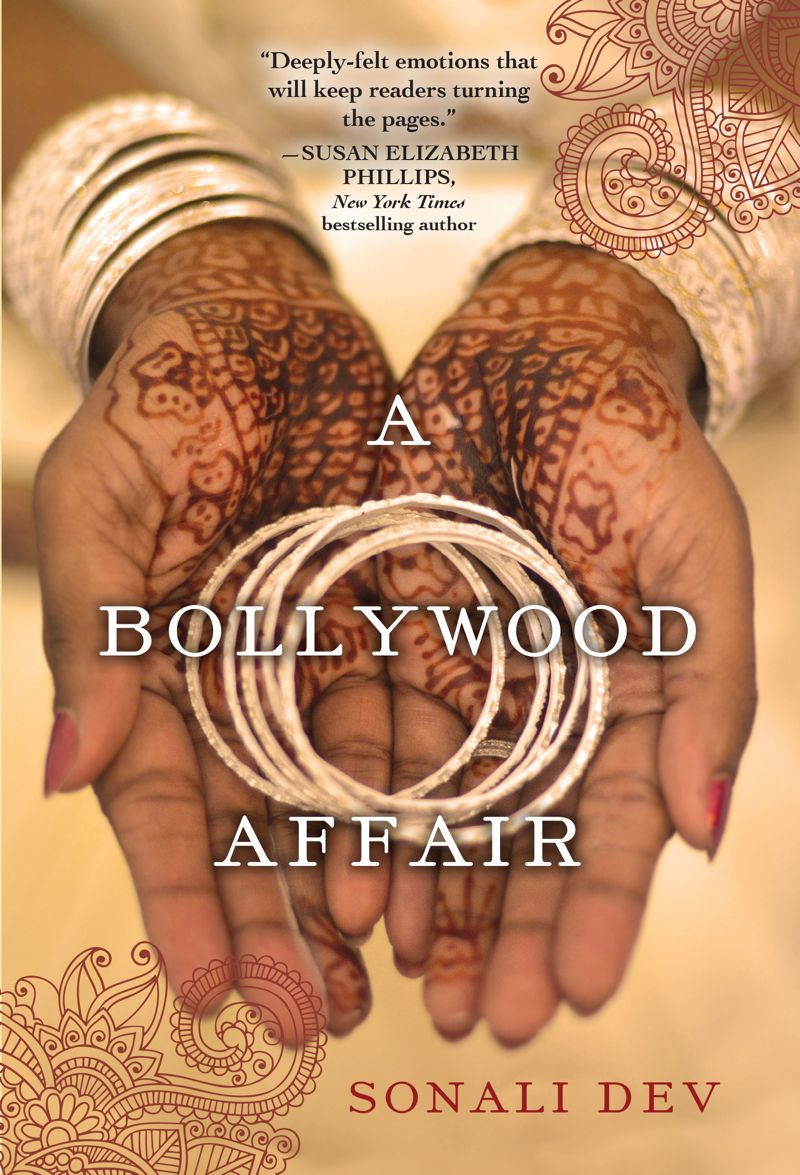
ABOLLYWOODAFFAIR_Cover

Turns out, I loved this beautifully written story – to the point that I stayed up late one night, flipping the pages to find out “what happens next?” I adored Mili, who wants to balance her feisty independence with her traditional side (such as remaining loyal for 20 years to a husband her family arranged for her to marry), as well as Samir, who starts to shed his “ladies’ man” persona before Mili as he cares for her in such heartwarming ways (especially all of the delectable Indian feasts he makes for her, described so deliciously I could almost smell the dal and parathas myself!). It was so much fun to be immersed in Indian culture, including all of the Bollywood movie references. And when have you ever read a love story where the heroine experiences an arranged marriage and a love relationship? A Bollywood Affair is such a unique and enchanting book that, even if you’ve sworn off the romance genre, you must read it.

I’m thrilled to introduce you to Sonali Dev and A Bollywood Affair through this interview!

SONALIDEVAuthorPhoto

Here’s Sonali’s delightful bio from her website:

Sonali Dev’s first literary work was a play about mistaken identities performed at her neighborhood Diwali extravaganza in Mumbai. She was eight years old. Despite this early success, Sonali spent the next few decades getting degrees in architecture and writing, migrating across the globe, and starting a family while writing for magazines and websites. With the advent of her first gray hair her mad love for telling stories returned full force, and she now combines it with her insights into Indian culture to conjure up stories that make a mad tangle with her life as supermom, domestic goddess, and world traveler.

Sonali lives in the Chicago suburbs with her very patient and often amused husband and two teens who demand both patience and humor, and the world’s most perfect dog.

A Bollywood Affair was named a best book of 2014 by Library Journal and NPR, and has won the American Library Association’s award for best romance as well as the RT Seal of Excellence. It was also nominated for an RT Reviewer Choice Award.

I sat down with Sonali to ask her all about everything from the inspiration for this story (including the Bollywood inspiration) to her take on arranged marriages versus love marriages.

Tell us about the inspiration for this novel.

Three summers ago, I was strolling along the riverwalk in my suburban Chicago town with my parents when they started reminiscing about a young couple they used to be friends with many years ago. Tragically, the husband died in an air crash just about a year into their marriage and his family from the village showed up with another young woman, who apparently was also his wife. He had been married to her when they were children. The family claimed all his assets, because his wife, who was now his second wife, wasn’t his wife at all because polygamy is illegal in India.

I just could not get that story out of my head. I couldn’t stop thinking about those two women. One was raised to believe she had a husband, when really she didn’t, and the other had a husband and yet really she didn’t. The crashing of the rural and urban faces of India has always fascinated me. Tradition versus progress, freedom versus the most stringent societal norms, it’s incredible how diverse the worlds India spans even today are. I absolutely had to write this story and trace the arc of the journeys I imagined for these women.

Being raised in your typical close-knit family by a-typical thinkers, traditional concepts like putting your family before all else were coded into my blood, but my concepts about the place of women in society and my own role as a woman was anything but traditional. Consequently, a lot of my own life has been about walking the very fine line between the security of family and the independence every individual needs to meet their full potential. With A Bollywood Affair I tried to explore that balance between staying tied in familial bonds and seeking freedom from the corrosive and regressive rules that bind women.

The novel starts off in the midst of Mili’s wedding in India, a time when she was a very young child. Were child marriages uncommon or illegal at the time that the wedding takes place in your story?

Child marriage is illegal in India and has been since 1929. However there are communities and sub-cultures, mostly rural, within which it still happens and the law is not fully enforced. It doesn’t happen on a huge scale but way more than it should. It’s definitely a social evil that the government and NGOs are actively trying to stop. Having said that, it is extremely uncommon for a child to be married as young as Mili was (but not unheard of). Mili’s case is unique because her grandmother is trying to get the responsibility of having a girl child married taken care of. As an older woman who is Mili’s only support and guardian, she feels like the child needs to be taken care of in case something happens to the grandmother before Mili grows up.

Mili and Samir, the main characters in your novel, come from drastically different worlds. Mili is a young independent woman who grew up in rural and traditional part of India, determined to become the perfect wife for a husband she has never met in her life. Samir is a huge Bollywood director who always has a way with the ladies, and can charm his way through anything. How did you conceive of these two characters?

I’m fascinated by the ‘real’ lives of celebrities. Not the face we see in the media but what really happens when the spotlight turns off. And I don’t mean the reality TV version either, but more what are they like in the privacy of their own homes, with their parents, with their closest friends, when they are alone with their thoughts. I don’t really think any of us can know these answers for sure, but I am definitely taken up with the idea of imagining that inner life of these people we can only ever see the outer lives of. That’s where Samir came from. There’s this breed of filmmakers in Bollywood who are celebrities in their own right. They model and host TV shows, but they also create and write so they’re artists as well. I wanted to fall into the head of someone who can achieve all that.

So, Samir was really in my head for a few years before I heard that story from my mother and Mili came about and boom, the entire story just followed from these two people from these two seemingly diametrically different worlds, but a shared past.

This novel is filled with all sorts of fascinating references to Bollywood movies – and I have to admit, it even feels like a Bollywood movie at times. Did you take any inspiration from the world of Bollywood and weave it into your story? And if so, could you give us some examples?

I grew up watching Bollywood films and there used to be this quality to the films that pulled you into their world and stayed with you for days after. So, definitely I wanted my story to hit those same emotional highs and lows and be that absorbing, and in that sense the story is Bollywood inspired. But it’s more than just creating a Bollywood film in prose.

To me Bollywood is a two pronged concept, one cultural and the other stylistic. Culturally, it’s the popular face of stories centered around Indians and the Indian state of mind — which is essentially as rich a background as you could find for any story, with a history that spans millennia, a culture that holds within itself hundreds of sub-cultures, the meeting and melding of the eastern and the western, the opulent and the wretched. And against this backdrop we have familial bonds that are so tight they have the power to stifle the life out of you as much as yank you back from the edge of tragedy.

As for style, to me the ‘Bollywood style’ is reminiscent of the large sweeping family sagas Bollywood tends to make. A wide-angled shot of what I see as the essence of being Indian. It’s the dramatic, just this side of melodramatic. It’s families that have no boundaries, no concept of privacy, love that makes choruses burst in your head. It’s beautiful people in beautiful places, but also the smell of the most wretched sewers. It hops around the world but is tied to the traditions of an ancient land. It’s the clash of the oldest culture in the world warring with the most modern values.

So, really, at a personal level, it was about writing what I know. This world is who I am, it’s the people I grew up with in the worlds I inhabit. It’s the reality I’ve seen, but on steroids. I also have friends and family who work in the film industry, so it is a world I feel l have an insider’s view to.

In your story, the main character Mili experiences an arranged marriage and a relationship based on love. Do you believe that the outcomes for couples in arranged marriages versus love-based marriages are different?

That’s an easy question for me. Most certainly not. I’ve seen decade long love affairs that ended in divorce within a couple years of marriage and I’ve seen arranged marriages that took a week to arrange but produced happily ever afters that lasted six decades, and everything in between. In my opinion, the wedding ceremony is a big fat reset button. Once you sign up, you start on day one and from there your marriage is a creature that takes every skill you posses to nurture and a whole lot of luck for good measure. Your chances of success have nothing to do with how you got together and everything to do with what happens after you start cohabitating and sharing the bathroom, the family and a bank account.

What message or messages do you hope readers come away with from your novel? 

I think we all struggle with balancing our conditioning with growth. Regardless of whether we come from a traditional culture and family or not, the belief system instilled into us in childhood is a very powerful force. But because the world we live in is no longer homogenous, when we grow up we are exposed to all these new belief systems that are different from our own and we have to make choices between the new ideas and the old ones. There’s no road map for this. The only possible help comes from listening to your heart and growing your mind by also listening to those who differ from you and balancing those two things out to find your own voice. If there is a message at all, then that message is in finding that voice, finding your own worldview and therefore yourself under the conditioning and expectations and then finding the courage to live your life based on that.

Thanks so much to Sonali Dev for this interview! To learn more about Sonali and A Bollywood Affair, you can visit her website and follow her on Twitter.
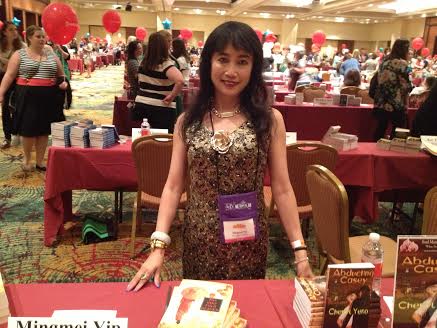
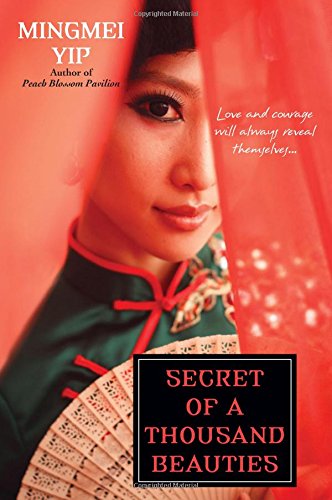
Interview with Mingmei Yip on her Novel “Secret of a Thousand Beauties”

It’s not everyday you come across a novelist who is also a qin musician, painter and calligrapher. Mingmei Yip stands out for many reasons, including her beloved series of historical novels set in China. In Mingmei’s fiction, strong women rule and there’s plenty of love and romance to go around.

But I’m reminded of Mingmei’s “renaissance woman” background by her latest novel, Secret of a Thousand Beauties.

51V5mM+M6gL

That’s because the story introduces us to a talented group of young women in Suzhou engaged in the traditional art of Chinese embroidery. Spring Swallow finds shelter in this sisterhood of embroiderers after escaping a ghost marriage, where she discovers the secrets of their celebrated art – and the determination to live life on her own terms (including when it comes to love). Fans of Lisa See and Gail Tsukiyama will enjoy this and the many other novels by Mingmei Yip.

It’s my pleasure to introduce you to Mingmei Yip and Secret of a Thousand Beauties through this interview.

Mingmei Yip
Mingmei Yip

Mingmei Yip holds a PhD from the University of Paris, Sorbonne and has served as faculty at the Chinese University and Baptist University in Hong Kong. Seven major Hong Kong newspapers have published her columns, and her press coverage includes appearances on over forty TV and radio programs in Hong Kong, Taiwan, Mainland China, and the U.S. She has performed as a qin musician at many fine institutions including the China Institute in New York City. The New York Open Center Gallery in SoHo also held a one-woman show of her paintings and calligraphy. Besides Secret of a Thousand Beauties, she is the author of Peach Blossom Pavillion, Petals From The Sky, Song of the Silk Road, Skeleton Women, The Nine Fold Heaven, Chinese Children’s Favorite Stories, and Grandma Panda’s China Storybook: Legends, Traditions, and Fun. Her novels have been translated into an impressive nine languages. You can follow Mingmei on Facebook, Twitter, Goodreads and her author website, and also watch this trailer for Secret of a Thousand Beauties to learn more about the novel.

In this interview, I asked Mingmei about everything from ghost marriages and Chinese embroidery to how interracial relationships were viewed in 1930s China.

—–

Your book offers a window into the world of Chinese embroidery, which has a 2,000-year history in China. What inspired you to build a story around the lives of women embroiderers?

In traditional China, women, considered men’s possessions, didn’t have much independence or freedom. A Chinese saying goes “The worst thing that can happen to a woman is to marry the wrong man. The worst thing that can happen to a man is to enter the wrong profession.” Unfortunately, because marriages were usually arranged, many women ended up marrying the wrong man at the cost of any chance for happiness. Wary of a bad marriage, some decided to remain single for the rest of their life. These women would join small communities established for non-marrying women. They displayed this choice by tying up the hair in a long pigtail.

Intrigued by these women and their sisterhoods, I decided to write a novel about them. Most worked as maids, but some were more fortunate and could learn a traditional woman’s craft. One of these was embroidery, an art that has always appealed to me, so I decided to write about this small group of embroiderers. They are supposedly celibate, but of course many succumbed to desire.

I was taught embroidery in elementary school and came to love it as a craft and art form. So it was natural for me to write about women embroiderers in China. As I wrote it I often imagined that I was moving the needle to create images in delicate colors.

Why did you choose to set the novel in 1930s China?

I love history, because it is like a mirror reflecting all that’s good and bad in humanity. I think 1930’s Shanghai was one of the sexiest eras in world history, populated with larger than life characters: glamorous women, cynical politicians, and corrupt police. But also with idealists trying to help China find its way in the modern world. It was also a time of extremes – from sybaritic luxury to abject poverty. I have tried to describe both from the indulgences of the rich to the miseries of the poor.

The thirties China was a time when everything was changing and the world seemed new.

At the heart of the novel is Spring Swallow, a “bad-luck woman” determined to fight for her own happiness at a time when women had few options in life. Could you talk about how you conceived of this character?

Most of my novels are about strong women who never give up despite all difficulties. I feel great rapport with these women because I went through very difficult times myself during my youth. Had I grown up in that earlier era, my difficulties would have been far greater. Though Spring Swallow faced much bigger challenges than I, I hope I share her indomitable spirit.

 Your story offers many different aspects of love and marriage in China — including arranged marriages, secret love affairs and even concubinage. Could you share with us something fascinating or surprising about love and/or marriage in China that you learned while working on your book?

Ghost marriage was one of the many ways women were oppressed in traditional China. Couples were often betrothed in childhood, or even before birth. Since only half of children survived to adulthood, many lost their fiancés. Because they had already pledged marriage, the cruel custom was to marry the woman to the dead man. As a practical matter, this meant she was a slave to her supposed in-laws. And also she was denied the possibility of actual love with a living human. Chinese women have always been resourceful and many found ways to have affairs, though secretly and at great risk. Of course such relationships tended to be fleeting, leaving many women to a lonely old age.

A foreigner and a Chinese end up falling in love in the course of the novel. How did people in a 1930s China view interracial relationships?

Even when I was a teenager living in Hong Kong, people disapproved interracial relationship, especially between a Chinese woman and a white man. However, in the 1930ies, China’s jazz age, such relationships were more shocking, except in cosmopolitan cities like Shanghai and Beijing. But many believed such unions were based on lust, not true love. Chinese men were particularly resentful, blaming the Chinese women for benefiting a foreigner instead of their own race. However, though there might be name-calling, active oppression or violence was extremely rare. Now, White-Asian marriages are so common they attract little notice.

What message do you hope readers come away with from your novel?

Novels and movies provide entertainment, but I strongly believe that readers should also be given something more. Besides enjoying an escape filled with excitement and adventures, I hope my readers will discover some ancient Chinese wisdom and come to know a little more about human nature.

When I write about strong women who overcome obstacles, I feel that they became my teachers. Now I have a comfortable life, but getting there was a long journey. I hope my characters will inspire others not only to succeed, but also to develop wisdom and compassion.

—-

Thanks so much to Mingmei Yip for this interview about Secret of a Thousand Beauties! Remember, can follow Mingmei on Facebook, Twitter, Goodreads and her author website, and also watch this trailer for Secret of a Thousand Beauties to learn more about the novel.

Interview with Texan in Tokyo about her book “My Japanese Husband Thinks I’m Crazy”

Texan in Tokyo remains one of my favorite blogs for a number of reasons – especially the delightful comics. Grace Buchele Mineta loves to poke fun at her own misunderstandings and missteps in Japan as she navigates life as the white American wife of a Japanese businessman. I consider her comics one of the best and most addictive things about her blog.

That’s why I was excited about her Kickstarter project earlier this year to self-publish an autobiographical comic book titled My Japanese Husband Thinks I’m Crazy, an amusing look into her life in Tokyo with Ryosuke through many new comics and articles you won’t find on her blog. She was wildly successful in funding her efforts and now her book is now available for purchase on Amazon.com.

My Japanese Husband Thinks I'm Crazy

If you’re a fan of graphic novels and you’re curious about Japan, you don’t want to miss My Japanese Husband Thinks I’m Crazy. Grace’s comics capture the joys and pitfalls of living abroad with wonderful humor and wisdom, and the articles included in the book will provide you with a fascinating introduction to different aspects of daily life in Japan.

For those of you new to Grace and her blog, she’s a native Texan who moved to Tokyo with her college sweetheart, where she now writes and blogs about interracial and intercultural relationships, daily life in Japan, and the life of a freelancer. You can also find her writing on The Huffington Post and countless other blogs (including her guest posts my site, which you can read here and here). Grace is an alumnus of Ursinus College in Pennsylvania and received the Boren Scholarship to spend a year in Tokyo.

I interviewed Grace about My Japanese Husband Thinks I’m Crazy, including the inspiration for her book and how she decided on the title.

—–

Tell us about the inspiration for your book. Why did you decide to write it?

I think anyone who has been blogging for at least a year entertains the idea of writing a memoir or book. I wasn’t any different. I started the ‘first draft’ of this book just for fun while my husband and I were on vacation a couple months before the wedding. Back then, I wasn’t drawing comics – it was a regular, run-of-the-mill book about my life in Japan.

The book didn’t become a real possibility until May of this year. I was struggling to find a non-English teaching job in Tokyo with reasonable working hours (my best offer had a 15 hour work-day, with four of those hours unpaid overtime). I knew my biggest passion was blogging, but it is ridiculously difficult to monetize a blog. What I was making from ads and affiliate sales was just enough to cover hosting costs and a couple cups of coffee a month.

Everyone recommends writing a book or selling a product, instead of hosting ads on your blog. By the end of June, I had decided to write a book. It was an all-or-nothing last attempt at becoming a professional blogger. If I was successful, I would do this full-time. If I failed, I would throw myself into job hunting and put my blog on the back-burner.

Needless to say, it went better than I ever could have imagined.

Picking a topic was simple. I always knew I wanted to do some sort of book that could illustrate the joys and wonders of being in an intercultural relationship and living abroad. I’m a huge proponent of the idea that everyone should travel/live/work abroad at least once in their life, preferably while they’re young. You can learn so much about yourself, when you’re completely out of your element.

By early July, I decided I would write a comic book. My comics were getting more and more popular – and I was in the zone. Plus, it’s much easier to explain Japanese culture through illustrations, rather than trying to put complex ideas into words.

I launched a Kickstarter (crowd funding campaign) to fund the book in late July. When I hit “publish” on the campaign, the book was less than 20% completed, I hadn’t finished the cover illustration, and I didn’t even know how many pages I could/would draw. However, I figured I needed to start ‘now,’ or I would keep putting it off for the next couple months, waiting until everything was “perfect.”

无标题2

I have to ask you about the title. How did you come up with it?

I have my husband to thank for the title. He tells me I’m crazy on a fairly regular basis (but he says it with love, don’t worry).

Also, as lame as this sounds, I needed the title to be practical. Since I self-published the book, I don’t have a publishing company behind me to help with marketing. It’s just me. The only way people are going to find my book is through my blog or through the Amazon search feature.

Right now, there is only one other book with the keywords “Japanese husband” in the title, so I figured I could easily compete in that field. In fact, if you type in “Japanese husband” in Amazon, my book is the second thing to pop up.

However, I didn’t want to do something like “My husband is Japanese” or “I have a Japanese husband” because, really, the book isn’t about him being Japanese. It’s about me adapting to living in Japan and being in an intercultural relationship. The book is told from my point of view.

In the end, I came up with My Japanese Husband Thinks I’m Crazy because:

  1. It’s true. He does think I’m crazy.
  2. It has good keywords
  3. It’s an intriguing title – that also tells you exactly what the book is going to be about.

I think all three elements are essential for a book title.

无标题3

Your book offers a view into your everyday life – and moments – as the wife of a Japanese man living in Japan. Why did you choose this focus for your work?

I write really crappy fiction.

Like, I know some people say “I’m bad at creative writing” to be humble and stuff, but I’m not being humble. I generally suck at writing stories. I can’t craft characters, I don’t understand plot, and my dialogue is cheesy and awkward. It’s actually borderline hilarious how bad my fiction writing skills are. And then the other half is just plain sad, because I typically digest 2-3 fiction books a week and still can’t seem to make any of my own.

I can only write what I know. I know what it’s like to move to grow up in a rural part of Texas, where a lot of the girls were pregnant/had a child before graduation and most students never went to college. I know what it’s like to move to Africa at 13; start boarding school in a foreign country at 14; get married at 21; and try to immerse myself in Japanese culture as the white wife of a Japanese man.

It’s ok if I write really crappy fiction, because I’m lucky enough to not need to write fiction. I can just write about my own life, and people read it.

I picked this genre because honestly, it’s the only thing I can do. And I love doing it.

Do you have a favorite comic (or favorite comics) you would like to mention?

I love all my children/comics. I think good “representations” of my work and book are these four comics:

无标题4

(Japanese women typically want to look pale, so many will wear long sleeved shirts, layers, and hats to the beach instead of a swimsuit)

无标题5

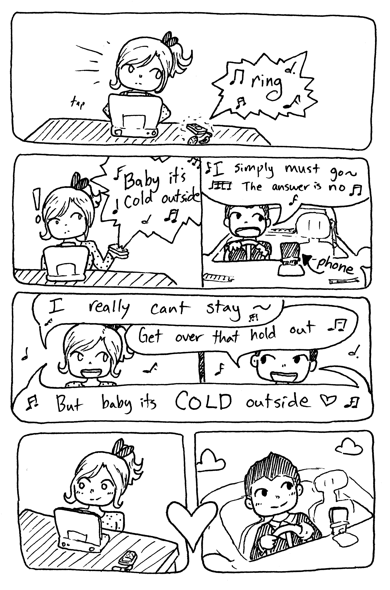
(I work from home and Ryosuke drives around as a sales rep. We often call each other over the phone to chat/sign together)

无标题6

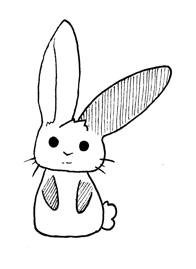
(Marvin is my imaginary rabbit – a figment of my imagination that I talk to when I get lonely freelancing)

无标题7

(I’ve slowly gotten used to earthquakes in Japan)

Throughout the book, you break up the comics with short articles – some essays you’ve published previously, and others informative pieces about living in Japan. How did you decide to structure the book in this way?

This is going to sound like a really bad answer, but I actually never planned on including essays in the book. After my Kickstarter (crowd funding) campaign ended, I sent off a couple sample copies of the book to my sister and two other regular readers of my blog. Back then, the book was about 150 pages of just comics.

All three bounced back the book saying a lot of the comics didn’t make sense. While two of the three readers had spent the summer in Japan, things like how to separate your moldy tofu containers by Japanese standards or the “salaryman lifestyle” never came up in daily conversation.

Long story short, I panicked. At the last minute, I decided to include about 40 pages of essays, summaries, and vocabulary lists – and removed about 25 of the comics that didn’t make sense without a background in Japanese culture.

It was all spur of the moment. Looking back, I’m glad I did that, because I think the essays really tie the book together.

无标题8

One of the unique things about your comics is a bunny named Marvin (who you describe as “a figment of my imagination – a combination of stress, coffee, and loneliness from being a freelancer in Tokyo.”). Where did you get the idea for Marvin?

Wow, I’m sounding pretty lame in this interview. I got the idea from my mother. She speed-reads my blog 1-2 times a month from the not-so-great internet in Ghana. I drew this comic back in June (the month before I launched my Kickstarter), about some pillow talk Ryosuke and I had. I wondered what rabbits would say, if they could talk. He said they would be stupid and silly; I thought they would be sassy fashionistas.

In late June, my mom called and said the idea for a talking bunny was gold – and I should totally run with it. I drew a couple sample comics just for fun (that never ended up getting posted) but I couldn’t seem to flesh out the character.

I was Skyping with my brother in Texas a bit later (after I had launched the Kickstarter) and mentioned the rabbit thing. He was just like “scrap your earlier comics and draw up 60 new comics for the book using the talking rabbit.”

I mean, how do you argue with that? Both of them loved the idea for a sassy, bossy, imaginary talking rabbit. I put a small poll on my blog’s Facebook page and also go a resounding “Yes!” for the talking rabbit.

Thus, Marvin was born.

无标题9

What do you hope people come away with after reading your book?

Living abroad can be fun.

I have always been a firm believer in the idea that it is beneficial to be routinely out of your element. I try to put myself in uncomfortable situations (travelling through Peru without speaking Spanish, spending two months living alone with my Japanese in-laws while my husband is on a business trip, freelancing regularly with a company where no one speaks English, networking with people way above my level, etc) on a fairly regular basis.

It’s awkward… but when you’re faced with your greatest fears, they usually end up being not as bad as you imagined.

I’ve been able to grow quite a bit by taking (manageable) risks.

I want people to know that risks aren’t scary. And that being in an interracial and intercultural relationship is fun. And that living abroad at least once in your life can be incredibly personally rewarding.

无标题10

—–

Thanks so much to Grace for doing this interview! You can learn more about My Japanese Husband Thinks I’m Crazy and get a taste of her comics and writing by visiting her website Texan in Tokyo.

Guest Post: My Very Own Mr. Darcy, Except Talkative And Half Chinese

It’s an honor to share with you this guest post from Shannon Young, who edited How Does One Dress to Buy Dragonfruit? True Stories of Expat Women in Asia (Signal 8 Press), an anthology featuring my essay “Huangshan Honeymoon“.

In her post, Shannon writes about her own marriage to a half Chinese (from Hong Kong) and half British man she first met while studying abroad in London. She also shares an excerpt about how they first fell in love from her new memoir Year of Fire Dragons: An American Woman’s Story of Coming of Age in Hong Kong (Blacksmith Books), which details that life-changing year she lived in Hong Kong while managing a long-distance relationship with him. It’s a beautifully written story about how far people will go for love — and the unexpected joys life can bring us when things don’t work out as planned.

Fire-Dragons_A

You can purchase Year of Fire Dragons: An American Woman’s Story of Coming of Age in Hong Kong in Hong Kong bookstores or directly through Blacksmith Books (who provides free shipping to anyone in Asia).

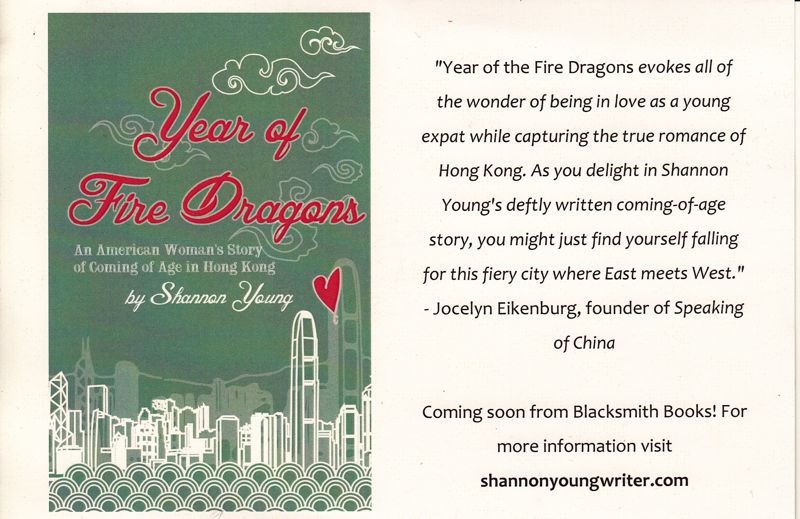
On a personal note, I’m thrilled that Shannon featured my blurb for Year of Fire Dragons on promotional postcards for the book:

Year of Fire Dragons postcard_nice scan

Want to meet Shannon Young and get a signed copy of Year of Fire Dragons? She’s appearing at the Hong Kong International Literary Festival on Sunday, November 9 at 10am at Room 202, Duke of Windsor Building. Tickets are $90 to attend. You can purchase your tickets and learn more about the event at the Hong Kong International Literary Festival website.

—–

My husband is half Chinese (from Hong Kong) and half British, and I am an American. Sometimes this means we connect easily, thanks to his Western side. He’s a native English speaker, and we share a common cultural language: American movies, Harry Potter, an independent streak, an appreciation for British humor.

He looks more like his English father, so he can easily pass for a Westerner — until he starts speaking Cantonese. We live in Hong Kong, and it’s always fun when my husband speaks Cantonese to shopkeepers, taxi drivers and acquaintances for the first time. We’ve had countless variations on the scene:

The man at the goldfish market explains something to us in tentative English.
My husband asks a clarifying question in Cantonese.
The goldfish seller stares at my husband’s Western features for a moment, then laughs and unleashes a string of compliments about his fluency.
My husband explains that, yes, he is half English and half Chinese (I understand this part).
The goldfish seller and my husband chat for a few minutes in Cantonese (I don’t understand this part).

Because he seems so Western at first, both culturally and in appearance, my husband’s Chinese side can come as a surprise. He has a strong sense of filial responsibility. He was raised in a Hong Kong family where the only acceptable career choices were doctor, banker or lawyer. He followed the common Hong Kong practice of living with his parents until our marriage (not counting the ten years he spent on his own in the UK). He has an all-consuming passion for good food: he cooks; he talks about restaurants a lot; he has strong opinions about frying pans and the right way to prepare instant noodles. This can be hard to match for an American girl who grew up on Kraft mac’n’cheese and weekly backyard barbecues.

Seb and Shannon Wedding 100
Shannon on her wedding day.

On the other hand, I care more about saving face than he does. He worries that I’m too concerned about being embarrassed. He’s very good at having frank discussions and urging me to talk through problems until they’re resolved. It’s a quality that’s all his own.

Living at the intersection of two cultures has made him the perfect candidate for our multicultural relationship. He is good at compromise — a nonnegotiable part of mixed marriages — and at seeing things from different points of view. I’ve learned a lot from him.

As we settle into our second year of marriage, I wonder which parts of myself I’ll compromise. Will I become a bit more Hong Kong in my thinking? Will he become a bit more American? I suspect it’s both. All couples, whether we’re blending two or three distinct cultures or two families from different parts of town, have to learn how to hold on to the best parts of ourselves as we work to form new families.

More importantly, we have to learn how to speak each other’s languages. People are more than the sum of their cultures. We each have our own special brand of communication. Marriage is all about learning how to speak your partner’s language, no matter where you’re from.

***

In my new memoir published in Hong Kong this month, I share the story of how I followed my long distance boyfriend to Hong Kong and his company immediately sent him away to London. Over the course of one year I got to know the city on my own terms, which allowed me to better understand his culture — and myself.

Jocelyn has allowed me to share the first chapter of my book below. It is the beginning of our love story, the story that brought me to Hong Kong.

***

YEAR OF FIRE DRAGONS

Shannon in Hong Kong, her husband's hometown.
Shannon in Hong Kong, her husband’s hometown.

The fire dragon trundled toward me through the crowded street. Smoke curled from the incense protruding from its long, thin body like thousands of spines on some mystical porcupine. Sweat poured down the faces and backs of every spectator. The fire dragon wound back and forth through the streets, faster and faster, dancing to the beat of drums. A wave of cheers rippled through the crowd each time it came near. The drums rattled the high-rises, the dragon danced, and the pavement shuddered under our feet.

This was the Mid-Autumn Festival in Hong Kong, a time to celebrate the moon goddess and her flight across the sky.

My flight wasn’t like that of Chang’e, the moon goddess who escaped her lover in a blaze of luminescence. I was flying toward mine. His gravitational field had pulled me across the sea, drawn me to a distant isle of fire dragons and skyscrapers. I’d follow him anywhere—even to Hong Kong. We hadn’t lived in the same country since we’d met, but this was our chance to be together, to build a life in the city where he grew up.

But one month ago, his company sent him to London.

I first met Ben in London, at a fencing club. I was a bookish American student on a semester abroad. He was an opportunity for a real live English romance, my very own Mr. Darcy, except that unlike Darcy, Ben was talkative—and half Chinese.

I’d taken up fencing several years before, attracted by the romance of sword fighting and the fact that it was something unique, historic, literary even. I wasn’t bad, and the sport brought me unexpected confidence. It seemed like a great way for an introvert like me to connect with people at the university in London.

When I pushed open the door to the club, the familiar buzz of the scoring machine and the squeak of athletic shoes on the floor reached my ears. I rocked on the sides of my feet, unsure how to join in. Ben came over immediately, introduced himself, and invited me to fence him. I was relieved at being included and already curious about this open-faced young man whose accent I couldn’t place. He won our first bout by one point; he always said I wouldn’t have dated him if I had been able to beat him.

We fenced a few more bouts, and then sat cross-legged in our matching gear, masks forgotten on the floor. He prodded at my shy shell; he asked me questions, joked about fencing, told me he was from Hong Kong. He had an eloquent vocabulary mixed with an offbeat sense of humor. He didn’t seem to mind when people didn’t get his jokes. He put me at ease, and I found myself stealing glances at him as I adjusted my equipment and met the other fencers. By the time I changed my shoes and left the gym, I was already lecturing myself about reading too much into his attention. I didn’t want to get swept away, blinded by the novelty of an international fling. But it was too late.

For two months, we wandered the streets of London together, kissed on street corners, and took spontaneous trips to Oxford and the coast. He took the time to get to know me, using our shared love of fencing to get me talking. He surprised me with his insight, his persistence. He seemed to understand why I, analytical and introverted, never quite fit into any group. As someone who had grown up shuttling between Hong Kong and London, not quite Chinese and not quite British, he knew what it was like to be an outsider. Ben had a gift for coaxing people to confide in him and trust him. Before long, he got even the most reserved, responsible American girl to give him handfuls of her heart.

When the semester ended, we said goodbye at Heathrow in a flurry of kisses and long-distance promises: “It will just be for a year, maybe two.”

“I can visit you in America.”

“I’ll get a job wherever you live after graduation.” Our confidence in each other was reckless and optimistic, but staying together felt like the only sensible thing to do.

In 2010, thoroughly in love, I moved to Hong Kong to be with him.

IMG_0320

It lasted for one glorious month.

Ben left me in Hong Kong on the eve of the Mid-Autumn Moon Festival. Instead of exploring the city with him, I was at the airport saying my goodbyes while the children of Hong Kong flooded the streets and parks with lanterns. Instead of walking beneath the Mid-Autumn moon together, we shared a fierce hug and made a hundred tiny promises. The next day, still reeling from the sheer solitude, I found my way to Tai Hang—to the incense and the drums. The fire dragon loomed, full of possibilities.

It had already grown dark, or as dark as it ever gets in the city, when I emerged from the subway into a night that felt nothing like the end of September. The humidity surrounded me like steam pouring out of a broken dumpling. I made my way along the street. An arch announced the festival in gold foil and tissue paper fringe. I found a spot beside a Chinese family of three or four generations. A group of Mainland girls chattered in shrill Mandarin in front of me. The balconies of a hundred apartments teetered over our heads.

I hadn’t had a chance to ask Ben what the fire dragon would be like before the airport security line swallowed him and carried him away. The fire dragon in my mind looked like a dancing, tuft-eared Pekinese dog, with people standing under a big sheet to form the body, holding up the head. Of course, that’s an image from a lion dance, not a dragon dance, I would soon learn. I was just starting to discover that Hong Kong was full of surprises—and I was ill prepared. I jumped up on my toes and looked for the Pekinese head.

The drums began. “Want me to hoist you up?” An American man stepped close behind me. He was tall, and the scent of stale alcohol mixed with the incense.

“No, thanks,” I said.

“You sure? You want a good view when they bring out the dragon,” he reached for my arms.

“I can see just fine.” I maneuvered away from the man, finding refuge on the other side of the Chinese family. My fingers curled tighter around my purse. Suddenly, I was aware just how alone I was in the crowd, and in the country.

“Why didn’t you just go to London instead of Hong Kong when you found out Ben would be leaving?” my friends had asked me. “You’re already moving across the world for him.” I wondered the same thing myself—now. But this was 2010. I wasn’t in a position to jet around the world after men lightly. I’d graduated from Colgate University with nearly $80,000 in student debt, debt I had taken on before the economy crumbled. Moving without a job was not an option. Employment would be hard to find in London for an English major with limited work experience and no visa. I didn’t have a chance.

Jobs were not easy to come by anywhere in the Western world. My generation faced the worst job market in living memory. My college-educated friends competed tooth-and-nail for part-time barista work, borrowed more money for graduate school, and moved in with their parents. There was a mounting sense of desperation among those of us who had taken out big student loans only to discover there was no work for us in our own country when we graduated.

Asia was another story.

IMG_9441

There were rumors going around that this was where the jobs were to be found. Ben had found work in Hong Kong, his hometown. My own sister had recently begun teaching English in South Korea. So, I spent nearly a year applying and interviewing for a job in Hong Kong (and yes, living with my parents while I did it). When a local school emailed and asked me to be their new English teacher, it seemed the long distance part of our international romance, which had lasted two and half years by now, was finally done. I showed up with a work visa and a salary advance, ready to take on the city and the next stage in our relationship. Yet here I was, alone in a crowd as the fire dragon approached.

I couldn’t afford to give up my new job when Ben’s circumstances changed. With a one-way ticket and a monthly student loan payment of $935, I stayed in Hong Kong.

The drums pounded. A row of children appeared, carrying lanterns that bobbed above the crowds. Their glow mixed with the lights from the apartment buildings looming over our heads. My arms brushed an elbow on one side, a woman’s handbag on the other.

Ben had been lucky, really, to be sent to London. It was a one-year placement at a law firm with the prospect of a permanent contract afterwards. All I had to do was spend this year in Hong Kong looking for an opportunity in London where we could be reunited once again. “It’ll be for one more year, and then we’ll be together,” we promised each other as we set up our web cams. “We already know we can handle the whole long distance thing.” We plotted our reunion in a whirl of emails and long distance calls. “It’ll just be this year,” we said, “and then that’s it. No more long distance.”

Of course, the other thing people asked was, “What if you don’t get along when you finally do live in the same country?” That was a question I couldn’t answer.

As I stood in the Mid-Autumn crowd, little did I know that my move to Hong Kong would bring about our longest separation ever, a separation that would bring me face to face with the reality of the risk I had taken.

The pounding of the drums intensified. The people around me drew closer together, choking what little breeze there was. Finally, the fire dragon appeared, followed by more children carrying lanterns. I was surprised when I saw what it was really like. It had an elaborate head, made from branches twisted into impossible shapes and filled with a thicket of incense. The thin body was over 200 feet long and muscular bearers danced beneath its undulating shape. The people around me cheered as the dragon’s head passed us and then turned back on itself, leaving behind a million tiny trails of smoke. I felt a growing sense of excitement as the fire dragon whirled and darted through the streets. Its wiry, crackling body defied my expectations. It was fast. It was wild. I pushed forward so I could see better. I was a part of the crowd. I didn’t feel like a foreign girl, alone, in an interrupted romance. This was an adventure! I could do this; I could live in Hong Kong, alone. Ben and I would be together soon enough.

As the dragon twirled in front of me, I didn’t know that in nine months I’d be sitting on the floor of my single apartment, cell phone pressed to my ear, feeling the foreign ground shift beneath me, feeling a panic I’d been too confident to anticipate. I pulled my hair away from my neck, trying to find relief from the suffocating heat, too stubborn to guess at the coldness that was coming.

This was not what I had planned. Nothing happened the way I expected. This was Hong Kong.

As the rumble of the drums reached a crescendo, the men carrying the dragon pulled off the sticks of incense and passed them to the crowd. Within seconds, the fire dragon dispersed into a thousand tiny sparks in the night.

***

Shannon-Young-Writer
Shannon Young

You can connect with Shannon on Twitter @ShannonYoungHK or follow her blog, A Kindle in Hong Kong. For more information about her books, including Year of Fire Dragons, please visit ShannonYoungWriter.com.

—–

Thanks so much to Shannon for this post and lovely excerpt! Don’t forget, if you’re in the Hong Kong area this weekend and would love to have your very own signed copy of her excellent memoir, Shannon will be appearing at the Hong Kong International Literary Festival on Sunday, November 9 at 10am at Room 202, Duke of Windsor Building. Tickets are $90 to attend (purchase yours here).

Interview with Linda Leaming on Her Book “A Field Guide to Happiness”

Married to Bhutan by American Linda Leaming — which tells the story of how she found her bliss and a husband in this oft-forgotten Himalayan country — remains one of my personal favorite AMWF memoirs for a very simple reason: Linda.

She’s delightfully self-effacing (such as when she shares her many awkward “lost in translation” moments while learning Dzongkha, the official language of Bhutan), hilarious (a friend mistakenly calls Bhutan “Butane” and then she tells them the country is located in Africa), and wise too (such as when she points out that “Happiness can’t be willed.”). Linda’s voice ultimately makes the book a pleasure because she’s the one taking you along for the ride — and what a ride it is.

So when Linda told me about her new book A Field Guide to Happiness: What I Learned in Bhutan about Living, Loving, and Waking Up, I was excited to jump into her world once again.

A Field Guide to Happiness revised

True to its subtitle, this book dishes out Linda’s own personal insights on that universal topic of happiness through a collection of stories from her life in Bhutan (including a LOT of stories that feature her Bhutanese husband, Namgay). But she does it without being too preachy or new age, or even expecting you to, say, complete exercises throughout the book.

Honestly, it’s more like sitting around Linda’s table with a cup of tea in your hands, hearing a friend tell you all about her most vulnerable and ridiculous and embarrassing and even scary moments in life. The lessons you learn along the way feel authentic and relatable, and ultimately will make you think about your own happiness in life.

I’m thrilled to introduce you to Linda Leaming and A Field Guide to Happiness through this interview.

Linda Leaming
Linda Leaming

A native of Nashville, Tennessee, Linda Leaming has written pieces for publications including Ladies’ Home Journal, Mandala, Guardian UK and A Woman’s Asia (Travelers’ Tales, 2005). She received her M.F.A. in fiction from the University of Arizona and was even featured in Eric Weiner’s bestselling book The Geography of Bliss. You can learn more about her and her writing (including Married to Bhutan) at her website LindaLeaming.com.

In this interview, I asked Linda a number of questions about A Field Guide to Happiness — including why she chose to explore the idea of happiness through her experiences in Bhutan, how her husband Namgay felt about being featured prominently in the book, and why she choose one of Namgay’s unique paintings for the cover.

—–

246852_10150208237164774_4620141_n
(photo courtesy of Linda Leaming)

While you’ve titled your book A Field Guide to Happiness, it also reads as a love letter to Bhutan (a love letter in the sense that you love this place, warts and all, so to speak). Why did you decide to use your experiences as a way to discuss happiness?

I’ve found a lot of happiness in Bhutan. The first time I came in 1994, I knew I had to get back. It was such a peaceful, calm, quirky, funny, remarkable place. The people were laid back but strong. I decided that I had to live here. It was really hard to pull off, but I couldn’t see my life any other way. The Bhutanese have a lot to teach the rest of the world about how to be happier. They live with less, they live with a spirituality and a sense of themselves that’s conducive to happiness. They believe kindness and compassion are the glue that holds a society together. They’re funny.They take care of their environment. All the things I wrote about in the book are things I learned in Bhutan about how to be happier. But you can do them anywhere and be happier. Or you can find your own things that make you happy.

Your husband Namgay – and your marriage, for that matter — is an important part of this book, as he shows up in the vast majority of the stories you tell. How did Namgay feel about that?

It’s mixed. He’s proud of me and maybe flattered that I choose to write about us. He likes my writing and thinks I write good books.I think he’s also a bit wary because it’s not his nature to be an extrovert and show himself. He’s shy. He thinks what I write about is sufficiently interesting and worth the invasion of our privacy– most of the time.

171806_498057994773_5731032_o
Linda and Namgay (photo courtesy of Linda Leaming)

What part of your book was your favorite part to write and why?

I liked writing about the different relationships — the married couple who divorced but then the wife became close to her ex husband’s new daughter, my own relationship with Namgay, especially the chapter when we encountered the monkeys. Having an intercultural marriage means you have to look at relationships differently, and think differently. End of story. Your relationship won’t survive if you don’t bend. And bend and bend.

I also enjoyed writing the story of the broken washing machine. It’s a good example of being able to bend– or rather to flow.It’s a nice counterpoint to the first chapter and the description of how I felt when I first came to Bhutan: impatient, disgusted, unhappy.

I liked writing the end. Because it was the end haha.

You often mention in the book how you and your husband divide your time between Bhutan and the US. Why did you decide to split your time between the two countries?

We went to the U.S. because we needed to be there for my family. And Namgay needed to spend some time in the U.S. We had always talked about how we’d spend time there so Namgay could see how I grew up and where I came from. He’s had opportunities to teach and paint and do fellowships in the U.S. and it’s easier for me to publish if I’m in the U.S.

163792_493121524773_1918495_n
(photo courtesy of Linda Leaming)

One of the unique features of this book is your cover. You wrote about this in your book, saying, “The front of this book is a painting by Namgay called The Great Game, which he painted when we were coming back from Bhutan from the U.S. I think with his rocket paintings Namgay is reminding himself to be mindful, to wake up. I know he thinks of himself in a rocket, going somewhere really fast, and with no idea where he’s going. He says that’s what he feels like in the U.S.” Why did you choose to put this on your cover?

I love that painting. It’s looks so happy– it’s bright and colorful, but it also has a deeper meaning: It’s the two sides of our lives, East and West, the dragon and rocket. My publisher, Hay House, liked the idea of using his art for the cover, as they did with my first book, Married to Bhutan, and I sent them some images the they actually picked this one. I was thrilled.

If there’s one piece of advice you hope people come away with after reading this book, what would that be?

Happiness is a habit and it’s another word for contentment, and you can have more of it if you treat it like a habit to be cultivated and understand that it comes from inside you, from doing a lot of little things well.

—–

Thanks so much to Linda Leaming for this interview! To learn more about A Field Guide to Happiness (including upcoming book-related events), visit her website at LindaLeaming.com.

Help Test Recipes From First-Ever Chinese Cookbook Covering The Entire Cuisine

All Under Heaven

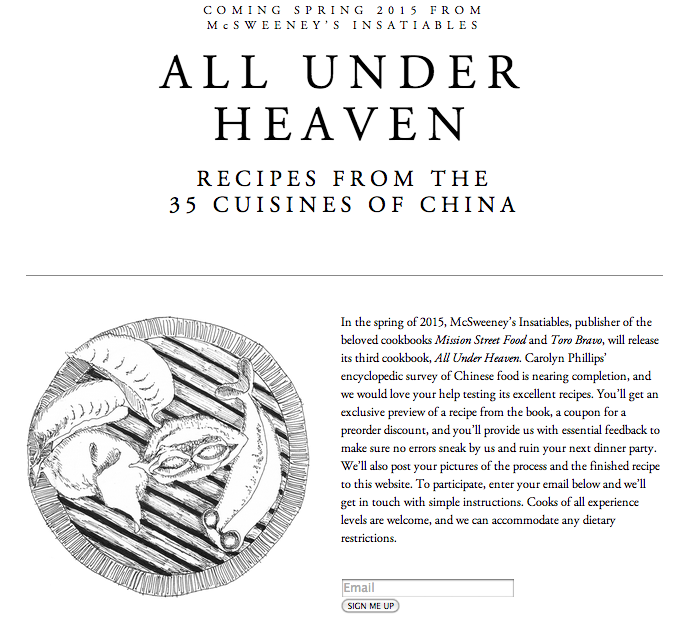
Fabulous food writer — and fellow yangxifu — Carolyn Phillips (who I interviewed a few years back) has a historic cookbook coming out in May 2015. Titled All Under Heaven, it’s the first Chinese cookbook to cover all of China’s 35 cuisines. Here’s the intro from the publisher’s website:

Vaulting from ancient taverns near the Yangtze River to banquet halls in modern Taipei, All Under Heaven offers a comprehensive, contemporary portrait of China’s culinary landscape and the geography and history that has shaped it. With dozens of recipes and lucid, set-by-step instructions, this is the first cookbook in English to examine all thirty-five cuisines of China. Drawing on centuries’ worth of culinary texts, as well as her own years working, eating, and cooking in Taiwan, Carolyn Phillips has written a spirited, symphonic love letter to the flavors and textures she fell in love with over thirty years ago. From simple fried green onion noodles to Lotus-wrapped Spicy Rice Crumb Pork, All Under Heaven serves as both a handbook for the novice and a source of inspiration for the veteran chef.

So here’s the deal — they need folks to sign up to test out recipes from the book:

You’ll get an exclusive preview of a recipe from the book, a coupon for a preorder discount, and you’ll provide us with essential feedback to make sure no errors sneak by us and ruin your next dinner party. We’ll also post your pictures of the process and the finished recipe to this website…. Cooks of all experience levels are welcome, and we can accommodate any dietary restrictions.

If you’re a huge fan of Chinese cooking and would love to be a part of this, head on over to the All Under Heaven webpage and enter your e-mail right now!

Meet “Good Chinese Wife” Author Susan Blumberg-Kason in Hong Kong!

If you’re based in Asia and itching to meet Susan Blumberg-Kason, author of Good Chinese Wife (an AMWF memoir you really don’t want to miss — see my interview with her from this past July), here’s your chance in October 2014. Come on down to Hong Kong for one of these special events!

Meet Susan Blumberg-Kason, author of Good Chinese Wife, in Hong Kong!

Monday, October 13, 7:45pm – Hong Kong Jewish Community Center (Reading and Signing)

Everyone is welcome to attend this event, but due to tight security you MUST be on the guest list in order to enter. Contact Erica Lyons at [email protected] to get your name on the list. Bring your ID the night of the event to get in, plus a cover charge (HK$65 for JCC members, HK$100 for non-JCC members) that includes dessert and a drink. Books will be for sale.

Tuesday, October 14, 6:30pm – Hong Kong Foreign Correspondents Club (Talk)

Susan will be speaking to the Hong Kong Women in Publishing Society (WiPS) about memoir writing, but anyone can attend this event. There will be a fee to get in (HK$200 for non-WiPS members and HKD$100 for WiPS members). Appetizers will be served and books will be for sale here, too.

Thursday, October 16, 6:30pm – Bookazine in Exchange Square (How Does One Dress To Buy Dragonfruit? Launch Party)

If you can’t make the previous two events, you can still meet Susan at this launch party for the anthology How Does One Dress to Buy Dragonfruit? (which includes her essay, as well as mine!). There will be wine, dragonfruit and giveaways, including a chance to win your very own copy of Good Chinese Wife. All are welcome.

 UPDATE: Added in correct fees for the Hong Kong WiPS event.

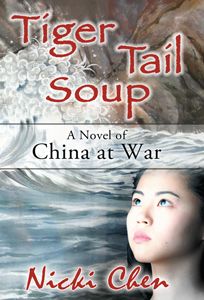
Interview with Nicki Chen about her Novel “Tiger Tail Soup”

9781457526756cvr.inddIn her new book Tiger Tail Soup, Nicki Chen transports us to a corner of China you don’t often find in wartime China literature – Fujian Province’s Gulangyu Island, an international settlement near Xiamen. But what makes this book even more fascinating is that it was inspired by stories from her Chinese husband, who was actually born on Gulangyu following the Japanese invasion.

Anyone who has read Nicki Chen’s blog – cleverly titled Behind the Story – knows she has some incredible tales to spin (thanks in part to her marriage). This novel about An Lee, a young mother who shows extraordinary courage, resilience and patriotism in the face of danger, is also a lovely story. Tiger Tail Soup offers a touching and poetic tale that ultimately speaks to the enduring power of love.

It’s my pleasure to introduce you to Tiger Tail Soup through this interview with Nicki Chen. A native of Sedro-Wooley, Washington, she holds an MFA in Creative Writing from Vermont College and has lived in some of the most beautiful places on earth, from the Seattle area to the Philippines and Vanuatu. Nicki also married her husband Eugene during the extraordinary year of 1967 (yes, the very same year that interracial marriage was finally deemed legal across the US). You can learn more about her writing at NickiChenWrites.com.

Nicki Chen
Nicki Chen

—–

Your husband and his family’s stories were the major inspiration for this novel. Could you tell us briefly about some of your favorite stories behind Tiger Tail Soup?

The title of the novel is taken from one of my favorite stories. My late husband was born soon after the Japanese invaded Fujian Province. During his early years, his family seldom had enough food. Meat was especially hard to come by. One day they heard that the Japanese had killed a tiger, so they sent their maid out, hoping she’d be able to buy some tiger meat. As expected, the Japanese commander claimed the heart and liver and the other officers and soldiers took most of the meat. But in the end, there were some scraps left over to sell to the Chinese. My husband’s maid stood in line all morning, and that afternoon she returned with a small piece of the tiger’s tail. A grand prize under the circumstances. In the days to come, they made soup, boiling the tail over and over until every last bit of nourishment and taste was extracted.

Another favorite tale involved my husband’s grandmother. She was a cigarette smoker, but she didn’t want people to know. Unfortunately, her bound feet were too tiny and crippled for her to run to the store. So when my husband was old enough, she sent him. One day after buying her cigarettes, he fooled around so long, playing and talking to the shopkeepers that he had to rush home. Even as the sun set, he took a shortcut through the cemetery. And that’s where he saw the ghost: a Western woman in a long white dress floating above the gravestones. When he told his grandmother, her advice to him was simple. “Don’t worry,” she said. “If you didn’t mistreat the person when he or she was alive, the ghost will not harm you.”

At the heart of this novel is An Lee, who you have described as “a young woman who longs for a life of patriotic heroism” even as she stays at home to take care of her family. You created a very fascinating character in An Lee—a woman who on the surface seems much like a typical housewife, but who in fact demonstrates incredible courage and strength throughout the story. Could you talk about what it was like creating this character? Was she inspired by real-life individuals or by fictional characters you’ve come across in your own reading?

The Chinese women I’ve known, friends and family, are without exception more strong and independent-minded than the old American stereotype of the submissive Asian woman. In that sense, the character of An Lee was inspired by all the Chinese women I’ve ever known and read about. When I was researching the novel, though, I was struck by accounts of the patriotic fervor of the Chinese men and women as they coped with the invasion of their country. I knew that An Lee would be caught up in that fervor, but, like every other human being, she would have her ups and downs—her struggles to keep fighting to survive.

The story is set during the Japanese invasion and occupation on Fujian’s Gulangyu Island, which was where your husband grew up and a place rarely featured in historical fiction about China. How did the Japanese invasion and World War II impact Gulangyu differently from other parts of China?

When the Japanese began their invasion of China in 1937, they weren’t ready to go to war with the Western Powers. And since Gulangyu was an International Settlement that housed many consulates, they stayed off the island, in the beginning at least. It was surrounded by the enemy, though, flooded with refugees, and cut off from shipments of food, fuel and medicine. People in the international sections of Shanghai experienced similar circumstances. Then, in 1941, the Japanese bombed Pearl Harbor and marched into Shanghai and Gulangyu. They remained under occupation until the war’s end in 1945.

It’s too bad that Gulangyu and Xiamen are rarely featured in historical fiction about China since they’re the ancestral homeland of most Chinese in Southeast Asia.

What message or messages do you hope readers will come away with after reading Tiger Tail Soup?

I hope the reader will take away a sense of possibility and hopefulness. We all face challenges and pain; we make mistakes and feel like giving up. But, like An Lee, we can survive and succeed. In a more general sense, I hope Tiger Tail Soup increases the reader’s empathy and understanding of other people. When we read a novel and imagine ourselves alive in another time and place, we escape the narrow confines of our own lives and become someone new.

—–

A big thanks to Nicki Chen for this interview! You can learn more about Tiger Tail Soup and her writing at NickiChenWrites.com, where you’ll also find an excerpt from the novel.

Interview with Alex Tizon on His Memoir “Big Little Man: In Search of My Asian Self”

If this blog was a course and you were one of my students, there’s one book that would be at the top of your assigned reading list: Big Little Man by Alex Tizon.

Big Little Man: In Search of My Asian Self

Subtitled “In Search of My Asian Self”, Alex Tizon’s new memoir deftly covers many of the popular topics I’ve written about on this blog. Yellow fever? Check. The challenges of Asian men in the dating world? Check. Hollywood’s harmful stereotypical portrayals of Asian men? Check. The myth that Asian men have small penises? Check. Discrimination against Asians (especially Asian men)? Check. Asian male role models that make us proud? Check. Big Little Man considers just about everything about Asian masculinity in the West in one fantastic book, which is one of the reasons I adore it.

But what I love most about Big Little Man is how Tizon tells the story. He’s painfully honest about his own struggles with things such as identity and feeling inferior in an America that has traditionally marginalized Asian men. He also keeps you turning the pages with his superlative writing and storytelling skills, which is where his journalist credentials especially shine through (Tizon received a Pulitzer Prize for his work in 1997).

Ultimately, this is a memoir I’ll cherish for years – and chances are, you will too. You must read Big Little Man. And if you’re like me, you’ll want to peruse its compelling pages again and again.

I’m thrilled to introduce you to Big Little Man and Alex Tizon through this interview.

Alex Tizon
Alex Tizon

During his 20 years as a journalist, Tizon worked first for the Seattle Times and then the Los Angeles Times. A graduate of the University of Oregon and Stanford, he now teaches journalism at the University of Oregon. You can learn more about him and his writing at AlexTizon.com.

In this interview with Alex Tizon, I asked him all about Big Little Man – from what it was like writing about yellow fever and his own insecurities about penis size, to what he thinks it’s going to take for Asian men to be seen as desirable romantic partners.

—–

You offer one of the most devastating critiques of Western men with yellow fever seeking Asian women that I’ve ever read. While you acknowledge at the end of the book that you’re now more accepting of these relationships, for a time this phenomenon actually angered you. How did it feel to revisit your past feelings on this issue?

It didn’t feel very good. It felt terrible, actually. And the feeling wasn’t limited to just this phenomenon. The writing process itself is painful to me, and when you combine it with the probing and remembering that were required to tell the story, the whole enterprise at times seemed too much to bear. Remembering the sense of exile that I felt as a young man actually recreated the feeling of exile. Remembering the indignation I felt upon seeing rich old white men buying the affections of impoverished 15-year-old prostitutes in the Philippines filled me once again with anger and resentment, and I walked around that way. It put me in a snarly mood. I wasn’t fit to be around people. I withdrew and took a lot of naps. I really hope my next book won’t be such a torture.

In your memoir, you courageously confront the pernicious “small penis” stereotype of Asian men in part by sharing your own very personal and intimate experiences. When I was reading this section of your book, I almost often felt as if I was sneaking a peek at your diary! What was it like writing so honestly about something most men would never dare to discuss?

People are surprised to hear that it wasn’t that difficult to do, really. There were sections of the book that were much harder to conceptualize and write about. If I were thirty years younger, I might not have been able to write about this topic because of adolescent ego and vanity that are still so powerful at that age. But I’m in my 50s, with a respectable record of romances, and am happily married. I’ve sufficiently proven myself, at least in my own mind. My insecurities have moved on to other areas.

The challenge in writing the penis chapter was to do it in a way that elevated the discussion, at least a little, from the junior high locker room level to something that addressed the symbolism of the subject. I don’t know if I succeeded. My wife thought the chapter was extraneous and a little puerile. In my defense, I was more interested in exploring what the penis represents in the various mythologies about race. It would be incomplete to talk about the Asian male experience without addressing the idea of his mythically small penis, just as it would be incomplete to talk about the black male experience without addressing his mythically large one. These myths exert social force. Both myths are hollow, of course. “Asian” covers too many people over too large a swath of geography, as does “black” or “African.” The riotous diversity in those swaths! When you make simplistic generalizations about such immense sections of humanity, you’re bound to be wrong half the time. Nevertheless, the myths endure.

You devote an entire chapter to exploring Asian men in American TV and the movies, from the embarrassing stereotypes to “yellowface”. It’s one of the most comprehensive takes on this subject that I’ve encountered. How do you feel about the state of the Asian man in American movies and TV for this year?

There are promising signs. ABC will have two primetime comedies this fall starring Asian leads, including one, Selfie, in which actor John Cho plays a lead role, and some predict a romantic lead role. We’ll have to wait and see if that pans out. There’s Steven Yeung on The Walking Dead, and Daniel Dae Kim in Hawaii Five-O; both of those are supporting roles but good ones.

Cultural habits are hard to break, though. One show on TBS, 2 Broke Girls, that was called by the New Yorker as “so racist it’s baffling,” features an Asian male character straight out of KKK central casting: a diminutive, sexless, bumbling, language-challenged restaurant owner who is a constant butt of jokes, and he takes it like a true spineless loser. He’s the 2014 version of Lloyd Lee on Entourage, and Hop Sing on Bonanza. White America needs at least one per generation to remind itself that, oh yeah, this is what we think of Asian men. Chop Chop!

A few weeks ago, I watched a movie called Edge of Tomorrow in which the lead character was played by Tom Cruise. I like Tom Cruise. But the movie was based on a Japanese graphic novel, written by a Japanese author, in which the lead character is Japanese. There’s another movie coming out soon – same situation, based on a novel out of Japan, but the lead role was given to blonde, green-eyed Garrett Hedlund, who I’m sure is a terrific actor. When Hollywood starts casting Asian men in roles originally conceived as Asian men by writers who are also Asian men, then I’ll know we’re making real progress.

Regarding your romantic life as a young man in college, you wrote, “My sense was female eyes did not see me…I was undesirable.” The three distinguished young Asian men you profile in your book, who you single out as examples of progress, also admit to challenges of dating at universities where most women are white. What do you think it’s going to take for Asian men to be seen as desirable partners?

Time. And a re-positioning of the world order, which is happening as we speak. Desirability in men is so often tied to power. As Asian nations and diasporas, and Asian Americans, both male and female, continue to accrue power – economic, social, political, corporeal – the more appealing they’ll become, and the more influence they’ll have in affecting ideals of beauty and desirability, which will be redrawn in their likeness. It’s a matter of time. Of course I’m talking about historical time: decades and generations rather than weeks and months.

While your entire book is an incredibly fascinating portrait of Asian manhood, I especially enjoyed your chapter on the Chinese concept of Wen Wu (文武) as it relates to masculinity: “For the past two thousand years in China, you could not be merely a tough guy to be considered an ideal man. You also had to be scholarly, poetic, and wise. The manliest of men were philosopher-warriors, and more philosopher than warrior. A cultivated mind was more highly esteemed than big biceps or deft swordsmanship.” How did it feel to discover this tradition of masculinity, and that it had such a long history?

It really put in place a missing piece of the puzzle for me. But it was more a sense of re-discovering it rather than discovering it. Because I grew up with it in my family, only I didn’t realize it at the time. We didn’t have the language for it, nor sufficient knowledge of our own history. But when I realized that the dynamics of our family, specifically the ones that shaped my father and brothers, were part of an old tradition of masculinity (I like the way you put that: a tradition of masculinity) that went back to the ancient Chinese, whose teachings influenced the whole continent, it made sense of things I’d been trying to figure out. It also liberated me in a very real way. I was freed to be the man that I was raised to be.

You write briefly about your first marriage to a white woman, which ended in divorce. You stated, “I don’t believe our ethnic and racial backgrounds played a huge role in our breaking apart, but they may have played a role.” How much do you think ethnic and racial backgrounds matter in relationships?

I have to believe that it will matter in different ways and in different intensities for different couples. I can really only speak to my own experience, and I’m more and more believing that I underestimated the influence, on a subconscious, molecular level, of our families or, as I put it in the book, our clans. I think the Emerson quote I use in the book, that we’re each a quotation from all our ancestors, is true. The wider the gulf between our ancestors, the greater the potential for disconnect in present-day relationships.

But I also know of a few interracial and interethnic marriages that are as solid as any I’ve encountered. They make it work. They do the impossible work of bridging impossibly wide gulfs. And let’s face it, the gulf between men and women everywhere and in all times can seem impossibly wide. But these couples seem to have what it takes for any couple of any background to last a long time: humility, deep friendship, an ability to create a spark now and then in some area of life. A little luck doesn’t hurt either.

You write about initially feeling uncomfortable with being lumped together with all the different ethnic groups from Asia under one label (“Oriental” when you were growing up, and “Asian” today), as if Japanese and Filipino is “the same thing”. At the end of your book, you state, “For the time being, and until we collectively move on to more enlightened ways of identifying ourselves, I guess I am an Asian guy.” What do you think would be a more enlightened way to identify ourselves?

Almost anything other than “Asian” or “Black” or “White” would be more enlightened. Nationality or ethnicity or geographic location would be an improvement. Perhaps the more specific the better. I am a fisherman from the Pacific Northwest of the North American continent. When I traveled to my mother’s home province in the Philippines in the early 1990s, I was enchanted to meet people who identified themselves, not as Filipinos or even as Tarlacenos (from Tarlac Province), but as people of such-and-such mountain or such-and-such river. They harkened from a very specific place, and identified themselves accordingly.

I’m watching the HBO series Game of Thrones, which is roughly based on medieval Europe, and I love the way the characters identify themselves with these very long, compound sentences: I am Alexander of House Tizon, Son of the First Men, Subject of the Seven Gods of Hodor, Squire for the Protector of the Realm, Native of the Andals and Ally of the Cebuano Fishers of the Black Sea, etc. I mean, it gets a little long-winded but it’s so eloquent and beautiful and rich, and so multidimensional. Wouldn’t it be great if we did the same in identifying ourselves. It might require the creation of a new language and a new tradition. Might it actually enrich our experience? Because what we name ourselves, I believe, profoundly affects how we see ourselves as individuals, and in turn how we conduct our lives. “I’m Black” or “I’m White or “I’m Asian” seems to open the door to such a limited reality – small and ridiculously vague at the same time.

Among some Indian tribes in New Mexico, there are over a hundred words for sunlight. There’s a word for the light that peeks over a hill in the morning. There’s a word for the light as it moves behind a particular kind of cloud. There’s a word for the sun just as it disappears below the horizon, and so on. You have to believe that their experience of the sun had more dimensions to it, was richer, and more poetic and precise. If we can figure out how to identify ourselves in ways as textured and layered and nuanced, we’ll have done a kindness and maybe come closer to the enlightened approach I hint at in the book.

—–

A huge thank you to Alex Tizon for enlightening us all about Big Little Man through this interview! For more information about Tizon and his writing, you can visit his website AlexTizon.com (where you can also find links to him on social media sites). You can purchase Big Little Man at all major online retailers including Amazon.com.

Interview with JT Tran & Alice about New E-Book “Online Dating For Asian Men”

It’s true — online dating is unfair to Asian men.

But try telling that to the high-powered exec in Shanghai who e-mailed me a few months back, saying he didn’t have time for anything else but finding women on the Internet. Some guys are busy and online dating — even if it is racist — is better than nothing.

Or does it have to be that way?

What if Asian men could improve the online dating odds? What if there was a way for them to achieve results that could match or surpass those of white men?

That’s what JT Tran (aka “The Asian Playboy”) and Alice Zindagi of ABCs of Attraction are promising in their new e-book Online Dating For Asian Men: The Scientific Method to Dating Girls Faster, Easier and With Less Rejection.

10617357_910374102310877_2103488337_n

I sat down with JT and Alice to learn more about their e-book, from why they’re calling it “revolutionary” to some of the online dating tips they’ve uncovered. (Disclosure: JT Tran is one of the advertisers on my site.)

—–

You’ve called your online dating experiment “revolutionary” when it comes to online dating. How is it revolutionary?

ALICE: Our experiment is revolutionary because the dating world almost always fails to acknowledge the difficulties of dating for minority communities, especially Asian men. Everyone knows that dating when you’re a tall, handsome white guy who looks like a carbon copy of Channing Tatum or Bradley Cooper is basically playing the game on easy mode and that being short or different is practically an online death sentence. But the majority in America have grown up with white privilege and they don’t realize that having a different race requires a different approach, especially when the media emasculates Asian men. You can see the direct result in every online dating study ever done that shows Asian men are universally the least responded and contacted group of men out there. OK Cupid did a study that showed AMs receive a lowly 22% response rate with Asian women responding even LOWER to Asian men than they did to other races. There are numerous products and services out there designed to help men improve their online dating game, but Asian men have been almost entirely left out of that equation. Until now that is.

JT: I’ve actually always avoided online dating and discouraged all my clients to stay away from it as well. Online dating was so slanted against Asian men that I felt that it was completely pointless to even try. It’s far easier and more enjoyable to meet real women in real life. However, I would get literally hundreds of emails every year from my fans who desperately wanted internet dating help. I resisted until Alice showed me the pet project that she had started on. And from there it exploded into the monstrous research project that you see before you: over 3000 messages sent, over 60 profile pictures tested, and a dozen profile descriptions written. We finally cracked the code and were able to achieve results that not only matched Caucasian male response rates, but also in some cases, SURPASSED THEM. If you had asked me if it was possible for AMs to completely conquer online dating and beat every guy out there, I would have said that was impossible. But not now.

Where did you get the idea for this online dating experiment?

ALICE: The idea initially surfaced when the Creepy White Guys tumblr made the rounds on Facebook in 2013. It’s basically a collection of screenshots from some of the creepiest white men with yellow female fever. I wanted to see if I could provoke the same results, so I created my own set of profiles but I didn’t encounter any racism until I made specific mention of having an Asian male preference. What was more interesting than the racist creeps, however, was the fact that Asian men were nonexistent in the absence of an Asian preference, but they flooded the inbox when they discovered a girl with a stated preference for Asian men. It was then that I realized this could potentially be a problem for Asian men in online dating if the only women they were contacting were Asian women and the rare non-Asian woman with a stated preference for AMs.

JT: All credit goes to Alice. Once she showed me what she had started, I gave her carte blanche to crack the internet dating code. I directed her to a perform a series of experiments using control profiles (White Males) and Asian profiles (one of them being mine). We also experimented with attractiveness level (Athletic, Average, Nerdy) and 9 types of openers. After a while, it took on a life of its own and became this massive undertaking. I was not only surprised with some of the data we were getting, but also really excited that some of the results were bearing fruit and showing me that internet dating for Asian men was not hopeless at all.

Alice of ABCs of Attraction.
Alice Zindagi of ABCs of Attraction.

Could you share with us some of your results? What surprised you the most?

ALICE: In general, the global response rates (that is, the averages from every kind of opener we tested combined into one number) were higher for white profiles than for equivalent Asian profiles. We expected this. But what we found to be interesting was that profiles of men who bordered on being nerdy or even fobby did better than profiles of average men. When we took the fobby men and cleaned them up with better haircuts, styling, and poses, their results were actually lower. These results indicate that, at least now, being a bit nerdy can be an advantage, which is a huge godsend for a chunk of the Asian male population. With the increasing acceptance of many elements of typically nerdy or fobby subculture and fashion, such as gaming and even heavy glasses, this is less surprising.

JT: A great many things surprised me. There were certain things I had assumed would make for a better online dating experience. For example, the most successful type of pictures wasn’t what I had originally thought: that of a well-dressed man in his profile picture or being surrounded by women. Neither scored very well. Or the type of openers (i.e. email conversation starters) that worked the best also surprised me. Using my own profile, I could at best only achieve a 30% success rate (equal to a white male). But when combined with the most optimized picture, optimized profile, and optimized email opener, I got a 40% response rate! Almost 200% more than the average 22% that Asian men get. When combined with the success rate of asking her out and getting her number (date template of which is included in the book), I could realistically GET A DATE EVERY SINGLE DAY FOR A WEEK by only working at it for an hour.

Can you give us a preview of one or two pieces of advice you’re offering men?

ALICE: Don’t try too hard to be sexy. It’s true that men who are classically handsome are going to have better results than men who aren’t. If you look like Takuya Kimura, you’ll get better results than William Hung. That’s just the way the genetic lottery is played and there isn’t much you can do about it. While you should make an effort to change the things you can, like your hair or fashion, when you try too hard you can often forget to be you and might lose some of the charm or quirks that draw women to you. If you’re not classically attractive, it’s not profitable to focus too much on your looks. That’s why it’s better to emphasize how interesting you are and give girls a different perspective. A picture of you rock climbing, dominating a basketball court, or wrestling a grizzly bear speaks more volumes than a bathroom selfie showcasing your $200 KPop haircut.

JT: Don’t try to have extended conversations online. I discovered that once a woman started to respond to my emails, I could easily get her number within about 3 emails and setup a date. Anything more than that risked getting lost in the friend zone or, even worse, risked you getting Catfished (a scam artist who intentionally targets Asian men because of our reputation for spoiling women). Any real emotional and romantic connection will come from when you go on your first date with her. It’s a lot easier than you think to ask for her phone number and go on the first date.

JT Tran (aka "The Asian Playboy") of ABCs of Attraction.
JT Tran (aka “The Asian Playboy”) of ABCs of Attraction.

Many of the men who read my blog are not native English speakers and therefore when they write to women online, their English isn’t going to be perfect. How much do you think that matters to women in online dating?

ALICE: Proper English is only important to a certain degree. If your grammar and vocabulary are so bad that you have to use Google Translate to construct a sentence in English because you don’t actually speak it, then you might have a problem and I would recommend taking a break from online dating to pursue an English class. But there’s nothing wrong with not typing perfectly. If anything, some girls can be intimidated by perfectly written English. It can make you look like you’re trying too hard and can put the pressure on her to match your perfection. Errors and mistakes are fun. People like emoticons. People don’t waste time with perfect punctuation if it’s not an essay for school. You have too much time on your hands if you do. As long as a girl can understand what you write, she’s not going to care if it’s written perfectly.

JT: This is why I think meeting people in person is so much better for Asian men because you can communicate with someone using just your body. About 33% of my clients are ESL so I’m not going to teach them useless verbal routines in order to hold a conversation with a girl. Instead, he can communicate with her using his body and subcommunication. Having said that, however, there are templates in Online Dating For Asian Men: The Scientific Method to Dating Girls Faster, Easier and With Less Rejection that they can use. There are screenshots and even transcripts of conversations that go from initial contact to getting her number that anyone can use regardless of their English skill level.

Where can people buy a copy of your e-book?

JT: They can pick up a copy right here online.

—–

Thanks so much to JT and Alice for this interview about Online Dating For Asian Men: The Scientific Method to Dating Girls Faster, Easier and With Less RejectionTo learn more about their work, visit the ABCs of Attraction website.