Guest Post: Food Preferences and Dining Etiquette in a Southern Chinese Home

I’m thrilled to share this guest post from Maria Deng, who authored AMWF Couples — A Canadian Perspective, one of my favorite AMWF guest posts on this blog. This time she writes about a topic I’m sure you all love — food!

Do you have a story about dining in your home or another guest post you’d like to see featured here? Have a look at the submit a post page to learn how you can follow in Maria’s footsteps.
—–

My husband’s family is from the province of Guangdong, which is located in Southern China. In this part of China, they speak Cantonese. I have always known dinner to be 吃饭, which translates to ‘eat rice’. When I first had dinner at my husband’s home, I noticed many differences in not only the food served however, in the dining etiquette as well.

Pot Of Apple Soup, Prepared By Maria’s Mother-In-Law

The Importance Of Soup

I noticed that my husband’s family had a small bowl of 汤 (soup) at the beginning of each meal. My 家婆 (mother-in-law) or 老爺 (father-in-law) would say 喝汤 (drink soup) before drinking. I began searching for the spoon at my place setting however, my husband had told me that soup is consumed by bringing one’s bowl up to their mouths. Afterwards, the pieces of meat or other items in the soup would be eaten with chopsticks once the liquid was finished. After the first few times of eating at my husband’s home, I then realized that this was much easier than eating soup with a spoon. Now, I always drink my soup in this fashion, without even giving the spoon a second thought.

An Entire Fish, Prepared By Maria’s Father-In-Law

Fish Eye

I also saw an entire fish being served for the first time at the dinner table. I didn’t know that fish was served in this fashion however, upon seeing it, I was told by my husband that 鱼 (fish) is quite important in the Chinese culture. I was surprised though when I first saw my husband eating the fish’s eyeball with such ease, something that to this day, I have yet to muster up the courage and try.

Pass The Toothpicks

Using toothpicks to clean one’s teeth after a meal was something I had never seen before. I noticed this happened at all of my husband’s family functions. When cleaning the teeth with a toothpick, one would place their hand in front of their mouth, which made it impossible to see the mouth or teeth. It was definitely a cultural difference for me as I had never seen that before however, I have become accustomed to it, welcoming the gesture with comfort.

Steamed White Rice

I always noticed a rice cooker filled with steamed, white rice on the counter-top when dining with my husband’s family. At first, I said to my husband, “is there any sauce or dressing that goes on top of this rice?” My husband then laughed, stating that in the Chinese culture, eating steamed, white rice was normal. I have now learned to eat steamed, white rice at times however, I do tend to slip in some sauce, which immediately brings a friendly roar of laughter from my husband’s family.

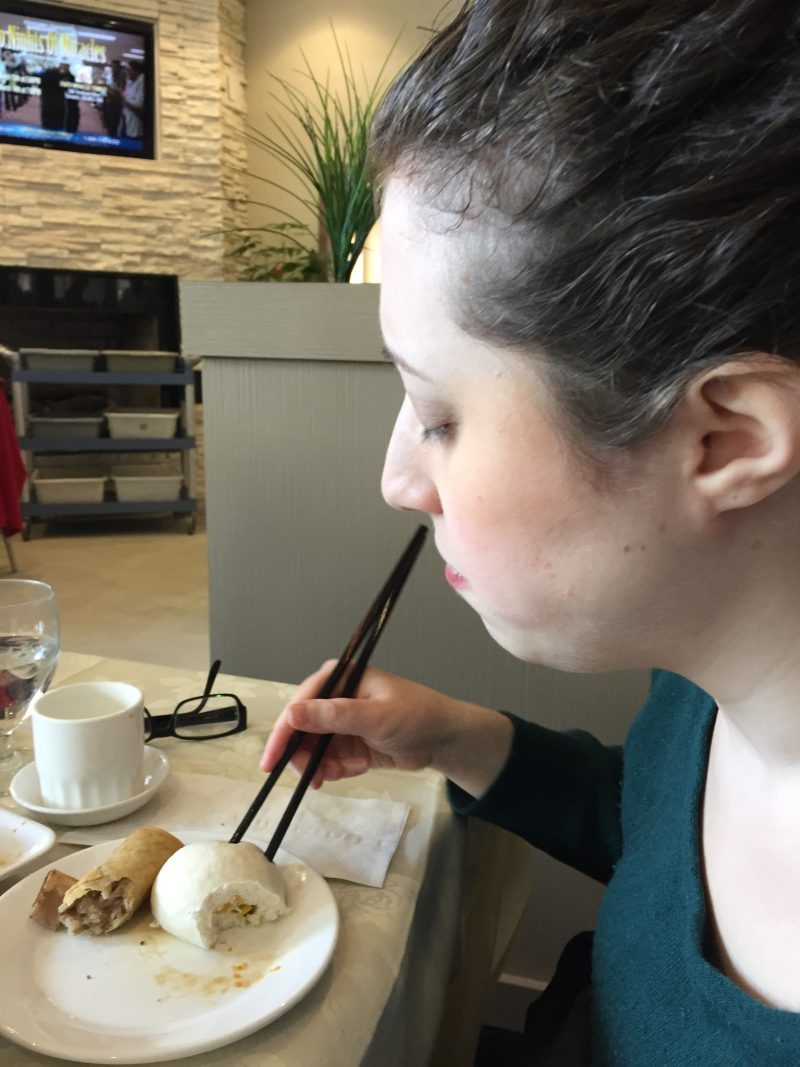
Maria ‘Attempting’ To Use Chopsticks

Chopsticks Or Fork?

Using 筷子 (chopsticks) was definitely a struggle for me. I had used chopsticks in the past when eating sushi however, rarely when eating other types of food such as rice, meat, or vegetables. I often struggled when dining with my husband’s family, which made me feel embarrassed at times. Luckily, I was given a pair of ‘beginner chopsticks’, which helped in making the necessary transition. However, I still struggle to this day when eating certain foods. Luckily, my mother-in-law places a fork on the table in-case needed.

These are just a few of the differences I have noticed, with many more as each dinner passes. However, embracing these differences have allowed me to form a deep appreciation for the food and etiquette one’s culture can bring to the table.

Have you noticed any food preferences or dining etiquette differences in the home of a friend or partner? If so, I would love to hear about them!

Maria Deng currently resides in Ontario, Canada with her husband Joey, who originally hails from Guangzhou, China. She loves reading about AMWF relationships, and looks forward to writing more about her experiences being married to a Chinese man.
—–

Speaking of China is always on the lookout for outstanding guest posts! If you have something you’d like us to feature, visit the submit a post page for details — and then submit yours today.

First Lady Faina Chiang, Russian Wife of President Chiang Ching-kuo

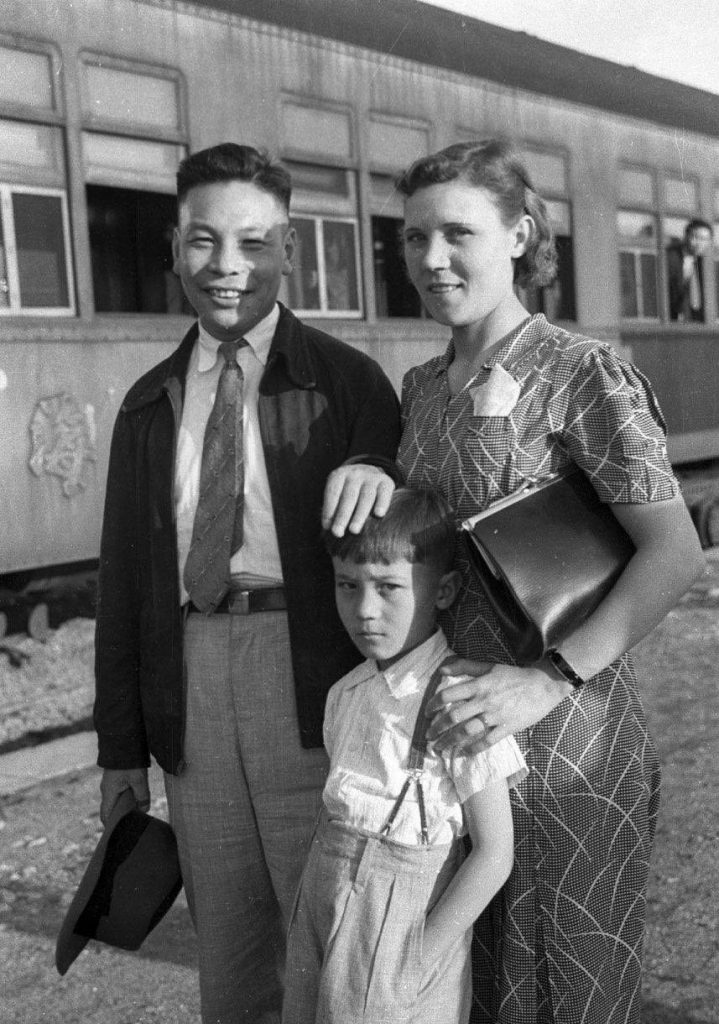
Faina Chiang with her husband Chiang Ching-kuo and their son in Gannan Prefecture. (By Unknown – http://bbs.big5.voc.com.cn/archiver/tid-2084241.html, Public Domain, https://commons.wikimedia.org/w/index.php?curid=15237990)

Faina Chiang (nee Vahaleva) and Chiang Ching-kuo were one of the few AMWF couples known as a First Lady and President. But while researching this couple for the blog, I found myself continually drawn to the story of Faina herself, for reasons such as this quote from the Taipei Times:

Chiang Fang-liang lived her life with the weighty crown of first lady. While she never enjoyed the glamour associated with the title, she will be remembered for her stoicism.

Faina and Chiang met and married in the former Soviet Union in the 1930s. In 1937, Stalin permitted Chiang to return to China, so the couple moved there. As many of us in international and intercultural marriages know, it can be tough to settle in a foreign country. Yet as the Taipei Times noted, “the Russian bride followed her husband to China.” They added:

Perhaps Vahaleva had thought little of the different language, culture and traditions in China that would no doubt be a great barrier to her, or perhaps her love for her husband gave her all the courage needed.

Reminds me of how many Western women I’ve known have chosen to move to Asia to be with their boyfriends and husbands, despite the challenges.

Faina Chiang and Chiang Ching-kuo in the Soviet Union. (By Unknown – http://tw.people.com.cn/GB/26741/15384128.html, Public Domain, https://commons.wikimedia.org/w/index.php?curid=16283523)

Speaking of which, Faina encountered another one all too familiar to me – the parental objection, as described in the Taipei Times:

Chiang Kai-shek was reportedly at first dismayed to have a Communist Russian daughter-in-law. But after the two met, Vahaleva — who has been described as possessing the virtues of a traditional Chinese woman to a greater degree than a Chinese woman — soon won the approval of her father-in-law and was given the name Fang-liang.

She even learned Ningbo dialect and forged a good relationship with her mother-in-law, Mao Fumei (Chiang Ching-kuo’s mother and Chiang Kai-shek’s first wife).

Faina Chiang with Chiang Ching-kuo, his mother Mao Fumei, and their first son Chiang Hsiao-wen in 1937. (By Unknown – http://service.photo.sina.com.cn/show_mop.php?type=orignal&pic_id=4a8a18bfg967637c6b217&pm=1&v=690, Public Domain, https://commons.wikimedia.org/w/index.php?curid=15629523)

As first lady, Faina rarely appeared in public, preferring a simple life behind the scenes:

She was used to doing all the household chores herself instead of employing servants. She would ask for her husband’s approval for everything. Private household expenses, such as water and electricity bills, as well as salaries for servants, were all paid directly by Fang-liang from Chiang Ching-kuo’s paycheck, instead of being deducted as public expenses.

At the same time, Faina never entirely lost her foreign customs, as the LA Times reported:

…she often spoke Russian with her husband and preserved several traditions from her homeland.

“Faina regularly greeted her husband at the airport with a hug and a kiss, to the wonder and embarrassment of Chinese spectators,” Jay Taylor wrote in his biography of Chiang Ching-kuo, “The Generalissimo’s Son,” published in 2000.

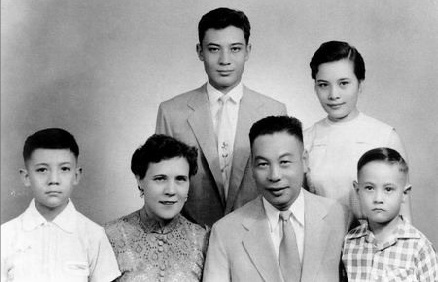
She braved many tumultuous years in China with her husband, reflected in the fact that three of her four children were born in different cities in China.

Faina Chiang, Chiang Ching-kuo and their family. (By Unknown – [1], Public Domain, https://commons.wikimedia.org/w/index.php?curid=15237453)
And, unbeknownst to her until after his death, she also endured an adulterous husband whose mistress in China bore him two sons. Imagine how heartbreaking it was to discover the truth through media reports of her husband’s death:

After Chiang Ching-kuo died, Fang-liang reportedly asked her second son Hsiao-wu, “I only have three sons, why are there reports saying I have five?”

Hsiao-wu, who had publicly reconciled with his half-brother Chang Hsiao-yan (章孝嚴/John Chang) chose to respond with silence.

On top of that, she suffered the loss of her three sons in the years after her husband passed away. The China Daily called her “the loneliest woman in Taipei”:

She had no real friends and no descendants close to her. Her closest relatives all lived overseas and even after her death, her only daughter was unable to attend the funeral because she herself was seriously ill.

How tragic.

Faina Chiang Fang-liang in 1944, cropped from the image at http://lz.book.sohu.com/chapter-1251-4-2.html

Faina died of complications from lung cancer on December 15, 2004 at the age of 88. Even though she eschewed the public spotlight, she’ll always be remembered for her hard work, modesty and devotion to her family.

The Love Affair of Mussolini’s Daughter Edda & Zhang Xueliang, Heroic China Warlord

Zhang Xueliang and Edda Ciano, Mussolini's daughter.
Zhang Xueliang and Edda Ciano, Mussolini’s daughter.

Here’s a romantic footnote you might have missed in your China history lessons. Did you know that Countess Edda Ciano, Mussolini’s daughter, had an affair with Zhang Xueliang? He’s the warlord who helped unite China against Japanese forces after his bold kidnapping of Chiang Kaishek in Xi’an in 1936 (aka the “Xi’an Incident”).

The New York Times actually mentions the two in this 2001 remembrance, when Zhang Xueliang passed away at the ripe old age of 100 (wow!):

Zhang Xueliang, a onetime warlord who in two turbulent weeks in 1936 helped turn the course of Chinese history — and then spent the next 55 years under house arrest, gradually and reluctantly becoming a national hero — died on Sunday in Honolulu, where he had been living in recent years. He was 100.

…His Northeastern Border Defense Army grew to 400,000 men, and in 1930 he was named deputy commander in chief of the Chinese armed forces. But he was distracted from military affairs by an active social life, including a dalliance with Countess Edda Ciano, daughter of Mussolini and wife of the Italian minister to China.

Here’s a more intimate look into their relationship from the book Zhang Xueliang: The General Who Never Fought:

Zhang and Edda Ciano first met in Beijing at a dinner for the League of Nations delegation headed by Lord Lytton. The delegation was there to investigate the roots of the Manchurian Incident and its developments. According to her testimony, Edda sat across from Zhang at the table and at the end of the evening he passed her a note inviting her to join him for a tour of the Imperial Summer Palace the next day, which she gladly accepted. The following day they spent a number of hours at the palace, with Zhang serving as Edda’s guide and giving her all his attention, while almost completely ignoring the other members of her entourage, including high-level personalities. The attention of the strongest man in China and ruler of its northern provinces, the daughter of the Italian dictator noted years later, ‘flattered my ego’. This indicated how Zhang had maintained his position in the kingdom, even at his lowest point after his defeat by the Japanese.

During the month following that tour of the Summer Palace, the friendship between the two deepened…. Edda managed to convince Zhang to purchase three Italian-made aircraft for the Chinese Air Force. The close relationship between the Italian and Chinese air forces, which developed during the 1930s, can be attributed to the personal friendship between Zhang and Edda. Years later, Zhang testified that Edda wrote many letters to him over a long period of time, but at some point asked him to return them to her. When he was asked if they were love letters, he refused to reply.

The two met frequently in Shanghai during Zhang’s drug rehabilitation process. [NOTE: Zhang was addicted to opium for a time.] One evening, Zhang held a festive dinner at his magnificent villa in honor of Edda and her husband ahead of their return to Italy, even though he and his entourage were about to sail on the same ship with their guests.

From right to left: Yu Fengzhi (wife of Zhang Xueliang), W.H. Donald (Australian consultant of Zhang Xueliang), Zhang Xueliang. In center the comtesse Edda Ciano (daughter of Mussolini and wife of Italian ambassador in China Galeazzo Ciano)
Edda Ciano, Mussolini’s daughter (third from left) stands with Zhang Xueliang (third from right) in Beijing, 1931.

According to the book Mao: The Real Story, there’s a fascinating political backdrop to the love affair between Zhang and Edda:

The naive marshal, who was sympathetic toward the fascists, invested particular hope in Il Duce, believing that only an ironlike totalitarian dictatorship like Mussolini’s could rescue China from the crisis. He also counted on help from the Duce’s daughter, Edda, the wife of the Italian consul general in Shanghai and future Italian minister of foreign affairs, Count Ciano. Zhang was a ladies’ man. Good-looking, youthful and dark-haired with a bristling mustache, he adored nightclubs and cabarets, was a splendid dancer, and courted women elegantly. The passionate Italian lady could not resist the handsome marshal, whose personal fortune, incidentally, amounted to some $50 million. It is hard to blame her, particularly since Count Ciano slighted her and preferred to linger in Shanghai’s bars and houses of prostitution. Edda’s romance with Zhang Xueliang continued for only a short time. In 1932 Edda and her husband returned to Rome.

A suave China warlord (who eventually makes history) romances the daughter of Italy’s infamous fascist dictator during the 1930s. Wouldn’t this make for an incredible movie? If it ever hits the big screen, I’ll be there.

4 Stinging 1890s Quotes on White Women Who Loved Chinese Men

By I. W. Taber - http://content.cdlib.org/ark:/13030/tf2779n8vr/?layout=metadata&brand=calisphere, Public Domain, https://commons.wikimedia.org/w/index.php?curid=3364494
By I. W. Taber – http://content.cdlib.org/ark:/13030/tf2779n8vr/?layout=metadata&brand=calisphere, Public Domain, https://commons.wikimedia.org/w/index.php?curid=3364494

The LA Herald published “Married to Chinamen – White Women Who Accept Mongolian Husbands” in 1892. But it’s hatred, not acceptance, that prevails in the piece.

Essentially, the article asks a simple racist question. What in the world is wrong with these white women, who would dare to love and marry Chinese men?

I’m amazed that there were white women in the 1890s courageous enough to overcome societal condemnation and love Chinese men regardless.

Think about it. This was only a decade after the US passed the Chinese Exclusion Act. In an era when the US wanted Chinese out of the country, these women welcomed them into their hearts and homes. They created families with them.

So, in an effort to remember the bitter early history of AMWF couples in America, I’m sharing 4 stinging quotes on white women who love Chinese men from this LA Herald piece:

#1: The average American cannot understand how any human being, however inured by custom, can live in an average Chinatown. That white women should live there by deliberate choice seems to him monstrous, horrible.

Racists crave dehumanizing language. So it’s not surprising that the paper describes these white women as if they were the brides of Frankenstein.

#2: She is but twenty-two years of age, remarkably beautiful and possessed of a voice that…would be a fortune. Yet three years ago, she met and loved a Chinaman.

If the 1890s ever ran a “public service announcement” against white women marrying Chinese men, it would probably start with something like this. (Oh my.)

#3: It is also well known that not one Chinaman in a hundred comes to these shores without leaving behind a wife in China; so by the laws of China, the white wife is not a wife…

And if that 1890s “public service announcement” continued, this is the climax, the heart of their argument. Don’t marry someone who can’t guarantee you a proper marriage! (Whoa.)

#4: They have had six children, of whom five are living – bright, intelligent half breeds. And Mrs. Watson (her husband took that name when baptized) is still handsome and pleasant spoken.

<sarcasm>Ah yes. Amazing that Mrs. Watson didn’t somehow become deformed or damaged after marrying a Chinese man. And her kids even appear normal. Incredible! </sarcasm>

You can read the full LA Herald article online. Prepare to cringe.

What do you think?

P.S.: Thanks to Tony of Frederickbee.com for linking to this article, which brought it to my attention.

I’m always on the lookout for more AMWF history. If you know of a couple or story you’d like me to spotlight, contact me today.

AMWF History: Sarah Burke and Wong Suey Wong, Arrested in 1883 USA (For Love)

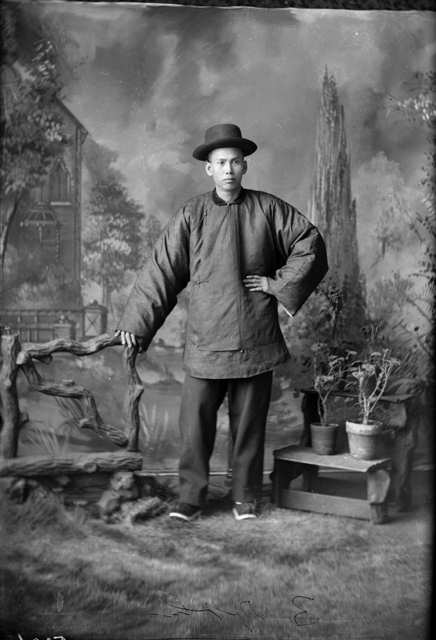
A Chinese American man.
A Chinese American man circa late 1800s/early 1900s.

Chances are, if you’ve ever been in an interracial or intercultural relationship, you’ve experienced your share of negative comments or racist remarks.

But at least you’ve never been arrested, like Sarah Burke and Wong Suey Wong were in San Francisco, California in 1883. That’s just one year after the Chinese Exclusion Act was passed.

Here’s the initial story from the San Francisco Chronicle, 7 April 1883 (per Frederickbee.com):

Officer Travers brought to the city prison at 12:30 o’clock this morning a Chinaman on whose arm whose was hanging a pretty young girl of some twenty summers. The couple proved to be no others than Wong Suey Wong and Sarah Burke. The arrest was made at 728 Jackson Street, a house of ill-fame, being the abode of several Celestial courtesans. Here Sarah Burke was found, in one of the upper rooms, in a bed completely hidden by sheets used as curtains. At the police station she said that she had gone to the house on Tuesday last, knowing that it was a house of ill-fame, but not caring, since in a day or two she would be legally married to the choice of her heart, with whom she has been living for the past five months. On being parted from her Chinese lover she squeezed his hand, which he returned with equal fervor. In the Chinaman’s pocket was found, besides a receipted bill for a bed and a spring mattress, a photograph of his fair amorata, from which he parted with evident reluctance. He was charged with felony in having lodged a girl under age in a house of ill-fame, while she was booked for residing in a house of prostitution.

In other words, the authorities dredged up some pretextual reasons to throw them in jail, since they didn’t like the idea of a Chinese man and a white woman being in love.

And if you had any doubt as to how people felt about a relationship like this in those days, well, read the first line of the April 8, 1883 story in the San Francisco Chronicle follows on 8 April 1883 (per Frederickbee.com):

Sarah Burke, who has unalterably set her mind upon a disgusting marriage with a Chinese laundryman, acknowledged that she had passed a dismally and frigidly cold night in prison on Friday. Wong Suey Wong, her Mongolian fiancée, coincided in this experience. About 11 o’clock yesterday morning some of the pair’s Chinese friends obtained the release of the couple on bonds in $100 each.

This April 8, 1883 story highlights the challenges the couple faced in trying to marry, noting, “…it was fortunately discovered that for decency’s sake a marriage between a white and an Indian, mulatto or Mongolian, was prohibited and therefore the County Clerk could issue no marriage license.” Sarah and Wong’s only options were a marriage under a civil contract or a marriage without a marriage license.

(As shocking as this sounds, it reminds me of the restrictions the US had placed on same-sex couples. Hard to believe the US Supreme Court only legalized marriage equality just last year!)

But it gets worse when Sarah’s father attempted to have her committed to an institution for insanity, “who deemed the fact of her infatuation for a repulsive Chinese sufficient grounds for believing that she had lost her reason.” Ugh!

Here’s the story in the San Francisco Bulletin 12 April 1883 (per Frederickbee.com):

The father testified that his daughter had always been possessed of ordinary common sense until about the first of last January, when she conceived her unhallowed desire to wed Wong Suey, since which she had acted as though possessed of the Infernal One. He had never had any reason to doubt that she was a chaste and moral girl until now. Sarah Isabella was also examined. She again reiterated her love for Wong Sue, and desires to marry him….

The Commissioners, however, concluded that they could not commit the girl as insane. She was evidently suffering from a moral eclipse, but her mental trouble did not, in their opinion, come within the meaning of the law….

The story even chronicles how “a stalwart policeman grabbed Wong by the nape of the neck and small of the back, and hurled him into the hallway adjoining the Commission” after Wong entered the room and embraced Sarah. Horrible!

Fortunately, all charges were dismissed against Sarah Burke, and the couple were married by Reverend Mr. Vrooman.

But did they live happily ever after? Hard to say in the late 1800s in America, a world filled with hostility for interracial couples.

What do you think?

P.S.: Thanks to Tony of Frederickbee.com for tipping me off to this story and offering a wonderful repository of information at his website.

I’m always on the lookout for more AMWF history. If you know of a couple or story you’d like me to spotlight, contact me today.

Guest Post: What Do Pickup Artists Tell Us About Dating?

I’m thrilled to welcome Wang Jia (who you might remember from his AMWF TEDx speech) back to the blog with a post exploring the world of Pickup Artists (PUA).

Do you have something you’d like to see featured on Speaking of China? Check out the submit a post page and then contact me today with your ideas or draft post.
—–

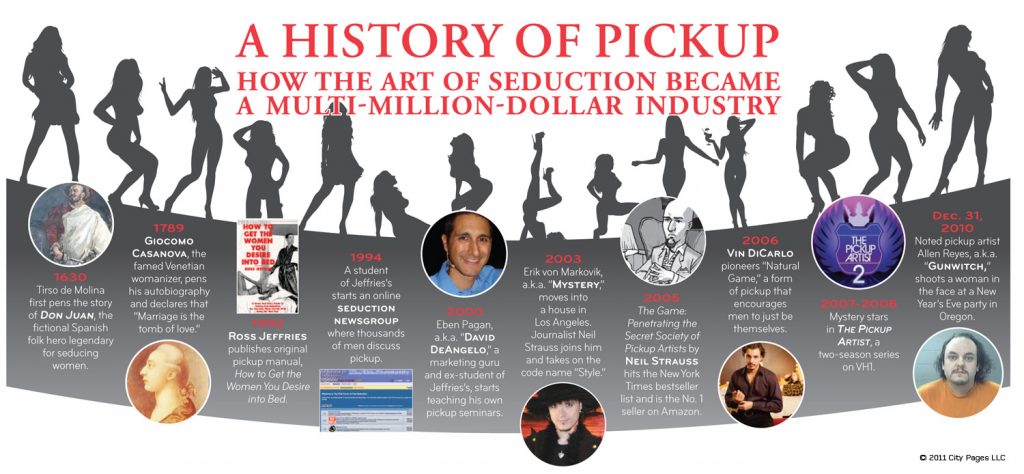
Pick-up artists (PUA) present one of the most controversial issues in the modern dating world. According to Wikipedia, PUA is the seduction community and their goal is to achieve sexual success with women. In the past 10 years, due to the success of the book “The Game: Penetrating the Secret Society of Pickup Artists”, PUA has grown from some thousands of geeks exchanging pickup lines to a multi-million dollar industry.feature Wingmen_1575.indd

While many feel appalled at PUA, I think it provides a unique angle to look at the modern romantic relationship. Though not a PUA myself, I have come across many of them while preparing my previous TEDx speech. [https://youtu.be/sWnAtLt8kSs] Some are very helpful to provide me an inside look into the dating world. And I think their argument/explanations are in general sensible and well grounded. Some PUAs are even interviewed by Jocelyn to provide advice for Asian men. [JT Tran interview: https://www.speakingofchina.com/ask-the-yangxifu/jt-tran-asian-playboy-interview/]

So why do we have polarized impressions/opinions against PUA?

Though much PUA stuff is self-help and aiming at improving men’s life style, the ultimate goal of PUA is predominantly sex – to have as many “lays” as possible (in PUA language). For many women that is a real turn-off. It seems that many women believe PUAs often play tricks to achieve short-term benefit of having sex.

I see that men’s impression of PUA differs a lot from women. Men often feel that they have some kind of privilege when they are able to have sex with many women. I am no exception. For a period of time, I secretly admired those who can easily find sexual partners, and I was very insecure due to the lack of success. PUA comes in to help. But is that the best way? Has the Western culture set many desperate men to that route?

Are PUAs happier than average men?

Arguably PUA is mainly for those who believe “more women = better life”. As many things in life: the quality is more important than quantity.

Nearly all PUA gurus have sex addiction. They especially enjoy the variety of sexual choices, but they cannot sustain a long term monogamous relationship. Getting married is the end of their life style – a great example is the author of the book “The Game” Neil Strauss, who basically announced GAME OVER when he finally got out of a lot of trouble and married. I think top PUAs are basically different human beings than average men like me. I was always looking for that special one person, and I am very happy to keep her in my life. Some men thought that PUA life style is the happy world. They end up in a deeper trouble.

But to be fair, compared to those men with zero access to sex, PUAs are certainly happier.

Is it true that those people who practiced PUA significantly changed their dating lives?

Some men certainly did, but only those who are disciplined and keep trying for an extended period of time. At the beginning it’s not fun. PUA is like many other skills or professions: theory is not hard to find – still no results without practice. If you are only looking for a shortcut to solve your problems you will be disappointed.

Does PUA prove that we all make irrational decisions constantly in dating?

We are emotional creatures, and we don’t make many relationship decisions based on logical thinking. Is that the fundamental reason why women can be manipulated? Mmm, that’s a good Ph.D. topic for social psychologists. (I reserve it for my next life. One Ph.D. title is enough J) Well, many PUAs do claim that their methods have a neuro-psychological foundation. I don’t think scientific research is that far yet.

Should I believe that PUA can make me a dating master in a short time?

As I mentioned, I don’t believe there is the quick and easy shortcut. Even though 90% PUA sites try to sell you a shortcut/trick/secret. I believe that the right PUA method does give men a workable system to improve. It is A method, not THE method. There are already honesty-based methods immerging. (Ironically, developed partially by ex-PUAs.) And I believe that’s the better direction to help men. Search for names like Mark Manson, Johnny Berba, Johnny Soporno, Nick Sparks.

Would I recommend PUA methods to Asian men?

It depends. If you are fully aware of the potential negativity of PUA, by all means, try it. If you are disadvantaged in some parts of the world due to lack of understanding how dating works, PUA has a lot of good explanations on Western dating processes. But, (a big BUT) I would rather recommend to focus on self-improvement: communication skills, confidence, healthy life style, purpose in life, understanding yourself, etc. – in another word, those things that are bigger than just sex. Many ex-PUAs find that period of life more of a stepping stone to something more meaningful.

PUA methods come from real world experiences and they give good examples of how practice + feedback can take you to another level. This method is similar as in many scientific fields. I explained this in my recent TEDx speech “ Chemistry of Relationships”. [https://youtu.be/TZC-_h8rl9w]

(This TEDx speech is not about PUA. But my next TEDx is coming. And my plan is to bring up the PUA topic.)

—–

There is often no yes-or-no answer. The existence of PUA has deep-rooted reasons in human society. Many questions remain. How do you think PUA will impact our dating world in the future? Have you met a PUA? Please give your opinion here. I am interested to hear! Questions are welcome. I am happy to comment. And it may help me to prepare my speech. But keep in mind, I am just an amateur PUA expert.

Wang Jia delivered a TEDx speech on AMWF: Western Women, Eastern Men (https://youtu.be/sWnAtLt8kSs). He also blogs about the chemistry of relationships at whyamwf.wordpress.com.
—–

Speaking of China is always on the lookout for outstanding guest posts! If you have something you’d like us to feature, visit the submit a post page for details — and then submit yours today.

Interview with Joke Tummers, Professional Clarinetist and Music Instructor/Entrepreneur in China

IMG_0180Many foreigners come to China hoping for opportunity and a little adventure. But how many can say they joined a symphony orchestra here? Or ended up running a music school in China?

For clarinetist Joke Tummers, China adventures mean making beautiful music with others (including her husband Haiwen, who manages the JT Music Academy along with her). I talked to her to learn more about how China shaped her career as a professional musician and later entrepreneur/instructor.

Here’s her bio translated from the Netherlands group blog China2025.nl:

Joke Tummers has lived in Guangzhou for 8 years. The first five years she served as an associate clarinet in the Guangzhou Symphony Orchestra. After the birth of her first daughter, motherhood and orchestra proved not to be a good combination. After a short break and the birth of her second daughter, it was time for a new challenge. She and her husband took over a music school. Joke is now the artistic director of the JT Music Academy where she also gives private lessons.

You can follow Joke on her blog, LinkedIn, and WeChat (JT_22_QK).
—–

image1
Joke with her husband Haiwen and one of their daughters.

Tell us about how you and your husband first met.

We met in Holland at my part time job a youth hostel. I was in charge of giving residents an evening snack and doing the dishes afterwards. Haiwen had just arrived at the hostel to start his job in the area. The company had given him the choice between a hotel and the hostel where I worked at. They told him that it would be much easier to make friends and meet people at the hostel. Hahaha, prophetic words!

I was urging the residents to eat a bit faster as I needed to go to a rehearsal of my wind band because we had a concert the next day. Long story short: Haiwen came to listen to the concert and we started dating soon after.

IMG_1548
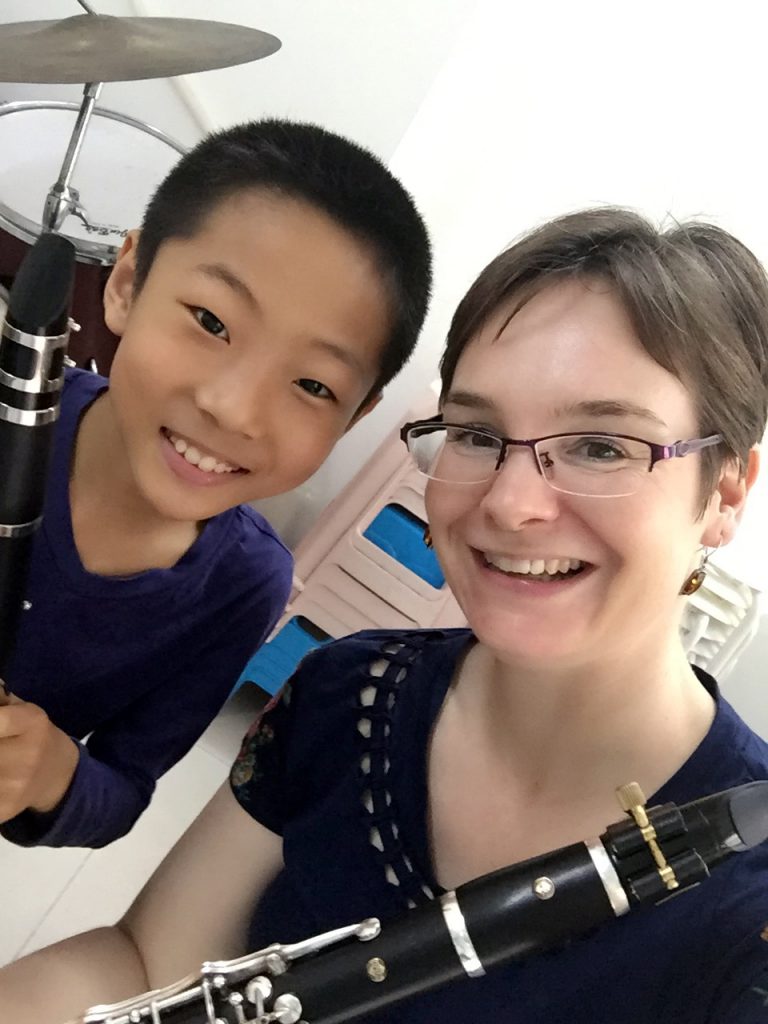
Joke with one of her students.

How did you and your husband come to move to China?

I was finishing up my Master of Music studies in Amsterdam when Haiwen suggested we go to China. He felt he had been abroad for a long time already (he studied in the UK before coming to Holland) and he wanted to return to Guangzhou.

I on the other hand was ready for some adventure as teaching at a local music school where all classes are only 25 min long didn’t sound very appealing. Orchestra jobs were really hard to get in those days and the situation has only deteriorated since then, with a lot of funding for the arts being cut.

IMG_0252
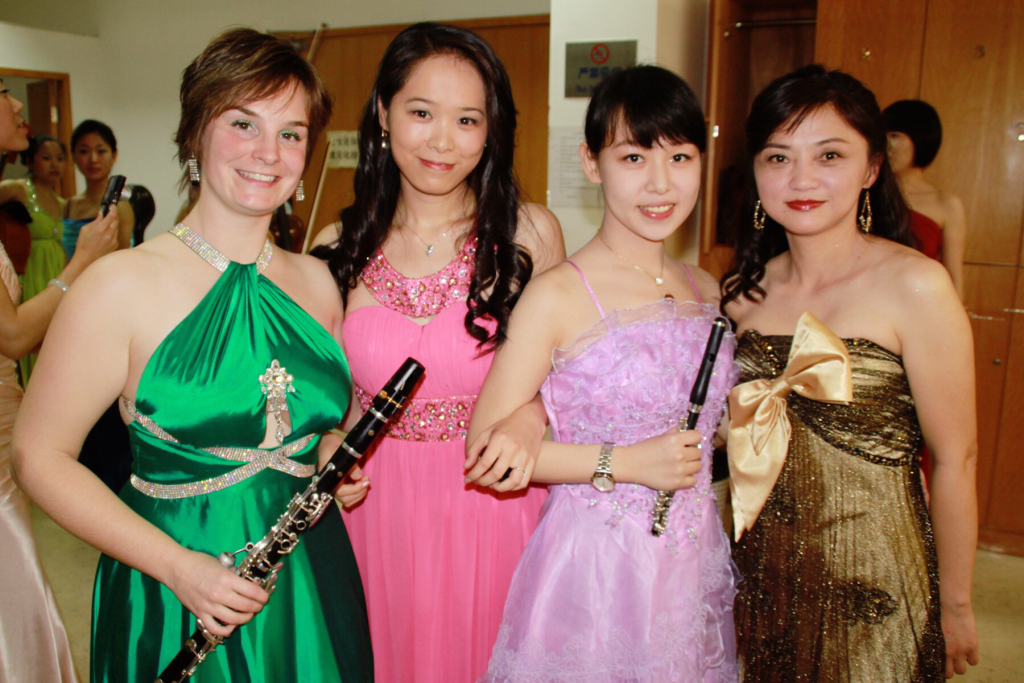
Joke along with her orchestra colleagues.

You were the associate principal clarinet for the Guangzhou Symphony Orchestra for 5 years. What was it like?

It was an interesting experience for sure. The cultural differences in how to approach and make music were huge. I’m used to showing up to a rehearsal knowing my parts, but my colleagues saw rehearsal time as their personal practice time. Management was very rigid and that is a big problem in the creative arts, where expression and flexibility are very important. It was very hard to communicate with my colleagues about how to play together better because most players were my seniors and they felt that they didn’t have to listen to me anyway. Music is all about communication so it was really hard for me to play in this stifling structure. After the birth of my first daughter I went back for a few months but decided to quit at the end of the season.

IMG_8310
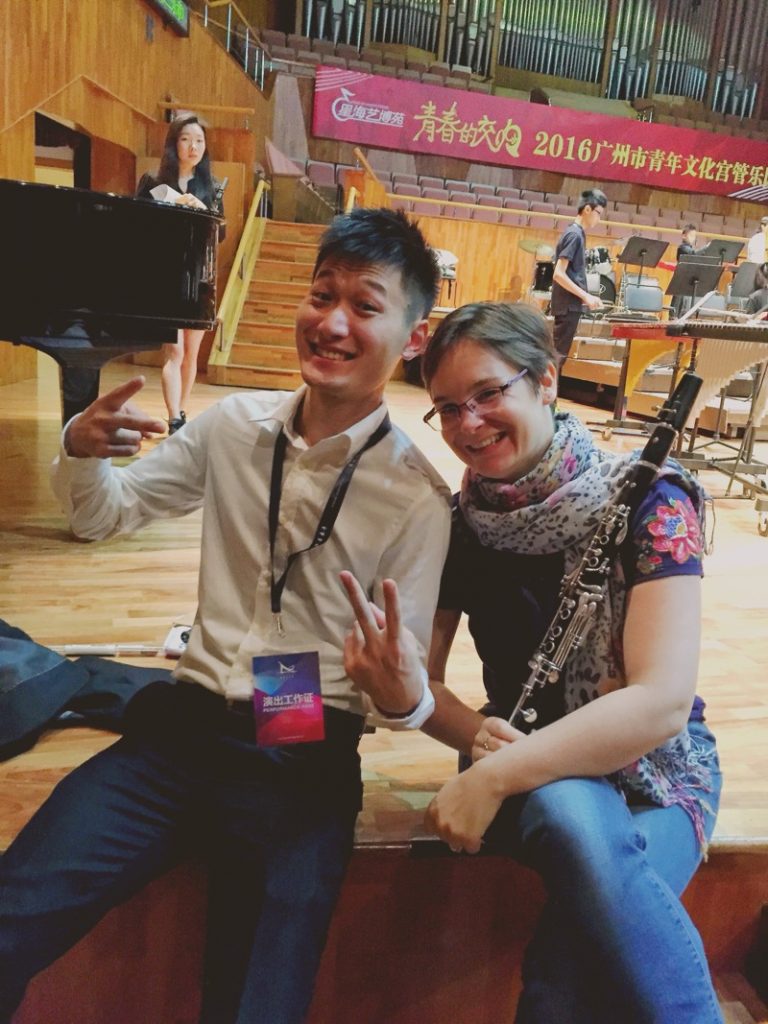
Joke with another musician.

How has China influenced your career as a musician?

In China I got the chance to play in a professional symphony orchestra. Of course it wasn’t always a smooth ride but I still had great experiences. I got to play many repertoire pieces and also played in many different concert halls, both in and outside China. We had many guest conductors and soloists and it was fun to get to know them. As one of the few foreigners in the orchestra I felt a bit like an ambassador so I would always go greet them and welcome them to China. With my colleagues I had a woodwind trio. We played at various locations and even did a concert in Taiwan together. That was a lot of fun.

IMG_0122
Joke with one of her students.

Tell us about how you came to open your own music school in China, and what it’s like running your own school.

After quitting the orchestra I became pregnant with my second daughter so I was home to take care of her. When she was a few months old my husband and I decided to take over a music school in our area. We didn’t have a specific one in mind but hubby worked his Internet magic and found a school 2 bus stops from our house. We did it this way to avoid having the additional start up costs and also to already have a name and teachers working for us. We added myself into the mix so to say. I teach clarinet, saxophone, flute, piano and music theory. This is a direct result of being in China: in Holland I would have been limited to clarinet only as that was my specialization. I had to get out of this frame of thinking and that was easier once I realized that I would teach the kids more about music and not just the specific techniques of their instruments. The added benefit for me personally is that my teaching days are very varied, just the way I like it.

It is rewarding to run the school and to teach kids at a level they cannot easily get outside of our school. Since woodwind specialists are quite rare over here I’m in a good position to attract eager students. It helps that I speak Mandarin as some kids aren’t comfortable with English. Of course there are also parents that are happy that I can teach their kids in English to improve their language skills as well. With a lot of students I use a mixture of Chinese and English. Once I’m sure that their English is quite good, I switch to English only.

IMG_1547
Joke with one of her students.

What do you think it takes to be a successful musician here in China?

As a classical musician I find it a bit hard to say. I usually join an orchestra or play chamber music concerts that my friends organize, I’m very lucky that way. As with every kind of artistic profession in China the problem is the outward fixation of many people. As long as it looks good, it must be amazing, right? The actual skills seem to be of lesser importance.

I think that some not yet established musicians may feel that they need to be very commercial and only play standard repertoire, preferably with Chinese songs mixed in to catch the attention of the audience. I’ve seen some change though as I went to listen to a contemporary music concert a while back. The music was very avant-garde but the hall was full of people. I thought that this was really cool and I hope that people will start listening to more and different kinds of music.

Joke and her daughters

—–

Thanks so much to Joke Tummers for this interview! To learn more, you can follow Joke on her blog, LinkedIn, and WeChat (JT_22_QK).

Guest Post: How I Met My Asian Christian Grey (Reader Discretion Advised)

Flye Hudson, a Lesbian Pickup Artist, shares the story of how she met her “Asian Christian Grey” in this guest post. She also reveals an excerpt from her new memoir PET., the story of how she was seduced by her Asian Christian Grey and how they both joined forces to become prominent members of the underground seduction community.

(NOTE: Flye references sexual content and language that may be offensive to some readers. Reader discretion is advised.)

Do you have a story you’re itching to share on Speaking of China? Check out the guest post guidelines at the submit a post page right now.
—–

GUESTPOST1A lot of people aren’t aware of the different types of relationships that occur for AMWF couples. A lot of people aren’t aware of the true dominance that Asian men really have. I read a lot of… romance books. And believe it or not, many of them are cheesy. What I’ve lived however is something that is very much on the dark side. A chaotic and messed up romance life in an underground community of seduction artists. I still can’t believe I am living the real thing.

There have been a lot of crazy things that have happened with my partner and I. We met off of a fetish website that catered to BDSM, which I was referred to by my former sorority sister. When I had filled out my profile, I was also trying to get back at my now ex girlfriend who had cheated on me with her girlfriend and her former boyfriends. I had specifically wrote in that I had high preferences for Asian men but was open to all kinds of men (at the time I didn’t think most Asian men would be attracted to my plainness. I was definitely the cat loving, rock loving, emo scene kind of girl back then unlike today). I had received MANY messages that were very inappropriate, especially some that were racist for me putting down Asian men. It’s amazing how insecure and rude some dudes can be on the internet.

I received a message finally from someone who approached me with the line: “Been hit up by a lot of creepers, huh?” At first I didn’t think anything of it because it was the first normal message I had ever received on the site. So maybe it was a little silly of me, but I went back and forth with him. But after a short exchange of messages, a Skype call, an accidental stand up on a date, and finally meeting in person, we ended up dating and getting into a lot of trouble.

Trouble means a lot of things. From obeying and serving an Asian Master, to having a threesome with my ex girlfriend on Halloween night, to two hospital visits, to learning the art of seduction, to the amazing parties and women we met on the way in our journey, to meeting his traditional Chinese mother who found our sex toy kit, we have been through so much. And while a lot of pain and torment came with some of our adventures, I do not regret them.

To get a taste of those adventures, here’s an excerpt from my new memoir PET.

*****

IMG_20160508_131208“Hey, did you forget about our date?”

I had already f***** it up! Wednesday at 2. How could I have forgotten? Perhaps it was me checking my bank account every so often that I stressed a little prematurely- I had taken an additional shift at an odd job that I considered to be sweet but had me going more insane than I already was.

“You’re really pretty,” said a six year old, playing with my hair. I look up at a few of the workers. They smiled with their mouths but glared with their eyes.

“You know what I wish?” the boy asked.

“No idea buddy,” I said, brushing off their stares, “What do you wish for?”

“I wish I were a zombie so that I could sneak into your room every night and bite your face off.” He whispered, then proceeding to put his hands around my neck and squeeze. I laughed nervously and looked to the other counselors for help. They stared angrily for a few moments before snatching the kid off and leading him to a different activity.

I didn’t understand my passion for working in such crazy conditions. Maybe I just had a heart for people who needed help- or maybe I was just crazy and wanted to work somewhere that made me feel more normal. But none of it mattered for the time being, because I had just lost the most exciting thing that happened to me all month.

“I’ll make it up to You,” I reasoned, “Let’s do Friday. I’ll buy You lunch, my treat.”

“Sorry, I don’t like getting stood up,” Ryder said, “Good luck in the future.”

“I know, I forgot and I’m sorry,” I said, “but I was really working. I needed the money and I just got paid. Let me treat You out.”

“I don’t know.”

“Is there any way I can make You change your mind?” I asked.

Silence. Five minutes later, my phone buzzed.

Ryder. “Let’s talk on video tonight. Right now.”

“Right now?”

“Why not? Are you a catfish? Why else would you be afraid?”

Because I looked like a pile of s***?

“Give me 30 minutes?” I texted.

“Yep.”

Plenty of time to do makeup and fix that hairrrrrrr.

Within 30 minutes I had clicked onto the video screen, made the call, and then… Wow.

It was love at first Skype.

“Hey,” He said. But at the time, there was no trace of seriousness on Him whatsoever. He was smiling, grinning ear to ear.

“Hello,” I said, immediately attracted to the man who looked better than His pictures online. I couldn’t feel my face for a moment, until He started laughing.

“What’s so funny?” I huffed, feeling insecure, “do You think I’m a catfish?”

“You’re hilarious,” He responded, “and no. I just never took you as a funny girl. But hey, thanks for not flaking on the call. You had me thinking you weren’t real.”

“Funny girl? Of course I’m real,” I justified. “And I’m sorry I flaked. Work, it just-”

Ryder laughed again. “No worries. You’re totally shady though.”

IMG_20160329_130401“Whatever you say,” I said, relaxing, “so You said You’re from Partytown University?”

“Yep. Now I work.”

“What do You do?”

“I’m a manager, remember?”

“Oh, that’s right,” I said, unfolding my fingers into quotes, “Ize Management Major.’”

He only laughed again. “Exactly.”

It was so confusing how calm and happy He seemed. His texts seemed a little more serious, but talking to Him- He was so laid back. It was just different from what I experienced.

But not bad, not bad at all.

“What about you?” He asked.

“I’m a social worker and some other s***,” I said, “interesting jobs.”

“How many jobs do you work?”

“2 part time.”

“How’s the money?”

“Decent enough,” I lied.

“You said you’re from Hometown?” Ryder asked.

“Yeah, it’s the pits.”

“Ain’t hard to imagine.”

“So what brought You to the site?” I blurted out. It was a question weighing heavily on my mind.

Another laugh- in a darker tone.

“I want to find a submissive,” Ryder said, “I had an ex girlfriend a while back who wasn’t into the lifestyle. Wasn’t very fun. So now I’m much more free to do as I please. I’m looking for someone who’s open minded, eager to learn, and who knows the meaning of loyalty. And what brings you here?”

“Have You ever had a submissive before?” I asked, cringing at the word ‘loyal’.

“A few. Have you always enjoyed avoiding questions?” Ryder snickered.

“Fine.” I said. Maybe I was playing too many games. “I’m here because I’m tired of the way I’m living my life. I’m not a bad girl or anything. In fact, I’ve usually spent most of my life being busy- even too busy for me. I want to figure out what I really want and experience more out of life with the right person. I just want to find someone that I can grow to love in servitude.”

Ryder’s expression was unreadable.

“I’m used to people f****** around with me,” I said suddenly, “people who like to push me over, use me, play their games. So if You’re here to play games and f*** me over, it’s not going to work.”

“But you’re the one who stood me up, right?” Ryder smirked.

He did have a point.

“Don’t worry,” Ryder said, “you’re not the only one in that boat.”

“How many girls have You been with?”

“9 or 10,” Ryder said, “you?”

“About the same,” I said.

“Guys or girls?”

“Girls.”

“So you’re a pimp,” Ryder teased, “or should I say a madam.”

“No, that’s not nice,” I pouted.

“But I’m not a nice guy,” Ryder winked.

Something peered at me from inside the closet.

Flye Hudson is also known as “The Lesbian Pickup Artist” and is the author of PET., the story of how she was seduced by her Asian Christian Grey and how they both joined forces to become prominent members of the underground seduction community today. You can contact her at [email protected]
13040884_1140515079332153_3336398700023868524_o —–

Speaking of China is always on the lookout for outstanding guest posts! If you have something you’d like us to feature, visit the submit a post page for details — and then submit yours today.
Vlogger Spotlight: AMWF Vlog “2 Wongs Make it Right”

Two Wongs Make it Right is more than just a clever take on that old saying. It’s also the name of a funny new AMWF vlog on Youtube hosted by Chinese American “Sum Ting Wong” and his white American wife “Never Wong” (not their real names). If you’re looking for videos that explore cultural differences in a relationship with lots of humor, you must subscribe to 2 Wongs Make it Right.

2 Wongs Make It RightHere’s the introduction they wrote on their Youtube Channel:

A channel about the life of an interracial couple, as people like to call it AMWF (Asian Male Western Female). Like every couple, we have our differences. We want to explore the differences in our culture and background and share with you all in a fun and entertaining way. 这是一个亚男西女情侣 (AMWF) 生活的频道。像每对夫妇,我们有我们的分歧。 我们会用一个充满乐趣的方式和大家探索我们的文化和背景的差异。

You can also check out this special episode on their vlog to find out how this lovely couple met each other.

I sat down with Sum Ting Wong to ask a few questions about 2 Wongs Make It Right – from how he and his wife decided to start the channel to how humor can play an important role in discussing cultural differences.

P.S.: This is just the start in what I hope will be an ongoing series about vloggers out there. If you’re a vlogger and would like to be featured here – or know a vlogger I simply must interview – please contact me today!
—–

Tell us about how you decided to start this Youtube channel.

Well, actually it was thanks to my sister. She recently started watching a lot of YouTube videos about the quirks of Asian Americans and it resonated with her. She encouraged us to start our own YouTube channel with our own interracial experiences. My wife is relatively shy and I wasn’t sure if she was up for it. Surprisingly, she thought it was a great idea. It has been a fun way to bond and learn from each other.

DSC08599I love the name of your channel, and also the fact that you call yourselves “SumTing Wong” and “Never Wong”. LOL! What’s the story behind it?

HAHA. The Wong last name gave my non-Asian friends all sorts of opportunities to make fun of me. And of course, I always feel like I am a bit abnormal from the rest, hence “Sum Ting Wong”. Also, a wise friend of mine once told me the secret to a happy marriage is a wife who is always right! ;D

JJ-0996I’ve noticed you love to explore culture in your episodes. For example, one of your popular videos is all about cultural differences in the foods you both like to eat, and another one discusses differences in how you celebrate the new year. Even better, you do it with humor. Do you think it’s important to have a sense of humor when dealing with cultural differences?

When we first started our channel, we wanted a theme rather than a collection of random ideas. We have a lot of differences (both culturally and personality-wise). The good thing is that we are both very open-minded and willing to learn and accept our differences. And we always try to approach life with a healthy dose of humor. Sometimes you just have to laugh at yourself a bit! This is especially important in dealing with cultural differences because something normal for one culture might be totally offensive for another. That’s why we aim to keep it entertaining while still being respectful.

IMG_2589What’s your favorite episode and why?

That’s a tough one. Probably our favorite episode so far has been “Food Talk: Weird Food Your Partner Eats” since food is such a big part of life! The most fun episode to film has been the “Most Embarrassing Moment” episode. We had a lot of fun laughing at ourselves taping that and hope it also brings some joy to our viewers.

IMG_3647What do you hope people learn from watching your videos?

Our main goal is to share differences between Eastern and Western societies through our eyes. We hope this can bridge some gaps and clear up misconceptions between our cultures while making it fun and entertaining for our viewers. In the end, love has no color. As long as you are adventurous and open minded, the opportunities are limitless.

Guest Post: 5 Reasons You Might Not Find Your Mr. Right in Asia

I met and married the love of my life here in Asia.

So did Anne Moss, who shared her own unique how-we-met story last fall in a guest post titled How an American Woman Exchanged Rings, Bows and Hearts with Her Amazing Taiwanese Husband.

But as we all know, AMWF couples are much rarer around the world, including in Asia.

In her latest guest post for this blog, Anne offers five reasons why it might be harder for Western women to meet that Mr. Right in Asia.

Do you have a compelling post or story you’d love to see featured on Speaking of China? Check out the submit a post page to learn more about how to have your words published here.
—–

While I have happily met and married my Asian Mr. Right, I have found my case to be rather rare. Excluding some typical cultural factors you might think of as a hindrance to finding your love across the world, I’ve listed my top 5 reasons why a western woman living abroad might not ever end up meeting her Mr. Right in Asia:

(photo by Mario Izquierdo via Flickr.com)
(Photo by Mario Izquierdo via Flickr.com)

#1: Unflattering stereotypes about Western women, thanks to Hollywood

Western media has done us ladies no favors – specifically towards attitudes about sexuality and relationships. I’ve found that men living in Asia have been heavily influenced to believe all us western women will end up sleeping with anyone who decides to smile in our direction. We are often portrayed as easy, with little family regard and would never turn someone down if they are willing to offer us some attention. Many times, the woman is never seen as someone to consider as material for a real relationship. I’ve experienced this myself, and my friends and husband definitely agree it’s an issue for Western women in Asia.

(Photo by Pedro Ribeiro Simões)
(Photo by Pedro Ribeiro Simões via Flickr.com)

#2: Different communication styles (indirect versus direct)

In my own household, I was repeatedly taught to speak to the point and ask for what I want or need, and learned that I shouldn’t make someone guess. That’s not necessarily the case here in Asia, where I’ve found that people tend to communicate more indirectly. And when you have different communication styles, it can create challenges in a relationship.

For example, if a problem arises in your relationship, sometimes the two of you might respond in completely different (and contradictory) ways. I’ve been in relationships with men in Asia where he may want to ignore the problem and not talk about it, while I would totally want to talk about it and find a solution.

I’ve also had challenges communicating with parents over here. I’ve found that sometimes trying to “talk” about an issue with an Asian parent basically means listening without your input. To do otherwise would be considered ungrateful and cause loss of face.

These differences can put a lot of stress on both of you when working through disagreements. Sometimes, when trying to help guys over here understand my ideas, feelings and concerns, I’ve felt as if I were continually running up against a brick wall. Sigh.

(Photo by Emily Gould via Flickr.com)

#3: Differences in how you express yourselves and your love

Unless the guy you’re dating speaks your native language well – or you’re fluent in his language — I’ve found that having deeper conversations in your relationship might take some time. It means that when you ask a guy a question like, “How was your day?” he might not always go into the kind of detail you might expect.

Also, how your partner chooses to show his love might be different from you. Is it with actual language? Even within the same cultural group knowing your love language is a skill learned and discovered with time. What is happening when you feel love from your partner? Love languages can include: physical touch, quality time, gifts, verbal confirmation or acts of appreciation. Just because you give love in one way doesn’t mean your partner will receive it in the light it may be given. Do you want love with quality time with your partner but he gives you physical gifts? Getting this far also takes a certain amount of self (emotional) knowledge (and effort to get there) of knowing and understanding yourself and your outlook.

(Photo by Jason D' Great via Flickr.com)
(Photo by Jason D’ Great via Flickr.com)

#4: Family expectations for Asian men

Family ties and expectations run deep in Asia. It’s not uncommon for men to live with their family before and even after marriage – which might be a deal-breaker for some Western women.

I’ve also found that children in Asia (especially the men) are often expected to provide financial support to their parents, regardless of whether they live with the parents and if there’s a real need for that money. I was surprised to discover this, and I’m sure this would challenge a lot of Western women, who usually aren’t used to giving their parents money like that.

(Photo by jorge larios via Flickr.com)

#5: Becoming invisible (if you’re not fluent in the local language)

For personal reasons I am monolingual – I can only speak English. Yet I live in Asia, where English is not the native language for the overwhelming majority of people and countries. This reality has been a hard blow for me. I was taught to be independent, stand up for myself and be in charge when needed. Yet I’ve left behind the America I grew up in for Asia, and it has meant giving up a huge chunk of my own independence. I’ve been forced to depend on my husband for a lot of things and sometimes I feel like I’ve become invisible. I’ve been at restaurants where the staff focused only on my husband, handing him the menus and directing all the questions at him. On many occasions when I’ve visited shops or banks together with him, no one would even make eye contact with me. It’s been one of the hardest things I’ve faced in our relationship.

Anne Elizabeth Moss has spent the last 5 years in Asia and currently lives with her Taiwanese husband in Singapore. She teaches Bellyfit®, Bellydance and Yoga classes and can be found at https://www.facebook.com/riksardance.
—–

Speaking of China is always on the lookout for outstanding guest posts! If you have something you’d like us to feature, visit the submit a post page for details — and then submit yours today.