When I discovered a highly ranked post for the search term “dating Chinese men” that was written based on the author’s one and only one date with a fellow, I decided it was time to provide a more balanced view on the Internet and wrote this post with the search term in the title. I also encouraged other bloggers to do the same and they did. I’m now pleased to report that anyone who searches for “dating Chinese men” will find a plethora of positive posts on the subject — and might just change a few minds in the future.
Also inspired by the online discussion regarding “yellow fever”, one of the commentators posed this provocative question — and led me to blog about it.
Whenever my husband mentioned the sesame balls they ate for Winter Solstice, I imagined a version of tangyuan, those delicious glutinous rice balls stuffed with sweet sesame or red bean paste traditionally served in parts of Southern China. Except John called them sesame balls or máqiú (麻球), not tangyuan. Maybe máqiú was just another name for tangyuan in the local dialect?
But then Saturday night I watched my mother-in-law prepare máqiú in her kitchen and had a double take. She dropped balls of glutinous rice dough straight into the boiling water without even filling them. Had she lost her mind? Where was the muss and fuss of filling the dough with sesame paste that I had to slog through all these years in the US?
When she fished them out of the boiling water and then rolled them in the black sesame seeds and sugar until every inch of the dough was covered in that sweet, black coating, that’s when I realized it. It was my mistake, not hers.
Sesame balls just fresh from the wok, coated in sesame seeds and sugar.
“Here, eat them while they’re hot,” my mother-in-law said as she pressed a steaming bowl of them into my hands.
“But that’s it?” I said, my face almost flushed with embarrassment. Could she tell that I had mistaken tangyuan for máqiú all along?
“Eh, it’s simpler! You don’t need to worry about all that trouble of filling them.”
Oh, I knew all about the trouble of filling them. All those years in the US, I had slaved hours upon hours to make so-called máqiú — never realizing the actual recipe was so easy and fast.
Sometimes, family traditions get lost in translation when you’ve never experienced them. I only learned about máqiú through long-distance phone conversations with John’s family over the years and through John himself (who definitely missed a few important details in his descriptions!).
Happy holidays from me and the family!
But aren’t you bound to misunderstand when you learn something secondhand? Today during our huge Solstice dinner, I tried explaining some of the foods we used to eat for Christmas — cranberry sauce, turkey and mashed sweet potatoes. How do you explain “cranberry sauce” to them when they’ve never even seen the actual berries at the heart of this sweet-and-tart holiday delight? How you can you describe the aroma of a turkey fresh from the oven when they’ve never eaten turkey and don’t have an oven? Even though sweet potatoes are native to this region, chances are they’ve never tried anything like my creamy, buttery sweet potato and parsnip mash. I wonder what went through their minds when I described Christmas dinners of the past?
Well, you live and learn — especially when you’re living with family. And actually, I’m kind of relieved about what I just learned. Never again will I have to mess around with filling rice dough in the name of tradition. Woo-hoo!
Happy holidays!
Winter Solstice Máqiú Recipe
I think of máqiú as “inside-out tangyuan” or even “tangyuan without the filling fuss”. They’re easy, delicious and a wonderful way to celebrate the holidays. They’re best eaten hot or steaming.
This comes straight from my mother-in-law, who approaches the whole process intuitively — hence, the lack of exact amounts.
Ingredients:
For the sesame coating:
Sugar
Black sesame seeds
For the rice balls:
Glutinous rice flour
Cold water
Oil (to protect your hands)
Toast your sesame seeds, then place them in a bowl. Toss them with sugar of your choice until sweet, and adjust according to your taste preference. Put the bowl of sugar/sesame seeds aside. (Note: this step can be done a day or two in advance).
Mix the glutinous rice flour with just enough cold water so the flour begins to stick together, but not more than that. You don’t want your flour to be too watery, so err on the side of less and then add small amounts of water as needed to clump the dough together.
Rub oil of choice on your hands. Pick up a small amount of dough — just enough to put in the palm of your hand — and squeeze it back and forth between your hands until the dough sticks together. Then, with as little pressure as possible (too much pressure will cause the dough to fall apart), roll the dough between your hands until it becomes a nice ball. Shoot for balls around 1 inch in size, give or take. Repeat until you’ve used up all the dough.
Boil water in a large pot or wok over the oven. Add the glutinous rice balls to the boiling water, and boil them until they float to the top.
Once you’re ready to fish them out, bring over the sesame seed/sugar mixture. After you remove the glutinous rice balls from the water, immediately roll them in the sesame seed/sugar mixture until fully coated. (Note: if you’re not sure that you’ve added enough sugar, sample your first one to determine whether it’s too sweet or not sweet enough). Repeat until you’ve coated every ball. Serve immediately.
What do you do when no one else notices Christmas is coming? That’s what it’s like here in China’s countryside as I spend December with my husband’s family — a family that never had the tradition to celebrate this holiday.
Well, I say — if they can’t bring the holiday to you, you bring the holiday to them. So this year, I’m giving my Chinese family a taste of Christmas…with some inevitable Chinese characteristics.
1. Pull out the old Christmas tree. There’s nothing that says Christmas quite like a tree — and fortunately, they’re easy enough to find in larger cities in China. Back when I first lived in China, I bought a fake Christmas tree from a local supermarket and it followed me through the years…until I left, and it was left at my inlaws’ home. Well, turns out they stored it all these years and it’s still lovely enough to bring me some holiday cheer. I plan to decorate it with the supply of Chinese-style ornaments I’ve acquired over the years, and can’t wait to see it shining brightly on Christmas Eve.
2. Stream holiday music online. One of the best gifts anyone living in China can have is a fully functional Internet connection. Find your favorite online station and stream holiday music, if available (I’m impartial to Folk Alley’s holiday stream myself). And if you’re really ambitious, use it to teach your family a few favorite Christmas carols.
3. Serve your family a Christmas dinner. Isn’t eating half the pleasure of the holidays? And everyone has to eat — so your family in China surely won’t protest if you suggest doing dinner for Christmas or Christmas Eve.
Of course, I can’t make exactly the same dinner my mom or grandma used to make. Here in China, I have a toaster oven and a cupboard full of ingredients completely different from those I used in the US. But I can always improvise. For example, Chinese haw fruit makes a wonderful substitute for cranberries and they’re widely available in China during the winter. Instead of the chocolate cake I hoped to make (sorry, no cocoa powder in the supermarket), I’ll flavor it with the mandarin oranges that are so plentiful nearly everyone in the village gives me a few when I visit. Ham is a traditional Christmas roast not commonly found in China, but I can make something else from pork (my husband insists on ribs, who can blame him?).
But if, say, you can’t live without cranberries at the table, then head to one of China’s online stores. Yes, Virginia, you can buy dried cranberries in China…though it will cost much, much more.
4. Spread some generosity. The Christmas season is all about giving…so why not give a little something back to your family in the form of some gift? It doesn’t have to be expensive either, just something to show your generosity and love. I’m planning on setting up some “Christmas hats” (using the plethora of knitted hats around the house in place of Christmas stockings) and stuffing them with some candies from the local supermarket.
If you’re in China, how are you planning to celebrate Christmas? Or if you’ve spent Christmas in China, what did you do? Share your experiences or ideas in the comments!
UPDATE on 12/15/13: My host finally determined the issue — a server problem! She’s going to move my site to a new server, which will solve the issue. Will keep you updated!
Right now, I know slow. This site is currently experiencing some frustratingly sluggish loading times and I have NO idea why. While I work with my host to diagnose the problem, I’m pulling a few entries on slow times from the archives — and giving my apologies for stepping back temporarily. I’ll return this Monday with some fresh content!
On my Chinese husband’s time. When John showed up late once again one evening, I wondered: How was it that my husband and I seemed to run on entirely different clocks?
My husband, almost switched at birth. Yes, it’s true — the neighbors suggested my husband’s parents swap him for their daughter. Fortunately, the timing didn’t work out for this one!
What if my husband was the only child? My husband is the youngest of three — born at just the right time, before the one-child policy. But I wondered, what would it be like if he was an only child?
The thought crossed my mind as I scrolled through the photos of John and me in the US. In one, I crouched before the cream-colored house in the suburbs we once called home. In another, he posed like a triumphant warrior before the rolling hills of Ohio we hiked every evening.
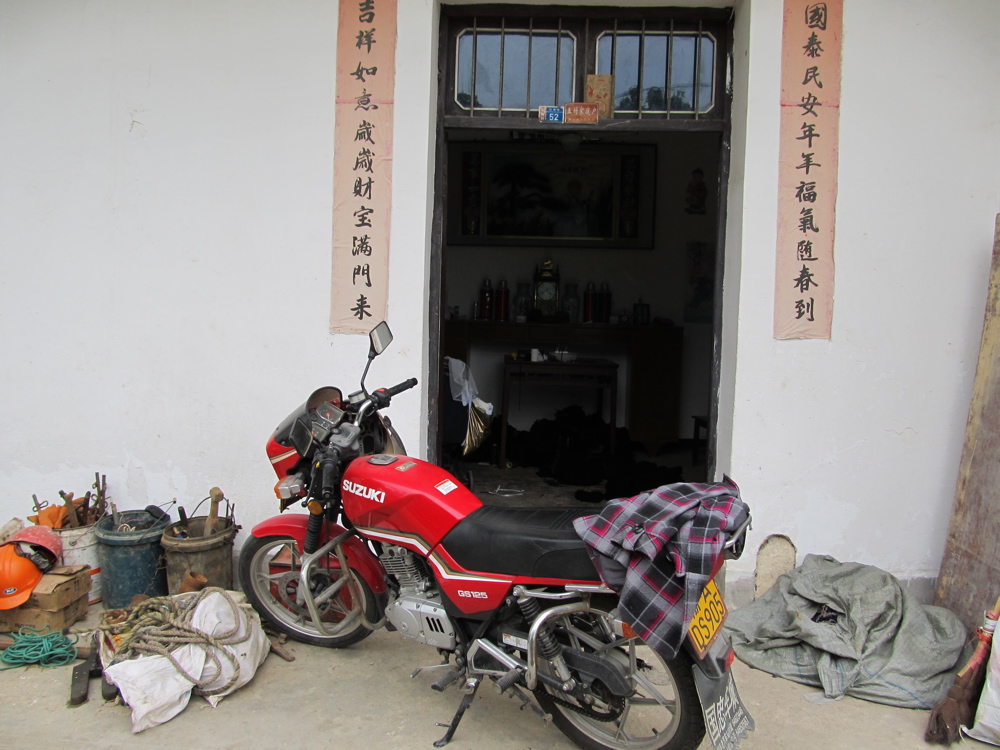
Some two weeks ago, I slept under the roof of that cream-colored house in Ohio and meandered through the trails in those hills. But now that I sleep under the roof of a white-washed home in rural Zhejiang and hike through mountains filled with bamboo and pines, my former life in the US feels like a fantasy — as if someone photoshopped me and John into those photos.
And oddly enough, it’s not the first time I felt this way. Whenever I’ve traveled between China and the US, my life in the country I left behind always seemed more like a long, extended dream to me. Not even artifacts of that previous life — such as those photos — could completely dispel this feeling that it was all just a hallucination.
Maybe that’s what happens when you’re in an international, cross-cultural relationship — where you straddle two different worlds. It’s not just geography that separates China and the US; different cultures and languages only serve to reinforce the separation. Meanwhile, I’m surrounded by people here in China who couldn’t really understand what it was like for John and me to live in the US — while in the US, most people I know don’t understand life in China. Sometimes, I feel as if these two separate worlds of mine will always remain strangers in a sense — where never the two shall meet.
Perhaps that’s also the power of living in foreign countries. Suddenly, you realize that the reality you knew growing up isn’t universal…that reality changes when you cross borders and oceans.
In the meantime, I’m enjoying my new reality in China. And someday, when I return to the US for a visit, perhaps this will all feel like a dream all over again.
During the mid-1990s, Rachel DeWoskin first dazzled audiences as the unlikely star of the Chinese soap opera Foreign Babes in Beijing — an experience she captured in her 2005 memoir of the same title, exploring life and love (both onscreen and off) in a changing China. Foreign Babes in Beijing has been published in six different countries and is currently being developed as a television series for HBO.
More recently, Rachel DeWoskin has dazzled readers with her award winning fiction set in Asia and beyond, exploring themes such as sameness and difference, empathy, women’s relationships and the Jewish experience. Her 2009 debut novel Repeat After Me won a Forward Magazine Book of the Year Award. Big Girl Small, her 2011 novel, received the 2012 American Library Association’s Alex Award and was named one of the top three books of 2011 by Newsday. Rachel DeWoskin was also the 2011 recipient of a three-month M Literary Residency in Shanghai, where she completed the screenplay for American Concubine and was inspired to develop a forthcoming novel to be set in Shanghai.
While Rachel DeWoskin currently resides in Chicago, where she is a faculty member in the Creative Writing Department at the University of Chicago, she returns to China every year and considers Beijing a second home.
Asian Jewish Life sat down with Rachel DeWoskin to learn more about her ongoing relationship with China, her forthcoming novels and screenplay, and her interest in exploring Judaism — including in Asia — through her writing.
As I struggled to remember all of the names for my Chinese relatives, I began to feel lost in the family tree. (photo by Kinsey)
As I transition back to living in the family home with my inlaws, brother-in-law, sister-in-law and niece in China, I went back through the archives and pulled a few classic posts related to my family in China.
The Chinese Relatives Name Game. Now that I’m in China, no doubt I’ll continue to struggle with all of the names of different relatives — just as I did a couple of years ago when I wrote this post.
Ruzhui: When Chinese Men “Marry Into” Wife’s Family. Ruzhui, where Chinese men “marry into” the wife’s family and have the child carry her name, turns Chinese marriage tradition upside down. And interestingly, it happened with a relative of mine.
I’ll be back on December 9 with some fresh content!
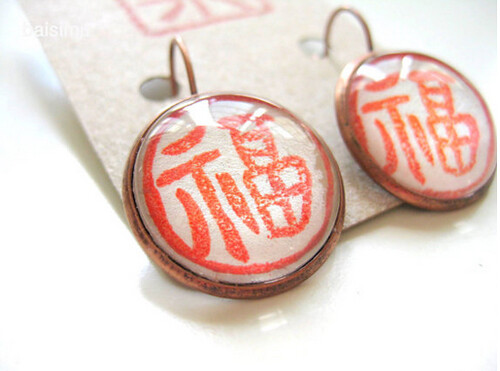
Red “good fortune” earrings with a copper backing (from Jean Toh’s Etsy.com Store)
Today is the infamous Black Friday in the US, the official start to the holiday shopping season. While I’m still transitioning over to China, I thought I’d pull a few posts from the archives for a little holiday gift inspiration.
BTW, for anyone doing a little online Black Friday shopping interested in Asian and Asian-inspired gifts, be sure to visit Zengerine.
Holiday Gift Roundup Post. Consider this your one-stop shop for all suggestions on what to buy that special someone — whether family or friends — in China.
I’ll be back on December 9 with some fresh content!
Tom Carter showing his camera to some new friends in China. (photo courtesy of Tom Carter)
As our departure for China fast approaches, thoughts of air travel, China and settling down occupy my mind. What better, then, than to reflect my current transition — and state of mind — then to share with you three archived interviews that touch on these themes?
Tiffany Hawk Interview: Love Me Anyway. While obsessing over my upcoming long-haul flight from New York City to Shanghai, my thoughts drifted back to this interview with Tiffany, a former flight attendant who turned her airline adventures into a fabulous novel with a little AMWF romance. Tiffany also shares her tips for overcoming jet lag.
Tom Carter Interview – CHINA: Portrait of a People. The breathtaking photographs Tom graciously shared in this interview about his collection of photography covering every province in China excite me about my upcoming move.
With Christmas coming up — and here in the US, Thanksgiving just around the corner — thoughts soon turn to entertaining and dinners. And if you’re in a Chinese-Western cross-cultural relationship or marriage, how can you reflect that in your holiday meals?
While I’m preparing to move to China next week, I thought I’d dig into my archives and share a few holiday food-related entries, plus link to my favorite Asian-style holiday turkey recipe on Food & Wine (sure to impress your Chinese and Western loved ones during the holidays)!
Soy-Sauce & Honey-Glazed Turkey. Soy sauce, honey, ginger, sesame oil and five-spice give this succulent turkey an Asian flair. I’ve prepared this at four times already and it always comes out moist and flavorful (so I’m told at least, since I’m actually vegan), and makes for fantastic leftovers. I usually add a little wine (shaoxing-style wine or a rice wine like sake) to the marinade as a slight variation to the recipe, a nod to my mother-in-law’s home-cooking (she almost always adds a little shaoxing-style wine to her meats). And if you’re hungry for more holiday dinner inspiration, check out the full menu that includes this turkey.
What are your must-have holiday meal traditions? Share your ideas — or even recipes — in the comments!
This website uses cookies to improve your experience. We'll assume you're ok with this, but you can opt-out if you wish.AcceptRejectRead More
Privacy & Cookies Policy
Privacy Overview
This website uses cookies to improve your experience while you navigate through the website. Out of these cookies, the cookies that are categorized as necessary are stored on your browser as they are essential for the working of basic functionalities of the website. We also use third-party cookies that help us analyze and understand how you use this website. These cookies will be stored in your browser only with your consent. You also have the option to opt-out of these cookies. But opting out of some of these cookies may have an effect on your browsing experience.
Necessary cookies are absolutely essential for the website to function properly. This category only includes cookies that ensures basic functionalities and security features of the website. These cookies do not store any personal information.
Any cookies that may not be particularly necessary for the website to function and is used specifically to collect user personal data via analytics, ads, other embedded contents are termed as non-necessary cookies. It is mandatory to procure user consent prior to running these cookies on your website.
 t’s the last Monday of 2013, nearly New Year’s Eve, and time for me to announce the top 5 Monday posts for 2013!




 Was that really me? Were we really there?