12 reasons you should read “Dragonfruit” anthology of true stories of expat women in Asia

Last week, I shared a photo essay as a companion to “Huangshan Honeymoon“, my own true story of the honeymoon vacation where my husband and I brought his father along to view one of China’s most breathtaking mountains. (Well, thanks to the lousy weather, I’ll have to take someone else’s word for just how breathtaking Huangshan can be.)

Yet that’s not the only reason you should pick up a copy of How Does One Dress to Buy Dragonfruit? True Stories of Expat Women in Asiaa collection I can’t stop raving about because of how personal and soulful every single essay is.

For me, this is the rarest of all anthologies. I actually devoured it from cover to cover in record time, and found something to love in all the essays — regardless of the story. But if you’re looking for the sort of stories that drew you to this blog, well, you’re in luck.

Love reading about cross-cultural relationships? Or dating and marriages and families in Asia? Or just want some great stories from AMWF writers? This anthology is also for you! Specifically, you’ll enjoy these 12 other essays I’d like to introduce to you. Think of them as 12 more reasons (besides, of course, “Huangshan Honeymoon“) why you should buy How Does One Dress to Buy Dragonfruit? True Stories of Expat Women in Asia.

Here they are in order of appearance:

(photo by Giorgio Minguzzi via Flickr.com)

1. “The Weight of Beauty” by Dorcas Cheng-Tozun

Dorcas instantly became one of my favorite writers when I discovered her funny and moving essay last summer titled How to be Mistaken for a Prostitute in China. Her contribution to this anthology is yet another exploration of her experience as the Chinese-American wife of a white American guy in China, but it also delves into issues all-too-familiar to many of us — how we view our bodies and ourselves. You can actually read it in the sample chapters featured Amazon.com — and chances are, you’ll love her writing as much as I did.

(photo by LeeAnn Adams via Flickr.com)

2. “Finding Yuanfen on a Chinese Bus” by Kaitlin Solimine

When Kaitlin steps onto that rickety, sleeper bus for a two-day journey from Kunming to Guangzhou, she ends up finding the ultimate road buddy (or should I say, “road gal”?). In the process, she ends up reflecting on her dating experiences in China with expats and locals alike. Kaitlin’s essay is so refreshingly honest, delving into all of the off-and-on madness, the one-night stands, the “just for sex” experiences…things most of us would rather keep locked away in our journals and minds. It’s this, plus her beautiful writing, that makes you fall in love with her essay — and long for more.

(photo by Shoko Muraguchi via Flickr.com)

3. “Love and Polka Dots” by Suzanne Kamata

Suzanne  has a different kind of AMWF family experience in Japan because of her special needs daughter Lilia, who is deaf and uses a wheelchair. Suzanne promised to take Lilia to an exhibition of artwork from the internationally renowned artist Yayoi Kusama in Osaka (which requires a two and a half-hour bus ride), and you can imagine the challenges involved in taking out a wheelchair-bound child and communicating in a language (signing) that, for Suzanne, can be tiring. Ultimately, they make the journey together to appreciate what Suzanne describes as Kusama’s “playful and whimsical” works of art (with, you guessed it, polka dots) and come away feeling stronger, inspired and even hopeful.

(By the way, many fans of this blog will enjoy Suzanne’s anthology Call Me Okaasan: Adventures in Multicultural Mothering.)
(photo by Jo Schmaltz via Flickr.com)

4. “Happy Anniversary” by Stephanie Han

While this essay tells the story of how one Korean American woman happens to fall in love with a white British man in Hong Kong on the eve of the turnover, it’s also an excellent meditation on the peripatetic nature of expat life (especially in an international family). It’s the details that make Stephanie’s essay a joy, from screaming “Kill it!” to the cobra coiled before her door (which challenges her identity as an “animal-lover”) to the $5 gold ring she got as a freebie from a Turkish rug salesman (which she subsequently uses when she gets married).
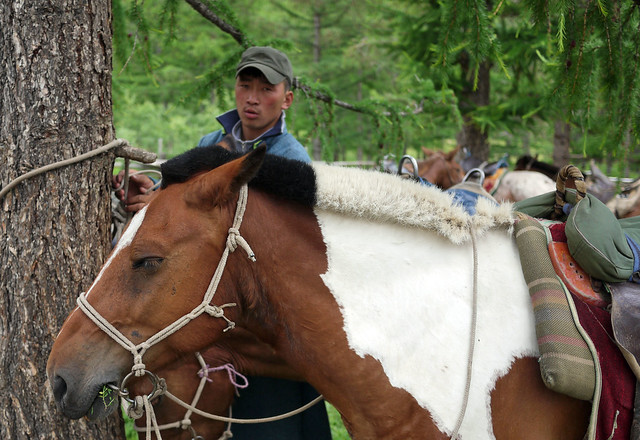
(photo by Jonathan E. Shaw via Flickr.com)

5. “Giving in to Mongolia” by Michelle Borok

A lifelong horseback riding enthusiast, Michelle once again returns to the saddle in her thirties and ultimately her passion draws her to Mongolia for a solo vacation. There she discovers a braver, stronger side of herself and finds herself gradually falling for “a man with golden eyes, a gentle voice, broad shoulders, and close-cropped salt- and-pepper hair” who speaks no English. It’s an epic story of love and personal transformation, and it stars an incredibly handsome Asian guy. What’s not to like?

(photo by Vanessa Berry via Flickr.com)

6. “An Awkward Phone Call” by Christine Tan

When she used to blog at Shanghai Shiok, Christine dished out some of the smartest (and most addictive) essays I’ve ever encountered about the experience of being an Asian woman dating a White man. And this contribution doesn’t disappoint, as she continues that conversation and deepens it with completely new and unexpected layers (including the shocking comment that drove her to abandon Shanghai Shiok). It’s moving, confessional and incredibly brave — and personally, I hope we’ll hear much more from Christine (such as finishing the memoir she alludes to in her essay).
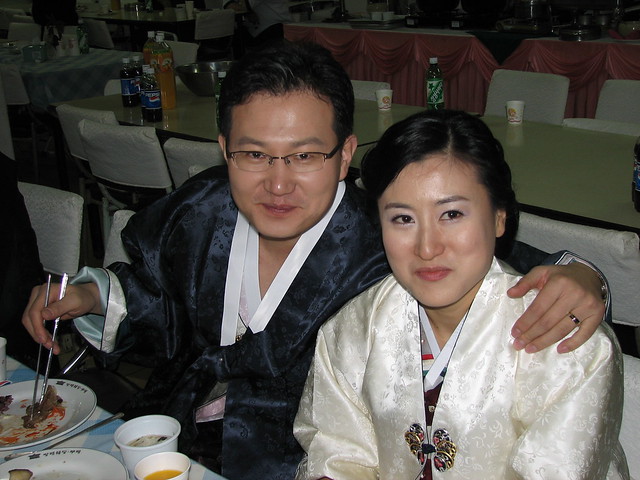
(photo by Sarah Kim via Flickr.com)

7. “How to Marry a Moonie” by Catherine Rose Torres

Stereotypes about cross-cultural relationships don’t end with “yellow fever”, as Catherine reminds us. “…the term moonie came to mean all Korean men seeking mail-order brides from poor countries like the Philippines. But I expected my friends to know the difference—to know I wasn’t mail-order bride material.” She’s Filipino, Jay is Korean, and the challenges they face go far beyond stereotypes. A terrific essay for anyone who has ever had the bride-to-be jitters (like me!) or managed to survive the kind of “our family will handle everything”, big, fat wedding I had in China.

(photo by Eric Hunt via Flickr.com)

8. “The Rainiest Season” by India Harris

As longtime readers know, I’ve railed against the whole “Asian women are stealing our husbands” stereotype that makes its rounds in the expat world. Still, you’ve heard the stories — how some white guy relocates to Asia with his wife in tow, only to toss her aside for a local woman. For anyone wondering what could happen when a marriage blows up this way (and for that matter, how the woman comes to reclaim her own life) here’s your essay. If you’re anything like me, you’ll keep turning the pages and thinking, “Oh. My. God.”

(photo by Jose Javier Martin Espartosa via Flickr.com)

9. “Moving to the Tropic of Cancer” by Philippa Ramsden

Living abroad doesn’t make you immune to the ravages of life, such as a potentially life threatening illness. That’s not what Philippa, who hails from Scotland, expected when she moved to Burma with her Himalayan Tamang husband. But suddenly, she’s forced to navigate hospitals, appointments and tests in a completely foreign world — and must find the courage to face one frightening diagnosis. A moving essay from an AMWF sister.

(photo by Sarah Joy via Flickr.com)

10. “Ninety Minutes in Tsim Sha Tsui” by Susan Blumberg-Kason

A stroll through this neighborhood in Hong Kong transports Susan right back to the days when she was still the “Good Chinese Wife” to her husband from Wuhan, and all of the challenges she faced back then. While you’re waiting for Susan’s book to come out in late July (titled, of course, Good Chinese Wife), this essay is the perfect introduction to what I’m calling the AMWF memoir of the year.
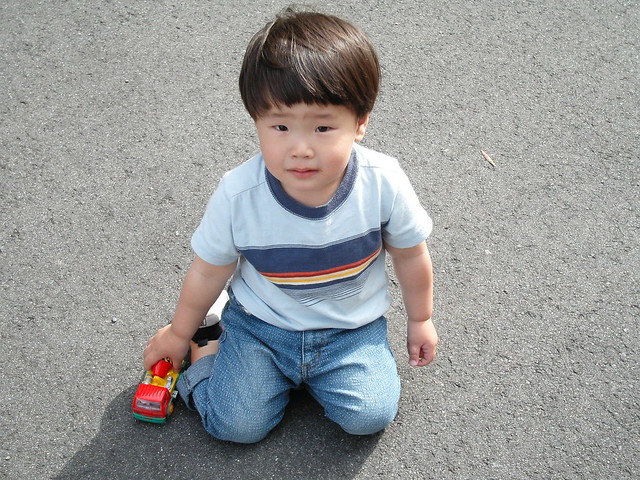
(photo by Boff Hiroshi via Flickr.com)

11. “Here Comes the Sun” by Leza Lowitz

Not every country and culture encourages adoption, including China…and Japan. That’s where Leza and Shogo, her Japanese husband, decide pursue this unconventional pathway to parenthood. It’s a tale of determination, silver linings, and what happens when a little boy suddenly becomes a new ray of sunshine in your life. And if you enjoy this essay, watch for Leza’s forthcoming memoir which covers her adoption experience.

8413571054_5b64023fed_z
Guo Jian and Ember Swift (photo by Luna Zhang)

12. “Chinese Stonewalls” by Ember Swift

Going abroad has a way of teaching us new things about ourselves. For Ember, who had only ever been with women, falling for a man (Guo Jian, the lead singer of Long Shen Dao) takes her by surprise in Beijing, and eventually pulls her into a life she never imagined for herself. Anyone who has followed Ember’s writing will enjoy the beautiful and life-changing story of how she came to be the queer girl who got married in China.

So what are you waiting for? Pick up your copy of How Does One Dress to Buy Dragonfruit? today and get swept away by these and the many other outstanding stories!

P.S.: On Facebook? Follow How Does One Dress to Buy Dragonfruit? now!
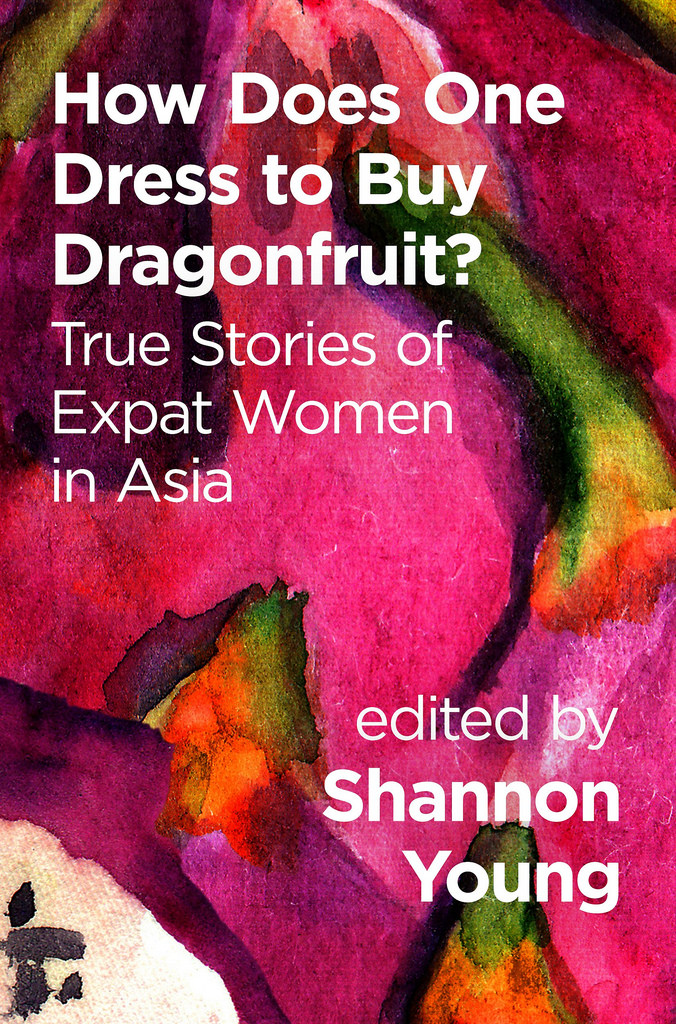
How Does One Dress to Buy Dragonfruit?

Double Happiness: Love on the Qinghai-Tibetan Plateau – Konchok and Kimberly

14350484514_7ba9cfa543_z

Ever since I discovered the blog Nama-Mama back in April, I’ve been dying to know the love story behind it all. I mean, it’s not every day you run across a white American gal who fell in love with and married a Tibetan man. Well, I’m excited that Kimberly stepped forward to tell us all how she and Konchok met!

If you’ve ever been intrigued by life in far Western China, Tibetan culture, or just what it’s like to raise a multicultural, biracial child in an unusual locale, you don’t want to miss Nama-Mama.

Want to share your own love story or other guest post here on Speaking of China? Visit my submit a post page to learn how
—–

Before I went to live in Xining I sometimes joked to my parents that I might find a nice guy there and settle down. My mother always gave me a disapproving look, which I laughed off because I wasn’t serious. I went back to China because I missed it, and because I had the chance to go to a place out west, where I could be among Tibetans and other minorities.

I met an amazing Canadian woman there and we became really good friends. At the time she was an English teacher for an organization. After she got to know me well, and I had told her that I wouldn’t mind meeting a nice young man, she introduced one of her students: K.

I’d seen him at a couple of gatherings previously but we hadn’t talked. She gave me his phone number and we began to exchange text messages. Then one night when my friend was out of town I couldn’t open her apartment door to feed her cats. I called K to come and help me and he did. We finally got the door open, cleaned up the cat mess together, then I made tea and we put in a movie. We didn’t watch it though, we just talked.

After that we continued texting and going out together on weekends. I consider our trip to the South Mountain our first date. We brought a picnic lunch and found a quiet place among the pines. I told him I was afraid someone was going to steal my boots. Later he shouted “Kim! Your boots are gone!” I scrambled around worriedly looking for them and spotted them right where I left them. The guy had a sense of humor, and I liked that.

Kimberly and Konchok

It wasn’t long before he started to tell his family about me. First his brother, who was quite supportive, and then his parents, who were worried about various things such as the high divorce rate in America and the inevitability of me leaving him once I got homesick for my own country. Though their concerns were valid (they didn’t know me), K did what he always does when it came to his own life: whatever he wanted. And in this case, he wanted to marry me. (I later found out that once a Tibetan tells his family about his girlfriend it means that they will get married if the parents agree. Otherwise, children will never talk about their romantic relationships with their parents.)

He started to talk about marriage three months into our relationship, which freaked me out a little, but if I’m honest, I knew by four months together that we would get married. I told him that we’d have to wait at least one year to be really sure that we were compatible. The months went by peacefully and to this day we have never had a fight. His family has also come to know and like me and we all get along fine.

We are now nearing our second wedding anniversaries. We have a baby daughter who brings us a lot of joy. We are both really relaxed most of the time and take things easy. I can’t imagine sharing my life with anyone else.

Kimberly is an American woman living in Xining City, Qinghai Province, with her Tibetan husband and baby daughter.

—–

Speaking of China is always on the lookout for outstanding guest posts and love stories! If you have something you’d like us to feature, visit the submit a post page for details — and then submit yours today.

Photo Essay: On “Huangshan Honeymoon”, my true story featured in “Dragonfruit” anthology

How Does One Dress to Buy Dragonfruit, the anthology featuring true stories of expat women in Asia, is now available for purchase through Amazon — and officially released everywhere on June 10, 2014! (Goodreads is also giving away five FREE copies!).

You’ll find my essay “Huangshan Honeymoon” included in the anthology, which explores a very different kind of honeymoon my husband and I enjoyed in 2005.

How was it different?

Well, yes, we planned our vacation around the chance to hike all the way up to China’s Huangshan or “Yellow Mountain”, instead of the typical honeymoon of sunny days spent lounging on golden sand beaches sipping tropical drinks and intimate twilit evenings laying in each others’ arms.

And yes, we chose to set out at the height of summer’s most sultry days, and stay in a region where July and August are feared for the ferocious heat of the “Autumn Tiger” that comes around every year.

But ultimately, this is what made our honeymoon so unusual: John’s father came along with us!

14318652422_789d5954c0_z

I never thought I would share my honeymoon suite with a man who once advised his son not to date foreign women. (Then again, I suppose he never imagined he’d have a foreign daughter-in-law!)

And as if that wasn’t enough, the heavens also brought us some of the lousiest viewing conditions for the mountain, thanks to the remnants of a typhoon that enveloped the scenery in a misty cloud of rain and fog.

(This is the one and only photo that offers a hint to the breathtaking views we should have enjoyed, had the weather cooperated!)

Why did we bring John’s father along? And how did that experience change my relationship with his father forever? You’ll find all the answers (and much more!) when you buy a copy of How Does One Dress to Buy Dragonfruit and read the essay. Don’t miss out on a collection that I can’t stop raving about! (Okay, yes, I am biased but it’s still really an amazing book.)

(Want to win a FREE copy of How Does One Dress to Buy Dragonfruit? Goodreads is giving away five copies of the book and you could be one of the lucky winners. Click here to enter!)

Guest Post: 7 of the Best Things about being married to a Non-Native English Speaker

I’m so thrilled to share this fantastic guest post from Grace Mineta of Texan in Tokyo, one of my favorite AMWF blogs. If you haven’t discovered her blog, you’re missing out on one of the best reads in the blogosphere. Thanks so much to Grace for this outstanding submission!

Want to be like Grace and have your voice featured on Speaking of China? Visit my submit a post page for details.

—–

The fact that my husband is a native Japanese speaker is part of the reason we get along so well.

I have a small confession to make – my partner and I look nothing alike. For one, he’s a man and I’m not. So his hair is closely shaved, while my is long and flowing; his muscles, feet, and hands are larger than mine. But those aren’t the differences people usually notice. My husband is Asian (from Japan) and I am white (from Texas).

无标题

And like most Japanese people, he is not a native English Speaker. The first time he really took an English class was in cram-school, trying to get into college.

Fast forward six years and his English is advanced enough to quite literally charm my family into letting him marry me and whisk me off to Japan. And aside from not quite being able to understand what the characters from BBC’s Sherlock are saying without subtitles (mostly because he can’t understand British English), my husband Ryosuke doesn’t have any problems with English.

It’s totally not weird to walk in on him pouring over the Steve Job’s Biography (in English) while taking extensive notes (in Japanese) on how to become a “more awesome person, like Jobs.”

But he is not a native English speaker.

And I really, really love the fact that he is not a native English speaker because:

1. He never gets onto me for my atrocious spelling.

A large part of my income comes from my blog, “Texan in Tokyo.” I write about interracial marriage, living in Japan as a foreigner, and other “neat” things about Japan.

But, as commenters point out time and time again, I cannot spell to save my life. I also have problems with grammar.

I was hanging out with a friend yesterday and we were semi-talking about my blog. I brought up the spelling mistakes, and she was just like “Yeah, they’re everywhere, but at least you know you have horrible spelling and grammar. Some people have absolutely no idea.”

I understand it is somewhat shameful for a blogger to not be able to type up even a short, simple post without extensively relying on Microsoft Word Spell-Check… but hey. That’s me.

Even when typing the title for this section, I spelt atrocious like “attrocious.”

But Ryosuke never gets onto me for spelling or grammar.

And I used to think it was because his English wasn’t advanced enough to be able to point out mistakes in English, but it is. If he wanted to, he could do it. He just chooses not to. Or, more specifically, he chooses not to correct my grammar and my spelling.

He loves me. I love him. He doesn’t correct my spelling/grammatical mistakes and I don’t correct his various mistakes (unless it’s for a professional purpose, essay, or cover letter). It is glorious.

2. I could listen to his accent all day

Back in high school, I used to be all on board with “British and French accents are the sexiest things in the world.” Not anymore. Of course, British and French accents are still attractive (as are African accents, I’ve come to realize), but Ryosuke’s accent takes the cake.

Ryosuke’s classically Japanese accent is the most adorable and sexiest thing in the entire world. I could just listen to him talk all day. In fact, I would be able to listen to him talk all day if only I could learn to shut up every once and a while…

[For more, check out: Asian Man/White Woman Relationships- The Good, the Bad, and The Ugly]

3. It is very easy to condition my husband to say the things I like.

When you’re learning another language, you have a tendency to parrot the people around you. For instance, if you are learning English and your friend always says “awesome” to everything, you might start saying “awesome” to everything too.

I like certain words over other words. I think the way the words “fantastic,” “fabulous,” “futile,” “phenomenal,” and “thrilling” roll of the tongue. (Now that I’m writing them out, I realize I might have a fetish for words that begin with an “f”.)

Ryosuke’s vocabulary closely mirrors my own. He calls me fabulous, says my writing is fantastic, my attempts to get him to watch “New Girl” with him are futile, my eyes are phenomenal, and hanging out with me is thrillingly fantastic. He doesn’t have the same kind of attachment I have for English words. To him, anything works. And gradually, over time, his vocabulary has been filled with fantastically wonderful words that I like.

In a similar manner, my speech closely resembles his when I speak Japanese. It used to make my college professor so angry – she thought Ryosuke was “ruining my pretty Japanese.” He probably did.

But that’s what happens when you spend extensive amounts of time with someone. You begin to mirror their mannerisms – especially speech. Now, both Ryosuke and I sound like socially awkward (but somewhat sophisticated) adults when we speak English and like comedic 15 year old boys when we speak Japanese.

4. We get to make up our own words.

The benefit of always learning new words in a foreign language is that it is surprisingly easy to slip in some new, invented words, just for fun. Ryosuke and I often switch between Japanese and English when we talk – and so we’ve come up with a whole list of words that are a mix between the two languages, conveying something that is difficult or complicated to explain.

For example “Sappuri” means “Surprisingly Samui (cold).” We use it when it’s a lot colder outside than we expected. Or the wind is surprisingly cold.

5. We always have our own language to fall back on.

Between our made up words and the constant switching between English and Japanese, Ryouske and I have our very own language. And having your own language is an important tool that facilitates intimacy and closeness – even when you’ve spent the last three days in close proximity with family.

We don’t have to censor what we say around my family and his family – because if it’s a serious concern, awkward question, or inappropriate (or funny) comment, we can use our partner’s language.

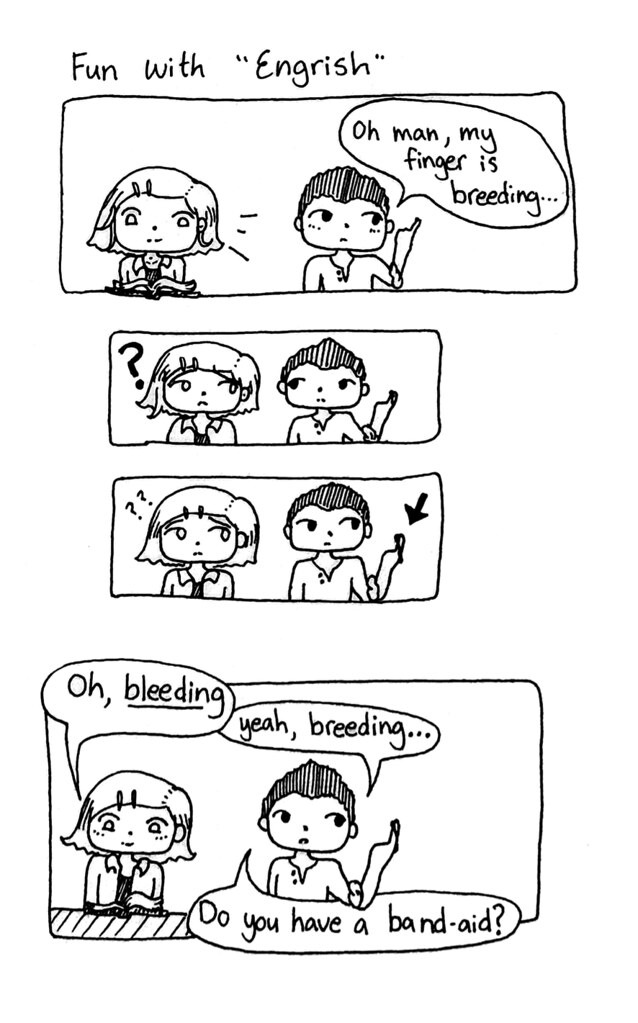
6. Our “Spot the ‘Engrish’” Games have a whole other side to them.

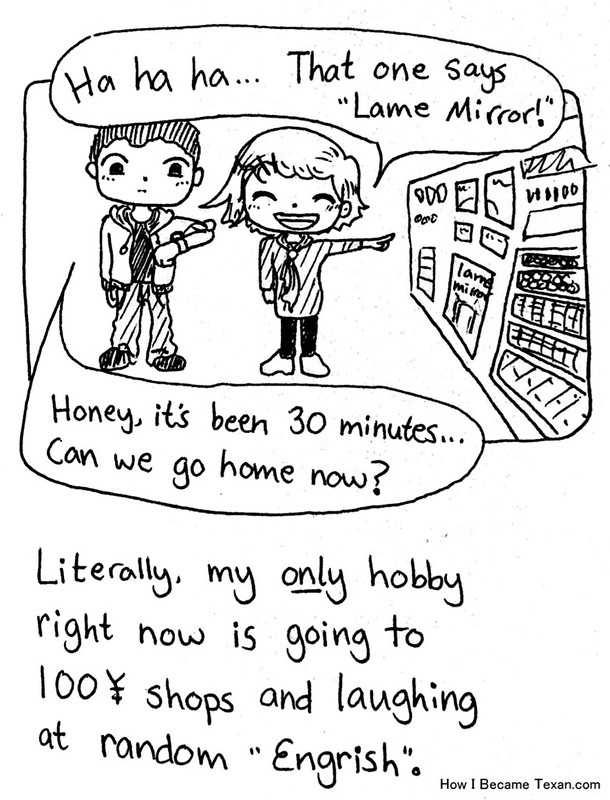
One of my favorite things to do is go to the 100yen shops (like the Japanese equivalent of a $1.00 shop, but much cooler and much less sketchy than American dollar stores) and laugh at the misplaced “Engrish” on the products.

Ryosuke enjoys the game as well. We will drive around all afternoon chatting, finding funny English, and eating peach jelly.

However, Ryosuke is also good at explaining why certain things ended up the way they did. He adds a whole extra level to the game – because as a native Japanese speaker who learned English, he can understand why native Japanese speakers who do not understand English write the things they do.

7. When we argue, we don’t get caught up in exactly what the other person is saying.

Our arguments aren’t a “he said, she said” battle. Of course he says socially unacceptable things while we fight – and in the beginning, I used fly off the handle at some of the socially unacceptable things he said.

Now we’ve learned to focus more on what the other person is feeling, rather than what they say. Our arguments are a “safe space” where you don’t have to worry about the other person freaking out if you accidentally say the wrong thing.

[For more, check out: Fighting – Things My Japanese Husband and I Culturally Disagree About]

It’s not fair to Ryouske to fight with complicated words and hidden meanings. We have to be very clear. And oddly enough, that has helped us both be much more honest when it comes to disagreements. He doesn’t have to worry about accidentally saying the wrong thing and I don’t have to worry about loaded up my words with hidden meanings.

Being married to a non-native English speaker is incredibly fun and always interesting. This cross-cultural relationship has opened me up to a whole new way to look at “language,” itself – which is kind of fitting because I write so much.

But then again, I’m partial because I am terribly in love with my husband.

Grace Mineta is a blogger, freelance writer, and fashionista in Tokyo. Married to her college sweetheart, Ryosuke, she spends most of her time hiking, drawing comics, and trying to navigate life as the American wife to a Japanese businessman.

—–

Speaking of China is always on the lookout for outstanding guest posts and love stories! If you have something you’d like us to feature, visit the submit a post page for details — and then submit yours today.

Tibetan husbands, dating Chinese pop stars, and other unusual stories of Chinese men & Western women in love

Kumbum Ta'er monastry at Xining, Qinghai China (photo by Remko Tanis via Flickr.com)
Kumbum Ta’er monastry at Xining, Qinghai China (photo by Remko Tanis via Flickr.com)

This week, I’ve stumbled upon a number of incredibly unique stories in the blogosphere about Chinese men and Western women in love. While I’m on deadline these days (and need a break from my usual posts) I thought I would share some of these fantastic blogs/posts with you. Enjoy!

A Tibetan-American love story in Qinghai

Earlier this week, a reader tipped me off to a few new AMWF bloggers — and one of them fascinated me the moment I read the short intro in her blog’s sidebar:

I’m Kimberly, an American lady living in western China with my Tibetan husband and our beautiful baby girl

Wow.

Kimberly’s About page offers a glimpse into how it all happened:

Following my stint in the home of Peking Duck, I went back to the states to get my Master’s Degree in Library and Information Science. (That’s right, I am a certified librarian.) By then I was itching to get back to China and decided to make my home out west, where the air is cleaner, the food is heartier, and the people are diverse.

I used to joke with my parents before I left that I was going to find a nice man there and settle down. To my surprise and delight (and my mother’s disappointment) it really happened. K and I were married on July 28th 2012…

…and on August 2nd 2012. We had two weddings, one western style in the city and one Tibetan style in the village.

Boy, what I wouldn’t give to sit down with Kimberly and hear the details of how she met and married her husband! Still, since starting her blog in March 2014, she’s already offered a lot of insight into her fascinating and unique life, including why she loves China, what she and her husband eat at home, pregnancy and birth in Qinghai, and local expectations for new mothers. This is definitely one blog to watch.

Dating a Chinese Pop Star

I’ve had my share of relationships with Chinese men (including my marriage to John), but I’ll never know — as Hannah Lincoln has reported on Beijing Cream — what it’s like to date a Chinese pop star:

Xiao Li was part of a gang of pop-folk musicians that included not just his band mates, all singers, but also their brothers and cousins and mentors and girlfriends and gal pals.

I had gone that night to get my culture on and enjoy some folk music. Awkward but uninhibited, I picked off one of the shy ones to practice my Chinese. We were having a pleasant conversation until his strikingly handsome friend cut in. He said I was really pretty and clinked beers with me. When I replied in Chinese, he slapped his hand on his face – “Wah! I didn’t know you’d understand me!” He then asked for my number, said he wanted to treat me to a meal.

…After a few weeks, I looked up Xiao Li’s band on Baidu. Apparently they had won China’s version of American Idol and were a go-to choice for the Party at official events.

Hannah recounts her time as the girlfriend of a pop star in China with honesty about it all, including her own missteps in the relationship. It’s a long post, but also worth reading and discussing.

What one Chinese man thinks of his foreign girlfriend

It’s no secret the the vast majority of stories about Chinese men and Western women in love are written by the women. And if we do hear from the men, rarely is it about a relationship that blossomed in China — one that, for that matter, is still going strong.

That’s why I’ve loved this recent post from C, the boyfriend of Spanish blogger Marta of Marta Lives in China. Here’s a snippet of his post, which reads like a valentine to Marta:

But Marta changed my point of view. She knows what is the real happy life, she prefers traveling to different countries rather than buying a CHANEL, she thinks we do not need to buy a house of our own(sorry but that is still one of my shot-term aims), she prefers walking more than driving a car, she is so kind and so nice to every member of my family, she is always so kind and polite, and she loves music.

Marta, he’s a keeper!

Check out the full post here, including a unique photo of the couple with tropical flowers in their hair.

Have you come across any unusual stories of Chinese men and Western women in love? Share them — or link to them — in the comments!

—–

We’re looking for a few good stories from Chinese men and Western women in love — or out of love — to share on Fridays. Submit your original story or a published blog post today.

“Starting from Scratch” – a new AMWF rom-com movie about love, taxes and breakups

Starting from Scratch

Starting from Scratch

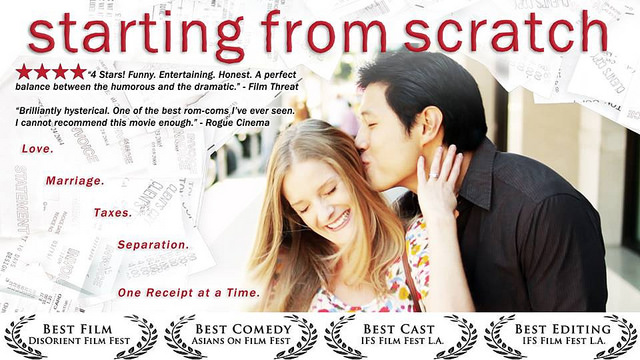
It’s not everyday you hear about a romantic comedy that deals with love, divorce and getting audited by the IRS. Or, for that matter, a movie produced by an Asian man (James Huang) and a White woman (Elizabeth Sandy) who are married and who also star in the film as the romantic leads.

Starting from Scratch is one unique rom-com. This movie dares to be honest about relationships and, in the process, offers a funny and poignant example of what happens when two people are facing a divorce and financial hardships at the same time. And for once, it tells the story — which is one that almost anyone can relate to — through an interracial couple.

Since 2013, Starting from Scratch has screened at film festivals across North America, winning awards including Best Film (DisOrient Film Festival) and Best Comedy (Asians On Film Festival). And now you can enjoy the film in the comfort of your own home, wherever you live. Starting from Scratch is available to watch online starting now for audiences in North America (USA, Canada, Mexico) and everywhere else around the world.

You can check out a trailer for the movie online or visit the official Starting from Scratch website to learn more about the film.

I’m so thrilled to introduce you to Starting from Scratch through this interview with actor and filmmaker James Huang, who wrote, directed, produced and edited the film, and also played the lead role of Jake Lew.

James Huang and Elizabeth Sandy

Starting from Scratch was inspired by a time in your life when you were broke and getting audited by the IRS while struggling with a relationship that ultimately ended. Yet this movie is a romantic comedy, which is really a twist! Why did you decide to turn this story into a romantic comedy, instead of just a drama?

The movie is a work of fiction, but all story is rooted in truth. When the IRS audited me a decade ago, you have to sort through a years worth of paperwork to account for work. You have to remember what each of these receipts and bills are and most them were memories of trying to salvage a broken relationship. I was forced to reflect on a terrible year in my life and it felt like I was being punished financially for all my mistakes and failures. It’s sobering to face your past choices by tracing how you spent money. It was the toughest and best therapy I ever had.

Six years later, I met Elizabeth, the love of my life, and I kept thinking to myself: ‘Do not mess this up! Do not make the same mistakes twice!’ I guess I started channeling my fears and wrote a story about my new marriage as if I hadn’t learned a darn thing. So the movie begins on a therapist couch before we go through the opposite and ridiculous ways that men and women deal with a broken heart. But the audit forces them to deal with each other throughout the separation.

I had a lot of funny things happen when I was miserable and trying to rebound because you get so off kilter, your behavior is always heightened, and you feel like a crazy person pretending to be normal. You try way too hard and feel too much and you’re constantly overly affected. To get through it takes swallowing your pride and over time if you are humbled, you can eventually laugh at yourself. My friends were always laughing at my embarrassing stories about a terrible rebound attempt and I guess it helped me find the humor through the pain. It was always comedy whether I felt it or not.

What was it like reliving this challenging experience in your life during the filming process with your wife, Elizabeth Sandy, whom you’re happily married to?

While the plot point of me getting audited after a messy break up is true, the film is just a funny and heart-felt tale of two dreamers who are trying really hard but are just facing in the wrong direction. It’s when the rom-com of your life ends and real life begins. I think audiences feel connected to the story and assume the movie is some sort of reenactment. But really, I think we’re reenacting everyone’s story in a way.

I miss the old romantic comedies, so I made my own with something new to share. Acting with Elizabeth in scenes about divorce was eye opening because it gave us a chance to fully imagine what it’s like to face each other under these circumstances. Then someone says ‘that’s a wrap’ and you go back to being in love all over again. As newlyweds, it was an exercise in love, hate, and ultimately – compassion. We work together every day and are very happily married.

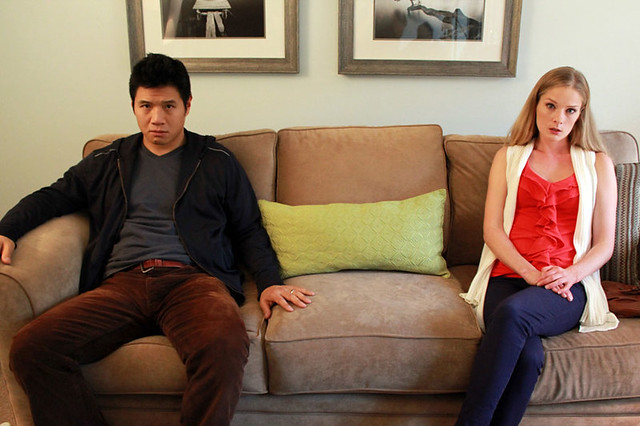
Sadie Alexandru and James Huang

Could you share with us one of your favorite scenes from the movie and why you love that scene so much?

Without giving anything away, there is a scene where I’m telling the therapist a story about my wife’s stinky feet. Rom-coms don’t usually have a pivotal scene like this play out with subtle nuance. For me, that scene landed on each phase of script, filming, editing, and audience. It’s a rare moment of alignment where I was happy as a filmmaker and as a viewer. Oh and by the way, in real life, I’m the one with the stinky feet. That’s what I mean about fiction rooted in truth.

While Starting from Scratch is funny, it’s also incredibly honest at the same time, particularly about how people deal with relationship struggles. What do you want people to come away with after viewing the film?

Maybe just that ‘showing love’ should replace ‘spending money’ and that ‘I’m sorry’ should replace ‘I hate you.’

Starting from Scratch has been playing at a number of film festivals and other venues since 2013, and you and Elizabeth have been present at some of these screenings. Could you share how you’ve seen audiences respond to the film?

Happily, it feels like everyone, everywhere, loves the film. Most people have experienced some form of a break-up (whether it be a divorce or a teenage heartbreak) and because they’re relating to it, they’re laughing through the pain together. It’s definitely inspired people to come up to Elizabeth and me and relay their experiences in love. It feels good to have touched people and perhaps helped them gain some perspective. I think that’s why we all love watching movies; a good story makes you feel connected to one another and not feel so alone.

Where can people buy, rent or view this movie online?

I’m glad you asked! We are very excited to finally share this film with audiences around the world. We made this film for you to enjoy.

Starting from Scratch just launched worldwide through on-line streaming (rent or buy) and on DVD.

North America (USA, Canada, Mexico)http://www.filmfestivalflix.com/film/starting-from-scratch

Everywhere outside North Americahttp://www.vimeo.com/ondemand/sfsmovie

—–

Thanks so much to James Huang for doing this interview! And if you enjoyed it, please support Starting from Scratch by watching it online (in North America or the rest of the world) and sharing it with all your friends!

Is “yangxifu” (foreign daughter-in-law) a magic word in China?

13925672946_4c22373bed_z

While a cold, misty rain hung over Hangzhou that February morning, in my mind there was nothing but sunshine. A feeling of happiness surrounded me as John and I left that building, a jubilant couple bounding down the street hand-in-hand.

“How could it have been so easy?” I wondered.

We recalled the smiles from the woman at the front desk, who helped us rearrange our materials. We remembered the uniformed officer who told my husband how to write up an invitation letter, word by word. And when we left, both of them offered us a warm farewell, with the officer even complimenting my husband on how outstanding he was.

To think that we had just left Hangzhou’s Public Security Bureau (PSB), and felt as if we were VIPs once John introduced me as his foreign wife needing to get a residency permit.

And what about those calls John made in advance to the PSB? The moment John mentioned he was inquiring about residency permits for his foreign wife, that person on the other line transformed instantaneously. They became a friendly and helpful voice on the phone, as if John had just dialed customer service.

All it took was one magic word: yangxifu.

In Chinese, yangxifu (洋媳妇) means foreign daughter-in-law. But people here — including my husband — commonly use the term to refer to any foreign woman (like me) married to a Chinese man. And sometimes it seems like the very mention of a yangxifu can light up some of the toughest people you’ll encounter in China. Meanwhile, my husband’s friends have called him a “legend” from the time he married me, and his cousin even wanted us to find him a yangxifu.

And if you turn to the Internet, there’s even more evidence of the popularity of yangxifu. For example, Baidu has two entire forums devoted to discussing yangxifu: Yangxifu Ba (洋媳妇吧), with over 5,000 followers and over 180,000 threads, and Waiguoxifu Ba (外国媳妇吧), with over 1,500 followers and over 40,000 threads. A Baidu forum devoted to yangnǚxu (洋女婿, foreign sons-in-law), however, has only 3 followers and 42 threads.

What is it about yangxifu that makes us popular in China? As I’ve written before:

To many Chinese, having a foreign girlfriend or wife is the best bling money can’t buy. Like cruising in a BMW or popping open a bottle of Moet (part of the worship of all things foreign in China, chóngyángmèiwài or 崇洋媚外) , we suggest he’s truly “made it.”

With a foreign woman by his side, that Chinese man casts a powerful aura around the world in China. People crown him as lihai (厉害, awesome), gaping in awe at his good fortune — and his social status soars.

My husband also believes that China’s love of yangxifu has something to do with how his country views marriage. The traditional view is that when a woman marries, she leaves her family to join his for good. So from this perspective, while a yangnǚxu will theoretically take his Chinese wife away from China to his foreign family, a yangxifu marries into a family in China (and thus, it’s a “gain” for China). Yangxifu are also much less common than yangnǚxu (as I’ve written before and a reader recently confirmed during a trip to Hong Kong), making us more of a novelty in China.

Still, it’s not like being a yangxifu will guarantee you a “magical life” in China all the time. I’m reminded of what fellow yangxifu Charlotte once wrote in a comment on this site:

No, being married to a Chinese gives me nearly no benefits when it comes to living here….

And after all, nothing — not even a marriage — can shield you from every sorrow in life. I should know, because my husband and I have experienced a lifetime of them together!

But really, when I think about it, the real wonder of being a yangxifu is not in enjoying a little VIP treatment from the PSB or making my husband a “legend” among his friends. To think that I could travel thousands of miles to from the US to China — a country I barely knew most of my life — and find a wonderful husband here, living happily ever after in his rural village. Now that’s magical!

6 Stunning Celebrity Couples of Asian Men & Non-Asian Women

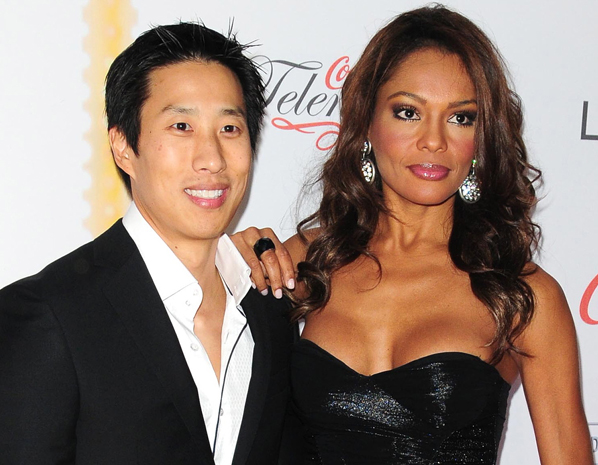
Award-winning journalist and Univision anchor Ilia Calderon, with husband Eugene Jang.
Award-winning journalist and Univision anchor Ilia Calderon, with husband Eugene Jang. (photo by Johnny Louis)

Every week, the entertainment mags churn out list after list of swoon-worthy celebrity and Hollywood couples. But these couples are almost always white…and I can’t remember the last time, if ever, that I’ve seen a single couple of Asian men and non-Asian women on their lists.

If my Pinterest board with real-life couples of Chinese men and Western women has taught me anything, it’s that the community of Asian men and non-Asian women in love is bigger than I ever expected — with plenty of beautiful faces. So it’s no surprise that our community includes some stunning celebrities and their equally stunning partners. Don’t they deserve a little love for once?

Move over, Brangelina! Here are six dazzling couples that could turn heads on the red carpet, while showing the world how lovely it is when Asian men and non-Asian women get together.

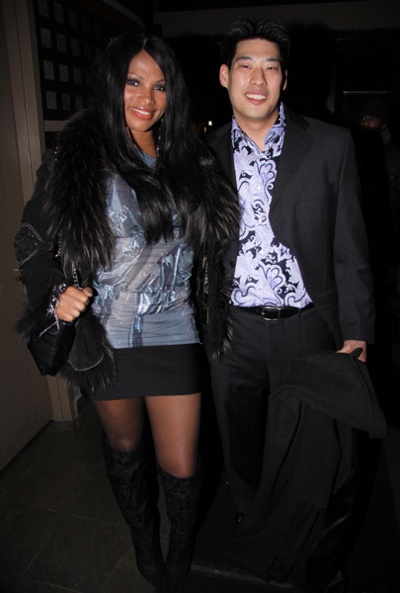
Sandra Denton and Tom Lo

d39c201feaa140c6bf6288d09d43f11e
Sandra first rocked our world as “Pepa” from the rap group Salt-N-Pepa, and now she has rocked the interracial dating world by choosing to date Tom Lo (as part of her 2010 reality show Let’s Talk About Pep). Was it romance or just reality TV? Are they still a thing? I have no idea. But they sure make one handsome Blasian couple, don’t they?

Diane Farr and Seung Yong Chung

(photo by John Solano Photography)

Who says that Asian men can’t land babelicious former MTV hosts? Seung Yong Chung (who is tall and handsome himself) snagged the lovely actress Diane Farr, best known for her roles on Numb3rs and Rescue Me (as well as a stint hosting MTV’s Loveline). Their relationship and marriage became the heart of Diane’s outstanding memoir on interracial dating, Kissing Outside the Lines.

Grant Imahara and Jennifer Newman

Grant Imahara of Mythbusters and his girlfriend Jennifer Newman
(photo via Twitter, @Jennernugen)

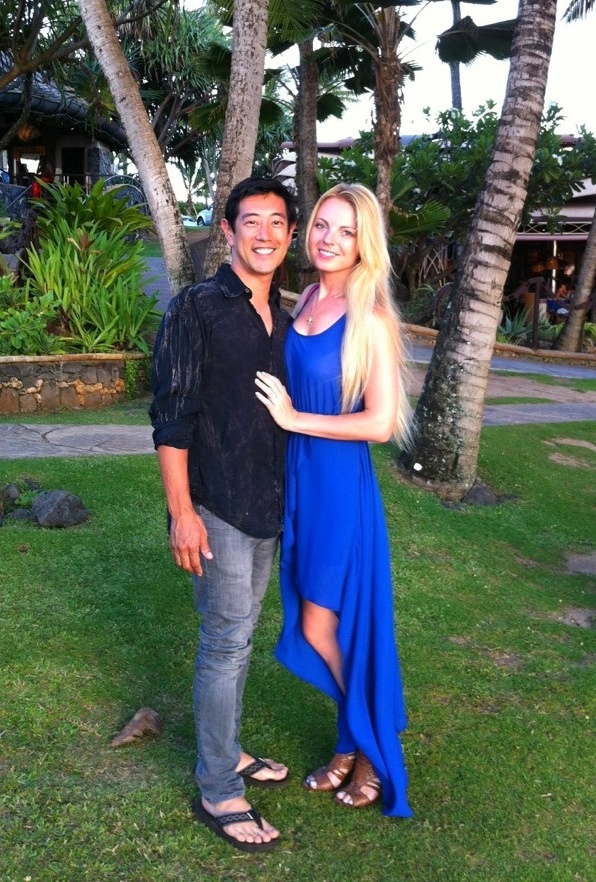
You know Grant from Mythbusters. Even if he’s the geekiest guy on this list (he’s one of the official operators for Star Wars’ R2-D2 and helped engineer the Energizer Bunny), he looks awesome in a tux and would make my shortlist of hottest electrical engineers any day. Put him together with his lovely blonde girlfriend Jennifer Newman (a self-proclaimed “robot girl”) and you have a couple that could turn heads almost anywhere.

Will Yun Lee and Jennifer Birmingham

will-yun-lee-240

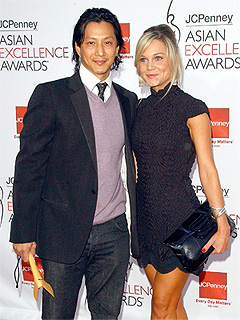
Actor Will Yun Lee (best known for his TV roles in Witchblade and Bionic Woman and on-screen roles for Die Another Day, Elektra and The Wolverine)  was named one of People’s Sexiest Men Alive in 2007. His wife Jennifer Birmingham, a Hollywood actress as well, looks like a natural on the red carpet. Together, they make one stunning AMWF (Asian Male, White Female) couple. If the Academy handed out Oscars for most gorgeous couple in the business, I’m sure these two could nab a nomination!

Julia Stegner and Steven Pan

julia-stegner-boyfriend-steven-pan-vogue-us-may09

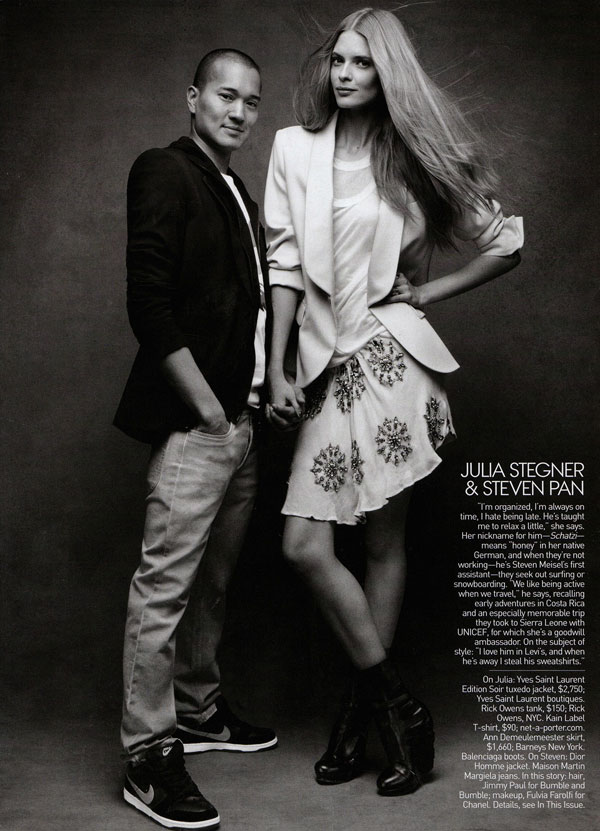
Could this gorgeous German supermodel and her handsome boyfriend Steven (a fashion photographer) make interracial dating between Asian men/non-Asian women a little more “en vogue”? They’ve already landed in a Vogue spread and could easily rock the magazine’s cover. The camera clearly loves them both!

Ilia Calderon and Eugene Jang

tumblr_m5st30NKBI1r84myb

Award-winning Colombian journalist Ilia Calderon is the striking anchor for Univision’s Noticiero Univision: Edicion Nocturna (so hot, she’s listed on the site TV anchor babes) — and also the wife of Eugene Jang, a physical therapist who is quite the looker himself. They fell in love at first sight, and look lovely together on the red carpet!

Who do you think are the most stunning couples of Asian men and non-Asian women? Who would you put on your list?

P.S.: To see more celebrity couples, visit my Pinterest board featuring celebrity couples of Chinese men and Western women.

Fenshou: After Eliza, he feared “she’ll disappear again”

(photo by Doug Wheller via Flickr.com)

Spencer Huang writes, “I dated other girls later on — Spanish, Polish, Welsh. But I could hardly overcome the recurring fear in my heart: ‘She’ll disappear again.’ At last, I returned to China with a lonely and tired heart. Eliza changed me completely.”

This is a story of how one Chinese man met an enchanting Polish woman in London, only to have her vanish from his life without an explanation.

—–

I’m a Chinese man who just finished a master’s degree in the UK, where I once had a relationship with a Polish woman. I’ve wanted to share this story ever since the Christmas of 2012, when I met her.

I was there in London, spending my Christmas holidays with my friend John, who visited me from China. We lived in a hostel to meet more people and to share their interesting life stories. That was where I met Eliza.

My friend and I tried to talk to anyone we met in the hostel during our journey. We were chatting with a Japanese girl earlier that day, but she had grown up in the US and knew very little about Japan. It wasn’t a very interesting conversation to me.

When I was dismayed that I couldn’t find anyone interesting to talk with, suddenly Eliza walked into that room. She reminded me of a lovely elf — petite with long blonde hair, green eyes and a small face.

Before I knew it, we fell into a fantastic conversation. We talked a lot about anime, manga, Japanese culture (especially Japanese pop culture), food and musicals (such as The Phantom of Opera and other Andrew Lloyd Weber works). I really admired her independence. She worked in London as a waitress to pay her way through university. She had also left home two years before; her father passed away many years ago and her mom remarried. We bonded over our lonely childhood experiences as well.

I never imagined that I could meet a girl who had so much in common with me. We were so happy as we talked together through the whole night.

Then I asked her, “Why don`t we go out for a drink?”

“Why not?” she answered.

We left the hostel at 9:30pm to hit the empty London streets that evening, which was still Boxing Day, to have drinks together.

The next day, what a perfect day it was. We visited Piccadilly Circus and many other sites in London, sharing food and laughter. That evening, I prepared a dinner for two of Japanese sushi while she sang “Think of Me” from the Phantom of the Opera.

Suddenly, a feeling of dread hit me: I had nearly forgotten my promise to a friend from Hong Kong. He needed a place to stay during New Year’s time because he had no money and nowhere else to go. Of course, I couldn’t leave my friend to sleep on the streets and had offered him my flat in Glasgow.

I had to leave Eliza suddenly that very evening, December 27. We hugged before I left, never realizing it would be our last hug.

Later, when I returned to London to find her, everything changed. We were meant to meet at this staircase in the hostel, but she never showed up. She just vanished and left me standing there. I spent over 16 hours there, thinking about her. At last, a group of Australians came over to me and gave me a bottle of whiskey. Then I could remember nothing but the fact that she never returned to that hostel again.

I dated other girls later on — Spanish, Polish, Welsh. But I could hardly overcome the recurring fear in my heart: “She’ll disappear again.” At last, I returned to China with a lonely and tired heart.

Eliza changed me completely. A part of me still hoped that someone special might appear in my life, but I was afraid of a stable relationship, something I yearned for deep inside.

It was tough since I returned to China, but I’ve decided to move on. In the end, the memories are beautiful enough for me.

Spencer Huang works as a project manager for a media company in Chengdu, Sichuan, China.

—–

We’re looking for a few good stories from Chinese men and Western women in love — or out of love — to share on Fridays. Submit your original story or a published blog post today.

How rare are Chinese men/Western women? Enough to be “nonsense”

One villager in John's hometown in China couldn't believe we were married
One villager in John’s hometown in China couldn’t believe we were married

As the wife of a Chinese man, I’m used to attracting attention when I’m out and about in China. The stares, the questions about where I’m from, the way cars slow down to gawk at us — it’s all par for the course.

So during one of our evening walks in the village, I wasn’t surprised when an elderly woman walking in the opposite direction suddenly began asking my husband questions.

“Where are you from?” she inquired in the local dialect.

John mentioned the name of his village, nestled right in the heart of the valley.

“Where is she from?”

“America. She’s my wife.”

The woman grimaced at him in disbelief. “That’s nonsense!” Yes, she refused to believe that someone from John’s little mountain village could have possibly married a woman from America. And she walked away, not to be bamboozled by us.

When John translated the whole conversation for me (I’m still working on my local dialect) I nearly doubled over in laughter. “Are you kidding? She thought you were lying about me?”

Hiking the mountains in John’s hometown

It was the first time anyone in China doubted the authenticity of our relationship. But as strange as it sounded, I could understand why. In John’s hometown, it’s not uncommon to meet people who have spent their entire lives, knowing little else beyond these mountains thick with hardy bamboo and fragrant Chinese red pines, and the rice paddies and terraced gardens sculpted into the hillsides. Who could imagine that one of their hometown sons would meet and marry a foreigner, let alone spend years in her country? As rare as it is to find Chinese men and Western women together in China’s urban playgrounds, out here in the Zhejiang countryside such a coupling sounds impossible and even ridiculous.

The Chinese government advises foreigners to carry their passports with them at all times in China. I have to wonder, should I also carry around my Chinese marriage license so I’m prepared for the next time someone calls my marriage “nonsense”?