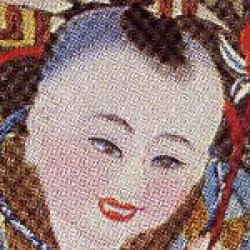
What’s the earliest example of an AMWF couple in recorded history? That distinction might just go to Arcadio Huang and Marie-Claude Regnier, who married in Paris in 1713.
Arcadio Huang was one of the first Chinese men to visit Europe, arriving in the early 1700s. He was the son of a Catholic convert in Fujian, and went abroad to initially fulfill his father’s wish that he become a priest. The religious orders, however, weren’t to his liking. So instead missionaries helped him settle in Paris, where he fulfilled a different destiny:
In the early years of the 18th century, European scholars made huge advances in their understanding of Chinese language and culture. Much of this work rested on the efforts of a remarkable young man named Arcadio Huang.
Huang became the Chinese interpreter for King Louis XIV of France, and began his groundbreaking work on a Chinese-French dictionary.
Along the way, Huang met and fell in love with a white French woman, Marie-Claude Regnier, who would become his lawfully wedded wife in 1713. According to research by Jonathan Spence, the couple faced some tough times:
Life was hard for Arcadio Huang in the autumn and early winter of 1713. Paris was bitterly cold and covered in fog. France’s long war over the Spanish Succession had demoralized the population, driven up the cost of food and eroded the value of money. Arcadio had married a young Parisian woman, Marie-Claude Regnier, in April 1713; their life quickly became a struggle for survival and self-respect. Their rented room in rue Guénégaud, on the south bank of the Seine across from Notre Dame cathedral, was always cold since they had not enough money for a regular supply of wood or coal. Their furniture was sparse, they had few clothes and they could not afford a decent matrimonial bed. Salt for their simple meals was too expensive. And, worst of all, on some mornings Huang would awaken spitting blood. After these episodes he felt a terrible lassitude and would need to rest in bed for hours.
Tragically, Marie-Claude would later die in childbirth in 1715. Huang passed away a year and a half later, leaving behind their daughter, who would die a few months after him. Nevertheless it is said the couple enjoyed a happy marriage during their short time together.
Let’s raise our collective glasses to Arcadio Huang and Marie-Claude Regnier, who might just be the first AMWF couple in recorded history in Europe, if not the world.
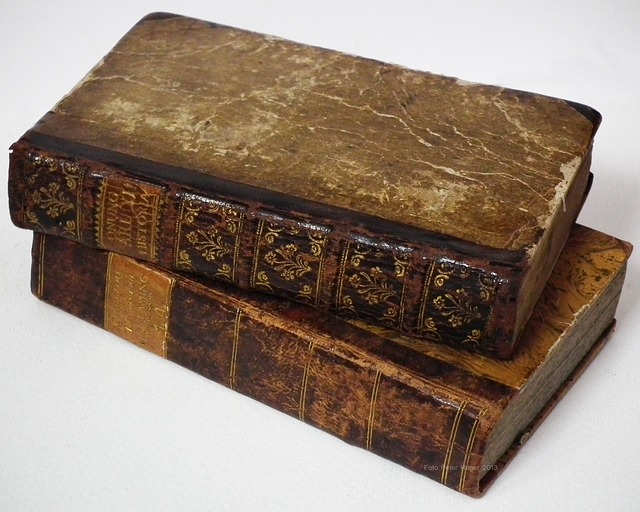
I’ve listed the titles in alphabetical order according to the author’s last name and linked them to Amazon, where your purchases help support this site.
When it comes to the success of a cross-cultural relationship, does culture or personality matter more? Susan Blumberg-Kason’s gripping memoir “Good Chinese Wife: A Love Affair With China Gone Wrong” offers a very personal answer to that question. Learn more through my interview with Susan.
It’s never too late to follow your heart to Asia. Just ask writer Janet Brown, who went to Thailand at age 45 and fell in love with the people and places. Learn more through my interview with Janet.
When Karen went to Burma in 1996 for research on the conditions of Burmese political prisoners, love wasn’t on her mind — until she met Maung, a sexy young Burmese revolutionary leader. But this isn’t just a love story, as she beautifully captures her entire experience in this country — including her interview with Aung San Suu Kyi.
Think gorgeous girls don’t go for Asian men? Then you haven’t met actress and celebrity Diane Farr, who married a Korean-American man and shared her story — and those of many others who crossed racial/cultural/ethnic lines in the name of love — in this humorous read.
A rare window into the world of a Western woman who married a Chinese man in the early 20th century, despite the estrangement of both families. Half a love story, half a collection of letters that capture the times in which they lived.
In her mid-forties and divorced, the last thing Ellen ever expected was to travel to China and marry a Chinese man she knew for less than a week. But the unspoken connection between then brings this unlikely pair together, and sustains them through the trials and tribulations of their new cross-cultural relationship.
Miranda’s book is an exploration of the many cultural rules and norms that govern women’s lives there, especially love, marriage and family. She dates some Indian men along the way, but reveals so much more through the Indian women she comes to know throughout the story.
Linda Leaming’s new book “A Field Guide to Happiness: What I Learned in Bhutan about Living, Loving, and Waking Up” reads like a love letter to Bhutan. Learn more through my interview with Linda.
Linda discovered her bliss — and later, her Bhutanese husband — in this oft-overlooked Himalayan country. This magical tale of her relationship with her future husband and his country is filled with moments that will have you laughing out loud.
Li Cunxin is a poor rural Chinese who skyrockets to fame as a ballet dancer. But when China sends him to Texas as part of an exchange, he falls in love with an American woman and America, and wants to defect. (Also a movie.)
Most of the story revolves around Liang Heng’s personal suffering during the Cultural Revolution. However, the last few chapters of this book document how Liang Heng and Judith Shapiro incredibly fall in love, and marry, in a China just barely open to the world.
Leza Lowitz shares her emotional journey towards marriage and motherhood in Japan (as well as opening a yoga studio in Tokyo) in “Here Comes the Sun”. Learn more through my interview with Leza.
If you’re a fan of graphic novels and you’re curious about Japan, you don’t want to miss these charming comics by Grace Mineta. Learn more through my interviews (here and here) with Grace.
Rebecca’s book explores her 30 years as the foreign housewife of a Japanese man in their 350-year-old farmhouse in Japan’s countryside, a home that you might argue is one of the most important characters in the story.
At 68, Eve fell for Sam Hirabayashi, a man 10 years her senior. She wrote about it for The New York Times, and the overwhelming response from readers helped spark this memoir exploring late-in-life love through her own relationship and others.
Dana truly followed her heart in moving to Vietnam when, in the course of learning the language and later teaching, she landed into an unlikely relationship with a local Vietnamese man. She writes about it with honesty and vulnerability, which made her a delightful narrator.
“The Good Shufu” by Tracy Slater is a heartfelt story about love & life abroad that proves sometimes those unexpected detours lead us to incredible joy. Learn more through my interview with Tracy.
Alex Tizon’s memoir “Big Little Man: In Search of My Asian Self” offers a personal view on Asian masculinity in the West — and is a book you must read. Learn more through my interview with Alex.
I connected so much with the experiences of the women interviewed by Wendy that I almost thought it could have been “Marriage in Translation: Foreign Wife, Chinese Husband.” (Sorry, John.) It’s not one memoir, but more like a collection brought together.
“Year of Fire Dragons” details the life-changing year Shannon Young spent in Hong Kong while in a long-distance relationship with her Eurasian boyfriend. Learn more through my interview with Shannon.
What memoirs did I miss? What would you recommend?
(Photo by Basheer Tome via https://www.flickr.com/photos/basheertome/5562132114)
He watches her from afar, the umbrella in his hand as it rained. The raindrops ran down her unprotected face, creating streak of tears. Late afternoon sun peeked out, almost shy and hesitant in breaking the reverie between the two. The clouds were of white hue, the unexpected summer rain. The smell of earth invaded his nostrils, reinvigorating him in body and soul.
Don’t be sad, he thinks to himself as he looks towards her. He just wants to make sure that she will be all right, his final goodbye. Silently he tries to send messages towards her, hoping against hope that she’ll receive them and will understand what he cannot express in words. Don’t be sad, he repeats the message inside, please remember the happy times you and I have had; the time I told you rabbit living on the moon stories, the time I taught you to use chopsticks and how to eat bibimbap.
All this time had passed, countless years, yet I cannot say these words in my heart. I know that you might think I have no feelings for you, but it’s not true. I wish you could understand more of my culture, but you cannot, and there are things that I cannot find words for in your tongue to express.
The present image faded, no longer there in front of him, but instead the history unfolded, how he first came over to a public school, and silent with humiliation of not knowing English. How he came to meet that unusual girl, Therese Fairbanks.
Slowly, even with blocks along the way, the two of them move forward to becoming more than friends, until that fateful day before the start of their senior prom.
It was May, the rain pouring steadily down, soaking the granite, the splattering heard everywhere. He is dressed in a black tuxedo, a small bowtie around his neck, and in his hands he carries a corsage. His parents are nearby, taking pictures of him, proud of his status, of his scholastic achievements. His father walks over then, and whispers into his ear. He remembers the father’s words, what he will do after the graduation.
He checks the corsage, noticing the crimson rose in the center, surrounded by baby’s breath, an island in the center of an ocean. His parents do not know about Therese, for it is customary not talk about a woman unless there is intention of marriage. His mother is dressed in traditional Korean dress for the honor and takes pictures of him. He hides the corsage, but his younger brother spots it. “What’s that?” He moves over, his fingers getting it out.
He says it is nothing as his fingers tightens over it.
His parents come over then and spot the wrist corsage. “A nice Korean girl, right?” His mother asks as she smiles. He walks away, hoping that they will forget about it. “How come you hadn’t told us?” She asks.
He does not want to tell them that it happens to be an American girl and not a Korean girl. His mother’s family suffered under the American control. “Ah, my apologies,” he says smoothly.
“I should meet her,” his mother continues as she takes a picture of him. She motions for the younger brother to get into the picture as well. “It’s good that you are sticking to Korean girls. I am proud of you. Aigoo, I have heard so many horror stories from the church members about their sons dating American girls, you wouldn’t believe. None of the relationships worked out however, and at least now the sons know better and are dating Korean girls.” Despite the feeling that a ship was sinking inside his heart, he stood beside his brother, smiling.
Very soon he went inside his car, carefully placing the corsage on the front seat so it will not get rumpled. He hopes Therese will like it. He hears rain in the background, pounding against his windows, sees the dark gray skies with endless rain, the streetlights begin to shine faintly, their light in waves when compare it to the incessant rain. His favorite weather though. The two of them agreed to dine in a romantic restaurant and then travel to the prom. He has tried to make it romantic to the best of his ability, but due to his schedule was unable to. She wouldn’t have a limo picking her up. The restaurant and corsage is the best he can do. She will pay for the tickets to go inside.
He stops by her house and honks the car, waiting for her to come out. He wonders if she will remember the umbrella and then decides no, she will not remember it. He gets the umbrella out and walks up to her house, ringing the doorbell, hoping that no one besides Therese will open the door. Much to his dismay, an older woman opens the door, staring at him curiously. She is tall, almost as tall as Therese, with a lined face and a mass of curly light brown hair. She brushes her hair away from her eyes and stares at him curiously. “And you are?” She says without preamble. He clutches the umbrella tightly, the drops becoming tiny waterfalls. He does not want to tell this woman of himself, for she might know his family and if it should be spread around that he is here, his family will be ashamed of him.
“I am a friend of Therese,” he tells her.
“Hmm,” she says, studying him. “For someone who’s from China you’re not that bad looking.”
He doesn’t reply. He is used to people thinking he is either from China or Japan, or else assuming he is from there. He stopped trying to explain to others where he is truly from.
“Hmm,” she says again. “I’ll go get Therese.” She shouts Therese’s name loudly and he sees her enter the room, wearing a crimson red dress that exposed her shoulders, a silk shawl the color that matched the gown was wrapped around arms, tiny flowers sewn in. Her hair was piled up, red rosebuds protruding from the curls. In a word, she is breathtaking.
She greets him with a smile and a wave of her hand as he places corsage on her wrist, carefully checking to make sure that it is not too tight or too lose. He does not meet her eyes, does not want for her to see his emotions inside. “It is still raining,” he says as he lets go of her wrist and picks up the tossed away umbrella. “I will walk you to the car.” He checks to make sure that she will not get wet and the two walk towards his car.
“I like this weather,” she says. “I often fantasized about romance on those days.” She chuckles.
(Photo by Holly Williams via https://www.flickr.com/photos/hollyleighanncatastrophe/7189104754)
Despite himself, he asks what kind of romance.
“Being in a restaurant as classical music plays, eating expensive dishes, getting an unexpected proposal.”
He does not say anything as he opens the car door and she gets inside. He gets into the driver’s seat and they drive away towards an expensive Korean restaurant that he reserved.
While driving, he calls the restaurant and orders bibimbap. She is sitting beside him, staring outside. The sun peeks out slightly, the dark clouds still on the horizon. He wonders if there might be a rainbow. “Have you ever eaten bibimbap?” He asks her, concentrating on the road.
“No. What’s that?” He hears shuffling from her side and sees her looking at him. “It has a cute name.”
“It is a Korean dish,” he begins to explain. “There are lots of vegetables inside, along with chili pepper and a raw egg and some meat as add-ons. Long time ago, the dish was for emperors.”
She doesn’t say anything.
“This dish, you mix it with chopsticks then eat it with spoon. Do not worry,” he tries to reassure her. “I will show you.”
It stopped raining as the sun peaked out as both saw a rainbow floating across the sky, the arc composed of violet, blue, then finally the bright colors of green yellow and red. “It’s beautiful,” she whispers. He turns towards her, noticing the arms crossing her chest. Tears begin to accumulate, dropping down on the dress, dark marks against the red color. “I hadn’t seen one since I was a little girl.” Carefully he parks the car, extracting the keys. Neither makes a move to leave though.
“We are here,” he reminds her.
“Please, let’s go in when the rainbow is no longer seen.”
“It may take a while.” He is eager to go inside, for the prom will start soon. Unlike her, once he sticks to a plan he does not deter from it and becomes stubborn to changes.
He exits from the car quickly, and moves to her door, opening it. Her eyes focus on his as her hand reaches out for his. He clasps it gently as she leaves her seat, her other hand brushing off the dress. From her hand he feels warmth encompassing his, and surprisingly, he senses a rapid heartbeat. Never before had he felt it from someone, much less from her.
In response, he feels his heart starts beating quickly as he moves her close to him, his body desiring to taste her lips, to give her the taste of himself. He finds himself throwing away the rules, if for a brief moment as his lips seek hers out. He senses her surprise and then he tastes mint from her breath as the breathing quickens for both of them. She stays in his arms for what seems like a long time, and reluctantly he lets her go.
Her eyes are wide; her lips are parted in shock. He turns away from her, the flush heating his cheeks. Inside of himself, he mutters in Korean, “Nae Saranghe,” the words he cannot say to her. Instead he collects himself and the two walk inside. He does not speak of what happened outside.
They are seated quickly, on the opposite side of each other. To his relief, she begins the conversation. Within the restaurant he hears The Classic soundtrack.
“Has anyone told you about the rainbow?” She asks innocently.
He shakes his head.
“There is this story of Noah and the ship. Noah was a righteous man among the bad ones. God was angry at the world and eventually flooded it. He spared Noah and his family though, and they lived in a ship. When they finally emerged from the ship, God set a rainbow in the sky, saying that this promise that He’ll never flood the earth again.”
“Interesting story,” he says. They continue to wait for bibimbap to arrive. He taps his foot impatiently, remembering the movie he had seen. He decides to tell her about the movie. “The music from a movie called Classic.” He says.
“I never heard of it.” The waiter then showed up with their water. She opens up the straw and begins to sip it noiselessly.
“It’s a Korean movie,” he explains. “It starts with a girl liking a guy, but she has friend who likes him too. The friend asks the girl’s help to write letters, and the girl agrees. They begin to write letters, and soon the girl discovers the story about her mother, how the mother falls in love with one guy while being engaged to another.” He stops, unwilling to spoil the movie anymore for her.
“How does the movie end?” She asks after a long pause.
“I will not tell you,” he says. “I want you to see it yourself.”
The food arrives by then. He showed her how to eat bibimbap, how to mix the red pepper and egg together with chopsticks, and then used his spoon to eat the food. She followed his suit. He sees that she likes bibimbap and feels relived. She starts to talk again.
“Would you like to make a promise?” She asks him.
He places his chopsticks on the table, surprised by her words. A promise? What does she mean? “What kind of promise,” he asks cautiously, his fingers remain near the chopsticks.
She places her chin on top of her hands, the chopsticks still in her slender fingers. “We will graduate soon,” she reminds him.
He nods his head in response, wondering where she is leading up to.
“I think,” she pauses as he sees her inhaling inside. She places her hands on her knees and her eyes look down. “I think,” she begins again. “I think I’d like to be your girlfriend.” This time he no longer sees her face. That was not something he expected. He expected for her to ask him about keeping touch together or something of the kind. But not a girlfriend.
“How is this a promise?” He asks calmly, calculating and wondering if there is something he should do or how to switch the topic from a girlfriend to something more favorable.
She clutches her chopsticks tightly, her fingers white from lack of blood. “Just promise me that I’ll be your girlfriend.”
By Agnes Ly (Agnes Ly) at Flickr – http://flickr.com/photos/agnes_ly/1394662616/, CC BY-SA 2.0, https://commons.wikimedia.org/w/index.php?curid=5601939
He panics inside then. A girlfriend, his mind echoes over and over. Not something he could escape from. He wants for her to be his girlfriend, but not now, not when his parents are thinking and encouraging him to date a Korean girl, not with his future being the way it is, a future leader of a special organization. Not when there is a very real possibility of him being killed. He realizes then that much to his chagrin, the magic of the day has flown away. He no longer wants to go to the prom. He remains silent, thinking the situation over, carefully considering the options.
“Will you wait for me?” He asks as he begins to eat again.
“What do you mean?” She asks.
“Wait five years before I say yes or no.”
“Why five years? Why not now?”
He finds himself no longer able to face her. He turns his head away from hers, feeling her eyes on his face. “There are things I need to do, things I need to prepare for. I cannot have a girlfriend now, it might ruin my life.”
“What things?” She asks.
“I cannot tell you,” he says. “Please wait.”
Afterwards she told him she didn’t want to go to the prom and so he took her home. He saw the tears flowing down her cheeks as she rang her own doorbell and ran inside when the door was opened. He drove home.
Few weeks passed until he graduated and then his job began. His father gave him the airplane ticket and he called Therese at the last minute, asking her to meet him at a restaurant for a final goodbye. During that time he contemplates on whether or not to tell his family about Therese and finally decides to tell them. Understandably they were angry and upset, his mother in particular reminded him of the atrocious acts the Americans have done against her own family. Despite their disappointment in his decision for a mate, he is still needed by them. “You will continue to work here,” his father tells him, “but you no longer will have us as your family unless you agree to break up with the girl.”
Even if the pain in his heart was great and he disliked the decision forced upon him, he told them that he will not break up with Therese. Instantly he was kicked out of the house, carrying clothes on his back. His father placed him in a more dangerous position than before and if he survived the next five years then he might return and claim Therese as his own.
With a heavy heart he returns to the much pressing present and no longer sees those happy times inside his mind. Instead, the present becomes more visible as he feels tears pour down his cheeks, mixing in with the rain, adding in the saltiness. His memories gather up together like a pile of leaves, each one unique and special, different emotion colored in, and he hopes that should they fly away, every single one will return to her so she could put them in a scrapbook and look at them each time she feels sad, and soon he watches as she gets up and walks away, her form and shadow fading into others, no longer standing out. He himself gets up and walks away to his destiny, wondering if he will see her again as behind them a rainbow begins to appear within the gray clouded yet at the same time clear sky.
(Photo by Ian D. Keating via https://www.flickr.com/photos/ian-arlett/24171851760)
Svetlana is a book review blogger and enjoys reading unique literature as well as discovering AM/WF books. Her blog has something for everyone.
A couple weeks ago, I happened to share a Global Times article titled, “When a Chinese Man Loves a White Woman”, which mentioned me and this blog. Naturally, it generated some conversation on social media. One of the comments came from a guy, asking why the author hadn’t mentioned the preponderance of male foreigners as a reason for the rarity of couples of Western women and Chinese men in China.
It would be tempting to point to this gender imbalance as the primary explanation for why couples of Western women and Asian men are such a minority. But if you did, you’d be missing the big picture.
After all, this gender imbalance fails to explain why there are so few AMWF couples around the world, and why even Chinese American men don’t feel the love from their fellow Americans (see the essay “Are Asian Men Undateable?”). If Asian men who were born and raised in the West have it tough in the dating world, we could hardly expect better for Asian foreign men who come to the West for work or education.
I would argue, then, that even if the foreign population in China was equally split among gender – 50 percent female and 50 percent male – you would still see an imbalance in the interracial dating world in China. You would still see far more couples of Western men and Asian women, and far fewer couples of Western women and Asian men.
American Jocelyn Eikenburg, founder of the popular Speaking of China blog has played a key role in the integration of the global WWAM community.
“Why don’t Western women date Asian men?” one of Eikenburg’s articles featured in the Huffington Post, wisely invited women to look at the vast ethnic and cultural diversity of Chinese men instead of writing them all off per se as a single, homogenized race.
A huge thanks to Katrin Büchenbacher for inviting me to be a part of the article, which begins like this:
The brunette with sparkling blue eyes beneath long eyelashes could pass for any American exchange student. Dressed in a simple khaki shirt, blue jeans and a spiky bronze necklace, she is stuck in the Shanghai traffic, running late for her video shoot with the Global Times Metro Shanghai. What sets this young lady, Vicky, apart from other expats in this city, however, is the person sitting next to her – a tall, handsome man in a crisp white shirt, speaking with a deep, confident voice. It’s her long-term boyfriend, a Chinese national.
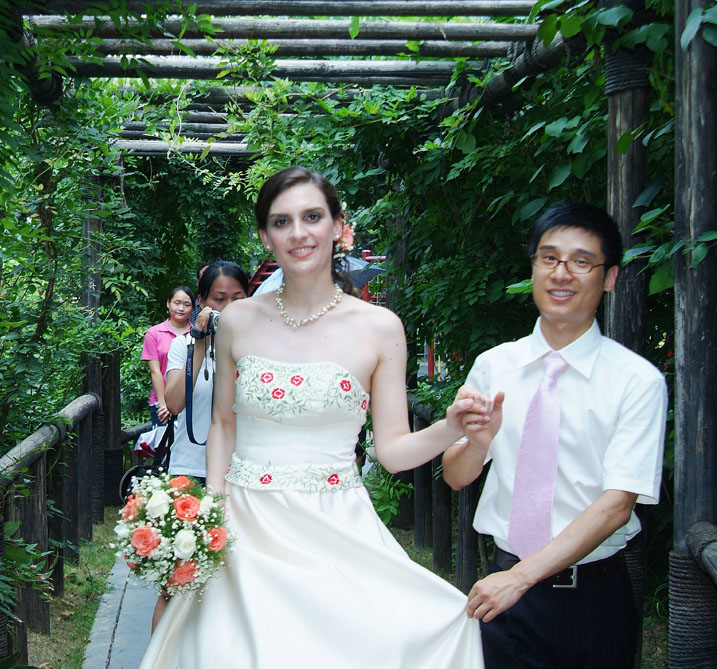
Chinese men dating or married to foreign women are still a rather rare form of interracial love. When they walk down the streets holding hands, they can literally feel people staring at them and whispering to each other, or even pointing fingers.
When I first met Jun, I was nursing a major heartbreak. I had just broken up with someone and spent much of my days in the office – the place where we both worked – in a melancholy funk.
To cheer me up, a mutual friend invited us both back to her hometown in Zhejiang Province for the weekend. That’s when I really got to know Jun. He kept making me laugh during the whole trip, to the point that I couldn’t help smiling (and even flirting) in his presence. I also discovered he was the kind of guy who really cared about your problems. When I finally opened up about my failed relationship, he listened in a way that made me feel heard and understood.
We exchanged numbers after that weekend and soon became close friends in the office. I would dig for any possible excuse just to visit him in the adjacent department – collaborating on a translation, editing some work for a client. I couldn’t wait for that moment when he would pull out the chair beside him and invite me to sit down in a prim British accent, as if I were a long lost Western princess arriving for a visit to his palace.
In fact, whenever I think about our courtship, I have to say I never felt more cherished by a man before. After all, this is a guy who cared so much for me he would accompany me the entire evening after work, from the gym to my apartment door. A man who would text me every evening without fail just to say “good night.”
It’s no wonder, then, that when he finally asked me out for an official date, it was perhaps the most romantic evening I had ever had. A candlelit dinner for two at a cozy vegetarian restaurant, followed by a walk under the stars beside the West Lake (and a lakeside kiss on a bench).
From that moment on, my heart would never be broken again by another man. And I would cherish him forevermore.
The other day, you told me how people constantly ask you, “Why would you date Chinese men?” You recalled that girl who grimaced at you just because you dared to date men in China. You said you felt like you were spending so much energy and time trying to defend your choices. You sounded tired of it all.
Believe me, I understand. Your comments brought me back to my first year in China, when I was sitting around the lunch table with my foreign female colleagues. One woman said, “When I arrive at the airport in America, the first thing I notice is the men, how handsome and how tall they are. I’ll just stare at them for hours, as if I were Chinese and had never seen a foreign man before in my life.” I knew what she was getting at, though another foreign female colleague put it more bluntly. “Chinese men don’t really seem that attractive.”
Even though I understood their every word, I couldn’t understand how they could brand an entire population of men as undateable. China is, after all, a country of nearly 1.4 billion people – and more people means more diversity and, ultimately, more great men.
It would take me years before I understood the depths of this problem – why Western women won’t date Chinese men. But I don’t need to tell you all this. You know it as well as I do. You’ve lived it.
But what do you do when the people around you just don’t get it? When they keep annoying you with the same worn-out questions about why you’d dare to date Chinese men?
Then again, who says you have to justify anything?
There’s nothing wrong with your decision to date Chinese men. Love is love. In a world rocked by so much hatred, fear and uncertainty, shouldn’t we all be delighted when someone gives their heart to someone else? Doesn’t that tiny act of goodness make the earth just a little bit brighter for everyone? Why should it matter that person happens to be a Chinese man?
It’s sad when people are so caught up in their own stereotypes about an entire group of people that they’re blinded to the possibility of happiness for someone like you.
But what’s worse is when they try to verbally walk you into a corner, putting you on the defensive for something nobody needs to defend in the first place.
So next time someone asks you “Why would you date Chinese men?” it’s time to put their proposed conversation in perspective. You might start with, “Why don’t you have something better to say?”
Mei Quong Tart By Unknown – This image is available from the Manuscripts, Oral History and Pictures Search of the State Library of New South Wales under the Item ID: 441601This tag does not indicate the copyright status of the attached work. A normal copyright tag is still required. See Commons:Licensing for more information.Deutsch |English |+/−, Public Domain, https://commons.wikimedia.org/w/index.php?curid=17880332
Mei Quong Tart may have married a white woman (Margaret Scarlett) in the late 1800s, a time when few dared to cross racial lines in the name of love. But he’s known less for his interracial marriage and more as one of the most beloved Chinese public figures in late Victorian Sydney, Australia.
He was educated by Mrs. Simpson, who took a lively interest in his welfare during the years he remained on the field, and, on leaving, Mr. Simpson gave him a big interest in an important gold claim, which the fortunate young protege turned to the best advantage. Mr. Tart employed about two hundred Chinese and Europeans, and in the course of a few years his mining speculations made him a comparatively wealthy man.
He could sing Scotch songs with singular pathos, recite Burns’ poems with a genuine accent, play Scotch airs on the piano, and jokingly alluded to himself as being a native of Aberdeen.
People would come to think of him as a regular English gentleman.
So it’s not surprising that when he resolved to marry, he chose to marry a Western woman. “…Quong’s good sense asserted itself, for he told his mother that when he did marry, it would be a European, for a Chinese woman in Australia would be but little help for him in carrying out the good works he intended doing.”
…Quong asked Margaret’s father, George Scarlett, for his daughter’s hand in marriage. Even though he was a friend of Quong’s, George refused. Quong Tart and Margaret waited until the day after her twenty-first birthday, on 30 August 1886, and married anyway. Quong was then thirty-six. The appearance of grandchildren eventually reconciled Margaret’s parents to their daughter’s marriage.
I have to wonder, did her family ever take note of Mei Quong Tart’s success as an entrepreneur? His teahouses and restaurants in Sydney were some of the most popular meeting places of the era, where he dazzled patrons with fine tea and even finer service:
His employees were ordered to treat all alike, whether they wore silk dresses or cheap prints, for Quong Tart had long learned that the silk dress did not make the lady, nor the fine black coat the gentleman.
Mei Quong Tart also became a well known philanthropist of his time, including building schools, caring for the poor, and supporting the local arts scene. He campaigned against the scourge of opium addiction in Sydney’s Chinatown.
…a well-known labour man was speaking in public and was pouring out his vials of wrath on “the wretched Chinese,” “everyone of whom,” he said, “he would, if he had his way, drive out of the State.” “Would you do that to Quong Tart,” cried out one from the crowd. “No, certainly not,” replied the Labour orator. “If they were all as good as Tart, I would let them stay here and come here, as they would be sure to be good citizens.”
Mei Quong Tart’s prominence in Sydney and his interest in the welfare of others, including his fellow Chinese, led to his involvement in some of Australia’s tragic anti-Chinese episodes.
For example, consider the case of the Afghan, a steamer carrying a large number of Chinese immigrants bound for Sydney in 1888. While the ship was en route to Australia, anti-Chinese groups successfully lobbied the government to pass a drastic Chinese Restriction Bill that made it impossible for anyone Chinese to land. It didn’t matter if they had all the lawful paperwork – if you were Chinese, you were denied entry. (Just replace “Chinese” with “a citizen of one of seven Muslim majority countries” and it sounds an awful lot like the US immigration brouhaha after Trump abruptly enacted his Muslim Ban 1.0 in early 2017.)
[Quong Tart] says that we can form little idea of the anger that was manifested by the masses in Hong Kong and Canton upon the return of the ships with the rejected immigrants on board. Many of the unfortunate people were landed in their native country in a state of utter destitution….when they landed after their enforced trip back they formed a rather striking illustration of the manner in which Australia had come to regard the question of Chinese immigration. Their want and destitution appealed to the sympathies of their countrymen and their stories of imprisonment on board the ships in Sydney Harbour inflamed the popular anger.
Mei Quong Tart’s service to the Chinese in Australia didn’t go unnoticed by the Chinese government, who named him acting Consular official to China and later conferred the title of Mandarin upon him.
Do you have a story — fictional or real — to share here on Speaking of China? Visit the submit a post page to learn how to have your words published on the blog.
—–
You look surprised. You are probably wondering how did you get to this place. It is so dark and there are no stars in the sky, even though it is obviously nighttime. It is okay. You have every right to be surprised. For I was the same long, long ago when I found myself in your same shoes. Please do not be afraid of me. I am not here to harm you. I am here to be your friend and companion for the long journey we are about to make. That is why I am holding this lantern in my hands. But most of all, I am here to help you understand the situation you are currently in. For understanding is the first crucial step to acceptance.
Now, please let me tell you straight and properly. You are dead.
You are probably now wondering, Is this man threatening me? No. It is not my intention at all to frighten you. You are dead in the truest sense, which is why you are here. Please take a moment to search your thoughts. Think long and hard about what happened before you woke up and found yourself standing in this desert. It is okay. I am a patient person.
You are starting to remember now. Which is good. It is slowly starting to come back to you.
It had just been an ordinary day in the middle of summer. You had showed up to work at that huge warehouse right at the dead-end road where the town limit stopped and the railroad tracks of the old terminal cut across the span ahead. Your supervisor had requested that you gather up a certain number of empty pallets for the delivery that is impending that day. You spotted a small stack of unused pallets resting atop a massive tower of freight that had been moved into the middle of the room. You wondered why anyone would put empty pallets somewhere so hard to reach. But you got to work immediately. One of your coworkers had borrowed the ladder, but you decided, for some unknown reason, that you would climb to the top of that tower, and throw the pallets to the ground one by one. Perhaps you wanted to save time. I don’t blame you, for I would have thought the same had I been there. However, did you really think it was that good of an idea to climb onto such an unstable mass of loosely stacked cargo? But you still went ahead and climbed.
You were almost at the top when the tower began to tilt. You only had one second. One long second, to utter a single cry of bewilderment, before you crashed to the concrete floor, breaking your back in the process. You had tried to get out of the way, but you were unable to move at all. Pallet after pallet toppled downward and crushed into you. Steel drums filled with paint thinner and kerosene, shattering every bone in your body, smashing your ribs into pieces and driving them through your lungs and heart like bullets. Your life was crushed out of you as you watched, helpless and in unbearable pain.
You woke up and found yourself here. Rocks and gravel stretching as far as the eye could see. A black, starless sky tinted reddishly at the horizon. And me, with my dusty worn coat, dirt covered slouch hat, and a lantern providing just enough light for us to see each other’s faces. But don’t worry. We ain’t staying here forever. Look to your right, where I am pointing. Do you see that road, stretching far down towards the horizon where the mountains loom and the red glow fills the sky? That is what we will be headed towards. I can see that you are scared. It is okay, for I had been just as scared as you when I walked this very road. It will be a very long walk, and when we finally reach the mountains, there will be a great river flowing at their bases. And it is there, where we will meet…him.
You are thinking now, Who is this him? Frankly, I don’t even know. I simply refer to him as the Raftsman. For he has the only boat in sight that can take us across the river. And it is when you are crossing the river in his raft, that all the deeds you have performed in your life so far will be weighed and judged before you. And perhaps, it is the Raftsman who will decide which direction your journey shall go next. But don’t worry. I know it is a long walk we will have to embark on, therefore, I shall tell you a story along the way. A story to brighten your heart and hopefully, keep the darkness and loneliness that surrounds us at bay. A true story, from a life long past.
So with that said, lets walk. Just keep your eyes and feet on the road, and follow me, and we should be fine. Now, perhaps I should tell you a little about myself and why I had ended up here. Before you had seen me as you see now, long, long ago, I had been a person just like you. In every sense of the word. I had a loving family, held a job, and had the most wonderful woman in the world to love and return my love. She was my life, and not a single day goes by without me thinking about her and yearning to return to her arms as soon as possible.
Her name was Anna, and by God I could remember the surprise on the faces of our classmates when they discovered that Anna had chosen to go with me to the prom. Me, the one that everyone was prone to teasing when they were in younger grades, albeit lightly. But Anna was a very quiet and timid girl who has just immigrated to this country from Ukraine and barely understood any English. It was her accent which had made her the primary target of the school bullies, and it was me who always came to her aid and comfort every time a page would be ripped out of her notebook or a foot will trip her up in the hallways and make her fall. I ain’t got that many friends anyway, so why shouldn’t I be with her. Someone really just like me in every bit. Even though I had black hair, and eyes that some folk like to make fun of, since they were, well, different. So it was only natural that I had spent more and more time with her. Time that I cherished, and held on to, as we grew older and matured.
However, I changed. And the worst of it is, I found myself drawn to easy money. I became a gambler, and as the poker and blackjack table slowly conquered my life, I had lost my job as well. Despite my beloved Anna pleading with me to change my ways and return to being the loving husband as I was before, I continued on the road to eternal misery.
All right now, before I continue again, please let me make you aware of a few…important things. You may have noticed now during our walk that there are shadows in the desert all around us. Don’t you look at me and pretend you don’t know what the hell I am talkin’ about. I saw you glancin’ around. You are probably thinking, This is a damn desert out here. Ain’t not one goddamn tree or shrub within miles to be casting shadows. Let me tell you right here on the spot. These ain’t shadows. What are they? How the hell should I know. It ain’t like you can talk to em’ or such. But the light from my lantern keeps em’ at bay. This I’ll let ye’ know.
Hey! Goddamit don’t stop. Keep on walking. These things can feel fear and weakness, and when they do, they pounce. I’ve seen em’ pounce. Seen em’ up close even, when I put this here lantern on the ground to rest. Their faces, Goddamit, enough with it. Just keep on walkin’, and keep yer’ feet on the road, on the path, and you’ll be fine. As long this lamp is lit, they ain’t gon’ come close.
Along the way, I had fallen into the company of evil men, who convinced me that my skills at the card table could be put into even greater use. I began to deal, and run rigged games, where the opposing side will always lose due to my trickery and ingenuity. The money I earned from these rigged games seduced me even further. I began dealing full time, working for those same men of ill repute who had introduced me to this world of thievery. And by God, how many lives I had ruined. Many of the men who came to the saloon and attended my card games were men who barely made enough to keep their families alive. I had robbed each and every one of them. Some, I had even taken their entire life savings, for no compulsive gambler could resist the urge to play on despite losing again and again.
I became a hated man. But I was drunk on ignorance, and did not care. Some of the money I had earned I had used to buy off the local sheriff, so the law will always turn its head to my goings on. I carried a pistol with me all the time. Carried on my hip, plain as daylight, to show the world that a new outlaw was in town. And he meant strictly business.
I never thought that one day, it will all catch up with me, and by God, catch up with me it did. I had become hated, but hatred was the only thing that all those men whose lives I had cast into bankruptcy were capable of.
But as time went on, some of em’ went further than just hatred. It caught up to me one bright, moonlit night as I stood outside the door of one of the saloons that I dealt in, counting my ill gotten wealth by the light of the entrance lamp. I never even had the time to draw my gun, for they hit me from behind. One of em’ smashed a crowbar into the side of my head, while another began to beat me savagely with a steel pipe. I hit the ground, gushing blood, screaming in pain. But nobody heard me. And even if some did, they ain’t giving a damn.
They had thrown me, still conscious, into the back of a pickup truck, and driven me out of town. They stopped on an old wooden bridge over a creek of whose significance I just remembered then. It was the place where she and I fell in love and shared our first kiss, all those long years ago. Anna. My sweet Anna. The one with the sweet face, blue eyes and long hair as yellow as the buttercups of summer. And the one who had long since left me and moved away when I stopped loving her in order to pursue my new vice.
I only had enough time to remember this, and shed a few tears, as they dragged my bleeding body out of the truck bed and flung me over the bridge into the creek. The creek was shallow, so I landed on my back in the water. I could hear my spine crack as it struck the rocks of the creek bottom. I stared up at the bridge again, and in the moonlight, I could see one of the men pull something out of his coat pocket. It was a revolver. Huge and glinting silver stainless steel .357 Magnum, just like the one I carried. With a barrel the length of your goddamn arm. They passed the gun amongst each other, each one blasting me in the head and chest until the cylinder emptied.
And I woke up, right here in this godforsaken desert country, in the same place you found yourself at the beginning of our journey. Where the night is eternal and ain’t no stars in the black sky, though the mountains in the horizon seems to be burning red. I walked this same here road we walked on right now. Cursing myself, crying out for Anna, for my old life back. Ain’t gonna happen though. Ye’ can’t undo what you done already.
See this road below your feet? See how worn it is. Plenty of men have walked this same road before us. Men who wish they could change what they done. George Custers’ done walkin’ down this road. So did ol’ Wild Bill, missin’ half his head from where Jack McCall done shot him at pointblank range.
I walked this road myself. And the Raftsman had judged me, just like he had judged all the others. But he ain’t sent me anywhere else. Not me, outta all those who walked here. Not me. He has said to me that I was a foolish one. One who had found love, what many have sought for, only to fail. I threw it away like a damn fool. And like the fool I am, he has given me this goddamn lantern and made me walk this road forever, telling my story to everyone that walks down this beaten path. Just like how in them old days, they make thieves stand on the street corner and wear a sign sayin’ all the bad deeds they have done, for the whole goddamn town to see. Guess that’s his way of makin’ me his personal village idiot.
Am I complainin’? After all this? Hell no. I earned it, and I git’ to spend it. By the way, look at how far we have come on this road. Them mountains sure seem closer now than before. But we still got a long ways to walk and we don’t have to wait for the Sun to come out soon. ‘Cause it ain’t gonna come out ever in this place. If you are tired, we can rest. I got matches, and there is dried grass and twigs all ’round. I’ll build us a fire and the light will keep these…fiends…at bay. For all my troubles the Raftsman had given me something I truly cherish. I thank him for every goddamn day. He’s given me all the whiskey I can ever drink, so I git’ to drink every day and think about what I done. Want a swig? Well then, take the damn bottle and drink it up pard.
Raymond Chen is the author of the graphic novel “Borderlands”, a story about a Chinese student and his beloved Peruvian wife. His harrowing journey through a landscape of death and brutality would become the fight for the survival of an entire nation. The novel is available to read at no charge here: http://blueskycountry.tumblr.com.
—–
This website uses cookies to improve your experience. We'll assume you're ok with this, but you can opt-out if you wish.AcceptRejectRead More
Privacy & Cookies Policy
Privacy Overview
This website uses cookies to improve your experience while you navigate through the website. Out of these cookies, the cookies that are categorized as necessary are stored on your browser as they are essential for the working of basic functionalities of the website. We also use third-party cookies that help us analyze and understand how you use this website. These cookies will be stored in your browser only with your consent. You also have the option to opt-out of these cookies. But opting out of some of these cookies may have an effect on your browsing experience.
Necessary cookies are absolutely essential for the website to function properly. This category only includes cookies that ensures basic functionalities and security features of the website. These cookies do not store any personal information.
Any cookies that may not be particularly necessary for the website to function and is used specifically to collect user personal data via analytics, ads, other embedded contents are termed as non-necessary cookies. It is mandatory to procure user consent prior to running these cookies on your website.
 What’s the earliest example of an AMWF couple in recorded history? That distinction might just go to Arcadio Huang and Marie-Claude Regnier, who married in Paris in 1713.





 )
)







 He stops by her house and honks the car, waiting for her to come out. He wonders if she will remember the umbrella and then decides no, she will not remember it. He gets the umbrella out and walks up to her house, ringing the doorbell, hoping that no one besides Therese will open the door. Much to his dismay, an older woman opens the door, staring at him curiously. She is tall, almost as tall as Therese, with a lined face and a mass of curly light brown hair. She brushes her hair away from her eyes and stares at him curiously. “And you are?” She says without preamble. He clutches the umbrella tightly, the drops becoming tiny waterfalls. He does not want to tell this woman of himself, for she might know his family and if it should be spread around that he is here, his family will be ashamed of him.
 Her eyes are wide; her lips are parted in shock. He turns away from her, the flush heating his cheeks. Inside of himself, he mutters in Korean, “Nae Saranghe,” the words he cannot say to her. Instead he collects himself and the two walk inside. He does not speak of what happened outside.



 The other day, you told me how people constantly ask you, “Why would you date Chinese men?” You recalled that girl who grimaced at you just because you dared to date men in China. You said you felt like you were spending so much energy and time trying to defend your choices. You sounded tired of it all.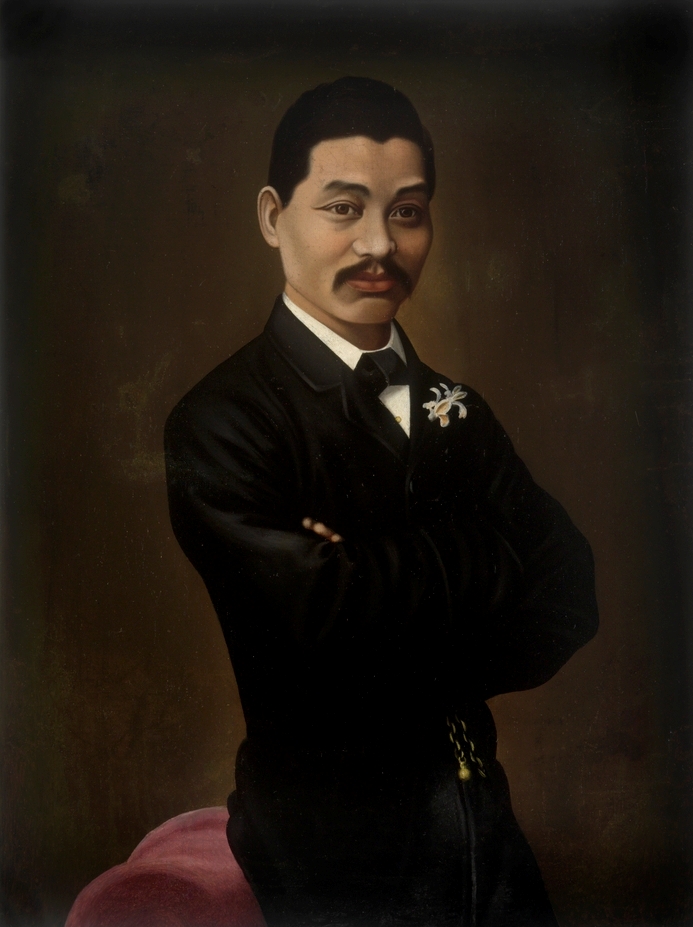
 You look surprised. You are probably wondering how did you get to this place. It is so dark and there are no stars in the sky, even though it is obviously nighttime. It is okay. You have every right to be surprised. For I was the same long, long ago when I found myself in your same shoes. Please do not be afraid of me. I am not here to harm you. I am here to be your friend and companion for the long journey we are about to make. That is why I am holding this lantern in my hands. But most of all, I am here to help you understand the situation you are currently in. For understanding is the first crucial step to acceptance.
 All right now, before I continue again, please let me make you aware of a few…important things. You may have noticed now during our walk that there are shadows in the desert all around us. Don’t you look at me and pretend you don’t know what the hell I am talkin’ about. I saw you glancin’ around. You are probably thinking, This is a damn desert out here. Ain’t not one goddamn tree or shrub within miles to be casting shadows. Let me tell you right here on the spot. These ain’t shadows. What are they? How the hell should I know. It ain’t like you can talk to em’ or such. But the light from my lantern keeps em’ at bay. This I’ll let ye’ know.