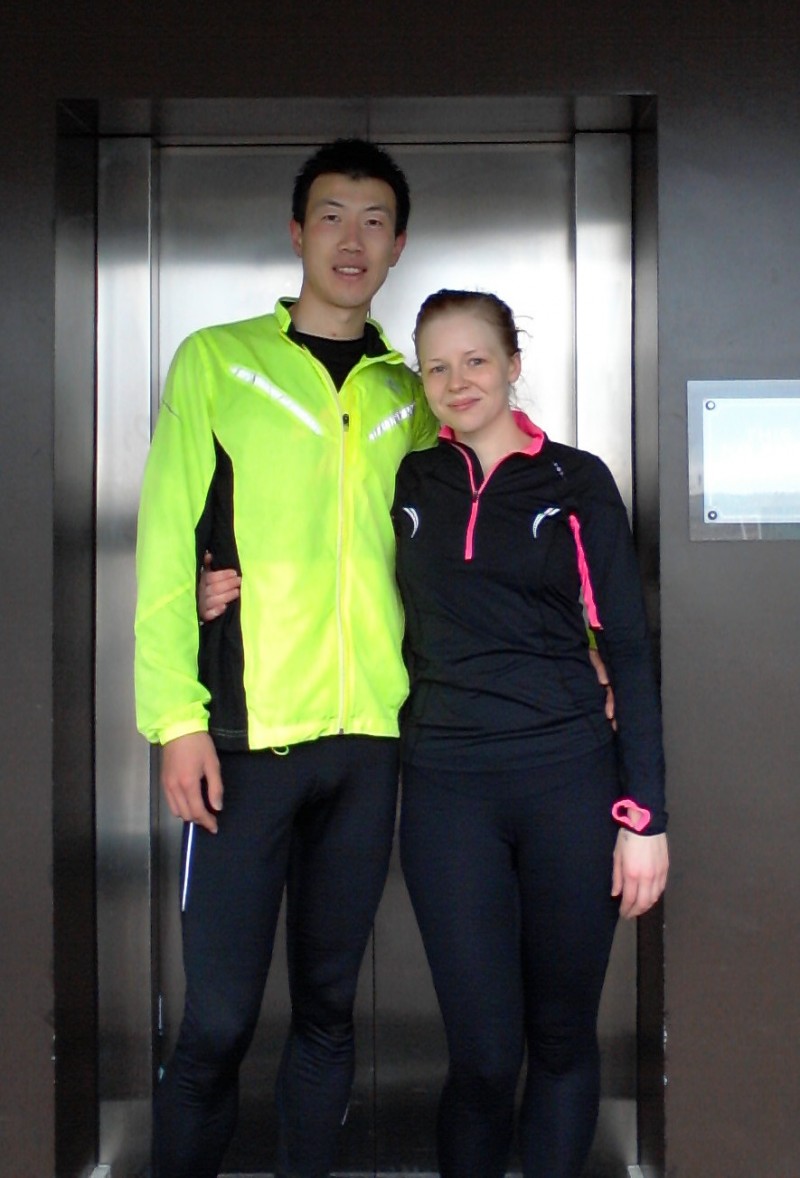
You never know where love’s going to find you — and where it might take you. Sarah (a native of Birmingham, England and the woman behind Diaries of a Yangxifu) had just finished the Half-Marathon in Birmingham, all sweaty and exhausted, when lo and behold, she discovered an incredibly handsome Chinese man right beside her. A man who would propose to her less than a year later in his hometown of Dalian, China.
Have an unusual love story or thrilling guest post you’d love to see published on Speaking of China? Learn how you can do it (just Sarah did) at the submit a post page.
—–
I never felt quite the same after that year of teaching English in Nanjing in 2010. When I returned to the UK, I found I had a little thing for Chinese men, who reminded me of my year in China and shared my love of 饮茶 (drinking tea) and 烤鱼 (roasted fish). However after about two years, I had got back in to the swing of things back home and was really enjoying living in a multicultural city with a big Chinatown and occasional trips to KTV.
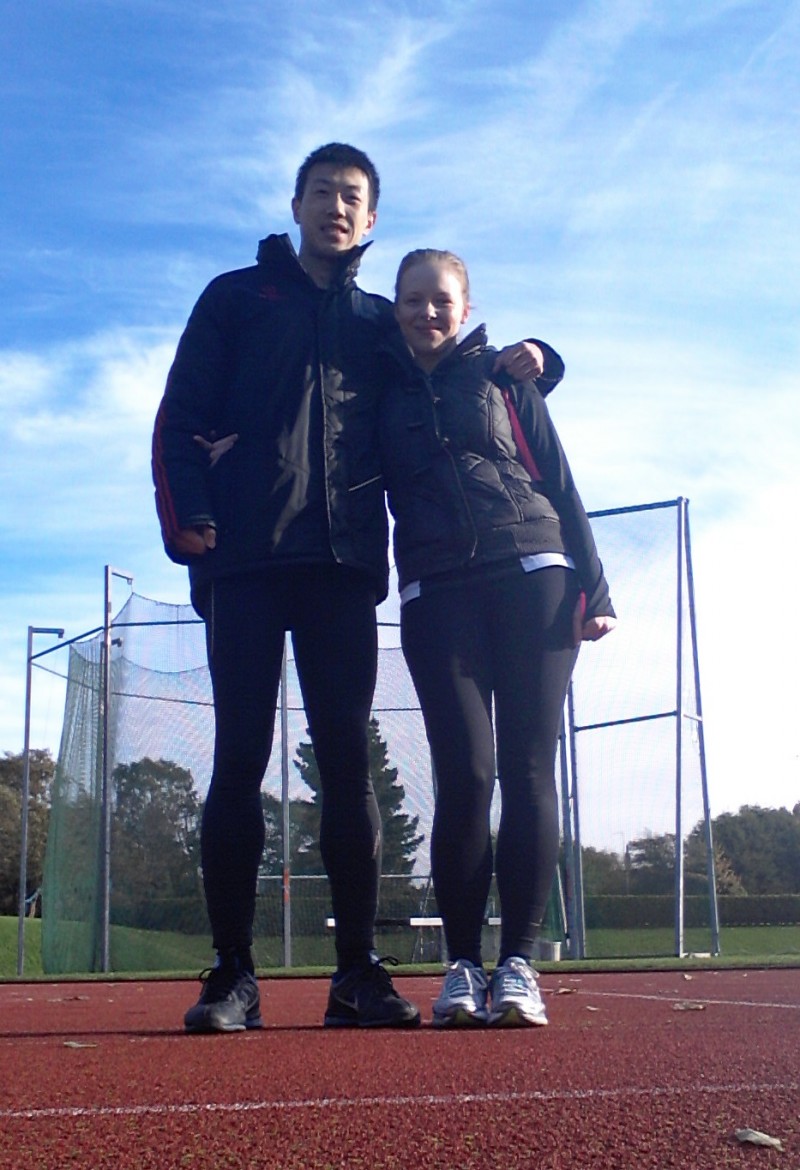
I had been training for the Half Marathon for over four months, including a three-week holiday in China where I managed to sneak in a few runs on the banks of the Pearl River in Guangzhou and along Victoria Harbour in HK. I was feeling incredibly proud of myself when I had completed the 13.1 mile run and felt on top of the world as I walked from the finish line to my home 10 minutes away. Still, I was a bit achey and was trying to decide whether to take a little rest or just get home and have a nice shower. I saw a free bit of wall in the square and decided to take a little rest.
I soon noticed the handsome Chinese man sitting on the wall next to me and was deciding how to make conversation, a habit of mine since returning from China. Then he turned to me and congratulated me on finishing the run. (Let’s hope it was the medal round my neck rather than the bright red face and disgusting hair that gave me away!)
We got to chatting for a while, exchanged snacks (they put some strange things in race finish bags) and chatted about sport. I had not met such a sporty Chinese person before, or one with freckles. Some time into the conversation I asked whether he was Chinese, and he replied, “Yes, but don’t be scared.” (I’m not sure what kind of experience he’d had of British people!). I answered (in Chinese) that I wasn’t afraid and actually I could speak a little Chinese myself, much to his surprise!
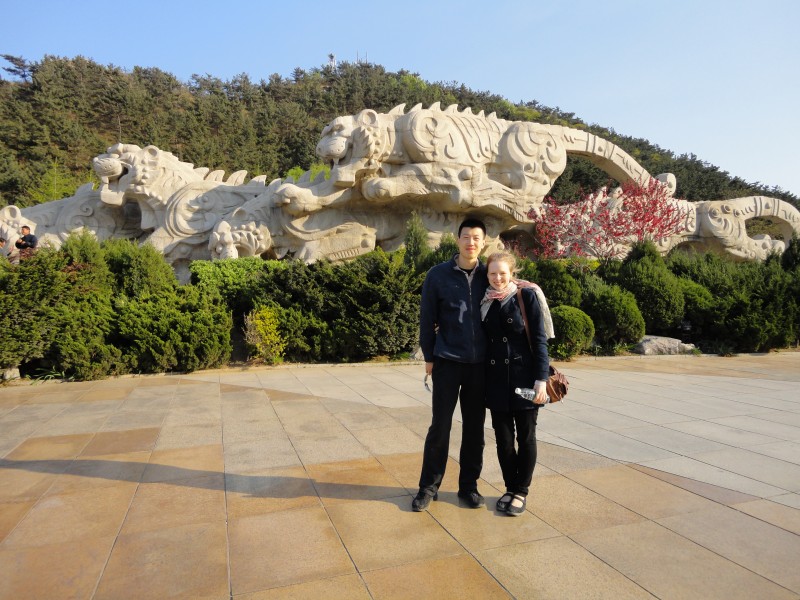
We spent the rest of that day together, and I think it was the best day of my life. I had not only met not only the most handsome man I’ve ever known. I also met the man who 10 months later proposed to me “movie-style” at the top of Dalian’s sightseeing tower observation deck, right in his hometown where we had moved a couple of months before. I feel so lucky to have met a man with such integrity and intelligence, someone who always strives to be better — just like me.
That day, sitting on a wall in the Birmingham city centre, marks the start of my greatest adventure: of marriage, of a new family, of living a taste of real Chinese life.
Sarah is currently studying Mandarin Chinese in Guilin, China, where she lives with her husband, and documents the challenges and the joys of her adventure at Diaries of a Yangxifu.
“I’d never dated or been attracted to Chinese men before,” writes Marissa Kluger — not until she met ZJ in Xi’an, a city that stole her heart away.
Marissa’s blog Xiananigans has been a pleasure to follow over the years (right down to her “explosive” Chinese wedding, where she dons the most gorgeous red wedding gown I’ve ever seen). Here’s the story behind it all, from how she discovered Xi’an and ZJ to how they eventually moved it to her hometown in New Jersey.
My first trip to China, in 2007, happened to be a three week intensive course abroad, a general education requirement instituted by Goucher College, my alma mater. Xi’an ended up being one of our destinations. Besides inspecting the soldiers at the Terracotta Warriors, bicycling around the Xi’an City Wall, and navigating the alleys of the Muslim Quarter, we met with an alumnus teaching at Xi’an International Studies University.
The city of Xi’an compelled me to return four years later to teach at Xi’an International Studies University. I’m a fairly indecisive person but I had made up my mind after listening to the alumnus’ anecdotes about his job, travels, and experiences. Meeting his students further cemented my longing to come back; they were inquisitive, interested in cultural exchange, American politics and exposing me to as much Chinese culture as several hours would allow.
Snapped at Delhi Darbar, our local Indian haunt, Summer 2013
Although I knew they would show us around their dorms, the campus, and give us small gifts, I was overwhelmed by their warmth, affection, and extroverted personalities. In many ways, they toppled every notion, or better yet, stereotype I read about Chinese students. We met students from universities in other cities during our travels, but XISU students left the deepest indent.
I also saw it as a one-year opportunity to do something outside-of-the-box before starting a career, although at that time I had little idea about what I’d be doing; I hadn’t even declared a major, still opting for that looming “Undecided” title. My parents thought I’d give up on the idea as I still had three years of schooling. They were supportive of the decision, also seeing it as a good opportunity, hoping I’d pick up the language and gain other valuable experiences that could propel whatever career path I chose forward.
In 2009-10, my final year at Goucher, I applied for a position at the university. Three months went by without a word, so I began applying for jobs in my chosen field in the Greater New York City area. A ray of sunshine appeared just a week before commencement…I had received an email from the university offering me a teaching position for the next academic year! When my college girlfriends offered their congratulatory sentiments, they also foreshadowed that 缘分, or fate would lead me to at least date, perhaps even settle down in China. I dismissed this as I didn’t really put much stock in fate.
Bicycling to the 798-like art district in Xi’an, Summer 2013
I arrived in Xi’an in late August 2010, and luckily I had the first month of September free, as I had been assigned freshman. Freshman have mandatory military training, and four years ago, this lasted an entire month. I took this chance to meet up with a very good friend of my former private drum instructor and his Chinese wife. Lu Min Lu, I called her Daphney, helped me settle in and introduced me to the nightlife Xi’an offered. She took me to Park Qin, a bar frequented by Xi’an expats. ZJ worked at Park Qin.
The first time ZJ and I met, I insisted on getting his phone number on behalf of a British girl. I initially cut in for several reasons: I was looking for Chinese acquaintances who might become friends, most of my college friends were guys, he was easy to talk to and charming. I, of course, did all of this not knowing anything about Chinese dating culture, or that ZJ considered himself “traditional.”
After getting his phone number and exchanging texts, we agreed to meet up on his next day off. Shortly after that first meeting, I went back to Park Qin and spent hours talking to ZJ about movies, music, college, culture and more. We had a lot in common, he spoke directly, didn’t seem shy or introverted, much like the students I met in 2007, but I didn’t see this going in a romantic direction. The American girlfriends I emailed back home were elated: “I told you.”
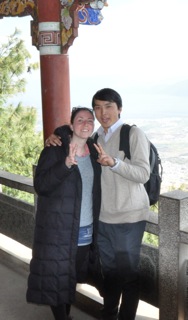
ZJ and I in Xi’an, Chinese New Year 2013
It was about a month later that ZJ and I began dating. In the early stages of our relationship, we looked more like friends. We weren’t affectionate in public and our relationship remained a secret. In February 2011, I met ZJ’s parents during our Chinese New Year visit to his hometown. He prepared me very well for that first visit, explaining that to his parents, bringing a girl home, let alone a foreign one, meant to them we were serious.
I met his best friend from high school as well as extended family from both his mother’s and father’s side; I felt more comfortable than I initially thought in an environment so different from Xi’an and New Jersey. ZJ cared, translated and interpreted for me; his way to show affection manifested itself unlike any previous relationships. I liked the nuances, subtlety of it all, and more importantly, started to fall for him, and so upon returning to Xi’an, ZJ moved in with me.
After moving in together, we spent Western Valentine’s Day on the City Wall, visited the Shaanxi Botancial Gardens, attended a professional soccer game at the sports stadium, and he attended Thanksgiving dinner I hosted with a friend. I went back to the US for the summer in 2011. Although we lived together, I worked during the day while ZJ slept after bartending into the wee hours of the morning. After 2012’s Chinese New Year, he decided to take a sabbatical from work.
The flowers ZJ procured by riding on a motorbike taxi in the pouring rain, at our engagement on June 8, 2013
When the holiday season approached, ZJ fostered my homesickness by taking me out for Peking duck on Christmas, a tradition commonly observed by Jewish-Americans. I went home for three weeks in January 2013; I wished he could have traveled with me, to meet my family and friends. I missed him when I went home for two months in 2011, staying in touch via Skype, however, those three weeks felt utterly painful. I enjoyed my time at home, but a sense of relief washed over me when I touched down in Xi’an a week or so before heading to his 老家 for Chinese New Year.
We had already started discussing getting engaged and this discussion was met with approval by 老爸, 老妈, 大哥和二哥. ZJ proposed to me on June 8, 2013. The timing of the ceremony, the set-up, and the ring were all a surprise to me. He told me we were celebrating his birthday; I saw this as slightly suspicious, but didn’t give it a second thought when he shot me down over WeChat when I asked if he planned to propose.
A collage put together by one of our foreign guests at the Chinese wedding ceremony, Feb. 5, 2014
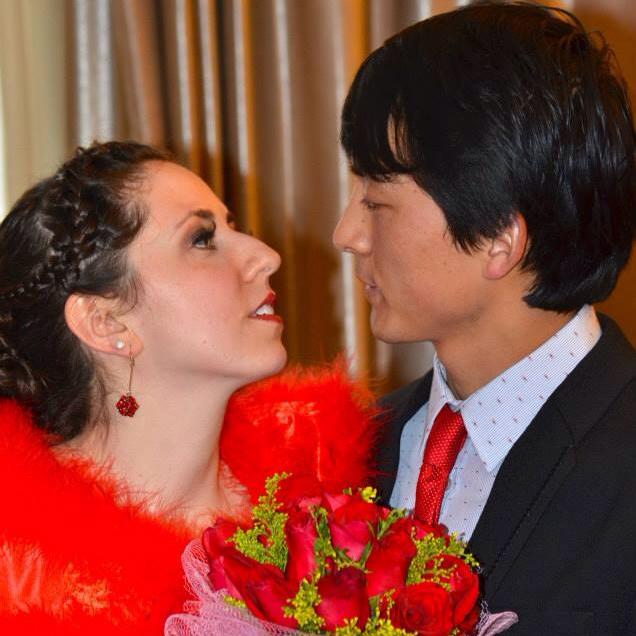
I wore an ankle-length red gown, one of three dresses purchased on Taobao for the ceremony held in the countryside. I opted for a red princess-poofy gown, complete with fur-like trim, flowers, taffeta-like mesh, all in red. I changed into a red lace qipao in order to toast the guests, wearing it with a qipao-style top as a jacket in hopes of keeping out the cold. I even wore all red undergarments. My youngest sister made the trip from the US, served as pseudo-maid of honor, taking on my hair and makeup. We also had a few foreign colleagues from the university attend. 爸爸和妈妈 Zhang, my brothers and sisters-in-law ensured the shindig, a once-in-a-lifetime affair, could be watched over and over again (there’s a video!). We had a honeymoon of sorts, to Lijiang and Dali, and I say of sorts, because my sister and friends of ours tagged along.
We had traveled to Guangzhou for the petition in January and a couple of months after all the wedding excitement died down, we traveled back again for the medical and interview portions. ZJ didn’t pass on the spot, as we had to send additional documents. A week or two later, we had ZJ’s passport with the appropriate visa in hand. I couldn’t believe how relatively quickly and pain-free the process had been! More foreshadowing…
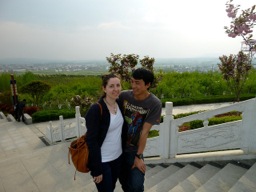
ZJ and I in Hanzhong, 2012
We’ve now been in the US for two and a half months. We live with my parents in the house I grew up in. I work part-time for Starbucks while I pursue other avenues. This is the first encounter ZJ’s had with my parents and friends, with the exception of my youngest sister, who also lives at home. He just received his social security number last week. When we went to the department of motor vehicles earlier in the week, they weren’t able to verify his status, meaning we have to wait before he can obtain his driver’s license. In other words, the ease we experienced during the DCF process meant more obstacles after landing stateside.
It’s not all bad news, though. I never imagined I’d be a 26 year-old “we”, returning from four years in Xi’an, and struggling to figure out what comes next. I would never take it back, or trade it in for an “easier life.” Much like the processes we’ve gone through in the last year: getting our red books, preparing for our Chinese ceremony, navigating the DCF process, prepared us for the ups and downs of a new life. I underestimated the adjustment moving to the US would be, but my husband never did.
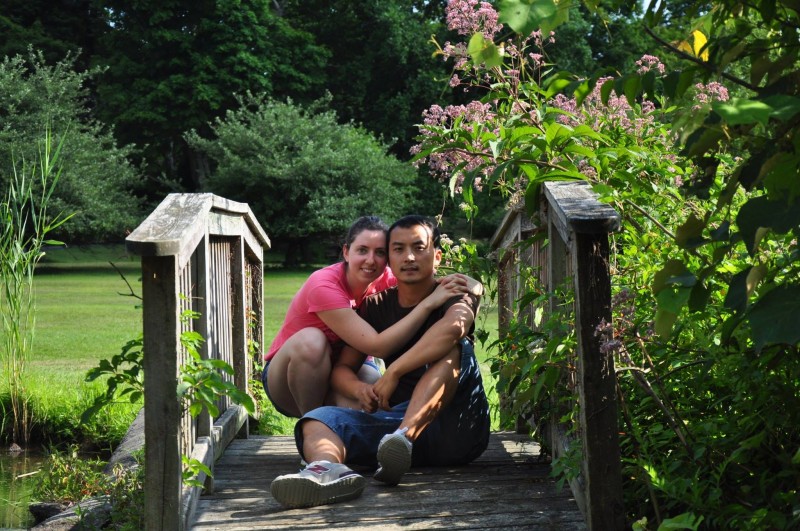
Ringwood State Park in New Jersey, July 2014
This is why I love him. When I’m losing it, he remains calm, rational, and thoughtful. When I’m overly emotional, which is pretty much all of the time, he’s calculated and prepared to counteract my moodiness by jokes, sarcasm, or a story. He knows exactly when I need solitude, a hug or a kiss, encourages me to not only pursue my dreams, but to do so independently.
His sense of humor is infectious, and he’s grown into a more talkative, outwardly affectionate individual. He supports me in all my endeavors. Our marriage and relationship may not be conventional in the eyes of some, and we may be opposites, but I always foresaw, if I did marry, ending up with my “other half.” You see, I didn’t think I would marry, especially in my mid-20s, not because I don’t believe in the institution of marriage, but after a failed serious relationship in college, preferred to bask in dating solitude.
It’s laughable that there are Western women in China who write off Chinese men. I’d never dated or been attracted to Chinese men before, but I’m very attracted to my husband: appearance, intelligence, and personality-wise. If I had written them off, the handsome, caring man sitting to my right reading the local paper wouldn’t be in my life.
Marissa Kluger married her Chinese husband ZJ a year ago. They live in New Jersey. She reminisces about Xi’an and muses about life in the US at Xiananigans.
As a white female who recently married an Asian male, I have become intrigued with AMWF couples. I’m also an avid follower of Speaking of China and enjoyed a guest post by Fred titled Are Interracial Couples of Asian Men & Western Women Really That Rare? A Field Report from Hong Kong, where he noted the presence of AMWF couples during a trip to Hong Kong. So I asked Jocelyn about completing a study of the presence of AMWF couples in Mississauga, Canada and she agreed to post the article.
I want to thank Fred and Jocelyn for inspiring me to conduct my own study of AMWF couples.
Maria and her husband Joey during their engagement photo shoot in May 2014.
Aside from my husband and me, there are two other couples that I personally know of in AMWF relationships. One is a close friend of mine, whom I set-up with my husband’s friend. She is Canadian with Macedonian heritage, while he hails from Thailand. The other couple is made up of two Canadians — her background is English/Irish and his is Chinese. They both currently reside in Mississauga, with one couple married and the other dating.
I decided to conduct this study over a period of one month. The study began on April 19, 2014, and ended on May 19, 2014. Unfortunately, I was only able to write about two days of viewing as those were the only days when I noticed AMWF couples during my travels. Each date includes the place where I observed the AMWF couples, their actions, and my perceptions of them.
Square One Shopping Centre, located in Mississauga, Ontario, Canada. This shopping centre served as a popular site for AMWF couples during Maria’s study.
Day 1: April 19, 2014
My husband and I were at Square One Shopping Centre, the largest mall in Mississauga. At this mall, I observed four AMWF couples.
Couple #1: The first couple I saw was walking through the mall holding bags. They were walking side by side, while laughing about something. They seemed to be enjoying each other’s company. They were quite young, possibly in their late teens/early twenties.
Couple #2: The second couple I saw was also walking through the mall. They were an older AMWF couple, most likely in their mid-late forties. They were smiling, while enjoying each other’s company (or so it seemed).
Couple #3: The third couple I saw was quite young, possibly in their late teens. The young woman was holding the young man’s arm. They seemed to be quite intimate in terms of their body language. They then departed at the entrance of a jewelry store. As they departed, they kissed each other passionately on the lips. They didn’t seem to mind the stares that they received as they looked to be very much in love. The young woman was holding a bag of food in her hand as she walked away.
Couple #4: The last couple that I saw was in a popular department store called Target. I was in the changing-room when I noticed a middle-aged man coming in and asking his wife, who was trying on an outfit, if she needed a different size. She seemed grateful to have his assistance, thanking him more than once.
Day 2: May 10, 2014
My husband and I were dining at a Korean restaurant in Mississauga called The Owl of Minerva. We were dining with my husband’s mother and father. I noticed one AMWF couple during the entire time that we were at the restaurant.
Couple #1: The only couple that I saw was sitting at a table behind us. They seemed to be very interested in each other, holding each other’s hands while they spoke with the young man’s mother and sister, who were also dining with them. The couple looked to be in their mid-late twenties, possibly just recently married.
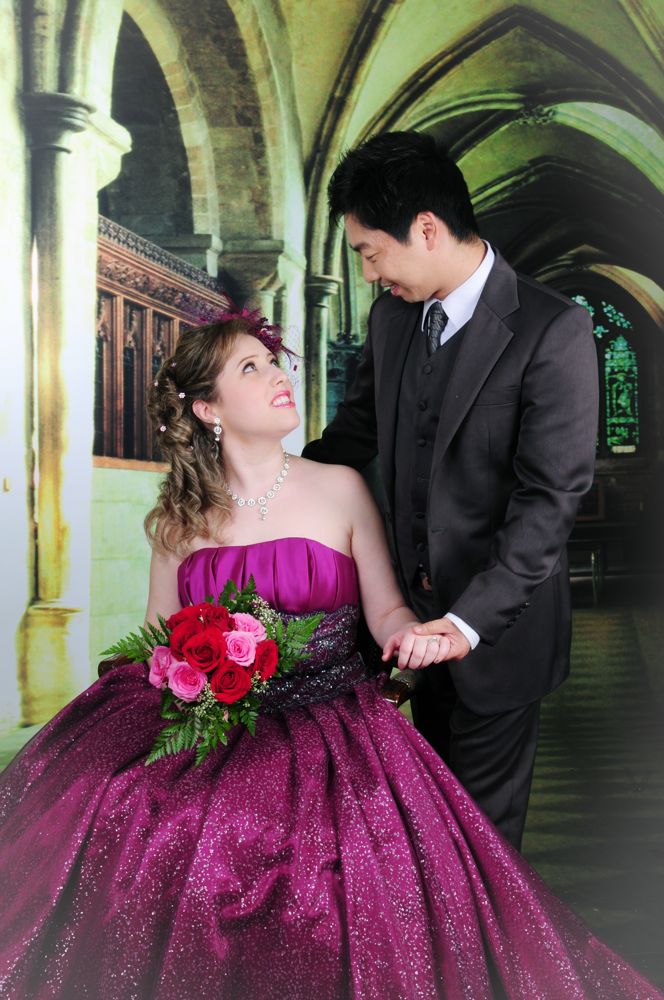
Maria and Joey on their wedding day in June 2014.
During my one month of observation, I only noticed five AMWF couples. I found this to be quite low as I would have expected to see more in a larger city like Mississauga. However, I am grateful for the couples I did see as I was able to observe their behaviour and consider the nature of their relationship. That being said, in comparison to Fred’s study of AMWF couples in Hong Kong, those found in Mississauga were similar in numbers, being slightly higher than the six noted by Fred. In total, we noted eight AMWF couples in Mississauga over the one month of observation (including me and my husband as well as the two couples we know personally).
Unfortunately, since I was focusing solely on AMWF couples, I neglected to include the number of WMAF couples that I had noticed. I will say it was much higher than the AMWF couples that I had noted above. Fred’s post nicely reveals the number of WMAF couples compared to the number of AMWF couples.
A comic of how Maria and Joey’s love story began, displayed at the venue where their wedding was held. Both were drawn by the talented Jasmine from Japan-aholic.
Of course, the sighting of AMWF couples all depends on time and place. Before this study took place, my husband and I dined at a popular Chinese restaurant in Mississauga called Summit Garden. We would attend Dim Sum (点心) in the mornings with my husband’s parents and friends. We often noted many other AMWF couples: some young, some old. We were pleased to see that AMWF couples, like us, do exist. Although AMWF couples will never be as numerous as WMAF couples, we are out there and we are proud!
What do you think of this article? Have you noticed many AMWF couples in your part of the world?
Maria Deng currently resides in Mississauga, Canada with her husband Guangjie (Joey), who originally hails from Guangzhou, China. She loves reading about AMWF relationships, and looks forward to writing more about her experiences being married to a Chinese man.
Our friends who dined with us that evening had no idea it was our 10th anniversary. (We actually told them it was a dinner to celebrate my birthday – which was true, in part.)
It’s crazy, I know. And you might be wondering, Why would they hide such an important anniversary from their friends in China?
Because in China, it’s incredibly awkward to be married for 10 years and not have any kids. So awkward, that my husband just doesn’t want to mention it to his friends or even talk about it with people we know (like a friend’s mom we walked through the park with the other night). It’s funny how something that made me feel so proud could actually make me feel embarrassed at the same time.
For those of you wondering what that awkwardness is like, here are 5 things that reflect the challenges of being a married couple of 10 years in China with no children:
1. You will need a coping mechanism for the many times people ask you, “Why don’t you have children?”
In the US where I grew up, this sort of question is mostly off-limits (unless you have one of those really nosy relatives who doesn’t know the meaning of the term “off-limits”). In China, it’s par for the course. After all, this is a country where “Are you married?” and “Do you have children?” are a Chinese equivalent of asking “Are you well?” – ways to show your care and concern for someone else.
Well, believe me, when people find out we’re married but have zero children, they look INCREDIBLY concerned.
This is a culture that believes marriage and children are as inseparable as Beijing duck and those tasty little pancakes – you just cannot have one without the other. Chalk it up to Confucian values, particularly filial piety. In fact, of the three unfilial actions, the worst of all is never having kids (which are the next generation to care for the elders and worship the ancestors).
When I hear this question – “Why don’t you have children?” — the flippant side of me desperately wants to say, “Mind your own business!” But that doesn’t go over too well with most people, as you can imagine.
Sometimes I just say, “Because we don’t.” Sometimes I tell people, “Because we can’t,” and leave it up to them to figure out what that means. Sometimes I just change the subject. But more often, if my husband is with me, I just leave the answering to him!
Me and my mother-in-law.
2. You will need to find your inner courage whenever your mother-in-law suggests you’re an “old maid”.
I love my mother-in-law to pieces, but whenever we return back to the family home after a long hiatus, she immediately brings up having kids and then tells me I’m “too old”. After all, we’ve been married for a decade and I’m over 30 (30 is the official “expiration date” in China for having kids).
I know what you’re thinking, it’s just her opinion and it’s just a bunch of words. But things like that have a way of wiggling into your subconscious and tugging on your insecurities. Before you know it, you’re wondering, “Am I too old?” Or worse, you follow this whole train of thought to its depressing end – often something involving you curled up on your bed crying away a perfectly good afternoon.
It takes a LOT of courage to fight through these awkward moments and find your inner confidence. I still don’t have a magic bullet to deal with suggestions that I’m too old. What I have found, though, is that moments of just being present – taking a walk through the park, or focusing on my breathing – can help me feel more comfortable with where I am right at this moment.
3. You will dread going home for holidays like Chinese New Year, when all of your husband’s peers from school come over to visit – with their school-age children.
Unlike us, my husband’s peers jumped on the baby bandwagon almost immediately into their marriages (including a friend whose wife was famously pregnant and showing at their wedding – a bridal bump I had the chance to witness with my own eyes).
So whenever Chinese New Year comes around, they come around to visit as well – with, well, their young and even school-age kids.
Actually, for the most part, his friends and peers don’t give us pressure. It’s their parents that do – parents who will compare us to John’s peers and then pelt us with all sorts of uncomfortable questions or comments (usually of the “Why don’t you have children” or “You’re too old” variety) when they notice we have no little ones in tow. The whole situation completely strips all of that sepia-toned nostalgia from the idea of “home for the holidays”.
We were able to dodge a lot of these questions this year, because most people were just glad to see us back in China. But next year? I don’t really know what’s going to happen. Deep down a part of me is secretly saying, “Help!”
4. You’ll feel isolated from your friends with kids – and instead gravitate to friendships with other people who “don’t belong”.
Don’t get me wrong, we love our friends with kids. But sometimes being around them can feel a little uncomfortable, particularly when they – with well intentions – bring up the topic of us having kids. Sometimes we feel like we don’t entirely belong to the same club, if you know what I mean. So of course, we inevitably gravitate to our other friends who feel as if they “don’t belong” in Chinese society.
In particular, one of our best friends in China is Caroline, who happens to be what people call a “leftover woman.” “Leftover women” and “leftover men” describe people of a certain age in China (over 27 for women, 30 for men) who haven’t married yet. They also feel as out of step with China’s society as we do, because it’s just not normal in China for adults to be single.
We’ve always loved Caroline, our mutual friend who introduced the two of us years ago. But maybe we feel even closer to her because she’s like the ultimate safe space where we can vent about the awkwardness of our situations – hers not being married, ours being childless.
I feel like I’ve come to understand Caroline’s pain every time someone else pelts her with that unwelcome question: “Why aren’t you married yet?” She’s even shared with us some of her less-than-pleasant encounters with the question, encounters that make her angry and frustrated, and I feel her. Because to me, the question isn’t all that different from “Why don’t you have kids yet?” It’s a question that also singles you out, that divides you from the world, that reminds you of something you lack or something that perhaps you even desire but cannot have.
The other night, she told John and me about this one ridiculous girl she used to work with (“ridiculous” was her description) who kept interrogating Caroline about things that could easily have been ripped from a list of the “10 most cringeworthy questions in China”: Why aren’t you married? Why don’t you own an apartment? Why don’t you have a car?
“What do you want to hear from me?” Caroline said to this girl (surely in a voice that was getting dangerously close to angry). “That I’m unable to find someone? That I have no money?” Somehow, just hearing about Caroline’s courageous, “take no crap” response to this girl made the three of us erupt in a cathartic burst of laughter. In these moments, we always feel a little less alone and isolated.
5. “Being married for 10 years with no kids and living in China” will become one of the scariest things you write about.
For the longest time, I never wanted to go public with this topic. It scares me because it’s such a personal thing – and one that weighs on me on a regular basis (for many of the reasons I mentioned above). Why put it out there and risk having more people tell me either 1) You’re too old for kids or 2) What’s wrong with you?
But one of the things I’ve learned from my husband is the importance of self-acceptance. This is who I am – a woman who has been married to her Chinese husband for 10 years, lives in China, and has no children. Will I be like this forever? Honestly, I really don’t know for a lot of reasons I can’t share on this blog. But regardless, I must face my reality and embrace it – in all of its awkwardness. And for the moment, maybe that’s enough.
Ten years ago on July 26, my husband and I stood before a government representative in Shanghai, promising to spend the rest of our lives together. It’s hard to believe that 10 years have passed since that moment, yet I love John just as much as the first time I stood before him and said, “Wo yuanyi!” (“I do” in Chinese — and yes, like most of us in China, I did it more than once for reasons explained in this post).
To commemorate those 10 incredible years I’ve enjoyed with the love of my life, a guy who still makes me swoon after all this time together, I’m sharing one of our marriage registration photos from 2004 plus 10 photos of us together (one from each year of our marriage)!
2004
This photo was taken just moments after we took our vows in a civil ceremony in Shanghai and signed our official little red marriage books. Can’t you just see that newly-registered glow in our faces? (Or maybe it’s the red we both wore that day!) 😉
2005
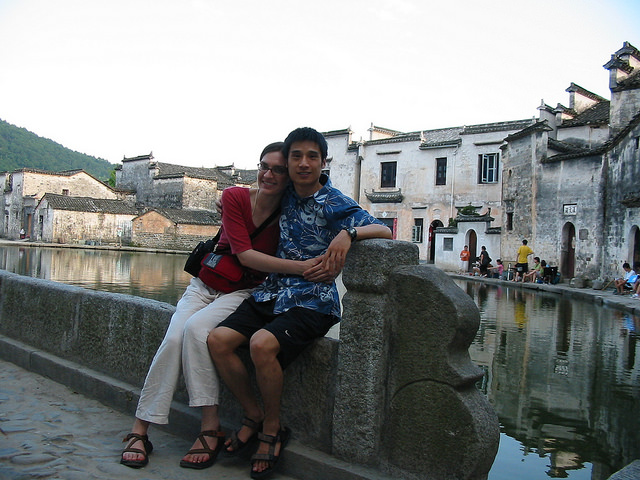
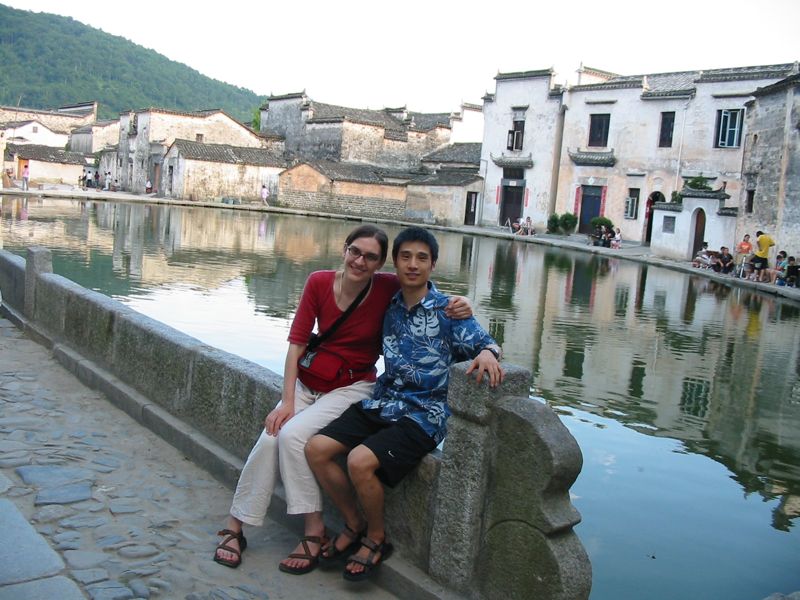
As part of our Huangshan Honeymoon in 2005 (which I wrote about in an essay for the new anthology How Does One Dress to Buy Dragonfruit) we visited a couple of traditional Huizhou-style villages in the foothills of Huangshan. Here we pose before a reflecting pool in Hongcun.
2006
We visited friends in Chicago in February 2006 and ended up strolling beside Lake Michigan, despite the freezing winter temperatures. Who needs to worry about cold weather when you have the love of your life beside you to keep you warm? 😉
2007
The summer of 2007, we returned to John’s hometown to make our marriage official (in the eyes of his family and friends) with a big Chinese wedding ceremony.
2008
Late in the summer of 2008, John and I took off for one last camping trip deep in the Rocky Mountains. What views!
2009
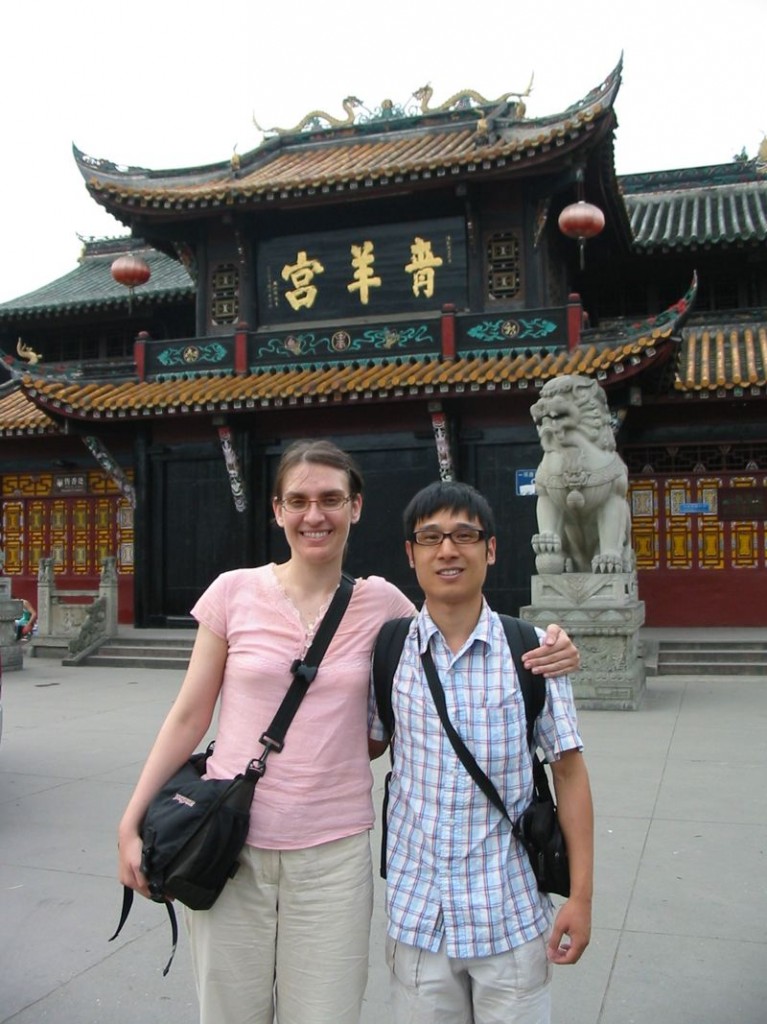
When John and I went to China for the summer of 2009, we indulged in a month-long trip across the country to take in all of the sights we never visited years before — from Xi’an and Chengdu to Changsha and Kaifeng.
2010
John and I welcomed the year of the tiger in 2010 as the emcees of a Chinese New Year celebration. What a night!
To commemorate our wedding anniversary in 2012, we enjoyed a relaxing evening of classical music performed by the Cleveland Orchestra. But before heading out, we posed before the flower garden to remember the evening.
2013
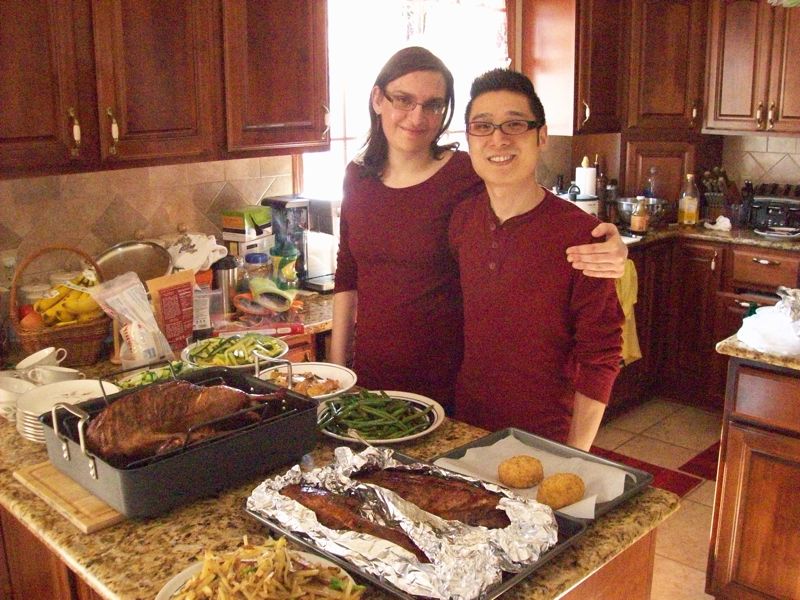
For Chinese New Year in 2013, John and I whipped up a traditional Chinese feast for the family — from roast goose and ribs to ginger-garlic green beans and stir-fried matchstick potatoes. We’re smiling, but there’s exhaustion behind those eyes because we spent the entire morning in the kitchen! Still, it was worth the effort.
2014
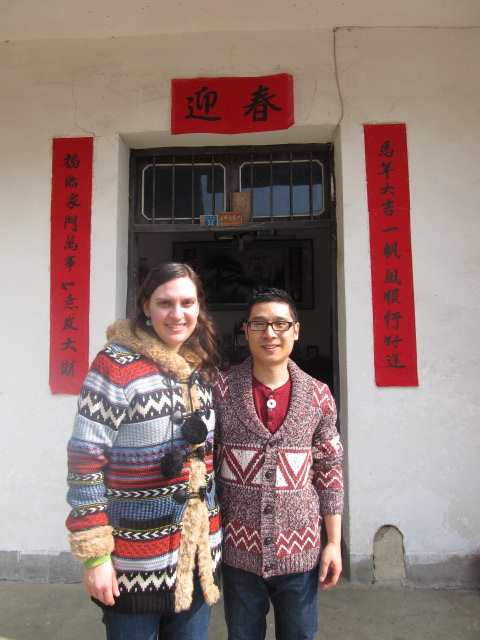
There’s nothing like finally spending Chinese New Year at the family home in China for the first time in years. In 2014, John and I reunited with his family and the country we love.
Here’s to hoping for 10 more incredible years with my incredible man. Thanks for everything, John.
(Note: I’m excited to be giving away one FREE copy of Good Chinese Wife! Want to enter the giveaway? Scroll down to the end of this post for details!)
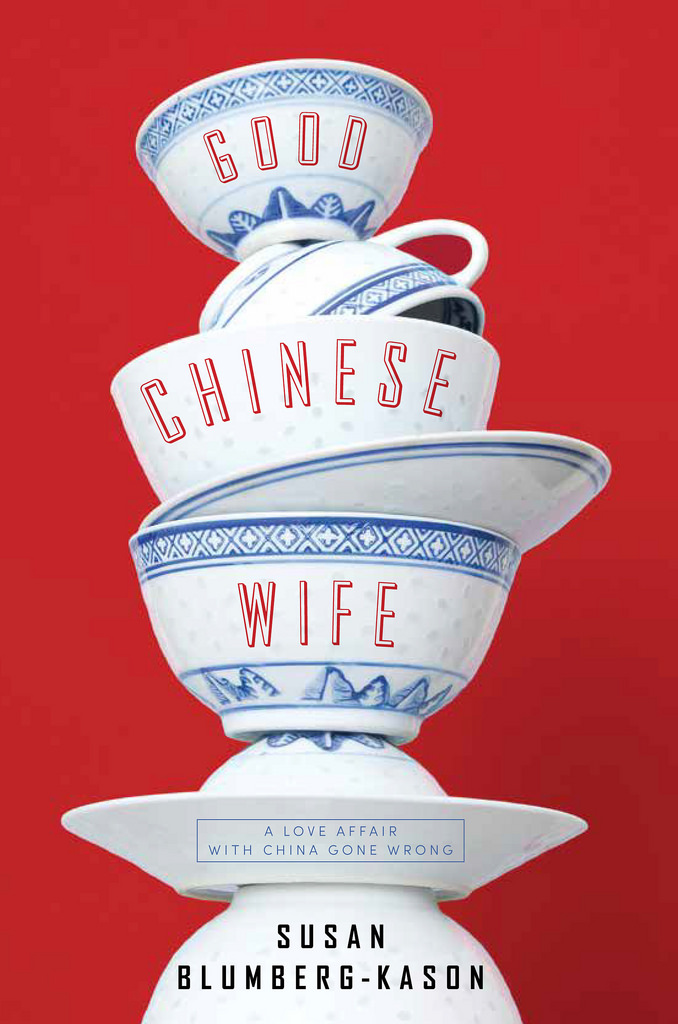
Susan Blumberg-Kason’s new memoir Good Chinese Wife comes with a revealing subtitle: A Love Affair With China Gone Wrong. Before you even open the book, you already know what kind of love this is – a marriage between a white American woman and a Chinese man that doesn’t end well.
I’m calling it the AMWF memoir of 2014 and you shouldn’t miss it.
This book has it all. A Chinese love interest with movie-star looks. A romance set in glitzy Hong Kong. A huge red wedding in Wuhan. A fascinating journey across China in the mid-1990s. And a transformative tale of how one shy young woman eventually finds the courage to make a dramatic escape.
But most importantly, Good Chinese Wife is just an incredibly entertaining memoir. It’s the kind of book that you’ll open, thinking you’re only going to read for a little while, and before you know it you’ve devoured the whole story in one sitting.
Susan Blumberg-Kason
As someone who has known Susan for several years, I’ve had the privilege to witness the inspiring metamorphosis of Good Chinese Wife from manuscript to published memoir. It is an extraordinary honor to introduce you to Good Chinese Wife and Susan through this interview.
A freelance writer in Chicago, Susan has written for the Chicago Sun Times, the Journal of the American Dietetic Association, and Chicago Parent magazine. Her essay “Ninety Minutes in Tsim Sha Tsui” is included in the fabulous new anthology How Does One Dress to Buy Dragonfruit. She also wrote All the Tea in Chicago, the ultimate guidebook to the city for tea enthusiasts.
I talked to Susan to learn more about her memoir – from what inspired her to write it, to her experiences as a yangxifu (the foreign wife of a Chinese man) in the mid-1990s, to what she hopes readers will come away with from her story.
—–
When did you first realize you wanted to turn your story into a memoir? What ultimately inspired you to write it?
I first thought about writing this memoir after my divorce attorney in California asked me to write out everything that went wrong in that marriage. She needed all the details in case we went to trial. It was 14 years ago and I was living with my parents. They didn’t have a laptop connected to a printer and I wasn’t in the mood to camp out in front of the basement desktop—after having felt so isolated for the past five and a half years—so I hand-wrote it over the span of a week in the company of my family. This document was sixty-seven pages! When I proofread it before sending it off to my lawyer, I thought, “Wow! This would make a great book.”
A week later I saw the movie “Not Without My Daughter” for the first time. It was about a woman who almost lost her daughter when her family traveled to Iran to visit her husband’s family. The husband had lived in the US for 20 years, but when he returned to his motherland, he suddenly wanted to stay there and keep his daughter there. I cried because the same thing could have happened to me. I wanted to share my story with others and hoped it would give parents in cross-cultural relationships something to think about if they’re in similar situations.
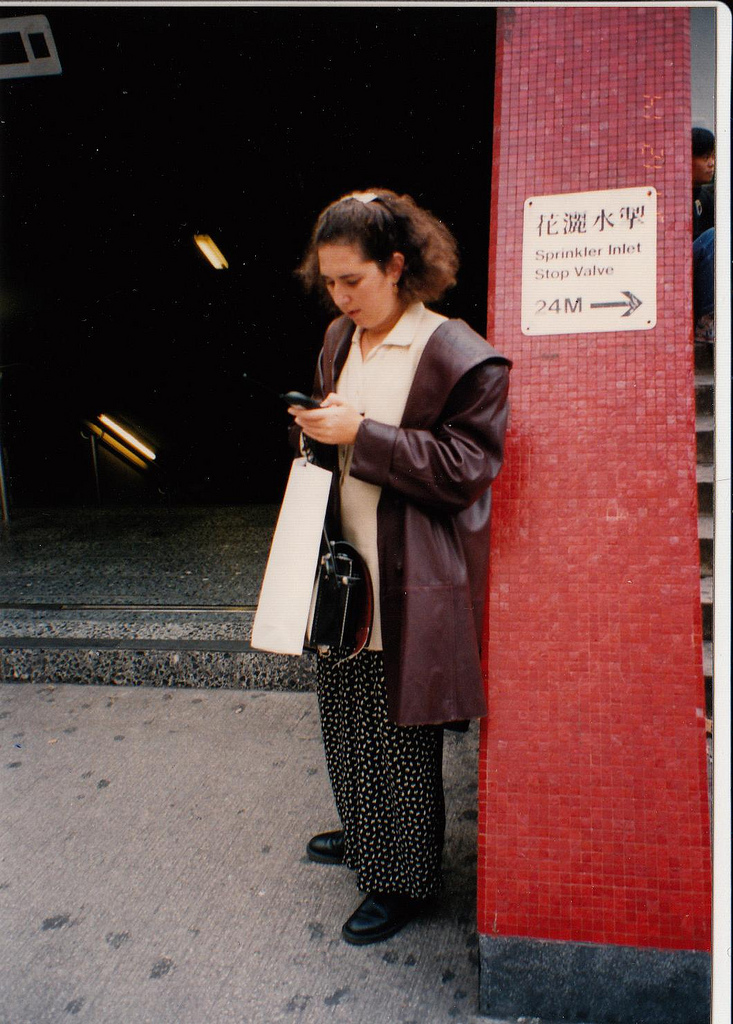
Susan at the Tsim Sha Tsui metro stop in Hong Kong.
Your love affair with Cai, a man from Wuhan, China, takes place in Hong Kong in the mid-1990s, at a time when you were mainly a graduate student. What are some of your most interesting memories about dating in Hong Kong back then?
Hong Kong was magical back then! I was so happy to be back (I’d lived there for a year in 1990-91) and open to new opportunities, including dating. Maybe it was the thrill of being back and the comfort I felt around Hong Kong people, but I definitely took more chances there than I had back in the US. There was a new confidence in the air as people who had left Hong Kong in the 1980s were returning. One was a friend of a friend who confided some pretty heavy personal history to me on our one and only date. At one point he became violent as he grabbed my arms and squeezed them as if in a vice. I was scared about leaving that bar—we were out in the middle of the New Territories—but in the end he paid for my taxi ride home, which was two hours away. I also went out with a television anchorman who promised a weekend away in Macau, but canceled at the last minute. And then there were the two guys I wrote about in the book, the two I went out with before I met Cai.
Hidden River, China – Cai’s hometown in Hubei Province
How did people react to yangxifu back in the mid-1990s?
It was a novelty for Chinese men to have a foreign wife. In Hidden River, Cai’s hometown in Hubei province, his parents had a friend whose son had married a Japanese woman. She was a legend in that danwei—whether or not people had met her—because she was a foreigner. So my inlaws were very accepting of me and liked to brag about me with their friends. When I walked around Hidden River, people were all very polite, even when they stared and pointed at my curly hair and western nose.
Your wedding in 1995 was special compared to the average wedding banquet in Wuhan. Could you share with us some of the things that made your celebration different?
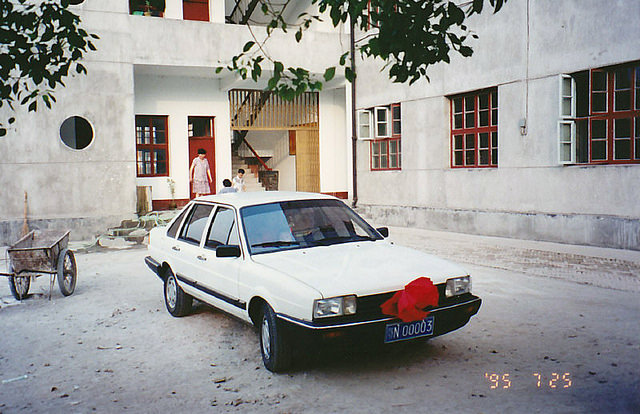
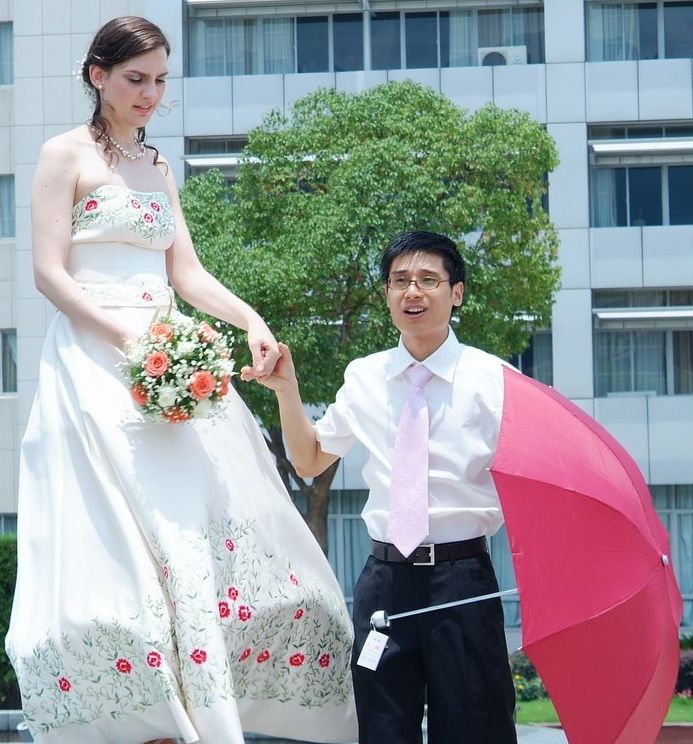
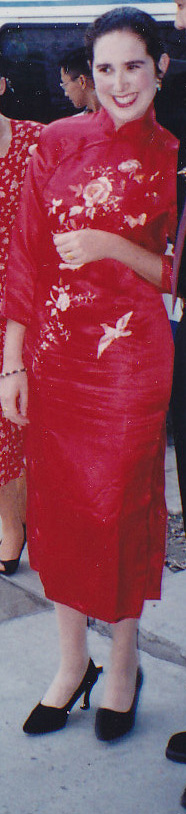
Well, back then children of Communist Party members had to have modest wedding celebrations. For instance, they could only use a couple of cars in their motorcades and could only have ten tables at their banquets. But because I was a foreigner, those rules didn’t apply to my wedding even though my father-in-law was a Party member. We had twenty tables at our wedding and five or six cars. Traditions were still low key in China then, so weddings were simple and quick. There weren’t tea ceremonies and the like. And women in Hubei didn’t wear red qipaos. It was all big poufy white wedding dresses. I had a difficult time finding a red qipao in Suzhou!
Cai’s parents also play a major role in your story. Give us one of your favorite scenes from the book featuring your inlaws.
I think my favorite scene in the book was when they were leaving San Francisco to return to China. They had lived with us for ten months and after many clashes about childcare, I realized too late, of course, how much I had appreciated their presence at home. Every night we watched Chinese soap operas and news from Beijing while Cai went out. And they were often my only adult interaction at home. As we said goodbye at the airport, I also thought about how difficult it must be for them to leave Jake, their beloved grandson. So this scene is full of contrasts and difficult emotions.
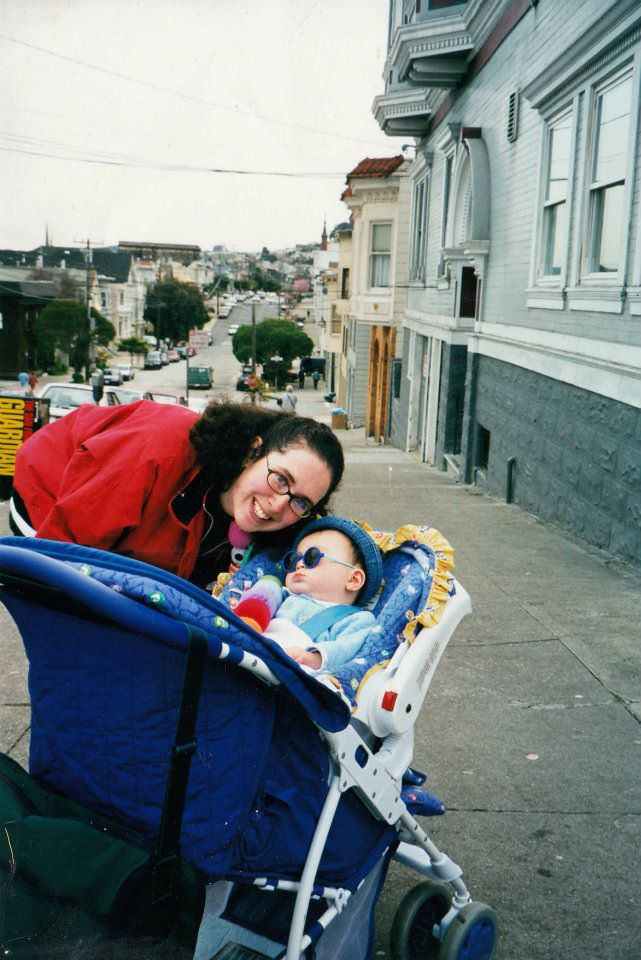
Susan and Jake in San Francisco in 1999.
Your book includes many memorable characters, but none more so than “Japanese father” — a rather unconventional father-figure to Cai. Without giving everything away, could you tell us something about this fascinating character?
Japanese Father was a music professor who visited China one summer and met Cai in Wuhan. The two became pen pals and wrote long letters to each other almost every week. The Japanese economy was so far ahead of China’s at the time—it wasn’t even comparable—so the opportunities that Japanese Father could offer Cai, and later his friend Rui, were very attractive to young teachers who had no other way of making more than US$75 a month. Japanese Father had a lot of time to spend on his Chinese protégées because he was estranged from his wife and son. His daughter still spoke to him, though.
Susan at the Miramar in Hong Kong.
As the subtitle explains, your story is “a love affair with China gone wrong.” Some people may see your book as yet another story that casts Asian men in a negative light, as well as AMWF relationships and even China itself. How would you respond to those concerns?
The subtitle refers to my initial attraction to China and how that all changed. It wasn’t necessarily a bad thing; it just didn’t go according to plan. As for a negative portrayal of Asian men, I can only see two Asian men who don’t come out looking great. Some reviewers think that Cai is sympathetic, and I can see that, too. But the others—Baba, Cai’s friend Rui, my former brothers-in-law, and even the guys I dated in Hong Kong—are portrayed just as men in any other countries. They have a variety of positive traits and aren’t lumped into one general category. And as one friend pointed out, at the end I go to lengths to protect the Chinese male who matters most to me—my son Jake. As for AMWF relationships, I clearly do everything I can to make mine work. In writing my story, I hope that people will see how not to conduct an AMWF relationship! And as for China, I felt aligned with many young Chinese at that time. Every time Cai and I returned to China, he was heartbroken that it was changing so quickly and wasn’t like the China of his childhood. I echoed his feelings and could see how things were different even from my first trip to China in 1988. To me, that’s not being anti-China, but rather wishing for a smoother transition, for China to have eased into the twentieth century instead of leaping into the twenty-first in one blink!
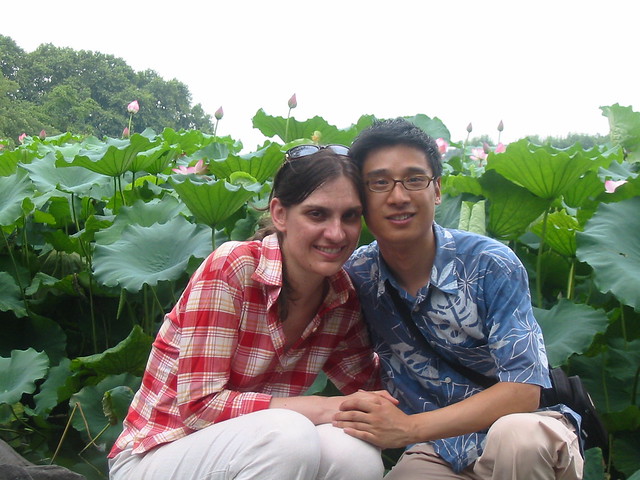
In Hidden River, Cai’s hometown near Wuhan.
Could you share some of the lessons you’ve learned from your courtship and marriage to Cai, and what you hope readers take away from your book?
From the courtship, people will probably conclude that I married Cai too quickly. But I think it’s more than that. He told me from the get-go that he had certain conditions for our marriage. Those are things I ignored or thought I could eventually get him to change. That should have been my red flag, not the time in which we became engaged and married. And from the marriage, I hope people can see that it’s not a good idea to justify bad behavior in the name of cultural differences, whatever those may be. (Unless we come from the exact background as our partner, we will have cultural differences. My new husband and I are from different religious backgrounds.) If something doesn’t sit well, it doesn’t sit well and shouldn’t be tolerated. It doesn’t matter if the person is from Asia or the US or wherever. One more thing: just be yourself and you’ll be fine!
Want to win a FREE copy of Good Chinese Wife? I’m giving one away on Twitter to anyone based in the US or Canada. And it’s simple to enter! Just tweet the following:
[Tweet “@jossailin is giving away the new memoir #GoodChineseWife and I want to win!”]
Entries must be received by 12 midnight Pacific Time on July 16, 2014! I’ll then notify the winner via messaging on Twitter. Good luck!
UPDATE: Congratulations to @JohnWGuise for winning the giveaway!
You’ll find my essay “Huangshan Honeymoon” included in the anthology, which explores a very different kind of honeymoon my husband and I enjoyed in 2005.
How was it different?
Well, yes, we planned our vacation around the chance to hike all the way up to China’s Huangshan or “Yellow Mountain”, instead of the typical honeymoon of sunny days spent lounging on golden sand beaches sipping tropical drinks and intimate twilit evenings laying in each others’ arms.
And yes, we chose to set out at the height of summer’s most sultry days, and stay in a region where July and August are feared for the ferocious heat of the “Autumn Tiger” that comes around every year.
But ultimately, this is what made our honeymoon so unusual: John’s father came along with us!
I never thought I would share my honeymoon suite with a man who once advised his son not to date foreign women. (Then again, I suppose he never imagined he’d have a foreign daughter-in-law!)
And as if that wasn’t enough, the heavens also brought us some of the lousiest viewing conditions for the mountain, thanks to the remnants of a typhoon that enveloped the scenery in a misty cloud of rain and fog.
(This is the one and only photo that offers a hint to the breathtaking views we should have enjoyed, had the weather cooperated!)
Why did we bring John’s father along? And how did that experience change my relationship with his father forever? You’ll find all the answers (and much more!) when you buy a copy of How Does One Dress to Buy Dragonfruit and read the essay. Don’t miss out on a collection that I can’t stop raving about! (Okay, yes, I am biased but it’s still really an amazing book.)
Sometimes, I think the love of a Chinese family is one of the best kept secrets in the world. And if ever there was an example of that, it’s our upcoming move to Hangzhou. As we trade the countryside for city life, I still can’t believe how my husband’s family has gone out of their way to help us make the transition.
Okay, I know rice cookers, pressure cookers, dishes, woks and bedding don’t appear out of thin air. But when my mother-in-law suddenly pulled out all of these brand-spanking-new things (and more!) from storage in our house, it felt like some magic trick. Or the wedding registry I never imagined I had signed up for.
Because, after all, we never asked them to buy any of these things. But they bought them anyway!
My mother-in-law has continued this apartment hocus-pocus almost every day leading up to the move, trotting out new things during lunch, and has even pulled a few extra-special surprises out of her own proverbial hat (including honey and even veggies from her garden).
Making it an auspicious move
“It’s not superstition. It’s the Book of Change, a Chinese tradition.” Whether or not you agree with my father-in-law, the fact remains that good luck matters to my in-laws in every important aspect of life — including moving house.
So naturally, once we announced the news on Saturday, my father-in-law whipped out that indispensable little red book in his library — the Chinese Farmer’s Almanac, based on China’s Book of Change. It lists every date in the year, recommending what you should and should not do on that date. According to his almanac, the best upcoming date for our move (and preparing our new bedroom) would be this coming Tuesday, May 27.
And believe me, this stuff counts to them. How much? Enough for my mother-in-law to make a second phone call to my husband’s oldest brother (who initially said he couldn’t move us on Tuesday), convincing him to do it earlier in the day!
Money? We didn’t ask for money!
Compared to so many Americans I know, Chinese families seen to operate on a completely different wavelength when it comes to money — and my husband’s family is no exception.
You don’t even need to ask them, “Could you lend us some money?” It’s a given they will, which I still haven’t quite gotten used to (yes, I am a bag of nerves whenever John has to borrow cash from his family — and John always thinks it’s so funny).
And more often than not, you don’t even need to bring up the topic of money with them — because they’ll do it first.
That’s exactly what my father-in-law did the other day when he sauntered over to John and me in the yard. John’s dad had this serious look on his face that made me all nervous inside, as if he was like my dad and about to lecture us on something we messed up in his house. But this “serious talk” turned out to be nothing more than him saying, “You’re going to need some money for your move. How much?” (A question that, of course, I felt too embarrassed to answer. I mean, here’s my father-in-law approaching me with a gesture that seems too generous to be real, and expecting me to give him a number?)
Days later, I discovered a thick stack of crisp, red bills lying in the corner of our room — an amount that turned out to be more than three times more what I expected!
Sometimes it’s not even a question, but an order. Like, yesterday John’s oldest brother phoned him out of the blue just to say “Open an account so I can send you some money” when John hadn’t even asked for it. After my husband recounted this to me, I was shocked (in a good way)…and then almost wanted to pinch myself.
Nope, it wasn’t a daydream.
In the end, it’s all about the love
My Chinese relatives will never hug or kiss us, or say how much they love us the way my American relatives do. But they’ll pony up brand-new apartment essentials and money without us asking them, and make certain we move on the luckiest possible day. It all comes down to one simple idea — this is how they show us their love.
Now if you excuse me, I’ve got a move to get ready for. Hangzhou, here we come!
In Hangzhou, the city where John and I fell in love — and love with all our hearts!
I have been reading your blog for some time now and the majority of your female readers are independent, intelligent women whom have (some) “feminist” values/ideas such as equality, rights, freedom of choice.
I would like to know has being married to a Chinese man and to the Chinese “extended family” changed your…“feminist” ( independent ) views? Did you have to change your way of thinking and adapt to situations, traditions, culture that may not share your own ideas and beliefs? Do you accept things in China that you wouldn’t accept back in your own country? If so how did/do you handle this? How does it make you feel?
—–
I thought about this question for many weeks and could never seem to come up with the right answer. And then I realized the issue here — the thing is, my marriage to John hasn’t really changed my core feminist/independent views all that much.
See, I married a feminist guy who just happens to come from the countryside of Zhejiang, China, as I’ve written before:
Over the years, from dating through marriage, John continued to blast stereotypes about Chinese men, that they’re so sexist. He loved my larger, curvier body in all of its beautiful imperfections, and never suggested I change a thing. During all those times when I was the family breadwinner, he always felt proud of me and my ability to make a living. He grew up in a household where no one hit women and children, and condemned domestic violence in all of its forms. He kept doing the dishes and his share of the housework, and never assigned a gender role to any household chores.
John has always loved me just as I am and always supported me in my endeavors, even when it comes to writing about him and our marriage together. In fact, if it wasn’t for him, I wouldn’t be writing this blog at all!
As for his family, sure, not everyone is as progressive as he is. But that doesn’t mean that I’ve had to somehow change myself to fit their expectations. We can disagree. And if we do, I usually say something to them. It might surprise you, but I find it far easier to speak up in front of his family as opposed to my own in the States. Perhaps it’s because foreigners in China are expected to be a little weird and get a pass when we do things differently. Maybe it’s because I’m speaking to them in a foreign language, which liberates me because it’s not the language I grew up with. And it probably helps that John’s parents (and most of his family) don’t fit those stereotypes of the strict and conservative Chinese family.
Of course, there are things about Chinese culture that, on the surface, seem to clash with feminist/independent views. Take for example the dependency among family members in China and the expectation that children should care for their parents when they’re older. Yet, some families in the US do these things too. My dad invited his father (my grandfather) to spend his final years living together with him, and my aunts and uncles take care of my grandmother so she doesn’t have to stay in a nursing home. As independent and feminist as I am, I still believe these are good values and would want to do the same if John’s parents needed our help.
And ultimately, there’s a difference between understanding a culture and completely overhauling your own views for someone else. It’s important to know and respect your partner’s culture, but that doesn’t mean you have to hide who you are to do it. Otherwise, you’re just dealing with a one-sided relationship and those are usually doomed to fail. Just as I’ve become closer to John’s culture, he’s also become closer to mine — and the whole process has only made our marriage that much stronger. Yet when it comes to our beliefs and our way of thinking, we’re still pretty much the same as we were all those years before when we first met.
Maybe my marriage really is unusual. And maybe to some people I might not seem “independent enough” or even “feminist enough”. But then again, that should tell you that there are no hard or fast rules for cross-cultural marriages in China or even what defines a woman as independent and feminist.
Sometimes, you really can find happily ever after in the most unlikely places in the world. 😉
How about you? How would you respond to this question?
—–
Do you have a question about life, dating, marriage and family in China/Chinese culture or Western culture? Send me yours today.
Kumbum Ta’er monastry at Xining, Qinghai China (photo by Remko Tanis via Flickr.com)
This week, I’ve stumbled upon a number of incredibly unique stories in the blogosphere about Chinese men and Western women in love. While I’m on deadline these days (and need a break from my usual posts) I thought I would share some of these fantastic blogs/posts with you. Enjoy!
A Tibetan-American love story in Qinghai
Earlier this week, a reader tipped me off to a few new AMWF bloggers — and one of them fascinated me the moment I read the short intro in her blog’s sidebar:
I’m Kimberly, an American lady living in western China with my Tibetan husband and our beautiful baby girl
Following my stint in the home of Peking Duck, I went back to the states to get my Master’s Degree in Library and Information Science. (That’s right, I am a certified librarian.) By then I was itching to get back to China and decided to make my home out west, where the air is cleaner, the food is heartier, and the people are diverse.
I used to joke with my parents before I left that I was going to find a nice man there and settle down. To my surprise and delight (and my mother’s disappointment) it really happened. K and I were married on July 28th 2012…
…and on August 2nd 2012. We had two weddings, one western style in the city and one Tibetan style in the village.
I’ve had my share of relationships with Chinese men (including my marriage to John), but I’ll never know — as Hannah Lincoln has reported on Beijing Cream — what it’s like to date a Chinese pop star:
Xiao Li was part of a gang of pop-folk musicians that included not just his band mates, all singers, but also their brothers and cousins and mentors and girlfriends and gal pals.
I had gone that night to get my culture on and enjoy some folk music. Awkward but uninhibited, I picked off one of the shy ones to practice my Chinese. We were having a pleasant conversation until his strikingly handsome friend cut in. He said I was really pretty and clinked beers with me. When I replied in Chinese, he slapped his hand on his face – “Wah! I didn’t know you’d understand me!” He then asked for my number, said he wanted to treat me to a meal.
…After a few weeks, I looked up Xiao Li’s band on Baidu. Apparently they had won China’s version of American Idol and were a go-to choice for the Party at official events.
Hannah recounts her time as the girlfriend of a pop star in China with honesty about it all, including her own missteps in the relationship. It’s a long post, but also worth reading and discussing.
What one Chinese man thinks of his foreign girlfriend
It’s no secret the the vast majority of stories about Chinese men and Western women in love are written by the women. And if we do hear from the men, rarely is it about a relationship that blossomed in China — one that, for that matter, is still going strong.
But Marta changed my point of view. She knows what is the real happy life, she prefers traveling to different countries rather than buying a CHANEL, she thinks we do not need to buy a house of our own(sorry but that is still one of my shot-term aims), she prefers walking more than driving a car, she is so kind and so nice to every member of my family, she is always so kind and polite, and she loves music.
This website uses cookies to improve your experience. We'll assume you're ok with this, but you can opt-out if you wish.AcceptRejectRead More
Privacy & Cookies Policy
Privacy Overview
This website uses cookies to improve your experience while you navigate through the website. Out of these cookies, the cookies that are categorized as necessary are stored on your browser as they are essential for the working of basic functionalities of the website. We also use third-party cookies that help us analyze and understand how you use this website. These cookies will be stored in your browser only with your consent. You also have the option to opt-out of these cookies. But opting out of some of these cookies may have an effect on your browsing experience.
Necessary cookies are absolutely essential for the website to function properly. This category only includes cookies that ensures basic functionalities and security features of the website. These cookies do not store any personal information.
Any cookies that may not be particularly necessary for the website to function and is used specifically to collect user personal data via analytics, ads, other embedded contents are termed as non-necessary cookies. It is mandatory to procure user consent prior to running these cookies on your website.


















 Your wedding in 1995 was special compared to the average wedding banquet in Wuhan. Could you share with us some of the things that made your celebration different?