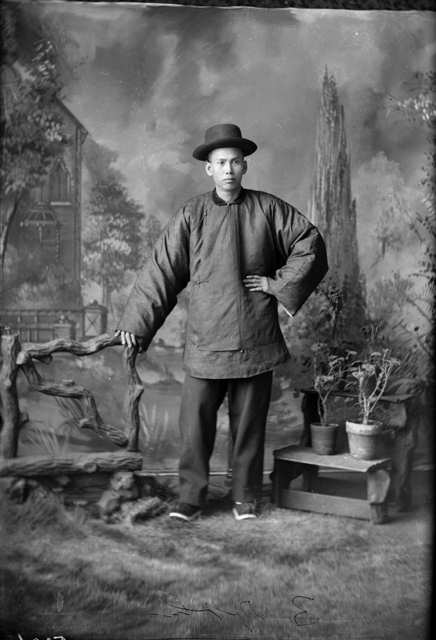
A Chinese American man circa late 1800s/early 1900s.
Chances are, if you’ve ever been in an interracial or intercultural relationship, you’ve experienced your share of negative comments or racist remarks.
But at least you’ve never been arrested, like Sarah Burke and Wong Suey Wong were in San Francisco, California in 1883. That’s just one year after the Chinese Exclusion Act was passed.
Here’s the initial story from the San Francisco Chronicle, 7 April 1883 (per Frederickbee.com):
Officer Travers brought to the city prison at 12:30 o’clock this morning a Chinaman on whose arm whose was hanging a pretty young girl of some twenty summers. The couple proved to be no others than Wong Suey Wong and Sarah Burke. The arrest was made at 728 Jackson Street, a house of ill-fame, being the abode of several Celestial courtesans. Here Sarah Burke was found, in one of the upper rooms, in a bed completely hidden by sheets used as curtains. At the police station she said that she had gone to the house on Tuesday last, knowing that it was a house of ill-fame, but not caring, since in a day or two she would be legally married to the choice of her heart, with whom she has been living for the past five months. On being parted from her Chinese lover she squeezed his hand, which he returned with equal fervor. In the Chinaman’s pocket was found, besides a receipted bill for a bed and a spring mattress, a photograph of his fair amorata, from which he parted with evident reluctance. He was charged with felony in having lodged a girl under age in a house of ill-fame, while she was booked for residing in a house of prostitution.
In other words, the authorities dredged up some pretextual reasons to throw them in jail, since they didn’t like the idea of a Chinese man and a white woman being in love.
And if you had any doubt as to how people felt about a relationship like this in those days, well, read the first line of the April 8, 1883 story in the San Francisco Chronicle follows on 8 April 1883 (per Frederickbee.com):
Sarah Burke, who has unalterably set her mind upon a disgusting marriage with a Chinese laundryman, acknowledged that she had passed a dismally and frigidly cold night in prison on Friday. Wong Suey Wong, her Mongolian fiancée, coincided in this experience. About 11 o’clock yesterday morning some of the pair’s Chinese friends obtained the release of the couple on bonds in $100 each.
This April 8, 1883 story highlights the challenges the couple faced in trying to marry, noting, “…it was fortunately discovered that for decency’s sake a marriage between a white and an Indian, mulatto or Mongolian, was prohibited and therefore the County Clerk could issue no marriage license.” Sarah and Wong’s only options were a marriage under a civil contract or a marriage without a marriage license.
But it gets worse when Sarah’s father attempted to have her committed to an institution for insanity, “who deemed the fact of her infatuation for a repulsive Chinese sufficient grounds for believing that she had lost her reason.” Ugh!
Here’s the story in the San Francisco Bulletin 12 April 1883 (per Frederickbee.com):
The father testified that his daughter had always been possessed of ordinary common sense until about the first of last January, when she conceived her unhallowed desire to wed Wong Suey, since which she had acted as though possessed of the Infernal One. He had never had any reason to doubt that she was a chaste and moral girl until now. Sarah Isabella was also examined. She again reiterated her love for Wong Sue, and desires to marry him….
The Commissioners, however, concluded that they could not commit the girl as insane. She was evidently suffering from a moral eclipse, but her mental trouble did not, in their opinion, come within the meaning of the law….
The story even chronicles how “a stalwart policeman grabbed Wong by the nape of the neck and small of the back, and hurled him into the hallway adjoining the Commission” after Wong entered the room and embraced Sarah. Horrible!
The words echoed through my mind like a bad nightmare. No, this isn’t happening. No, the emergency room doctor surely couldn’t have told me that. It’s impossible. I don’t even feel that bad. I can walk. He can’t be right. How could I need my appendix out?
But the bigger shock, more than the diagnosis, was the prospect of going under the knife in China.
I’ve lived in China for a total of 8 years (including the five and a half years I lived in China in the 2000s) and I’ve seen a lot of hospitals here.
Some reminded me of the hospitals back in the US – bright, clean and with high standards of care.
But others, like this emergency room where I’d just received the diagnosis, were the kind of crowded, sagging, institutional hospitals that made me anxious about surgery.
But if not there, where? We had to find a hospital fast. I knew enough about appendicitis to realize that if you appendix ruptures, it’s much more serious. With every minute I felt a fever coming on, a troubling reminder that I was indeed ill and desperately needing treatment.
Suddenly, my husband remembered his classmate had just transferred to a new Zhejiang University-affiliated international hospital, where she heading the nursing department. We decided to give it a go.
When my husband and I stumbled into the hospital emergency room at sometime after 4am that morning, the two of us never expected that I was about to have more than just a successful appendectomy. That we would have some surprising experiences — including positive experiences that would forever change the way I think about hospitals.
Here are 6 surprising experiences I had while in a Chinese hospital:
(Photo by Wendy via Flickr.com)
#1: Cutting up the hospital pants so I could wear them
We all know the hospital drill – once you’re admitted, you’re asked to strip off all your clothes and put on the hospital clothes. Thankfully, the hospital used hospital shirts and pants (instead of the mortifying hospital gown common across America with that infamous no-privacy slit in the back).
Now imagine my shock when the nurse hands over a pair of pants with a waistband that’s a little too small to fit for comfort. Especially with that wicked tight elastic, guaranteed to torture my already stressed-out stomach.
Yikes!
In retrospect, I should have totally expected this. While I’m an average and popular size in the US, I’ve struggled to fit into things like underwear and even pants in China. And when I do buy, it’s usually online and usually some crazy XXXL or XXXXL size. I know!
But it’s another thing entirely when you’re presented with a pair of pants you have to wear — with the most sadistically small elastic band you’ve ever seen. All because the hospital doesn’t run larger sizes for women.
So there I am, sitting on the toilet in the bathroom, hanging my head half in discomfort from the appendicitis and half because I can’t see how I’ll ever fit into the pants without feeling like my innards are caught in a vice.
Then the nurse says, “Try cutting them,” and hands Jun a pair of scissors. Sure enough, my husband eventually hacks off half of the waistband – and voila! They fit!
Fortunately, after that first day the hospital let me wear my own soft, roomy drawstring pajama pants from home. I don’t know if it was out of sympathy or because it’s too ridiculous to have to chop up hospital pants just to make them wearable. But I’ll take it. Sure beats a hospital gown!
(Photo by SonnyandSandy via Flickr.com)
#2: Waking up to my appendix in a plastic bag
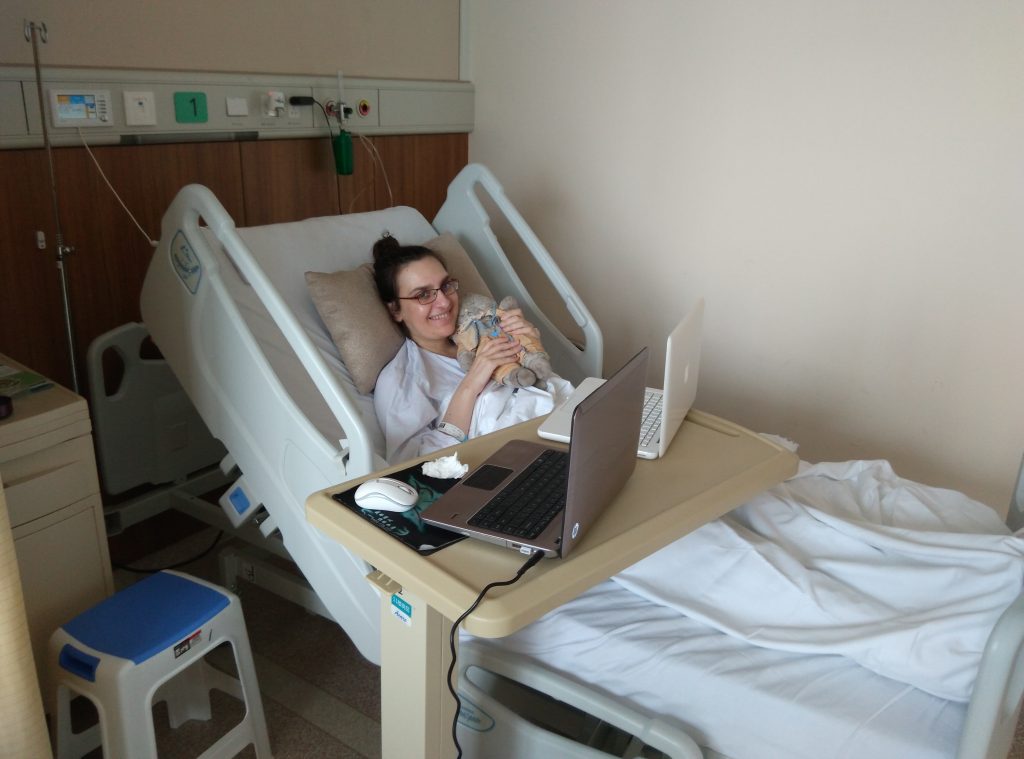
Disoriented, post-operative me got quite the awakening after coming out of surgery. First the doctor told me how successful the surgery was, leading me to shed tears of relief. And then, as proof of his work, he dangled my appendix above me in a plastic bag.
Did I mention that I gag at the sight of blood and guts?
Someone explained later on that this is common in hospitals in China. They always show patients what they removed from your body, if they removed something. It’s like a visual confirmation that the surgery was completed.
Fortunately I wasn’t wearing any glasses or contacts, so the blurry appendix appeared more like a slimy brown salamander. Thank goodness I didn’t throw up in the recovery room.
Nope, I saved the throwing up for later that evening, when the smell of my husband’s dinner caused me to vomit all over my clothing. Fun times, huh?
My husband looked even more serious — and pale — than this photo!
#3: That time when a specialist asked my husband to go outside to talk about me…and I thought I was a goner
“I need to speak with your husband outside.”
These have to be the eight deadliest words a doctor could have said to me in the hospital. Back in America, this would be code for, “You’re dead.”
There I was, just after getting my “nether region” checked by a different specialist (I’d rather not say why – embarrassing personal stuff), and the guy asks MY husband to step outside with him. I was already totally unnerved by having a doctor examine me down there, and now he thinks I’m a goner?
Even my husband freaked out. Jun is usually the easygoing side of our duo – the one who’s always laughing and optimistic, who never takes things too seriously. But those eight little words from the specialist drained the all color from his face.
The 30 seconds that elapsed – when the specialist was with Jun in the hallway – had to be one of the scariest moments in my hospital stay. I was laying there on my side, thinking the worst as I clutched the hospital bed in total fear.
Turns out, though, it was nothing serious at all.
It was a totally common, benign problem and they just prescribed some medicine for me. (I was so incredibly relieved when my husband reported this that I began sobbing so loudly two nurses ran into my room to ask what was wrong.)
Later, a nurse told me that it’s typical in Chinese hospitals to speak to the family members, rather than patients, about their care. Even when it’s something totally common and easily treatable, like my case. (But the hospital said they’re hoping to change this and instead communicate more directly with their patients.)
Still, after it all passed, my husband and I actually had a good laugh over it. I swear the image of my husband’s ashen face before going out into the hallway will be forever ingrained in my memory!
#4: Some of the nicest, most caring nurses I’ve ever met
My experiences with nurses in America and even China have been a mixed bag. Some have been friendly – and others so bored you almost wonder if they’re going to miss your vein for that blood sample. Smiles aren’t a given. Sometimes, you feel more like a commodity than a patient.
Not at this hospital. The nurses who cared for me always walked into my room with huge smiles and an extraordinary willingness to help me in any way they could.
One nurse piled my hair into a neat little bun everyday to make me look nice – and even brought me special breakfasts a couple of times. Others helped me brush my teeth (just after the surgery), wash my hair, and bring me more comfortable pillows. They always looked for the biggest, most comfortable shirts for me wear (remembering that I was that extra-large size compared to the average woman who stayed in the hospital).
The nurses there really made me feel like they cared about me as a person. It was a powerful experience. I fully believe that their warmth and positive energy was just as critical to my recovery as the medical care I received.
#5: Really good food (including dumplings) from a hospital!
We’ve all heard the jokes about hospital food. And we all know dining in a hospital room usually comes with even lower expectations than airplane grub. So the last thing I ever expected was to come out of the hospital raving about the food.
That’s right – I actually liked the hospital food.
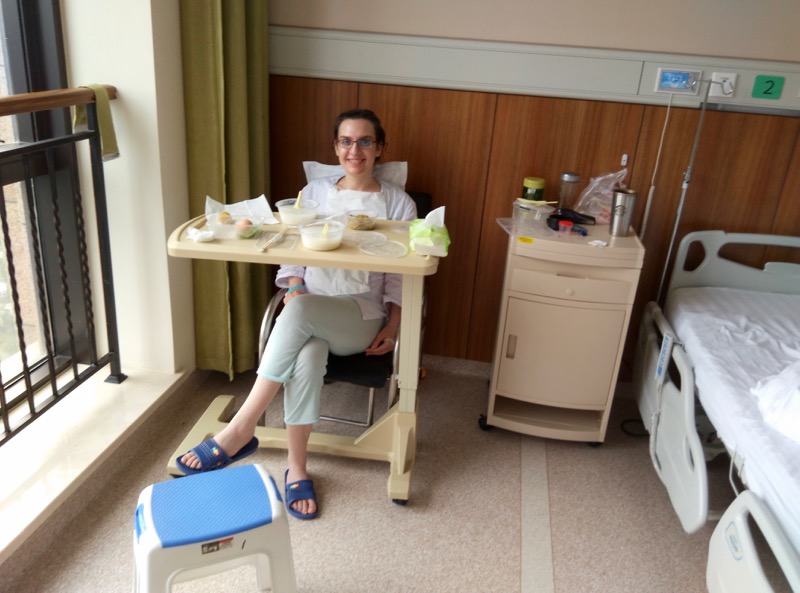
When the hospital found out I was a vegetarian, they sent down the head of their nutrition department, who worked up a special menu of stomach-friendly stir-fried veggies (served with rice porridge). That first evening, they sent me a dinner of pumpkin and winter melon. During the whole meal, I couldn’t stop saying “mmmmm” with every bite. Even my husband, who cleaned up my leftovers, had to agree the dishes were exceptionally tasty.
As my stomach became accustomed to more food, they even prepared me vegetarian dumplings from scratch filled with tofu and greens, served in a broth reminiscent of won-ton soup. Delish!
#6: Changing the way I see hospitals for the good
I’ve always had a certain dislike of hospitals and health care, and I trace it back to a traumatic experience I had in the hospital as a toddler. They had to forcibly strap me down to stitch up a gash in my forehead. It was so upsetting that it’s still a part of my subconscious, forever linking nurses, doctors and hospitals in my mind with really negative experiences.
But this hospital in China completely changed my perceptions.
The doctors in the hospital weren’t just skilled medical professionals (who left me with almost no visible scars from the surgery). They were also friendly, easygoing people who put me at ease and even had me smiling. One of the doctors was always laughing when he came to my room, and his laughter was a welcome sight in the hospital.
Add to that the incredible nursing care as well as the food, and it’s no wonder I feel grateful to have landed in such an excellent hospital. I never imagined that, in my emergency situation, I’d end up with great care.
Thank you, Zhejiang University International Hospital, for showing me what a hospital really should be.
Have you ever been in the hospital in China or abroad? What experiences did you have?
In China, there’s nothing that strikes fear into my heart quite like the phrase, “Let’s attend a wedding.”
I should know. A little over a week ago, I was worried when my husband’s old classmate was about to have a wedding banquet – and kept insisting that I simply had to come.
My palms started to sweat and visions of wedding banquets from hell in China flashed through my mind.
(Sadly, almost every wedding banquet I’ve experienced was pretty hellish in one way or another…)
The classmate tried really, really hard to persuade me to come. He offered to take care of everything that worried me about weddings, promising things would be different this time.
As much as I knew he was a nice guy, and as much as my husband trusted him so much he called him a “brother”, I wasn’t exactly buying it.
It’s not that I didn’t believe in his hospitality. It’s just that I know better about weddings in China. I know the drill. I’ve been there and done that. And I never, ever, want to go again if I can help it.
Here are my 3 reasons why I really dislike going to weddings and wedding banquets in China:
#1: I’m a vegetarian, which means I won’t have anything to eat
Wedding banquets in China are renowned for being extravagant feasts, with more dishes than everyone could humanly consume.
In theory, nobody should leave the table hungry.
But I, on the other hand, have left most wedding banquets in various states of hunger. At best, slightly hungry and requiring an additional snack; or at worst, so famished I ended up leaving the banquet hall before the affair was over.
That’s because wedding banquets almost exclusively serve up the finest meat and seafood dishes, while I’m a vegetarian (vegan actually) pining for something that’s not on the menu.
In China, people assume everyone eats meat, seafood and even eggs – and can’t imagine that there are people like me with special dietary needs. It’s such a problem that even dishes that technically ought to be vegetarian – like Chinese kale or tofu – end up being prepared with non-vegetarian ingredients like lard, ground pork or oyster sauce.
It’s bad enough to come for dinner and find there’s nothing for you to eat. But it’s pure torture to watch everyone else at the table blissfully devour their dinner while your stomach grumbles in vain.
Unfortunately, I’ve had this experience a few too many times at weddings in China. It’s enough for me to mentally link the occasion with “starvation” in my mind – and want nothing to do with wedding banquets in China.
Now, my husband’s friend did promise he would have commissioned the kitchen to prepare all the vegetarian dishes my heart desired. That was incredibly generous of him to offer. Still, that wasn’t enough to tempt me, because it’s not just the food that makes weddings in China so aversive to me…
(Photo by MiKi via Flickr.com)
#2: People usually smoke at wedding banquets in China, and I hate secondhand smoke
My husband and I are both fervent nonsmokers. We detest secondhand smoke and don’t want it crapping up the dining table – including when we eat out.
Well, it’s common practice at weddings in China to pass out cigarettes, guaranteeing most of the people there will light up. (And guaranteeing that if I were there, I would be coughing and hacking in agony.)
True to form, they distributed the Zhonghua brand smokes at my husband’s classmate’s wedding. My husband reported that the banquet hall was mired in a noxious cloud of smoke. Yuck!
#3: Weddings in China can be huge, overwhelming events — and I prefer small, quiet affairs
I’m an introverted, quiet kind of gal. I prefer long hikes in the mountains, lazy afternoons writing articles on my own, or reading a fantastic book all morning. I’m not a big party person, but when I do go I usually end up in the most low-key place with a handful of people to talk with – generally the kitchen. Loud noises unsettle me and crowds make me nervous.
In other words, I’m not at all suited for the kind of atmosphere you’ll find at most wedding banquets in China. You know, packed with at least 100 (and often more) people and often so noisy it’s difficult to carry on a conversation at the table.
Indeed, I’ve left more than a few wedding banquets in China wishing I’d just spent that time reading a good book instead.
The other night, while staying over at my in-laws’ place in the countryside, my husband and I were just about to get ready for bed when it hit us.
Oh crap, we’d left the laundry in the washing machine all afternoon. We’d forgotten to hang it out to dry.
We bounded downstairs to the laundry room with flashlight in hand, and fully expected to spend 10 to 15 minutes doing what we should have done more than six hours ago.
Except, when I ran over to the washing machine, it was empty. Totally empty. And when I turned my head, sure enough, there was our laundry, neatly hung on clothes hangers on a bamboo rack.
As much as I felt relieved that I’d been saved the trouble of doing that laundry this evening, a slight sense of guilt pricked me.
Once again, my mother-in-law had done housework for me. Housework I could have easily done for myself…and should have done, given it was my laundry.
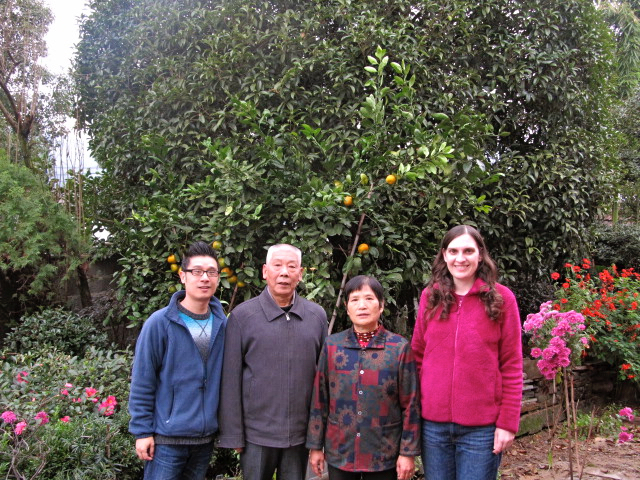
It’s embarrassing to admit that I’m in my thirties and still enjoy laundry assistance from my mother-in-law whenever we stay at her home in the countryside of Zhejiang Province. But it’s true. This sort of thing happens ALL the time.
So in the spirit of being honest, I’m sharing 4 embarrassing things that I’ve experienced with my Chinese in-laws. Here they are:
#1: My mother-in-law will still do laundry for us
Yes, it’s true. My mother-in-law has been known to hang up my clothing left in the washing machine…and she’s even done entire loads of laundry for us.
To be sure, though, I generally don’t ask her to do it. Even I know it’s embarrassing to be in your 30s and have your parents or in-laws do your laundry. (I mean, come on, anyone who has seen Legally Blonde would remember how Elle and Brooke howled over the fact that Warner still took his laundry home to get it cleaned.)
Here’s what usually happens. Either I put the clothing in the washing machine, but stupidly forget to hang it up on time (like I mentioned in the introduction). Or, my mother-in-law grabs my dirty clothing without telling me, and does the entire load for me (this happened ALL THE TIME when I stayed with my in-laws during the summer of 2011).
Sometimes, though, I do ask for her help. The other day, we were in a hurry to leave their house and I had just thrown a load of laundry into the washing machine. So I asked her if she could hang it and she said, “No problem” with a smile.
So now you know one of my biggest dirty secrets.
#2: My mother-in-law cooks all our meals
When we stay with my in-laws at their home, there’s one thing we can count on – three square meals, all home-cooked by my mother-in-law. Always.
This is the complete opposite of how things work at my parents’ home back in the US. There, the assumption is we’re on our own and have to make our own meals (or buy them). Unless, of course, my dad or mom specifically asks us to join them for a meal (or invites us out).
The difference totally blew my husband’s mind.
Anyhow, here at my in-laws’ home in China there’s never any concern about cooking. Everyone knows that when it’s lunch and dinner, my mother-in-law’s voice will echo through the corridors – time to eat! – and we’ll all come bounding down the stairs.
It’s a strange place for me. I spent so many years handling all my cooking (and enjoying much of it). Now, when I’m staying with my in-laws, I just show up to eat at the table.
I have spent some time with my mother-in-law in the kitchen, learning how to cook from her. (She taught me how to make vegan Chinese-style flatbread, for example.) But in many ways, I feel foreign in her kitchen, a feeling that has nothing to do with my nationality, actually. After all, she uses a fire-powered wok to do the majority of her cooking, and I honestly have no idea how to manage the fire. Given how clumsy I am, I might just burn down the kitchen if I tried!
Now that I think about it, maybe it is better to leave the cooking to a woman who won’t cause a conflagration in the kitchen.
#3: My in-laws give us money more often than you think
When a friend of mine — also a Western woman with a Chinese husband – posted in a private chat about how guilty she felt because her mother-in-law gave her some cash to buy a new laptop (her old one crashed), oh, how I could sympathize.
I thought about the many Chinese New Years that had passed since John and I returned to China in late 2013, and how his parents always gave us heaping hongbao filled with more money than adults in the family should have.
I remembered how my mother-in-law handed over an additional stack of bills last year because my husband was starting his business (and she wanted him to have some “lucky money”).
In America, the ultimate badge of adulthood is having your own place, separate from mom and dad.
Well, the most embarrassing thing I could mention on this list is the fact that we’ve lived in the same house as my in-laws – for long periods of time.
Even now, we divide our time between an apartment in Hangzhou and their home. Heck, they added an entire suite to the house just for my husband and me, which proves how welcoming they are.
It’s worlds away from America. I can guarantee you that if I asked my American friends and classmates, none of them would say that their parents or in-laws renovated their homes so they could live together. It’s just not done there.
As embarrassing as it is to admit this, I have to confess I’m also grateful. This suite they’ve provided us is symbolic of the incredible support they’ve given me and my husband.
—–
Life isn’t always easy for John and me. But knowing that we have a couple of incredibly loving parents behind us – willing to do things that I’m a little embarrassed to talk about – makes the hard times a little more bearable.
If you’re all grown up, is there anything you’re embarrassed that your parents or in-laws still do for you?
The Wall Street Journal Expat Blog just published an article titled Strategies for Coping as an Unhappy Expat. While I loved the suggestions provided by the author, the thing that struck me most about it was the focus. The idea of the unhappy expat.
Unhappy moments are not the sexy sort of thing we’d like to plaster all over our blogs and social media accounts.
Before I met Jun, I imagined international love to be as sexy as a James Bond movie, where lovers went from Monte Carlo to the Casbah as easily as ordering a martini. But then I went to China, and I was shaken and stirred by the reality there…
I think we’re all a little shaken a stirred – and not always in a positive way – when we chose to make another country home, with a spouse from that country. There are inevitable sacrifices and challenges that people don’t always talk about, but probably should. It would be a great leap forward to helping us all overcome the shame of feeling sad when we’re supposed to have these “fabulously sexy” expat lives.
Here are 5 unhappy things I’ve struggled with as a longtime expat in China married to a foreigner:
#1: Missing friends and family from your home country
I chose to live in China, half a world away from my friends and family back home. But, goodness, not a day goes by when I don’t think about them – and wish I could see them again.
Right now, for personal reasons, it’s just not feasible for me to return to the US. In fact, I haven’t returned ever since I moved here to China at the end of 2013, making it more than two years since I’ve been away.
This is probably a huge surprise to a lot of people, who might think expats always make those trips home at least once a year. But it’s not uncommon among the yangxifu (foreign wives of Chinese men) that I know. There’s one woman who actually lived six years straight in China before hopping on a plane to return to her home country. (Her reason was having kids in China – it was just too difficult for her to make the trip.)
#2: Feeling isolated
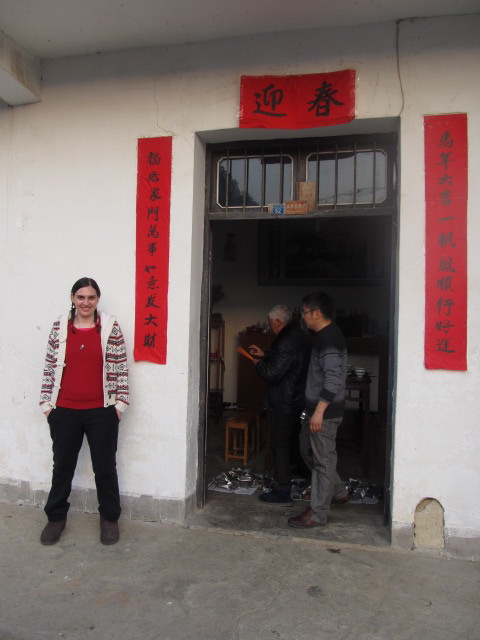
I live in Hangzhou, China. While it’s not a Beijing or Shanghai, it’s definitely right up there with the major cities in China. But there’s one thing Hangzhou doesn’t have – a vibrant, more permanent expat community.
The majority of expats in the city are pretty transient – overwhelmingly students at the universities – and don’t stick around too long. The rest of the working expats are scattered all over town. I almost never run into folks in the city, and there aren’t tons of venues to meet up with them either.
Add to that the fact that I also divide my time between the city and the countryside, and you’ve got a recipe ripe for isolation.
I have friends in China on my WeChat account, and we do chats every now and then. But honestly, just straight online chatting doesn’t really do it for me. Video chats are much better, though slow Internet can make it difficult too.
I’m learning the importance of reaching out to people when I’m struggling. Even then, I know that isolation will sometimes be a part of my life and I need to learn to find good coping strategies for it.
#3: Feeling misunderstood by your foreign family
I recently wrote, “It’s hard not to care about the happiness of my mother-in-law when, frankly, she spends so much of her time caring about ours.” and it’s a testament to how much I love her and the family I have here in China.
But the thing is, no matter how much I love them, there are things about my life that they don’t always understand. Especially things that have happened to me and my husband in America or places far removed from their rural Hangzhou life.
I can handle being misunderstood in small doses. But let me tell you, during Chinese New Year this month I was getting pummeled with it almost every single day from family members. And even though I know that words can’t really hurt you, I couldn’t help but feel down from it all.
Sometimes the best antidote to this is my husband, who tells me that I’m not alone in feeling like I do. With his experience living abroad and traveling, his family doesn’t always understand him or his decisions either. He’s a reminder that it’s OK.
To me, Jun was the guy who first kissed me to the tune of cicadas, next to Hangzhou’s West Lake. The man who loved to pick me up from the metro station late at night, and ferry me home on the back of his bicycle. But to the visa officer at the US Consulate in Shanghai, Jun was just another immigration risk from China with no apartment or car, let alone a wife or children. “You’re too young,” the officer declared in Mandarin, stamping a denial in permanent red ink into the passport….
I shouldn’t have pushed Jun to apply for that US tourist visa — except I longed for him to meet my parents. I had met his months before, but he’d only known mine through the occasional long-distance phone call. But instead of getting the third degree from my dad, Jun had to get it first from a US visa officer, a guy who wasn’t kidding about “no.”
But it can go both ways. In online chat groups with foreigners, I often hear about the seemingly interminable troubles that they’re facing with applying work visas. Things like having to make the expensive journey back to their home country just to submit an application, figuring out how to get an acceptable criminal background check completed, and more. Sigh.
#5: When people laugh at your foreign accent
The Chinese are known for their excitement whenever Westerners say even a simple “Ni Hao” or “Xie Xie” – but that doesn’t mean it’s impossible for people here to laugh at your accent.
It has actually happened to me, particularly when I’m around kids (and often in a classroom setting). When I speak my accented Chinese to them, they think it’s funny and then don’t respect me so much. Or make jokes about me behind my back.
Granted, it’s nothing compared to what Chinese might experience in America. Many Americans are such racists sticklers that they consider certain accents – including Asian accents – as proof that you can’t speak proper English. (Or worse, that you should “go back home”….)
But the experiences I’ve had here have made me even more sympathetic to foreigners in America. And they’ve given me a taste of the unhappy experiences you can have when you don’t speak exactly like a native.
—–
Don’t get me wrong – I’m happy most of the time. I love my husband, I love China, and couldn’t imagine living anywhere else in the world. But sometimes, it’s good to share the flip side of it all. For all the ups we experience as expats, there will also be plenty of downs as well.
So next time you’re feeling a little unhappy in your supposedly “amazing” expat life, just remember one very important thing – you’re not alone.
What do you think? What unhappy experiences have you had as an expat and/or as someone married to a foreigner?
The other night, I could hear those amplified voices through the paper-thin walls in my in-laws home. One of those voices sounded a lot like my husband’s; the other surely was his father.
And inside, I shuddered. What were they arguing about? Was something wrong between them?
As the minutes turned into an entire hour, my worries only grew. Because of course, only something really bad could take that long to hash out. The thought of my husband getting into a deep argument with his father made me feel nauseous. I wanted crawl under my covers and pretend this wasn’t happening, except nothing could seem to quiet the unsettling noise from next door.
So imagine my surprise when my husband strolls in the door with a satisfied smile and not a trace of tension in his face. How could this be?
“Sweetie, were you arguing next door?” I mentally braced myself for confirmation of my worst suspicions.
“Oh no, I was just talking about finding our ancestors’ graves with my dad.” He was so nonchalant about it all. As if it was normal to discuss this topic in loud, booming voices.
I breathed out a huge sigh of relief. “Thank god, I was so worried! I could hear you through the walls — I thought you were fighting. And you were gone so long…”
“Don’t worry,” he said to me, his overreacting wife. (I swear that “Don’t worry” is probably one of the top ten common phrases John has to say to me in our relationship, because I’m always misinterpreting things for the worst.)
But it’s really easy to make mistakes like this when it comes to conversations between my husband and his family and friends in the countryside. That’s because when people talk to each other, even in friendly and congenial ways, it can sometimes sound like an argument to my American ears.
Growing up in the Cleveland, Ohio region, I learned pretty quickly that raising your voice was a sign of anger or disrespect. The times in my life when I heard yelling or loud voices in the house, it invariably meant an argument was in progress. Speaking loudly was just not a good thing.
But here in my husband’s rural Hangzhou village, people speak loudly all the time about normal, friendly things. I’ve watched my aunts and uncles stroll in with their booming voices, discussing how the weather was that day or what their ducks did in the yard. I’ve heard neighbors, in the most shrill voices I’ve ever heard, say nice things about my family’s home. I’ve observed family members discuss things they care deeply about – like finding an ancestor’s grave – with their vocal volume turned up.
You should see my mother-in-law when she answers the landline at the family home. She invariably speaks to the caller in a tone that you would probably classify as a “yell”, yet what she’s saying is totally friendly and normal. Have you eaten yet? Come over to visit us.
The funny thing is, I know all of this and yet I forget time and time again. It’s as if any loud voice has been permanently branded in my mind as angry and threatening. The fact that I don’t always understand everything that’s said here – as most people use the local dialect to communicate – only compounds the issue.
Will I ever get used to this? Maybe someday, years from now, after I’ve spend decades living in China. In the meantime, I’ll have to get used to being wrong about this, a lot.
Sometimes, it’s really good to be wrong about something. 😉
When North Korea sent some 357 men over to the former East Germany in the 1950s to train them, the two countries also unexpectedly set in motion some of the most dramatic and bittersweet stories of forbidden love that I’ve ever encountered.
Renate returned to Germany on Tuesday after a 12-day reunion with her long-lost husband in North Korea – a highly unusual episode given the Communist government’s policy of keeping most of its people without mail or telephone links to the rest of the world, not to mention the Internet.
Traveling with Renate were their two sons. Peter Hyon Zol was 10 months old, and Renate was pregnant with Uwe, when the family broke up in the vortex of the Cold War.
Renate Kleinle and Hong Ok Geun met in 1955, when they attended the same freshman chemistry class at Friedrich Schiller University in Jena, East Germany. Hong was a humorous exchange student from North Korea, then East Germany’s Communist ally.
They fell in love. Because both governments frowned on marriages between North Korean students and East Germans, the couple married in 1960 in a rural town where the local authorities were unaware of the national government’s policy. There were no guests.
The couple’s happy time lasted only one year, however. In 1961, the Pyongyang government recalled all 350 of its students in East Germany, a measure believed prompted by a few North Korean students’ defections to the West. Hong was given 48 hours to pack.
Holding 10-month-old Peter, Renate bid a tearful farewell to Hong at the Jena train station.
I’m tearing up just imagining that scene for myself.
Well, German filmmaker Sung-Hyung Cho stumbled upon Renate’s love story and it inspired her to discover more of these couples, ultimately leading to a new documentary film released in June 2015 titled “Verliebt, Verlobt, Verloren” (“Loved, Engaged, Lost”). Here’s the trailer on Youtube for the documentary film, presented in German (folks in China, you’ll need a VPN to view it):
Sung-Hyung Cho: The story of Renate Hong was very popular in South Korea. In 2006, her story became the talk of the town after a South Korean historian – who had conducted some research in Jena about the relationship between North Korea and East Germany – met Renate Hong by chance.
She narrated her story, and he propagated it on the Internet. The response was overwhelming. The Koreans were blown away by the sad but beautiful love story.
Most Koreans, myself included, know the story. Moreover, I was greatly interested in knowing and better understanding former East Germany. I also wanted to know more about North Korea, even if only indirectly.
Have you ever heard about this fascinating chapter of AMWF history between Germany and North Korea? And, for those of you who have seen the film, what did you think of it?
P.S.: Thanks to Ruth of the wonderful blog China Elevator Stories for tipping me off to this!
Recently, I shared the story of my own unlikely pathway to marrying a Chinese man, including what I originally thought of Chinese men before coming to China, in an opinion piece for the China Daily. Here’s an excerpt from that:
When I think back to the months I spent in preparation for that year of teaching English in Zhengzhou, I draw a blank on Chinese men, apart from one simple thing. I assumed they weren’t dating material for me, and I wasn’t alone. An American man who had once taught in China famously told me, “You don’t have to worry about the students falling in love with you.”
It made sense to me. I had only ever forged friendships with foreign Asian men at my university, feeling romance was never a possibility, and had yet to move past “Hello” with any of the Chinese men on campus, who almost never noticed when I smiled or waved at them while passing by on the way to classes. I never saw white women dating Asian men on television or in the movies. Even the handful of Asian men who went to high school with me in my very white, very middle-class suburb didn’t seem to date anyone, let alone a girl like me. It was as if the universe decreed that there was a racial and cultural line that I was never meant to cross if I wanted to find love.
But beyond all expectations, love happened to me in China – and it was a love deeper and more passionate than anything I had ever experienced before. It was as if I had never truly loved before. Here was China, giving me a real-life lesson in what it actually meant to be intimately connected with someone else.
None of this would have happened if I hadn’t opened my heart to the possibility of love – if I hadn’t transcended my own past assumptions and biases about dating in China.
For me, the interracial and intercultural relationships I’ve enjoyed in China – including, most of all, my marriage to John – have been a transcendental experience. They’ve allowed me to go beyond what I used to believe about Chinese men and Asian men, and have made me more aware of how prejudices and stereotypes against certain racial groups still loom large in the dating world.
Granted, I know that one person isn’t a lot. But I’d like to think that every time someone like me ends up loving beyond their own boundaries — their own perceptions of what it means to be in love – it brightens our world a little more.
Do you think that interracial/intercultural relationships can be a transcendental experience?
As I was reading her article, I suddenly realized that I too had a pre-China backstory worth sharing – one of relationships that never came to be, and what ifs that point to my own prejudices. So here goes:
—–
In coming to China, the last thing I expected was to end up dating a local guy, let alone marrying one (as I ended up doing with John, pictured here with me). Why?
“You don’t have to worry about the students falling in love with you.”
Before I embarked on my first trip to China, where I would teach English at a college, I met up with one of the former teachers several times for dinner or drinks. And when the subject of student crushes came up – something he had been forced to navigate very delicately – he negated the possibility of anything similar happening to me.
Of course I didn’t question his words. Hadn’t I already envisioned my year-long assignment much like a vow of chastity? I spoke to friends of my interest in studying Tai Chi over there and visiting some local temples, as if I were about to spend my months as a nun instead of an English teacher. It was an opportunity to travel to a new country, a way to postpone my post-graduate dilemma regarding career decisions, and nothing more than that.
Or so I thought.
Then I moved to Zhengzhou, China – and found myself with a crush on one of the first guys I met there, a former student from the program I would teach for. Over a month later, he introduced me to his friend, a guy who was also a former student – and would become so much more to me in the weeks that followed:
Yao came into my life, in all of his sleek, sexy and sullen James Dean perfection, dressed in a black leather jacket as dark as his mysterious melancholy. When my heart raced after our first dinner together, I thought it was just another adolescent crush. Embarrassed, I wanted to just box my feelings away like all of the Barbie Dolls and little girl hairclips of my past.
Then he took me to that teahouse one Sunday afternoon. Over two Taiwanese bubble teas, the truth bubbled through to the surface of my own heart — I loved him with an uncontrollable depth that plunged far beyond the bottom of my tea cup. And, I began to realize, so did he, because he overflowed with confessionals that he had never before poured over with anyone else.
Not long after, our our passions percolated over into romance — a real boyfriend/girlfriend love that translated into steamy weekends at his apartment, hand-in-hand walks around the gardens of Zhengzhou University, and the occasional afternoon out at the Taiwanese teahouse, his favorite in the city. Bubble tea never tasted so sweet.
In his arms, it was so easy for me to forget that I had once secretly declared this year a lonely one without a single chance for dating. And it was also very easy for me to turn a disdainful eye to my female coworkers at the school, all Americans who had no interest in the local men.
I couldn’t help but wonder, why did I assume that I would be single in China? Why did I think I would never date Chinese men? Was it merely that I grew up in an incredibly white middle-class suburb (I could count on one hand the Asian men I knew from kindergarten to high school graduation)? Was it the overwhelming absence of positive images of Asian men in the whitewashed world of American popular culture?
I think back to my college years, a time when I met many foreign Asian men – including Japanese and Cambodian. I called many of them close friends, yet why did I never let them get any closer to me? Why did I always immediately relegate them to the “friend zone” and nothing more? Why did my white girlfriends and I only giggle over white celebrity heartthrobs in high school, like Tom Cruise?
It’s just not right.
All I know is this — in China, I found the sexiest and most amazing men that I had ever known. I ended up marrying one and I’m still crazy in love with him. (Thank you, John!) It took crossing an entire ocean and time zones to realize that my assumptions about dating in China were a lie.
Years ago, a fellow blogger with a Chinese husband wrote to me, “I follow some blogs by Western women married to Japanese men. You’d probably like them too.” It was the kind of friendly recommendation that you often get from other bloggers – except it came with a warning. “But shhh, don’t tell our husbands!”
Why did a suggestion to read someone’s blog suddenly get slapped with a cautionary note, as if all blogs written by Western women with Japanese husbands might be hazardous to our health? Simple. Like most Chinese men, her husband didn’t care for Japan – and neither did mine:
“Japan? I never want to visit Japan,”[John] hissed. “I’m anti-Japanese.” He launched into a brief history of Japanese aggression in China, from the first territorial swipes at China during the Sino-Japanese War, to the Second Sino-Japanese War, with Holocaust-like atrocities that Japan had yet to acknowledge publicly.
Yes, my marriage to a Chinese man has taught me a valuable lesson — that Asia is not the great, united, happy family (as some Americans might believe). That “Asians” don’t necessarily like being lumped together.
I didn’t realize the extent to our cultural amnesia about the true state of affairs in Asia until I met and married a man from China. A self-proclaimed “military fan” whose interest went deeper than tanks, submarines and aircraft carriers. A husband who schooled me in the many disagreements, wars and massacres between China and its Asian neighbors.
I’ve learned that Japan has yet to fully acknowledge the “Asian holocaust” it perpetrated against China and others, from the gruesome horrors of Unit 731 to the “comfort women” forced into prostitution. I’ve learned of the skirmish between Vietnam and China that led to a short war. I’ve learned about the border disputes between China and India, serious enough to lead my Lonely Planet guidebooks to print “The external boundaries of India on this map have not been authenticated and may not be correct” on their maps. And now I’ve learned everything there is to know about the emerging military alliance between Japan and the Philippines, especially how it affects China.
In America, we speak of “Asian” cuisine like it’s all the same – as if you could substitute one country for another – never realizing the countries here wouldn’t agree. That the Thai restaurant down the street from my father’s home serving Chinese delicacies alongside a sushi menu would look totally blasphemous to people in China, who still haven’t forgotten what Japan did to them.
I’m reminded of what Alex Tizon wrote about in his memoir Big Little Man:
As a journalist in my twenties and thirties, I wrote extensively about these [Asian] communities. No surprise, I found each group exuberantly complex and instinct, and perceiving themselves as separate from — and often antipathetic to — other Asian ethnicities. The parents and grandparents clove to their countrymen, the Vietnamese with other Vietnamese, Koreans with Koreans, Cambodians with Cambodians.
It was the children and grandchildren, the ones growing up in America, who would find — or be coerced into — common ground. Years of checking “Asian” on countless forms, of being subjected to the same epithets and compliments, of living in the same neighborhoods and housing projects, and sharing similar challenges and aspirations — the most important to become Americanized — all of these would compel young Vietnamese, Cambodians, and Filipinos to accept their belonging to the category known as Asians.
Perhaps the most unifying force was the perception that everyday Americans saw them as the same, and what made them the same was their “racial uniform,” to use a term coined by sociologist Robert Park. The uniform was thought to consist of a certain eye and nose shape, hair and skin color, and body type, usually shorter and skinnier — identifiers of the Yellow or Mongoloid or Oriental and finally now the Asian race.
…We Asians were now in the same boat. Our uniform did not lie. Like Lisa said on the Grand Concourse: Japanese, Chinese, Filipino — same thing!
Yep, this is what happened in America – we just clustered everything from Asia together, and assumed that it was one great unified map. Never realizing that it was one great lie.
Asia isn’t that great, united land where countries always peacefully coexist. But that doesn’t mean friendships don’t happen to cross unlikely borders. After all, even if he still dislikes Japan’s government, my husband has actually changed his feelings towards the country as a whole. He has Japanese friends. Still, there is one thing though:
“So, does this mean I can buy you a Toshiba someday?” I prodded him, with a grin.
“Not really. I still have standards, you know,” he smiled.
This website uses cookies to improve your experience. We'll assume you're ok with this, but you can opt-out if you wish.AcceptRejectRead More
Privacy & Cookies Policy
Privacy Overview
This website uses cookies to improve your experience while you navigate through the website. Out of these cookies, the cookies that are categorized as necessary are stored on your browser as they are essential for the working of basic functionalities of the website. We also use third-party cookies that help us analyze and understand how you use this website. These cookies will be stored in your browser only with your consent. You also have the option to opt-out of these cookies. But opting out of some of these cookies may have an effect on your browsing experience.
Necessary cookies are absolutely essential for the website to function properly. This category only includes cookies that ensures basic functionalities and security features of the website. These cookies do not store any personal information.
Any cookies that may not be particularly necessary for the website to function and is used specifically to collect user personal data via analytics, ads, other embedded contents are termed as non-necessary cookies. It is mandatory to procure user consent prior to running these cookies on your website.


 “It’s appendicitis. You need surgery.”


 #5: Really good food (including dumplings) from a hospital!
 #6: Changing the way I see hospitals for the good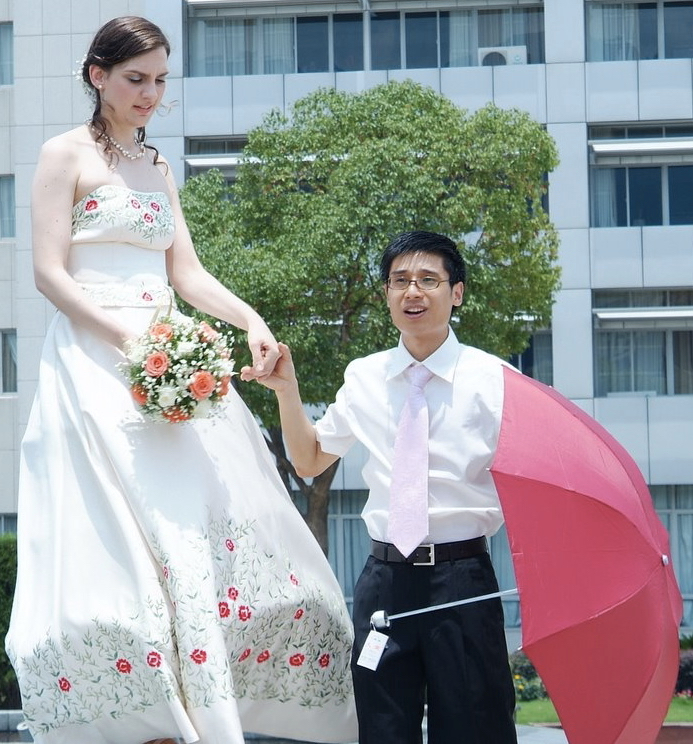


 #1: My mother-in-law will still do laundry for us
 #2: My mother-in-law cooks all our meals
 #3: My in-laws give us money more often than you think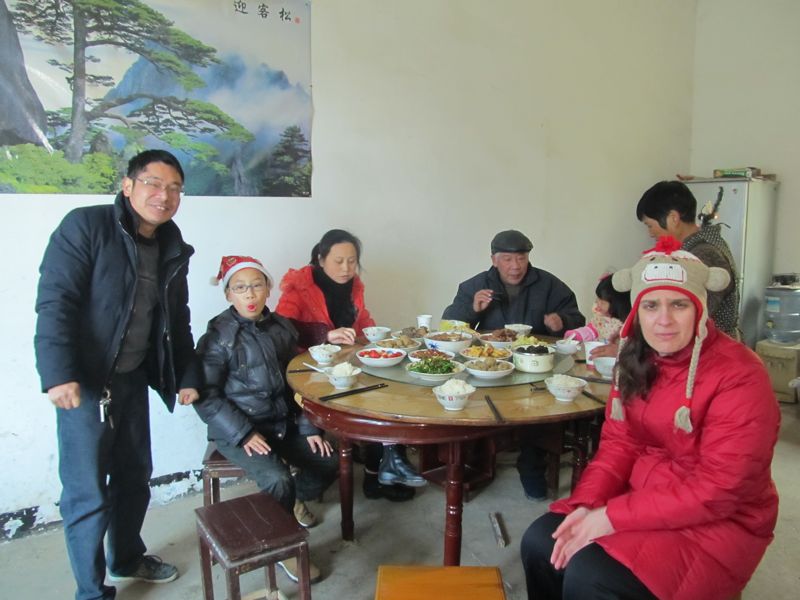
 #1: Missing friends and family from your home country
 #2: Feeling isolated
 #3: Feeling misunderstood by your foreign family
 #4: Visa woes
 #5: When people laugh at your foreign accent