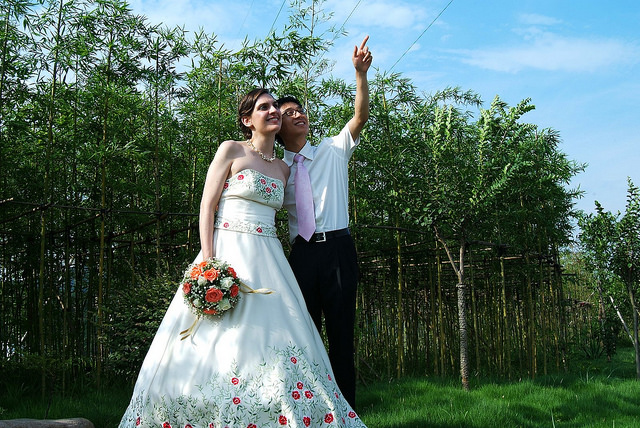
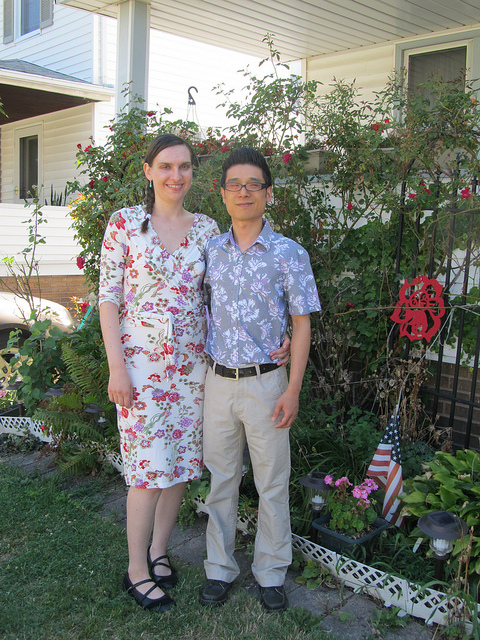
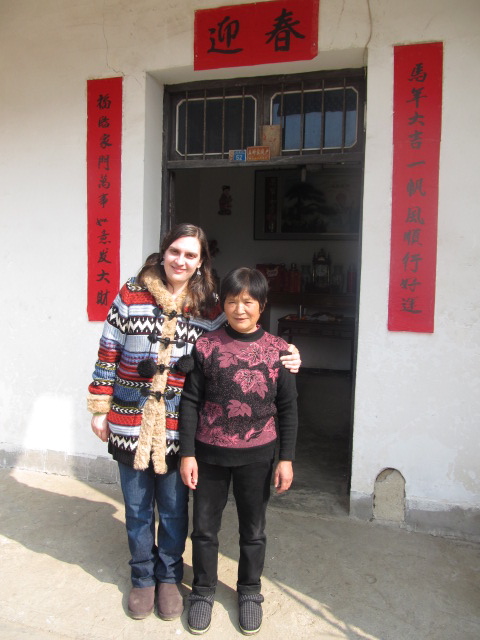
While a cold, misty rain hung over Hangzhou that February morning, in my mind there was nothing but sunshine. A feeling of happiness surrounded me as John and I left that building, a jubilant couple bounding down the street hand-in-hand.
“How could it have been so easy?” I wondered.
We recalled the smiles from the woman at the front desk, who helped us rearrange our materials. We remembered the uniformed officer who told my husband how to write up an invitation letter, word by word. And when we left, both of them offered us a warm farewell, with the officer even complimenting my husband on how outstanding he was.
To think that we had just left Hangzhou’s Public Security Bureau (PSB), and felt as if we were VIPs once John introduced me as his foreign wife needing to get a residency permit.
And what about those calls John made in advance to the PSB? The moment John mentioned he was inquiring about residency permits for his foreign wife, that person on the other line transformed instantaneously. They became a friendly and helpful voice on the phone, as if John had just dialed customer service.
All it took was one magic word: yangxifu.
In Chinese, yangxifu (洋媳妇) means foreign daughter-in-law. But people here — including my husband — commonly use the term to refer to any foreign woman (like me) married to a Chinese man. And sometimes it seems like the very mention of a yangxifu can light up some of the toughest people you’ll encounter in China. Meanwhile, my husband’s friends have called him a “legend” from the time he married me, and his cousin even wanted us to find him a yangxifu.
And if you turn to the Internet, there’s even more evidence of the popularity of yangxifu. For example, Baidu has two entire forums devoted to discussing yangxifu: Yangxifu Ba (洋媳妇吧), with over 5,000 followers and over 180,000 threads, and Waiguoxifu Ba (外国媳妇吧), with over 1,500 followers and over 40,000 threads. A Baidu forum devoted to yangnǚxu (洋女婿, foreign sons-in-law), however, has only 3 followers and 42 threads.
To many Chinese, having a foreign girlfriend or wife is the best bling money can’t buy. Like cruising in a BMW or popping open a bottle of Moet (part of the worship of all things foreign in China, chóngyángmèiwài or 崇洋媚外) , we suggest he’s truly “made it.”
With a foreign woman by his side, that Chinese man casts a powerful aura around the world in China. People crown him as lihai (厉害, awesome), gaping in awe at his good fortune — and his social status soars.
My husband also believes that China’s love of yangxifu has something to do with how his country views marriage. The traditional view is that when a woman marries, she leaves her family to join his for good. So from this perspective, while a yangnǚxu will theoretically take his Chinese wife away from China to his foreign family, a yangxifu marries into a family in China (and thus, it’s a “gain” for China). Yangxifu are also much less common than yangnǚxu (as I’ve written before and a reader recently confirmed during a trip to Hong Kong), making us more of a novelty in China.
But really, when I think about it, the real wonder of being a yangxifu is not in enjoying a little VIP treatment from the PSB or making my husband a “legend” among his friends. To think that I could travel thousands of miles to from the US to China — a country I barely knew most of my life — and find a wonderful husband here, living happily ever after in his rural village. Now that’s magical!
Well, Fred returned to Hong Kong earlier this month and decided to do an informal “study” so to speak. Specifically, he wanted to know whether interracial couples of Asian men and Western women were really as rare as I had written before. Keep in mind that this is not a scientific sampling by any means — it was simply one person’s observations during a vacation in the city.
So what’s the verdict on interracial dating between Asian men and Western women in Hong Kong? Read on to find out! And thanks so much to Fred for filing this report! 😉
—–
When I first sought to date Western women over 14 years ago, I found that it was often a lonely experience because I rarely encountered couples of Asian men and Western women (hereinafter “AM/WW”). I could not consult with anyone except my full brother who himself was married to a White woman and so I had tremendous difficulties bouncing ideas between couples of my equal.
On the other hand, I saw plenty of couples of Western men and Asian women (hereinafter “WM/AW”) like my younger sister and her husband. Often times, I did not find the advice useful or applicable when I consulted with WM/AW couples.
1) Why are there so many more WM/AW pairings as compared to AM/WW? 2) What are the statistics? (i.e. how many WM/AW pairings versus how many AM/WW pairings can be seen in a typical geographical area given a typical day or week?)
I found Jocelyn’s website and read On the Rarity of Foreign Women and Chinese Boyfriends/Chinese Husbands in China. I felt she did an excellent job explaining why AM/WW pairings are so rare. Among the reasons that she gave were stereotypes held by Chinese men against Western women and by Western women against Chinese men, the media (i.e. portraying Asian male as asexual and lacking masculinity), Western perceptions of the relative physical size of a certain intimate part of Chinese men that makes it unattractive to Western women, etc.
However, there are no statistics on the number of WM/AW versus AM/WW pairings. There were some statistics I read once from the Shanghai Marriage Bureau showing the number of marriages between Chinese men and foreign wives compared to Chinese women and foreign men. However, they did not account for the couples that are not married and dating but nevertheless still a couple.
Jocelyn wrote in her article that it was not uncommon to see an expat walking hand-in-hand with a Chinese (or other ethnically Asian) girl. But neither Jocelyn nor any source told me the numbers. So, I decided to investigate the matter further. In order to answer question number 2 above, I decided to take the matter into my very own hands. I was also curious to see if Jocelyn was really right when she averred that AM/WW pairings are rare. I wanted to prove or disprove her article.
If AM/WW pairings are so rare as she wrote, then how rare are they? What is the proportion of WM/AW over AM/WW pairings?
So, I decided to take the matter into my own hands and do my very own personal investigation. My White Western wife and I, along with my two children, were heading to Hong Kong between April 2, 2014 and April 12, 2014 for a brief vacation to visit my half brother and half sister and their families and to do some sightseeing. So I made it a top priority during that trip to use my very own eyes to count how many WM/AW couples we saw compared to AM/WW couples. Every day I brought a sheet of paper and a pen with me, and I drew a vertical line in the middle. On the left side of the paper I wrote the heading “WM/AW Team” and on the right side I wrote the heading “AM/WW Team”. Then every time I saw either a WM/AW couple and/or AM/WW couple, I would mark a vertical stroke on the corresponding side of the paper. On the fifth stroke, I would mark it as a horizontal stroke. I would continue counting this way until my return to the US. This would be like a game for me; it started when I first entered the plane in the Los Angeles International Airport and would end when I returned to LAX International.
(Please note that my personal study is by no means scientific as it is not done by random sampling or any type of representative sampling method. It was purely my personal daily observation not predicated on any scientific basis whatsoever.)
My team was “AM/WW” and when I entered the airplane on April 2, 2014 en route to Hong Kong I wrote a stroke on the right side of the paper (i.e., one point for AM/WW team) as my wife and I constituted a AM/WW couple. So, our team was immediately leading the game by one point versus zero for the WM/AW team. “Hurray for us!” I said to myself filled with confidence that our numbers may not be so rare after all, contrary to what Jocelyn wrote.
Well, guess what? My team’s lead was very short lived.
No sooner after landing at the Hong Kong International Airport, the other team WM/AW immediately scored 3 points and now the score was 3 to 1. As time passed between April 2, 2014 and April 12, 2014 the score was skewed more and more in favor of the WM/AW team. In fact, when I visited my half-brother and his side of the family, I had discovered that on his side of the family his youngest of the two daughters is engaged to a White European man (Arnold) from France, and they are both living and working in Hong Kong. Furthermore, Arnold’s father, another White man from France, divorced his French wife many years ago, moved to Hong Kong, and now is dating and living with an Asian woman in Hong Kong. It seemed that the WM/AW pairings are incredibly ubiquitous, just as Jocelyn wrote. Well, all of my hopes of winning the game were dashed.
So, here is the final score from Hong Kong between April 2, 2014 to April 12, 2014:
1) AM/WW Team: 6 couples (including me and my wife)
P.S.: Please note that Hong Kong is considered quite Westernized. If the AM/WW couples are so rare in Hong Kong, I can only imagine how rare they must be if we conducted this study in mainland Chinese cities such as Guangzhou, Shanghai and Beijing.
Fred practices employment law in Torrance, California.
—–
Do you have a “field report”, guest post, or even love story about Asian men and Western women that’s worth sharing? Submit yours today!
Spencer Huang writes, “I dated other girls later on — Spanish, Polish, Welsh. But I could hardly overcome the recurring fear in my heart: ‘She’ll disappear again.’ At last, I returned to China with a lonely and tired heart. Eliza changed me completely.”
This is a story of how one Chinese man met an enchanting Polish woman in London, only to have her vanish from his life without an explanation.
—–
I’m a Chinese man who just finished a master’s degree in the UK, where I once had a relationship with a Polish woman. I’ve wanted to share this story ever since the Christmas of 2012, when I met her.
I was there in London, spending my Christmas holidays with my friend John, who visited me from China. We lived in a hostel to meet more people and to share their interesting life stories. That was where I met Eliza.
My friend and I tried to talk to anyone we met in the hostel during our journey. We were chatting with a Japanese girl earlier that day, but she had grown up in the US and knew very little about Japan. It wasn’t a very interesting conversation to me.
When I was dismayed that I couldn’t find anyone interesting to talk with, suddenly Eliza walked into that room. She reminded me of a lovely elf — petite with long blonde hair, green eyes and a small face.
Before I knew it, we fell into a fantastic conversation. We talked a lot about anime, manga, Japanese culture (especially Japanese pop culture), food and musicals (such as The Phantom of Opera and other Andrew Lloyd Weber works). I really admired her independence. She worked in London as a waitress to pay her way through university. She had also left home two years before; her father passed away many years ago and her mom remarried. We bonded over our lonely childhood experiences as well.
I never imagined that I could meet a girl who had so much in common with me. We were so happy as we talked together through the whole night.
Then I asked her, “Why don`t we go out for a drink?”
“Why not?” she answered.
We left the hostel at 9:30pm to hit the empty London streets that evening, which was still Boxing Day, to have drinks together.
The next day, what a perfect day it was. We visited Piccadilly Circus and many other sites in London, sharing food and laughter. That evening, I prepared a dinner for two of Japanese sushi while she sang “Think of Me” from the Phantom of the Opera.
Suddenly, a feeling of dread hit me: I had nearly forgotten my promise to a friend from Hong Kong. He needed a place to stay during New Year’s time because he had no money and nowhere else to go. Of course, I couldn’t leave my friend to sleep on the streets and had offered him my flat in Glasgow.
I had to leave Eliza suddenly that very evening, December 27. We hugged before I left, never realizing it would be our last hug.
Later, when I returned to London to find her, everything changed. We were meant to meet at this staircase in the hostel, but she never showed up. She just vanished and left me standing there. I spent over 16 hours there, thinking about her. At last, a group of Australians came over to me and gave me a bottle of whiskey. Then I could remember nothing but the fact that she never returned to that hostel again.
I dated other girls later on — Spanish, Polish, Welsh. But I could hardly overcome the recurring fear in my heart: “She’ll disappear again.” At last, I returned to China with a lonely and tired heart.
Eliza changed me completely. A part of me still hoped that someone special might appear in my life, but I was afraid of a stable relationship, something I yearned for deep inside.
It was tough since I returned to China, but I’ve decided to move on. In the end, the memories are beautiful enough for me.
Spencer Huang works as a project manager for a media company in Chengdu, Sichuan, China.
John and I knew exactly where we wanted to live and work in the future: China. But these decisions don’t always come easy for other couples — and sometimes lead to breakups.
Over the years, I’ve noticed a certain e-mail finds its way into my Ask the Yangxifu inbox. The story usually goes like this: Chinese boy who was born and raised in China meets Western girl, they fall crazy in love and the future seems ripe with possibilities for the two of them…until reality hits in the form of a few simple questions. What about our careers? Where will we live?
So when I receive these questions — which are invariably confidential — it either happens that 1) the couple can’t decide where to live (often China versus her Western country) because each country somehow handicaps one person career-wise, or 2) the relationship ended because one or both of them gave up.
Whenever people talk about Chinese-Western international marriages, you would think that language or culture pose the greatest barriers. But when it comes to Chinese men and Western women in love, this “love, location, career” dilemma more often threatens an otherwise outstanding relationship. Career options aren’t always the same for both people in his home country (China or another Asian country) versus hers. Sometimes, when a couple can’t reach an agreement, they sadly break up — just as my Chinese ex and I did years ago.
At the time, he had moved from China to a European country for university and hoped I would follow him and, in his words, “be his wife.” It sounded glorious at first when he whispered this to in my arms…but not when I discovered the unappealing possibilities for a US national in this European country (not to mention all of the visa headaches for me). It didn’t help that his phone calls, e-mails and other communications dwindled over time, until an entire month passed without a single e-mail from him. So on top of the whole “where to live/work” issue, I also started doubting our very relationship — the foundation of everything we had together. In the end, I had to say, “Enough!” I couldn’t justify all of the headaches of moving to this country when he couldn’t make the time to even write me a simple e-mail or call me.
My face was glazed with tears the day that I called him and said I couldn’t move there. I knew our relationship would collapse and sure enough, we broke things off officially in the weeks that followed. But looking back, I also realize that — in a sense — he determined our fate the moment he put down a deposit for that European university. He was fluent in English and could easily have chosen to study abroad in the US, my home country…but he didn’t, citing a personal distaste for America.
Hence I learned my first lesson in cross-cultural relationships: love isn’t always enough. When you add into the mix each person’s careers and dreams (often linked with a specific country or place in the world, especially if a person only speaks one language) it complicates things in a way that couples from the same country would hardly understand.
I think about my stepsister, for example, who is happily married to her college sweetheart. They both were born and raised in the Cleveland, Ohio region in the US and, naturally, always wanted to settle and build their careers up there as well. There was never any question about what country might offer the two of them the most opportunities and most benefits, no tug-of-war about living here versus there or somewhere else.
Nothing like what I experienced with my ex-boyfriend in China. It was his lifelong dream to reside in this European country, so naturally he wanted to study abroad there. But his dreams clashed completely with mine. Granted, I was still trying to find my way in the world at the time. But the longer I pondered moving there with him, the more I intuitively realized I just didn’t belong in that country — that following him would be a colossal mistake.
With my husband John, though, the choices were a lot easier and, in the end, much more obvious. John had always envisioned getting educated in the US and then bringing his talents back to China to start a business. We had discussed this years before when we started dating, developing a long-term plan together to help him achieve his dreams. But it’s not as if I was putting his needs before mine. In fact, China made sense for me personally and professionally for a variety of reasons…not to mention that I’m fluent in Mandarin Chinese, absolutely love this place, and find endless inspiration here for my writing.
Unfortunately, decisions don’t always come so easy.
For example, I’ve heard from couples where she wants to settle in her home country in the West for career reasons, but he doesn’t for reasons of his own (he can’t speak the language, he has better opportunities in China). I’ve also met couples who decided to live in her country, only to realize even more problems with his career — for example, people don’t value his degree from China. Even gaining an education in her country offers no guarantees of employment, as prospective employers may discriminate against him.
Then there’s the flip side — he says, “Let’s live in China,” and she’s not sure. Maybe she struggles with Mandarin Chinese or can’t even say a word. Or she spent years studying in a certain field — which offers few or no opportunities in China — and doesn’t want to abandon her chosen career.
How should Chinese men and Western women handle a “love, location, career” dilemma? Here are some of my thoughts:
Support, support, support. He’s into pharmacy, she dreams of being a physical therapist. Whatever your partner’s work dreams are, you should say, “More power to you!” In other words, support them.
Think about both of your respective careers first and foremost. Don’t get caught up in finding the ideal for your own career — instead, the question you should be asking is, “What’s good for both of us?”
Don’t fall into the “sacrifice your job for my sake” trap either. I’ve heard of couples, where one person expects the other to quit their careers or jobs for all sorts of reasons — but that should honestly be your last resort, if at all. It breeds resentment (i.e., “How come I have to make the sacrifice and he/she doesn’t?”), and resentment is not a good bedfellow in any relationship.
Compromises sometimes have to be made — but if so, give it an expiration date. For example, my husband washed dishes in a restaurant in the US, but we both agreed he would only do this for half a year. I also know of an American woman considering teaching English in China for a year, which would give her the chance to remain closer to her fiancee while they apply for his US green card from China.
Never choose places over him/her. Preferences and prejudices about where to live and work can sometimes wreck an otherwise awesome international relationship. For example, my Chinese ex could have chosen to go to the US; maybe that wasn’t his dream location, but he would have had no problem finding endless universities with his field of study (a very popular one) and I would have had no problems finding a job. Instead, he prioritized geography over me — and contributed to our eventual breakup.
If you and your partner both agree on where to live (like John and me) you’re fortunate! If not, look for locations that benefit both of you career-wise. It could be your home countries or even a third country or region. For example, one American woman married to a fellow from Northeast China agreed to try living in the US first, with Hong Kong and Singapore as backup options.
Back to school. Sometimes all you or your partner needs is a little education — whether graduate school or business school — and suddenly you end up with a great location for everyone in the relationship. I know several couples of American women and Chinese men who are moving to the US, where both husband and wife will enroll in graduate school. Studying Mandarin Chinese at one of China’s many universities (like Sara Jaaksola) can offer foreign women a wealth of career opportunities in China.
It’s the relationship, stupid. Still butting heads over London versus Shanghai? Sometimes that’s just a symptom and the real issue is your relationship. Look at my Chinese ex — he didn’t e-mail me for an entire month, proving that we had bigger issues going on in our relationship.
If you have a relationship problem and both of you feel motivated to work on it, consider relationship counseling.
What do you think? What advice do you have for couples struggling over where to work and live?
I’m the good foreign daughter-in-law…because I stay around home.
Whenever my husband calls me his nèirén (内人), we both erupt in laughter — and for a good reason. Nèirén, a traditional Chinese term for “wife”, also literally means “inside person” — a perfect catchphrase for my current situation. After all, I spent my days either inside our home or inside our village, almost never venturing into the nearby town or beyond.
I have to confess, it’s a little strange to admit that my life remains pretty much confined to this rural mountainous village in Zhejiang Province and, specifically, to the family home.
You might wonder, why don’t you and the husband travel? You could go to Shanghai or some other nearby city? You could visit friends in China or see the country? Well, we have our reasons for sticking around here instead — reasons I’m unable to share here on the blog.
Still, here’s the really odd part for me — I no longer even run errands, things I used to do many years before when John and I lived in Shanghai. Back then, I used to go shopping on the weekends, mail things at the post office, and more. But here? Nothing.
In a sense, that reflects the fact that I’m living under one roof with my husband, his parents and other family members. My father-in-law handles pretty much all of the shopping for our home and does all of the post office runs — so if anyone needs something, we just let him know and he takes care of it.
But what if I wanted to go shopping in town on my own? Maybe I’m curious about what that local Falian Supermarket actually has on the shelves? Every time I’ve suggested anything like this to the family, I’m always met with a resounding “no”! Usually they say, with a grimace on their faces, “Don’t go, it’s too much trouble!”
Yet it’s more than just a matter of trouble, as my husband has told me. “It’s about safety,” he once said to me while we were walking through the mountains. “It’s better if people in town don’t see you.”
How could my simple stroll into town create a safety problem?
According to my husband, it works like this. If I head into town for shopping or other errands, invariably I’ll turn a lot of heads. People will stare, giggle, and talk about me — and if I’m unlucky, the wrong kind of person might notice me. You know, a thief.
Among this beautiful mountain village hides the ugly specter of theft. Every year, someone in the village is robbed, especially just before Chinese New Year, and past victims include my husband’s uncle and aunt who live just next door to us. My mother-in-law cited all kinds of shocking tales — of people who were at home while the robberies happened, of thieves who pried open the bars on windows to enter, of homeowners fast asleep as the criminals tip-toed into their rooms and bedrooms to steal valuables. As crazy as the stories sound, I believe them. Every evening I tune into the local Zhejiang news, reporting the latest batch of outrageous robberies in the province — and every small tragedy reminds me that the whole family must be careful, especially me.
The problem is, most Chinese think foreigners are wealthy, making my home an especially tempting one for any would-be burglar. Since it’s such a small town, it wouldn’t take long for anyone to ask around about where I live. In China, people love to talk — particularly when you have a yangxifu (foreign wife of a Chinese man) in town, the only one around for miles.
And if people came to rob my suite, they’d probably rob from the rest of the family too I would feel horribly guilty if my selfish desires to explore the town — a town that, when it comes right down to it, doesn’t have anything really special to offer — ended up harming the entire family.
Hence, being an “inside person” has become my life.
Sometimes I’ve wondered, how long can we keep this up before the wrong person discovers where I live? Well, as my husband and family sees it, the problem people would be in town, not in this village. Here in the village, only locals — folks who grew up in this area their entire lives — reside (it’s still against the law to buy or sell property in the countryside). But in the town a 15 minute walk away from us, you’ll find restaurants, rooms for rent, and all the other signs that outsiders (Chinese from other areas) and migrants pass through. Most Chinese believe that outsiders tend to commit crimes — and even though it’s a stereotype, it sort of makes sense. Everyone in China returns to their hometown for Chinese New Year, so why would you spoil it (or worse, increase your chances of being caught) by, say, robbing your neighbor there?
Still, please don’t feel sorry for me. I may be a good daughter-in-law who sticks to home and the village…but what a heck of a playground it is!
Yes, now that I think about it….I could get used to this whole “inside person” life here in China. 😉
While the other men in the background have to drink up their baijiu, my husband (front and left) is off the hook — because of me.
During Chinese New Year, the alcohol flows as freely as the conversation — and sometimes a little too much so. On the second day of the new year, a lunch packed with mostly male relatives and well-lubricated with baijiu — the vodka-like hard liquor of choice — actually landed two of the men in the hospital for alcohol poisoning.
It works like this. The elder male relatives at the table insist their younger male relatives drink in a gesture of respect. Of course, nobody in Chinese history ever said filial piety involved imbibing the alcohol for your elders — but such reasoning is pointless at the table, where peer pressure and the expectation that “real men” can handle their alcohol rules.
Yet my husband John survived the entire holiday without a single drunken incident and ultimately only enjoying a few sips of red wine by choice. And when I asked him why, he cited me, his foreign wife, as the reason.
“I have a yangxifu,” he said. “You’re a good excuse not to drink.” In other words, because I’m a foreigner here, John’s relatives assume he needs to care for me more than if I was just Chinese (despite my fluent Chinese and years of living in this country). So if he was stupid drunk, he couldn’t fulfill his so-called “responsibility” to me.
We both laughed at this comical idea — that my being John’s wife actually shielded him from the pressure to drink in China.
Still, given John’s low alcohol tolerance, drinking among relatives will always be a dangerous pursuit. So as bizarre as it is, if my presence might save him from a drunken stupor — or worse, a trip to the hospital — I’ll take it. 😉
Sabine and her husband, who live happily ever after in Dubai.
It’s always a thrill to hear from yangxifu around the world, especially countries outside the usual Anglosphere (Australia, North America, the UK). So when Sabine, a woman from Tunisia, sent me a lovely photo of her with her Shanghainese husband, I leapt at the opportunity to share the story of how they met in Tunisia, married, and moved to Dubai.
Wishing this beautiful couple success in the year of the horse!
—–
I am a Tunisian woman. Seven months ago, I married a man from Shanghai.
The first time we met was in 2012. He came to Tunisia for a business meeting. At that time I was a student and the company that happened to host him was also training me.
While he was visiting the company, we had some conversations. He said he wanted to know more about Tunisia and visit our tourist attractions. We exchanged e-mails. Then we met up a couple of times, where we had coffee together and enjoyed a nice Tunisian lunch. Before he left Tunisia he gave me his phone number in Dubai and his Facebook ID so we could keep in touch.
Within three months, our relationship evolved from normal friends to “shy lovers”. I became so attached to him and found myself falling in love with him. He is always nice, tender, understanding and wise. These qualities are very hard to find nowadays in Tunisian men.
Eventually we decided to get engaged after my graduation. Initially, my family was very surprised with my choice. After they met him, they liked his personality and realized that his values were the same as ours.
We married in Spring 2013. His family couldn’t attend the wedding because of distance and the cost of airplane tickets, but they offered us their blessings. His best friend, however, was able to partake in the celebrations. One month after our wedding, I followed him to Dubai, where we now live together. Next year we hope to visit his family in China.
I would like to encourage single women out there to give Chinese men a chance. While I’ve only dated a few men, I never met a man as honest, committed and affectionate as my husband.
Sabine and her husband are enjoying their happily ever after together in Dubai.
One villager in John’s hometown in China couldn’t believe we were married
As the wife of a Chinese man, I’m used to attracting attention when I’m out and about in China. The stares, the questions about where I’m from, the way cars slow down to gawk at us — it’s all par for the course.
So during one of our evening walks in the village, I wasn’t surprised when an elderly woman walking in the opposite direction suddenly began asking my husband questions.
“Where are you from?” she inquired in the local dialect.
John mentioned the name of his village, nestled right in the heart of the valley.
“Where is she from?”
“America. She’s my wife.”
The woman grimaced at him in disbelief. “That’s nonsense!” Yes, she refused to believe that someone from John’s little mountain village could have possibly married a woman from America. And she walked away, not to be bamboozled by us.
When John translated the whole conversation for me (I’m still working on my local dialect) I nearly doubled over in laughter. “Are you kidding? She thought you were lying about me?”
Hiking the mountains in John’s hometown
It was the first time anyone in China doubted the authenticity of our relationship. But as strange as it sounded, I could understand why. In John’s hometown, it’s not uncommon to meet people who have spent their entire lives, knowing little else beyond these mountains thick with hardy bamboo and fragrant Chinese red pines, and the rice paddies and terraced gardens sculpted into the hillsides. Who could imagine that one of their hometown sons would meet and marry a foreigner, let alone spend years in her country? As rare as it is to find Chinese men and Western women together in China’s urban playgrounds, out here in the Zhejiang countryside such a coupling sounds impossible and even ridiculous.
The Chinese government advises foreigners to carry their passports with them at all times in China. I have to wonder, should I also carry around my Chinese marriage license so I’m prepared for the next time someone calls my marriage “nonsense”?
Nicki and Eugene (photo from http://nickichenwrites.com/)
American writer Nicki Chen, who blogs at Behind the Story, has lived one fascinating life. She married her late husband Eugene (who grew up in China) in 1967, the same year that the US Supreme Court made interracial marriages like theirs legal in every state in the country. Nicki also spent 15 years in the Philippines with her family as an “expat wife” and traveled to China in the 1980s. It’s no wonder, then, that her experiences have inspired much of her writing and blogging.
In this guest post, she writes, “Before I decided to marry my husband, I remember thinking: We complement each other, and that’s a good thing. We had a lot in common, too, enough to make our marriage work. But the fact that we were so dissimilar meant we had a lot to learn from each other.” I could have easily written the same about my own marriage. Chances are, many of you will relate to the “whole new world” Nicki captures in her post.
Thanks so much to Nicki for this fantastic essay! If you love her writing, you can subscribe to her blog and follow her on Facebook.
—–
Bruce Lee vs. Mary Poppins
(photo courtesy of Broadway Tour)
My first martial arts movie was The Big Boss starring Bruce Lee. It was 1971. We’d recently moved to the Philippines, and though Bruce Lee was already well known for his role as Kato in The Green Hornet, I’d never heard of him. My taste in movies ran in a different direction. I’d seen every musical that came to the Dream Theater in my hometown: Oklahoma, South Pacific, West Side Story, My Fair Lady, The King and I, The Sound of Music, Mary Poppins, Camelot … I’d seen them all and memorized most of the songs. What did I know about kung fu movies?
My husband was Chinese however. In his childhood, while I was in the United States reading fairy tales and Little Women and Little House on the Prairie, he was in China living under occupation and reading Romance of the Three Kingdoms, which is not a romance at all. It’s a four volume Chinese classic written in the fourteenth century, a non-stop account of the historical and fabled battles and intrigues that took place between 169 AD and 280 AD when three kingdoms were struggling for dominance in China.
Pompoms and judo
Eugene after judo class (photo courtesy of Nicki Chen)
In our teenage years, while I was taking ballroom dancing classes and shaking pompoms at basketball games, my future husband was in Japan, studying judo and kendo after school.
So now, here I was, expanding my horizons as I accompanied my husband to the little theater in Binondo, Manila’s Chinatown. The Hong Kong version of The Big Boss was definitely more violent than I was used to. It showed, for example, Bruce Lee’s fingers piercing the rib cage of the villain, a scene that was partially cut to get an R rating in the United States. And yet, Lee was a sympathetic hero. And though the evening was punctuated with the sound of our fellow moviegoers cracking melon seeds between their teeth and throwing them on the floor, the movie intrigued me. I could conceive of liking martial arts movies.
Enter the Dragon
Nicki in her dancing shoes in 9th grade (photo courtesy of Nicki Chen)
The following year Fist of Fury and The Way of the Dragon came out. I liked them … and sometimes I didn’t. In 1973 we saw Enter the Dragon, Bruce Lee’s last movie before his tragic death. This time it was playing in the big modern theater in Makati. We brought our oldest daughter, who was five years old by then, old enough we thought to be introduced to a kung fu movie.
I suppose I’ll never be the biggest fan of martial arts movies. I still prefer a film in which dialog and meaning trump violent action. And yet, I have to admit, a good fighting scene is a pleasure to watch. I’m glad my husband helped me expand my horizons.
The Promise of an Interracial Relationship
Before I decided to marry my husband, I remember thinking: We complement each other, and that’s a good thing. We had a lot in common, too, enough to make our marriage work. But the fact that we were so dissimilar meant we had a lot to learn from each other.
Kung fu painting
Every relationship provides opportunities to learn and grow, to share ideas and enthusiasms, hobbies and histories. But in an intercultural or interracial relationship, those opportunities are enormous. If both people are open to new ideas and experiences, their worlds can double in size.
Nicki Chen blogs at Behind the Story and is the author of the forthcoming novel Tiger Tail Soup.
Back in December, many of you — including myself — followed a rather disturbing news story regarding racist backlash against Lorde and her Asian boyfriend James Lowe. Many readers sent along links and encouraged me to write something about it. That proved challenging in December when I just moved to China and was juggling a ton of post-moving/settling in issues that drained my energy, along with some technical difficulties for my website. Well, it’s nearly a month since the incident…but never too late for me to put my 2 cents out there and start out 2014 with a bang.
——
Sometimes people say to me, Why do you write about your relationship? You’re a white woman dating a Chinese man, so what’s the big deal? Thanks to what happened in December, I have a new answer for them: Lorde and James Lowe.
For those of you who were hibernating in December or busy with Christmas shopping, here’s the scoop:
After Kiwi chanteuse Lorde apparently said (to someone, somewhere—I literally can’t find any sources on it besides teens on Twitter) that Justin Bieber and the members of One Direction are “ugly,” wounded superfans began firing back with a barrage of potshots at James Lowe, Lorde’s rumored boyfriend. In the way that the overemotional rantings of the ignorant so often do, the attacks turned racist almost immediately.
I was still dazed and jet-lagged in the wake of an exhausting move from the US to China, but even then the news hit me hard. In the midst of the Christmas season, traditionally that time of “peace on earth and goodwill to all men”, here was a gang of cyberbullies spewing racist comments about Lorde and her boyfriend (see this story for examples) and laughing about it. And to date, no evidence has surfaced proving Lorde made the alleged “ugly” remarks about Bieber/OD…which makes me wonder if someone just went ahead and fabricated the whole thing as an excuse to humiliate Lorde.
Ugh. It’s just chilling to see this sort of thing.
But Lorde isn’t alone in her experience. After all, I’ve had to moderate hundreds of racist comments on my blog, and still receive the occasional hate mail because I’m married to a Chinese guy and blog about it with great pride.
What happened to Lorde stands as a very public example of how the Anglosphere (people in English-speaking countries) still harbors negative attitudes about dating Asian men. As much as it shouldn’t matter who you date, the racist reaction to Lorde’s boyfriend only proves that other people will make it an issue when your special someone happens to be an Asian guy.
Maybe you’ve never been publicly insulted like Lorde, but might understand this in a different way. Perhaps your great uncle made a racist comment in passing about your Asian boyfriend or husband. Or someone said you shouldn’t move back to China with him because the society is too patriarchal and you’ll be oppressed by him. (Never mind, of course, that your guy is such a kind and caring sweetheart who has never been oppressive or sexist towards you.) Or what if, like Grace of Texan in Tokyo, you discover that “You will need a coping mechanism to deal with the question ‘Why don’t you just date a white guy?’”
Please, especially if you’re a non-Asian WOMAN, you need to speak up against this shit. You need to be the counteractive voice to these idiotic children. Write something, post something, or share this. You say you like Asian culture? Then voice your opinions.
Amen.
And Lorde, if you’re reading this, know that you’re a sister in the community of Western women and Asian men. We’ve got your back, girl.
This website uses cookies to improve your experience. We'll assume you're ok with this, but you can opt-out if you wish.AcceptRejectRead More
Privacy & Cookies Policy
Privacy Overview
This website uses cookies to improve your experience while you navigate through the website. Out of these cookies, the cookies that are categorized as necessary are stored on your browser as they are essential for the working of basic functionalities of the website. We also use third-party cookies that help us analyze and understand how you use this website. These cookies will be stored in your browser only with your consent. You also have the option to opt-out of these cookies. But opting out of some of these cookies may have an effect on your browsing experience.
Necessary cookies are absolutely essential for the website to function properly. This category only includes cookies that ensures basic functionalities and security features of the website. These cookies do not store any personal information.
Any cookies that may not be particularly necessary for the website to function and is used specifically to collect user personal data via analytics, ads, other embedded contents are termed as non-necessary cookies. It is mandatory to procure user consent prior to running these cookies on your website.