Guest Post: AMWF Couples – A Canadian Perspective

Sometimes, one good turn — in this case, a great guest post — deserves another! Fred’s post Are Interracial Couples of Asian Men & Western Women Really That Rare? A Field Report from Hong Kong encouraged Maria Deng to do observations of her own in Mississauga, Canada. Thanks to Maria for submitting her report!

Feel inspired to write something for Speaking of China? Check out my submit a post page for details.

—–

As a white female who recently married an Asian male, I have become intrigued with AMWF couples. I’m also an avid follower of Speaking of China and enjoyed a guest post by Fred titled Are Interracial Couples of Asian Men & Western Women Really That Rare? A Field Report from Hong Kong, where he noted the presence of AMWF couples during a trip to Hong Kong. So I asked Jocelyn about completing a study of the presence of AMWF couples in Mississauga, Canada and she agreed to post the article.

I want to thank Fred and Jocelyn for inspiring me to conduct my own study of AMWF couples.
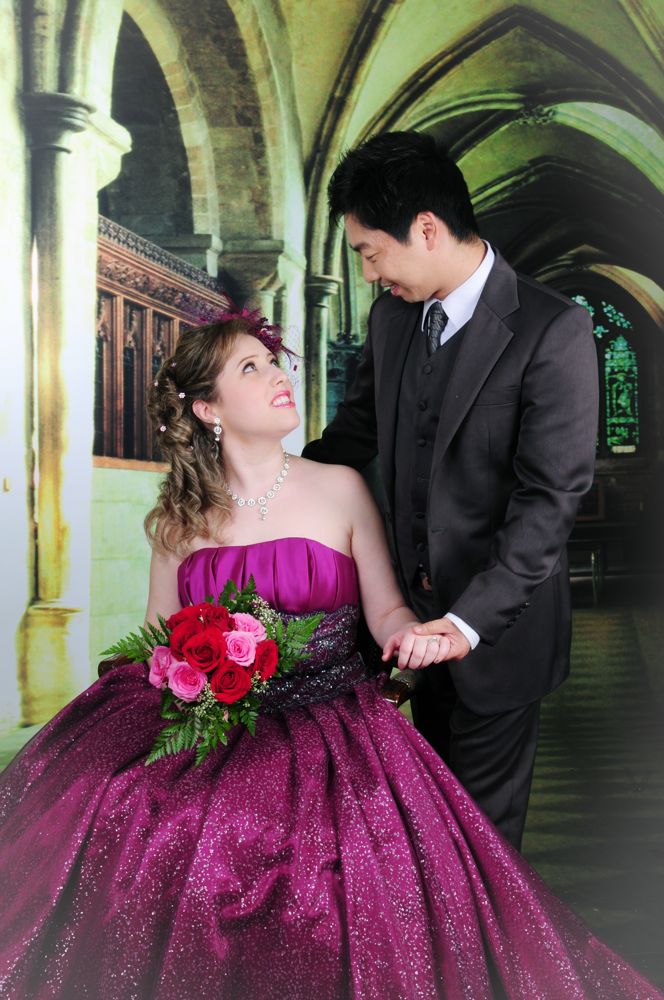
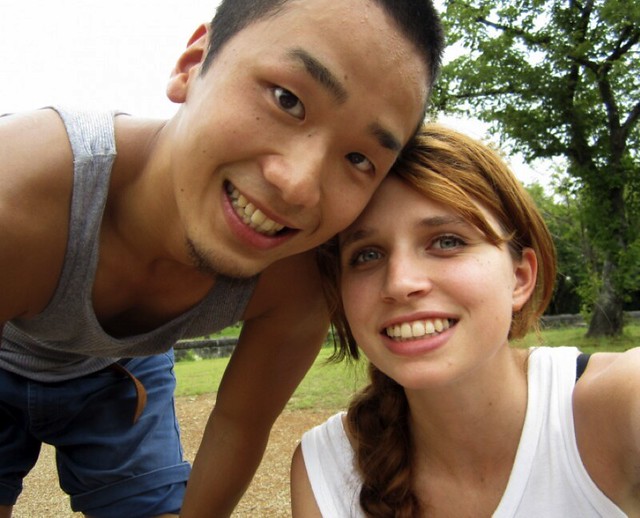
Maria and Joey - engagement photo
Maria and her husband Joey during their engagement photo shoot in May 2014.

Aside from my husband and me, there are two other couples that I personally know of in AMWF relationships. One is a close friend of mine, whom I set-up with my husband’s friend. She is Canadian with Macedonian heritage, while he hails from Thailand. The other couple is made up of two Canadians — her background is English/Irish and his is Chinese. They both currently reside in Mississauga, with one couple married and the other dating.

I decided to conduct this study over a period of one month. The study began on April 19, 2014, and ended on May 19, 2014. Unfortunately, I was only able to write about two days of viewing as those were the only days when I noticed AMWF couples during my travels. Each date includes the place where I observed the AMWF couples, their actions, and my perceptions of them.

Photo 2
Square One Shopping Centre, located in Mississauga, Ontario, Canada. This shopping centre served as a popular site for AMWF couples during Maria’s study.

Day 1: April 19, 2014

My husband and I were at Square One Shopping Centre, the largest mall in Mississauga. At this mall, I observed four AMWF couples.

  • Couple #1: The first couple I saw was walking through the mall holding bags. They were walking side by side, while laughing about something. They seemed to be enjoying each other’s company. They were quite young, possibly in their late teens/early twenties.
  • Couple #2: The second couple I saw was also walking through the mall. They were an older AMWF couple, most likely in their mid-late forties. They were smiling, while enjoying each other’s company (or so it seemed).
  • Couple #3: The third couple I saw was quite young, possibly in their late teens. The young woman was holding the young man’s arm. They seemed to be quite intimate in terms of their body language. They then departed at the entrance of a jewelry store. As they departed, they kissed each other passionately on the lips. They didn’t seem to mind the stares that they received as they looked to be very much in love. The young woman was holding a bag of food in her hand as she walked away.
  • Couple #4: The last couple that I saw was in a popular department store called Target. I was in the changing-room when I noticed a middle-aged man coming in and asking his wife, who was trying on an outfit, if she needed a different size. She seemed grateful to have his assistance, thanking him more than once.

Day 2: May 10, 2014

My husband and I were dining at a Korean restaurant in Mississauga called The Owl of Minerva. We were dining with my husband’s mother and father. I noticed one AMWF couple during the entire time that we were at the restaurant.

  • Couple #1: The only couple that I saw was sitting at a table behind us. They seemed to be very interested in each other, holding each other’s hands while they spoke with the young man’s mother and sister, who were also dining with them. The couple looked to be in their mid-late twenties, possibly just recently married.
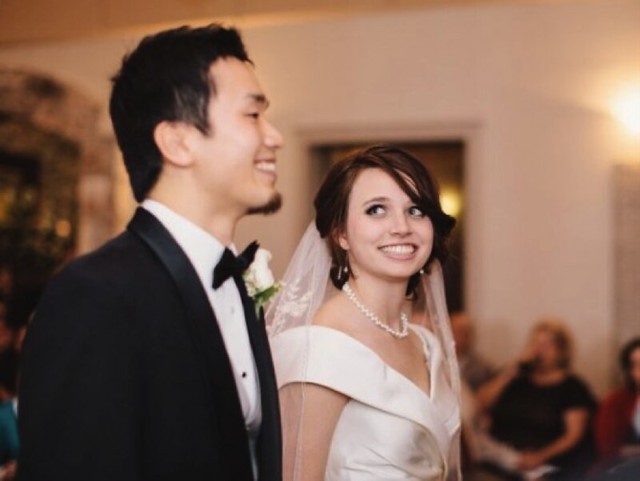
Maria and Joey on their wedding day in June 2014.

During my one month of observation, I only noticed five AMWF couples. I found this to be quite low as I would have expected to see more in a larger city like Mississauga. However, I am grateful for the couples I did see as I was able to observe their behaviour and consider the nature of their relationship. That being said, in comparison to Fred’s study of AMWF couples in Hong Kong, those found in Mississauga were similar in numbers, being slightly higher than the six noted by Fred. In total, we noted eight AMWF couples in Mississauga over the one month of observation (including me and my husband as well as the two couples we know personally).

Unfortunately, since I was focusing solely on AMWF couples, I neglected to include the number of WMAF couples that I had noticed. I will say it was much higher than the AMWF couples that I had noted above. Fred’s post nicely reveals the number of WMAF couples compared to the number of AMWF couples.

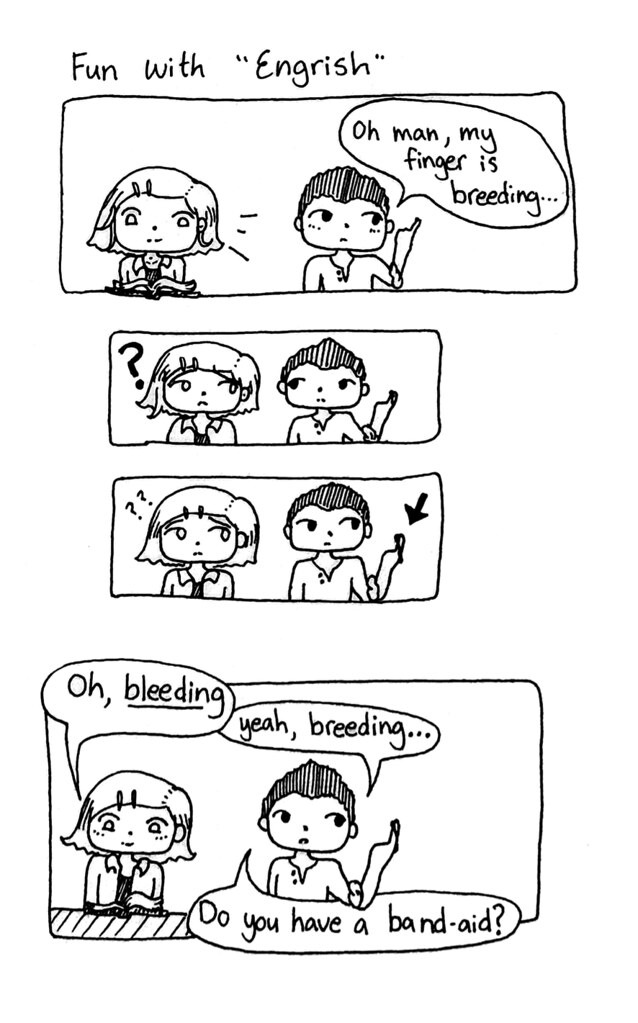
A comic of how Maria and Joey's love story began, displayed at the venue where their wedding was held.  Both were drawn by the ever talented Jasmine from Japan-aholic! ()
A comic of how Maria and Joey’s love story began, displayed at the venue where their wedding was held.
Both were drawn by the talented Jasmine from Japan-aholic.

Of course, the sighting of AMWF couples all depends on time and place. Before this study took place, my husband and I dined at a popular Chinese restaurant in Mississauga called Summit Garden. We would attend Dim Sum (点心) in the mornings with my husband’s parents and friends. We often noted many other AMWF couples: some young, some old. We were pleased to see that AMWF couples, like us, do exist. Although AMWF couples will never be as numerous as WMAF couples, we are out there and we are proud!

What do you think of this article? Have you noticed many AMWF couples in your part of the world? 

Maria Deng currently resides in Mississauga, Canada with her husband Guangjie (Joey), who originally hails from Guangzhou, China. She loves reading about AMWF relationships, and looks forward to writing more about her experiences being married to a Chinese man. 

—–

Speaking of China is always on the lookout for outstanding guest posts and love stories! If you have something you’d like us to feature, visit the submit a post page for details — and then submit yours today.

Double Happiness: Xi’an native introduces Kiwi fiancee to his hometown

Jo and Kane in Xi'an.
Jo and Kane in Xi’an.

A few weeks ago, Kane Gu graciously regaled us with the story of how one “foreign student-turned-party boy” found the love of his life in New Zealand. It’s a beautiful love story and worth a read.

But what happens when Kane finally introduces his fiancee to China and his hometown of Xi’an for the first time? A fiancee that has never stepped foot in the Middle Kingdom and doesn’t speak of word of Chinese? It’s one big cross-cultural adventure that the two of them will never forget. 

If you want to be like Kane and have your words published on Speaking of China, check out my submit a post page for details.

—–

In August 2012, almost 2 years after Jo and I first met, we became engaged to be married on a cool Autumn night by the beach at Maraetai. There, Jo whispered in my ear, “I will.” We both knew we were in for an adventure of a lifetime together.

My adventure first began when I crossed the Pacific and found Jo. Then one day, we decided to trace my steps back to visit my hometown of Xi’an, China. This is my place of origin, the land that nourished me as a child, the great Northwest and the Loess Plateau dotted with cave dwellings, the voice of Qin and of a people born tough but pure of heart.

Southern comfort, Northern discomfort

We arrived in late August, expecting the weather to cool down as Autumn approached. I had been away from home so long that I had forgotten just how vicious the sun was during the Xi’an summers. While I was born and bred in Xi’an, I had suggested that we should bring warm clothing, only to be assaulted by scorching temperatures above 38C upon our arrival. There we were, each carrying a thick coat as we stepped off the plane while quickly realising how big of a mistake we had made. Needless to say, suddenly I felt even more foreign than the white guy we saw at the airport dressed in a t-shirt and shorts.

Since we arrived at lunchtime, my parents decided we should grab a quick bite to eat before we get to their apartment. My heart yearned for some roujiamo and cold noodles — typical Xi’an street food — from a typical Xi’an roadside restaurant. As we walked in, I was reunited with all the familiar and delicious aromas of pickled garlic, slow cooked pork for the roujiamos, vinegar and chilli oil. With the noisy atmosphere and the scattered tables full of people, all these memories suddenly came pouring out and I felt home again.

I couldn’t say the same for Jo, however. She was the only white person in the entire restaurant. The moment she walked into the room, all the chattering and clinking of utensils ceased abruptly with her presence as 50 heads turned her way — some amused, some bewildered, and some just amazed. As we searched around and found a table to sit down, everyone gradually returned to their own business and the noise resumed. Our dishes arrived quickly to the table one by one and so did some curious gazes. Jo quietly said to me she felt uncomfortable with the amount of staring and attention she was receiving, which didn’t surprise me. Even I felt a little uneasy about it. But I had to reassure her that people are simply curious about why a foreigner would visit a humble local eatery, and what she was doing with a Chinese family. To many, an East-West relationship is still a novelty and when the man happens to be a local, he gets to become the “translator” and the “tour guide”, as I had been referred to on multiple occasions.

Lost in translation

Even with a translator on standby 24/7 (me), life still became difficult for my non-Mandarin-speaking fiancee.

A lack of English signage made outings impossible without me accompanying her. She had limited abilities to converse with anyone else but me and translations were not always easy with cultural and social contexts were thrown in. Once a minor mistake caused a major misunderstanding between Jo and my mother. Ever since Jo had some dental work done on her teeth, she was advised to avoid foods that are “hard to eat”. In English it would generally be intepreted as items that are hard or chewy, but in Chinese, if directly translated it becomes “nanchi”, which means “unpalatable”. This, unfortunately, was how I translated Jo’s English when she was discussing a particular dish with my mom — and you can imagine my mom wasn’t happy about her dish being regarded as “nan chi”. I finally explained to her that it was indeed an error on my behalf rather than because of her cooking.

Of course, while we were out exploring the countless heritage sites Xi’an and its surrounding areas had to offer, we were solicited by one hawker after another, attempting to offer us their goods and services at vastly inflated prices. A refusal from me in the local dialect however would normally suffice in stopping the harassment, even against the very persistent ones.

Jo in Xi'an.
Jo in Xi’an.

Shopping woes

While globalisation draw nations closer to each other than ever, you would think people around the world now would have more in common. But when it comes to fashion, this isn’t always the case.

What Jo, a young Kiwi woman, would consider as fashionable and attractive was almost never the same as her Chinese counterparts and vice versa. And on the rare occasions when she actually liked something, it was never in a size or style that would actually fit her. Jo had trouble shopping for almost everything in Xi’an. The biggest shoes we could find were always half a size too small. Not much luck with clothing either, as she is considered a big girl in China while her size is quite normal in New Zealand.

However, having a Chinese MIL shop with you could be a huge advantage. First, she knows where to go. Second, you end up saving hundreds as a result of her expertise in bargaining. And third, if she likes her daughter-in-law enough she might even offer to foot the bill as a gift. The drawbacks? Besides the aforementioned difference in taste, you will get taken to some very “Chinese” shopping complexes. Forget the modern, glitzy and smoke-free malls with all the creature comforts you can afford. Some hidden jewels and good bargains can be found in those sweaty, overcrowded, and sometimes gritty looking suburban shopping centers (if you knew how to find them in the first place).

For the love of food

To many expats out there, nothing reminds them more of home than the food they grew up on. It could be something simple like a burger or pizza, or in my case, cold noodles, roujiamo, and street snacks like barbecued lamb on skewers. Coming home brought me back to food paradise, but for Jo, it was a shock to the system, literally. All these new delicacies and spices just didn’t agree with her stomach.

When my mom suggested that we should go to Pizza Hut one day for lunch, I could almost hear the excitement in Jo’s voice as she said, “Please, that sounds great!” Just like back home? Perhaps it tasted even better than the Pizza Hut we remembered from back home, or perhaps I had cravings as well. So in the following days, we had sampled all the Western foods in the area — first KFC, followed by McDonald’s and Papa John’s pizza. It was like festival time for Jo and her poor shell-shocked Western stomach.

It all ended when Jo discovered Haidilao, that extremely popular hotpot chain across the country. Despite the unspeakable aftermath of each hotpot session, we kept coming back for more. Maybe Jo had found the perfect comfort food in China? It might not have reminded her of home, but it made her feel at home: a family sitting around a table, cooking and eating at the same time while laughing and chatting away. You’d never find this kind of family atmosphere in New Zealand!

Conclusion

That trip to China was a homecoming for me, and it was an eye-opening experience for Jo. She felt frightened at first, but then I witnessed her transformation as the days progressed. She established a mutual friendship with my parents as they readily accepted her into our family with open arms. She faithfully accompanied me halfway around the globe into a world of unknowns just to experience my homeland with me. What more could I ask for in a woman? My parents loved her as well. They already consider her a xifu or daughter-in-law despite the fact that we weren’t married yet.

Eventually, that inevitable day came when we had to say goodbye. As my parents watched us walk through the departure gate, that familiar feeling erupted in my chest again just as it did 10 years before when I left home for the first time. I tried to hold back my emotions and turned around to glance at Jo. But the moment I gazed upon her, she turned away. In the corner of her eye, I saw something flickering and eventually running down her cheek. Maybe I wasn’t the only one that had come home after all.

Kane Gu found his true love in Aotearoa, the land of the long white cloud.

—–

Speaking of China is always on the lookout for outstanding guest posts and love stories! If you have something you’d like us to feature, visit the submit a post page for details — and then submit yours today.

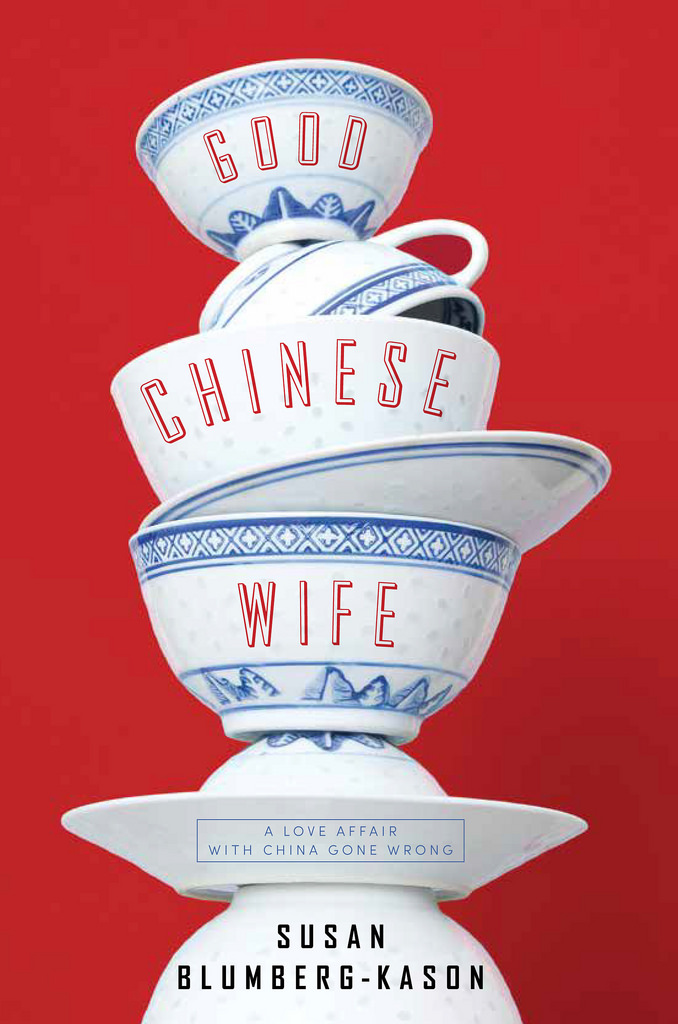
The “Good Chinese Wife” Interview with Susan Blumberg-Kason

(Note: I’m excited to be giving away one FREE copy of Good Chinese Wife! Want to enter the giveaway? Scroll down to the end of this post for details!)

Susan Blumberg-Kason’s new memoir Good Chinese Wife comes with a revealing subtitle: A Love Affair With China Gone Wrong. Before you even open the book, you already know what kind of love this is – a marriage between a white American woman and a Chinese man that doesn’t end well.

But as I’ve learned over time, there’s tremendous value in sharing the stories of couples that didn’t work out. That’s why I sent out a submission call for stories of love lost and unrequited love. And that’s why Good Chinese Wife should be on the reading list of everyone who follows this blog.

I’m calling it the AMWF memoir of 2014 and you shouldn’t miss it.

Good Chinese Wife: A Love Affair with China Gone Wrong

This book has it all. A Chinese love interest with movie-star looks. A romance set in glitzy Hong Kong. A huge red wedding in Wuhan. A fascinating journey across China in the mid-1990s. And a transformative tale of how one shy young woman eventually finds the courage to make a dramatic escape.

But most importantly, Good Chinese Wife is just an incredibly entertaining memoir. It’s the kind of book that you’ll open, thinking you’re only going to read for a little while, and before you know it you’ve devoured the whole story in one sitting.

Susan Blumberg-Kason

As someone who has known Susan for several years, I’ve had the privilege to witness the inspiring metamorphosis of Good Chinese Wife from manuscript to published memoir. It is an extraordinary honor to introduce you to Good Chinese Wife and Susan through this interview.

A freelance writer in Chicago, Susan has written for the Chicago Sun Times, the Journal of the American Dietetic Association, and Chicago Parent magazine. Her essay “Ninety Minutes in Tsim Sha Tsui” is included in the fabulous new anthology How Does One Dress to Buy Dragonfruit. She also wrote All the Tea in Chicago, the ultimate guidebook to the city for tea enthusiasts.

I talked to Susan to learn more about her memoir – from what inspired her to write it, to her experiences as a yangxifu (the foreign wife of a Chinese man) in the mid-1990s, to what she hopes readers will come away with from her story.

—–

When did you first realize you wanted to turn your story into a memoir? What ultimately inspired you to write it?

I first thought about writing this memoir after my divorce attorney in California asked me to write out everything that went wrong in that marriage. She needed all the details in case we went to trial. It was 14 years ago and I was living with my parents. They didn’t have a laptop connected to a printer and I wasn’t in the mood to camp out in front of the basement desktop—after having felt so isolated for the past five and a half years—so I hand-wrote it over the span of a week in the company of my family. This document was sixty-seven pages! When I proofread it before sending it off to my lawyer, I thought, “Wow! This would make a great book.”

A week later I saw the movie “Not Without My Daughter” for the first time. It was about a woman who almost lost her daughter when her family traveled to Iran to visit her husband’s family. The husband had lived in the US for 20 years, but when he returned to his motherland, he suddenly wanted to stay there and keep his daughter there. I cried because the same thing could have happened to me. I wanted to share my story with others and hoped it would give parents in cross-cultural relationships something to think about if they’re in similar situations.

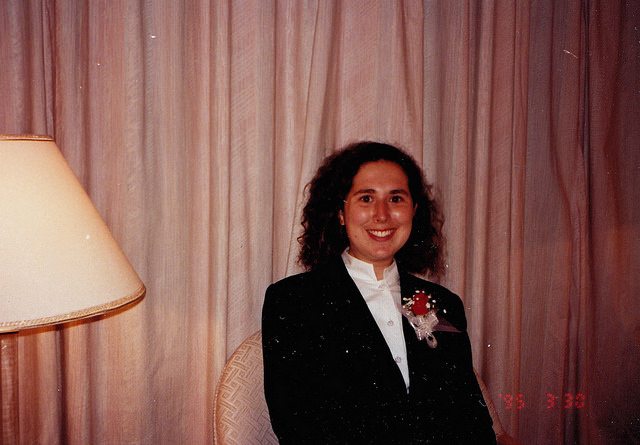
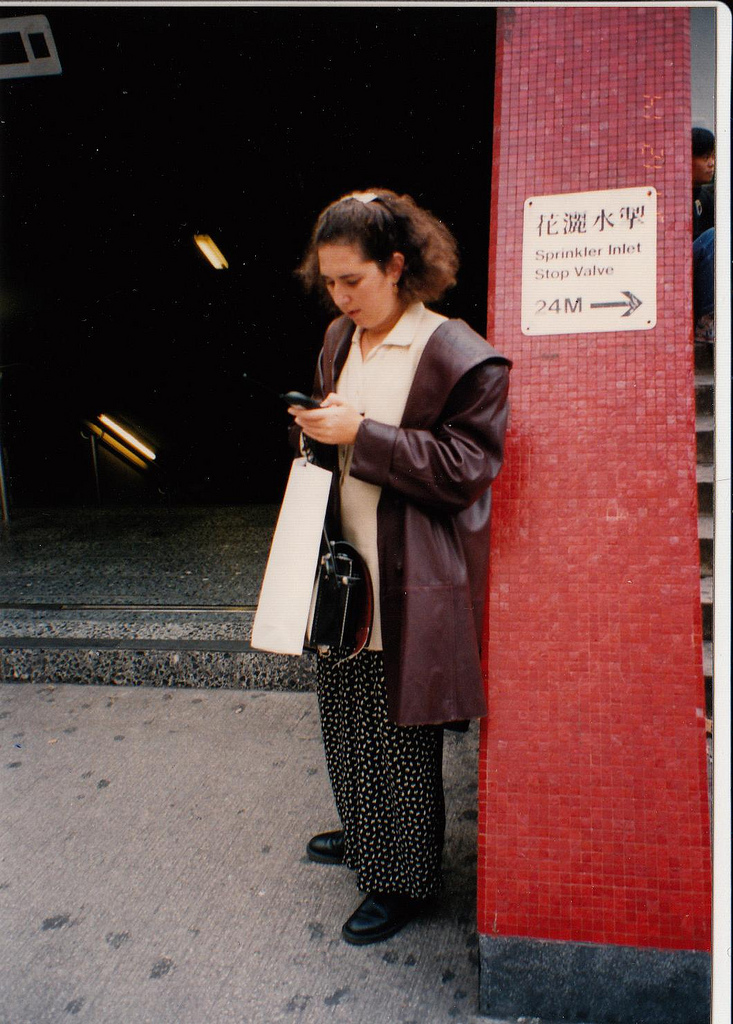
Susan at the Tsim Sha Tsui metro stop in Hong Kong.

Your love affair with Cai, a man from Wuhan, China, takes place in Hong Kong in the mid-1990s, at a time when you were mainly a graduate student. What are some of your most interesting memories about dating in Hong Kong back then?

Hong Kong was magical back then! I was so happy to be back (I’d lived there for a year in 1990-91) and open to new opportunities, including dating. Maybe it was the thrill of being back and the comfort I felt around Hong Kong people, but I definitely took more chances there than I had back in the US. There was a new confidence in the air as people who had left Hong Kong in the 1980s were returning. One was a friend of a friend who confided some pretty heavy personal history to me on our one and only date. At one point he became violent as he grabbed my arms and squeezed them as if in a vice. I was scared about leaving that bar—we were out in the middle of the New Territories—but in the end he paid for my taxi ride home, which was two hours away. I also went out with a television anchorman who promised a weekend away in Macau, but canceled at the last minute. And then there were the two guys I wrote about in the book, the two I went out with before I met Cai.

Hidden River, China - Cai's hometown
Hidden River, China – Cai’s hometown in Hubei Province

How did people react to yangxifu back in the mid-1990s?

It was a novelty for Chinese men to have a foreign wife. In Hidden River, Cai’s hometown in Hubei province, his parents had a friend whose son had married a Japanese woman. She was a legend in that danwei—whether or not people had met her—because she was a foreigner. So my inlaws were very accepting of me and liked to brag about me with their friends. When I walked around Hidden River, people were all very polite, even when they stared and pointed at my curly hair and western nose.

14583639023_393094e530_oYour wedding in 1995 was special compared to the average wedding banquet in Wuhan. Could you share with us some of the things that made your celebration different?

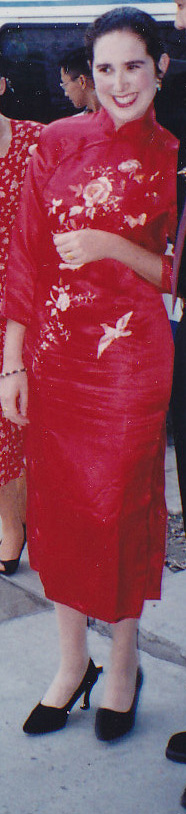
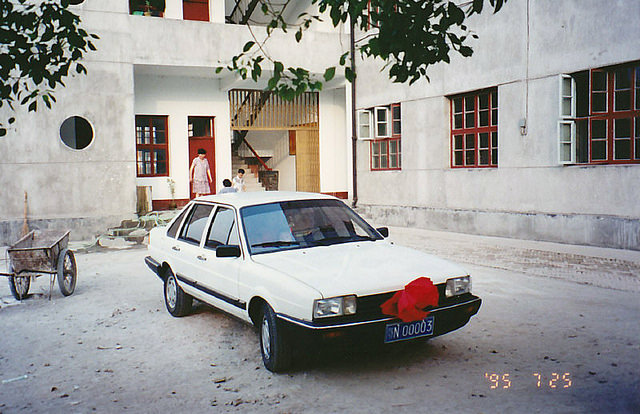
Well, back then children of Communist Party members had to have modest wedding celebrations. For instance, they could only use a couple of cars in their motorcades and could only have ten tables at their banquets. But because I was a foreigner, those rules didn’t apply to my wedding even though my father-in-law was a Party member. We had twenty tables at our wedding and five or six cars. Traditions were still low key in China then, so weddings were simple and quick. There weren’t tea ceremonies and the like. And women in Hubei didn’t wear red qipaos. It was all big poufy white wedding dresses. I had a difficult time finding a red qipao in Suzhou!

Cai’s parents also play a major role in your story. Give us one of your favorite scenes from the book featuring your inlaws.

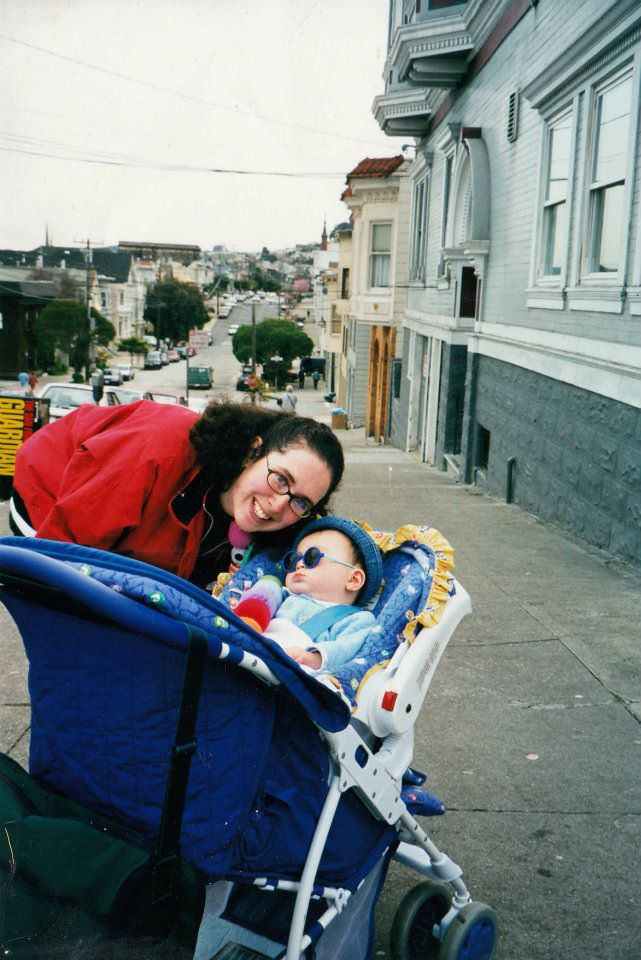
I think my favorite scene in the book was when they were leaving San Francisco to return to China. They had lived with us for ten months and after many clashes about childcare, I realized too late, of course, how much I had appreciated their presence at home. Every night we watched Chinese soap operas and news from Beijing while Cai went out. And they were often my only adult interaction at home. As we said goodbye at the airport, I also thought about how difficult it must be for them to leave Jake, their beloved grandson. So this scene is full of contrasts and difficult emotions.

Susan and Jake in San Francisco in 1999.

Your book includes many memorable characters, but none more so than “Japanese father” — a rather unconventional father-figure to Cai. Without giving everything away, could you tell us something about this fascinating character?

Japanese Father was a music professor who visited China one summer and met Cai in Wuhan. The two became pen pals and wrote long letters to each other almost every week. The Japanese economy was so far ahead of China’s at the time—it wasn’t even comparable—so the opportunities that Japanese Father could offer Cai, and later his friend Rui, were very attractive to young teachers who had no other way of making more than US$75 a month. Japanese Father had a lot of time to spend on his Chinese protégées because he was estranged from his wife and son. His daughter still spoke to him, though.

Susan at the Miramar in Hong Kong.

As the subtitle explains, your story is “a love affair with China gone wrong.” Some people may see your book as yet another story that casts Asian men in a negative light, as well as AMWF relationships and even China itself. How would you respond to those concerns?

The subtitle refers to my initial attraction to China and how that all changed. It wasn’t necessarily a bad thing; it just didn’t go according to plan. As for a negative portrayal of Asian men, I can only see two Asian men who don’t come out looking great. Some reviewers think that Cai is sympathetic, and I can see that, too. But the others—Baba, Cai’s friend Rui, my former brothers-in-law, and even the guys I dated in Hong Kong—are portrayed just as men in any other countries. They have a variety of positive traits and aren’t lumped into one general category. And as one friend pointed out, at the end I go to lengths to protect the Chinese male who matters most to me—my son Jake. As for AMWF relationships, I clearly do everything I can to make mine work. In writing my story, I hope that people will see how not to conduct an AMWF relationship! And as for China, I felt aligned with many young Chinese at that time. Every time Cai and I returned to China, he was heartbroken that it was changing so quickly and wasn’t like the China of his childhood. I echoed his feelings and could see how things were different even from my first trip to China in 1988. To me, that’s not being anti-China, but rather wishing for a smoother transition, for China to have eased into the twentieth century instead of leaping into the twenty-first in one blink!

In Hidden River, Cai’s hometown near Wuhan.

Could you share some of the lessons you’ve learned from your courtship and marriage to Cai, and what you hope readers take away from your book?

From the courtship, people will probably conclude that I married Cai too quickly. But I think it’s more than that. He told me from the get-go that he had certain conditions for our marriage. Those are things I ignored or thought I could eventually get him to change. That should have been my red flag, not the time in which we became engaged and married. And from the marriage, I hope people can see that it’s not a good idea to justify bad behavior in the name of cultural differences, whatever those may be. (Unless we come from the exact background as our partner, we will have cultural differences. My new husband and I are from different religious backgrounds.) If something doesn’t sit well, it doesn’t sit well and shouldn’t be tolerated. It doesn’t matter if the person is from Asia or the US or wherever. One more thing: just be yourself and you’ll be fine!

—–

Thanks so much to Susan Blumberg-Kason for enlightening us about Good Chinese Wife!

Want to win a FREE copy of Good Chinese Wife? I’m giving one away on Twitter to anyone based in the US or Canada. And it’s simple to enter! Just tweet the following:

[Tweet “@jossailin is giving away the new memoir #GoodChineseWife and I want to win!”]

Entries must be received by 12 midnight Pacific Time on July 16, 2014! I’ll then notify the winner via messaging on Twitter. Good luck!

UPDATE: Congratulations to @JohnWGuise for winning the giveaway!

Double Happiness: “He just never thought a Western girl could [love] him”

Marghini and Mr. B (photo courtesy of Marghini)

When Marghini wrote that her Chinese boyfriend “just never thought a Western girl could ever be interested in him,” it was as if she channeled my good buddy Xiao Yu from 2002. Back then, he offered a nearly identical explanation for the frustrating experiences I had with a number of Chinese men who drifted in and out of my life — and never responded to my subtle flirtations. (I would meet John only months later, who ended all of those frustrations for good!)

Marghini’s story speaks to a reality that, like it or not, exists not only in China but around the world. But it’s also inspiring to see how she and Mr. B still managed to fall in love in spite of it!

Do you have an inspiring story or guest post that you’d love to share on Speaking of China? Check out my submit a post page to learn how.

—–

The first thing I thought when I met Mr. B for the first time was that he looked very weird. I had arrived in Beijing only few days earlier and I quickly noticed how Chinese guys usually looked, behaved, dressed, and spoke English. Then I met this guy, who didn’t look, act, dress or speak they way the other Chinese boys did, yet sported a Chinese looking face.

Coming from a small Italian city, I was never really exposed to Asian Americans or simply to people with a very international upbringing. Therefore I just assumed that face and identity had to correspond. That is the reason why I was so confused at first; I couldn’t fit that funny looking guy into any of the categories I was used to. This confusion quickly turned into curiosity, which quickly became attraction. I was captured by the fact he looked so different from anyone else and my inability to decipher him just added to my attraction. His reserved personality, coupled with my inability to fully comprehend his American accented English, didn’t make it any easier for me to understand who this charming Chinese-non-Chinese was.

Time went by and slowly I got to know the guy better. I discovered why he looked so “mixed”, being born in Hong Kong but raised in Singapore, New Zealand and the US. My attraction grew bigger and bigger and I started thinking about how to show my interest to him. Being a hot-blooded Italian lady, I was used to being very direct and open about my feelings, but this time I found myself scratching my head. I didn’t know if I had to consider him Chinese or a Hong Konger or a New Zealander or an American, and I didn’t know if any of these identities would require a different approach from what I was used to. Groping in the dark, I decided I had to keep my Italian outgoing nature at bay. I bit my tongue and tried to approach the guy in a more delicate and indirect way — just few glances here and there, a couple of sweetish emails and a lot of eagerness to engage in conversations with him. Yet I felt so lost in translation! This soft strategy kept going for longer than a month and even though I sometimes felt like I spotted some sign of interest in me, nothing really meaningful happened. Then I tried to be a bit more direct, leaving a small present on his desk with a nice encouraging note, obtaining no reaction but a “thank you”.

I started considering the idea that maybe he was just not that into me. I tried to feign indifference, but in reality I felt incredibly sad and disappointed that the Chinese-non-Chinese boy didn’t share my same interest. At some point, I just stopped trying. I thought that my attempt to date out of the box just didn’t succeed and that maybe it was not my cup of tea. Maybe I had to stick to Italians as I always did.

I would have never ever guessed that Mr. B was actually very into me! He just never thought a Western girl could ever be interested in him, so therefore he just assumed he was misunderstanding my behavior. Funny enough, this handsome, smart, talented, kind and well-educated boy was convinced he was not attractive enough to date out of his race. His upbringing in New Zealand and the US, where he had to face some nasty jokes about his ethnicity, made him believe that Western girls would never even consider dating an Asian guy. He had been struggling for his whole life, feeling too Chinese in the Western world and too Westernized in China. He felt like he never really fit. Therefore, during the whole month I spent trying to communicate my interest, he was just trying to convince himself it was not possible that a girl like me was actually attracted to a Chinese boy.

Long story short, eventually Mr. B woke up and realized that he had to take a leap of faith. So he finally invited me out. We have been together ever since our first date.

Sometimes I still don’t understand whether he is more Chinese or New Zealand, or American. I would say that different sides of his personality reflect different cultures and identities, like a crystal prism projects different colors according to the edge. That is why I fell in love with him, and why I choose him everyday — because he is offbeat, different from anyone else and really unique.

Marghini is an Italian architect who accidentally stumbled into a life in Asia and has never been the same since. She currently lives in Hong Kong with her boyfriend while they figure out what’s next for them.

—–

Speaking of China is always on the lookout for outstanding guest posts and love stories! If you have something you’d like us to feature, visit the submit a post page for details — and then submit yours today.
Chinese Singaporean man seeks independent Western woman with “life in her” – and reminds us of diversity

(photo by Ed Yourdon via Flickr.com)
AMWF love in reality doesn’t look like the stereotypes. Nor do the men. (photo by Ed Yourdon via Flickr.com)

A few weeks ago, I received an e-mail from a reader in Singapore I’ll call “Tom”, who wrote:

First of, thank you for spending the time and effort to share your unique marriage experience. I have been reading and digesting what you have posted thus far.

However, as a Chinese Singaporean, I find myself caught in between the Chinese and the Chinese born and raised in a Western country. There is a lot of talk about these two groups but I feel left out of the conversation. A lot of hurdles that a White female may face with a Chinese seem to be almost non-existent when it comes to the sizable number of Chinese Singaporean men who come from english speaking families, and are highly educated with good and stable jobs. Such families tend to not be overly traditional and live out western values in their daily lives.

I am adamant that I would so much happier if I could have a life partner that has the qualities of a western female. Softness and meekness, and even home cooking, believe it or not, isn’t all that endearing to me. I want a girl that behaves as if she has life in her! I want a life partner, not a little girl. If I don’t give this a shot now I may settle for someone “lesser” in my mind’s eye. If I wanted to settle I would have years ago.

Tom’s e-mail also reminded me of an article in the World of Chinese about dating Chinese men, which mentioned:

Dating a Chinese guy has never been a hot topic to discuss with my friends. Some of these, I have found, have been harsh and unfairly judgmental. One even tried to warn me: “Don’t even think about it.” Their reason: they simply found the cultural differences too large.

When the author describes her judgmental friends, I’ll be willing to bet they have a very fixed and limited idea of “Chinese men” and subsequently what it means to date them. Chances are, not a single one of these women could imagine a guy like Tom.

There is incredible diversity when it comes to Chinese men — and more often than not, it looks completely different from the stereotypical images you hold in your mind. As an example, just look at these posts by China Elevator Stories, Sara Jaaksola, The Mandarin Duck, and Ember Swift about their own husbands, who are all so unique in their own right!

It’s almost crazy that things like this even need to be said. But then again, it is crazy that a lot of women come to China and then automatically cross Chinese men off the “dateworthy” column in their minds, as that World of Chinese article mentioned (a phenomenon I’ve sadly observed as well).

So ladies, don’t always assume he’s too conservative or traditional for you to date just because he’s Chinese and you’re an independently minded Western woman. For all you know, he could be like Tom.

What do you think?

Double Happiness: How one “foreign student turned party boy” found love in New Zealand

Jo and Kane (photo courtesy of Kane Gu)

When it comes to the love stories I’ve shared here, a lot of readers ask me, “Where are the Asian men?” Well, I’ve got a treat for you this Friday — the story of how Kane Gu, a self-described “foreign student turned party boy” snagged himself one special lady in New Zealand. 

Thanks so much to Kane for this submission!

Want to be like Kane and have your guest post or story published on Speaking of China? Check out my submit a post page for details.

—–

It is true that love can be found in the most unusual places, or in my case, two islands in the middle of the South Pacific Ocean.

I first arrived on the Kiwi shores 11 years ago at the age of 17. You could say that I fit the archetypal image of a young Asian international student: young, anxious and being the only child of the family. At the peak of New Zealand’s campaign in promoting its education system abroad, I was but one of the tens of thousands of students who left mainland China to study here. However, having lived and gone to school in Texas prior to my arrival also conditioned me better than most for my new life here.

Seven years later, after finishing school and tertiary education, I landed a job I was happy with. And with a few failed relationships thrown into the mix, I — the once clueless foreign student turned party boy — was anything but a stereotypical Chinese male. I had dated Aussie, British and of course Kiwi girls. Years of exposure granted me a social circle of almost exclusively Kiwis, and that meant, sadly, regularly consuming rather large quantities of the happy juice. My first attempt at a serious relationship was with a young Kiwi lass. We dated for one year before moving in together and things quickly turned sour because of things beyond my control. We called it quits just before we reached the two-year mark.

Having sunken into such low spirits, I in turn partied even harder than before. No amount of alcohol could alleviate the feeling of a terrible loss. I was such a mess and thoughts of returning home were already lingering in the back of my mind.

Time went slowly as the wound healed. Christmas came once again and I was invited to a friend of a friend’s party as usual, except this time, it proved to be the turning point of my life. There she was in an elegant pink dress, my future wife to be: tall, curvy and with long blonde hair. We had our eyes on each other instantly and my feeling was apparently shared by a few other guys at the party too. A little competition for her affections had started but it didn’t bother me for long because I won. As the drinks got flowing, we got talking. After expressing a mutual interest in each other, things quickly fell into place. We chatted all night and had so much in common that every sign was pointing in the right direction.

Things went great for two months, then came the hard times. Because of earthquakes combined with issues in regards to my visa, we both lost our jobs. Arguments started to flare, tensions were high but the mutual support never ceased. We had found a soulmate in each other and these tough times forged us into a stronger couple. We always believed there was light at the end of that tunnel, however long that tunnel might be, and we would make it through holding each others’ hands. When everything eventually took a turn for the better, we made the decision to move away from Christchurch to get Jo’s career on track again. Life in Auckland turned out to be very fulfilling for us, and we soon become engaged. Jo had the opportunity to return to Xi’an with me for a month in 2012. She was adored by my parents who started referring to her as their “xifu” even though we weren’t married yet.

With our four-year anniversary coming up at Christmas this year, our now one year old daughter will be joining our celebration. We have also planned a second visit to my parents in China this October, where our wedding will also take place.

Looking back now, it almost feels like things have always been this way. We found our missing puzzle piece in each other, even though we were once kept thousands of miles apart. Sometimes love just comes so naturally as though it had all been decided for you. The distance, the cultural differences and the color of our skin didn’t matter. Maybe that’s exactly what we Chinese call “yuanfen”.

Kane Gu found his true love in Aotearoa, the land of the long white cloud.

—–

Speaking of China is always on the lookout for outstanding guest posts and love stories! If you have something you’d like us to feature, visit the submit a post page for details — and then submit yours today.
Guest Post: 7 of the Best Things about being married to a Non-Native English Speaker

I’m so thrilled to share this fantastic guest post from Grace Mineta of Texan in Tokyo, one of my favorite AMWF blogs. If you haven’t discovered her blog, you’re missing out on one of the best reads in the blogosphere. Thanks so much to Grace for this outstanding submission!

Want to be like Grace and have your voice featured on Speaking of China? Visit my submit a post page for details.

—–

The fact that my husband is a native Japanese speaker is part of the reason we get along so well.

I have a small confession to make – my partner and I look nothing alike. For one, he’s a man and I’m not. So his hair is closely shaved, while my is long and flowing; his muscles, feet, and hands are larger than mine. But those aren’t the differences people usually notice. My husband is Asian (from Japan) and I am white (from Texas).

无标题

And like most Japanese people, he is not a native English Speaker. The first time he really took an English class was in cram-school, trying to get into college.

Fast forward six years and his English is advanced enough to quite literally charm my family into letting him marry me and whisk me off to Japan. And aside from not quite being able to understand what the characters from BBC’s Sherlock are saying without subtitles (mostly because he can’t understand British English), my husband Ryosuke doesn’t have any problems with English.

It’s totally not weird to walk in on him pouring over the Steve Job’s Biography (in English) while taking extensive notes (in Japanese) on how to become a “more awesome person, like Jobs.”

But he is not a native English speaker.

And I really, really love the fact that he is not a native English speaker because:

1. He never gets onto me for my atrocious spelling.

A large part of my income comes from my blog, “Texan in Tokyo.” I write about interracial marriage, living in Japan as a foreigner, and other “neat” things about Japan.

But, as commenters point out time and time again, I cannot spell to save my life. I also have problems with grammar.

I was hanging out with a friend yesterday and we were semi-talking about my blog. I brought up the spelling mistakes, and she was just like “Yeah, they’re everywhere, but at least you know you have horrible spelling and grammar. Some people have absolutely no idea.”

I understand it is somewhat shameful for a blogger to not be able to type up even a short, simple post without extensively relying on Microsoft Word Spell-Check… but hey. That’s me.

Even when typing the title for this section, I spelt atrocious like “attrocious.”

But Ryosuke never gets onto me for spelling or grammar.

And I used to think it was because his English wasn’t advanced enough to be able to point out mistakes in English, but it is. If he wanted to, he could do it. He just chooses not to. Or, more specifically, he chooses not to correct my grammar and my spelling.

He loves me. I love him. He doesn’t correct my spelling/grammatical mistakes and I don’t correct his various mistakes (unless it’s for a professional purpose, essay, or cover letter). It is glorious.

2. I could listen to his accent all day

Back in high school, I used to be all on board with “British and French accents are the sexiest things in the world.” Not anymore. Of course, British and French accents are still attractive (as are African accents, I’ve come to realize), but Ryosuke’s accent takes the cake.

Ryosuke’s classically Japanese accent is the most adorable and sexiest thing in the entire world. I could just listen to him talk all day. In fact, I would be able to listen to him talk all day if only I could learn to shut up every once and a while…

[For more, check out: Asian Man/White Woman Relationships- The Good, the Bad, and The Ugly]

3. It is very easy to condition my husband to say the things I like.

When you’re learning another language, you have a tendency to parrot the people around you. For instance, if you are learning English and your friend always says “awesome” to everything, you might start saying “awesome” to everything too.

I like certain words over other words. I think the way the words “fantastic,” “fabulous,” “futile,” “phenomenal,” and “thrilling” roll of the tongue. (Now that I’m writing them out, I realize I might have a fetish for words that begin with an “f”.)

Ryosuke’s vocabulary closely mirrors my own. He calls me fabulous, says my writing is fantastic, my attempts to get him to watch “New Girl” with him are futile, my eyes are phenomenal, and hanging out with me is thrillingly fantastic. He doesn’t have the same kind of attachment I have for English words. To him, anything works. And gradually, over time, his vocabulary has been filled with fantastically wonderful words that I like.

In a similar manner, my speech closely resembles his when I speak Japanese. It used to make my college professor so angry – she thought Ryosuke was “ruining my pretty Japanese.” He probably did.

But that’s what happens when you spend extensive amounts of time with someone. You begin to mirror their mannerisms – especially speech. Now, both Ryosuke and I sound like socially awkward (but somewhat sophisticated) adults when we speak English and like comedic 15 year old boys when we speak Japanese.

4. We get to make up our own words.

The benefit of always learning new words in a foreign language is that it is surprisingly easy to slip in some new, invented words, just for fun. Ryosuke and I often switch between Japanese and English when we talk – and so we’ve come up with a whole list of words that are a mix between the two languages, conveying something that is difficult or complicated to explain.

For example “Sappuri” means “Surprisingly Samui (cold).” We use it when it’s a lot colder outside than we expected. Or the wind is surprisingly cold.

5. We always have our own language to fall back on.

Between our made up words and the constant switching between English and Japanese, Ryouske and I have our very own language. And having your own language is an important tool that facilitates intimacy and closeness – even when you’ve spent the last three days in close proximity with family.

We don’t have to censor what we say around my family and his family – because if it’s a serious concern, awkward question, or inappropriate (or funny) comment, we can use our partner’s language.

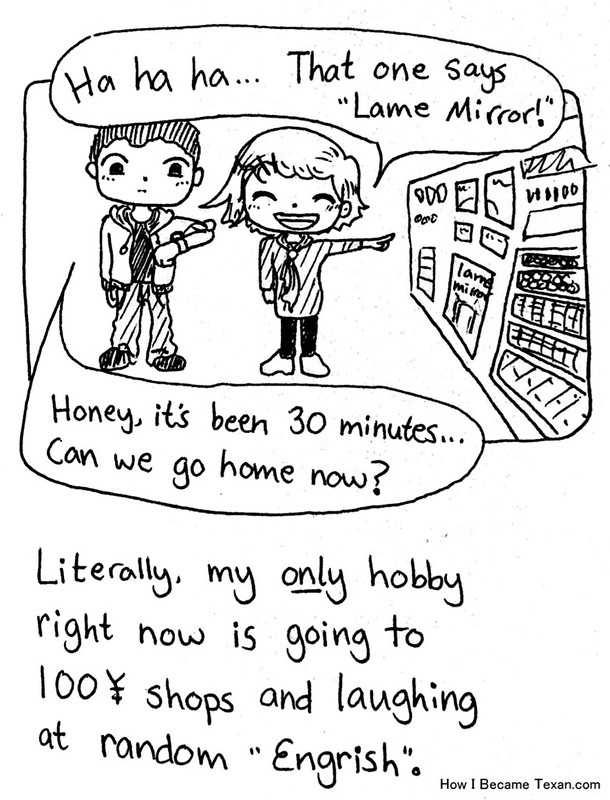
6. Our “Spot the ‘Engrish’” Games have a whole other side to them.

One of my favorite things to do is go to the 100yen shops (like the Japanese equivalent of a $1.00 shop, but much cooler and much less sketchy than American dollar stores) and laugh at the misplaced “Engrish” on the products.

Ryosuke enjoys the game as well. We will drive around all afternoon chatting, finding funny English, and eating peach jelly.

However, Ryosuke is also good at explaining why certain things ended up the way they did. He adds a whole extra level to the game – because as a native Japanese speaker who learned English, he can understand why native Japanese speakers who do not understand English write the things they do.

7. When we argue, we don’t get caught up in exactly what the other person is saying.

Our arguments aren’t a “he said, she said” battle. Of course he says socially unacceptable things while we fight – and in the beginning, I used fly off the handle at some of the socially unacceptable things he said.

Now we’ve learned to focus more on what the other person is feeling, rather than what they say. Our arguments are a “safe space” where you don’t have to worry about the other person freaking out if you accidentally say the wrong thing.

[For more, check out: Fighting – Things My Japanese Husband and I Culturally Disagree About]

It’s not fair to Ryouske to fight with complicated words and hidden meanings. We have to be very clear. And oddly enough, that has helped us both be much more honest when it comes to disagreements. He doesn’t have to worry about accidentally saying the wrong thing and I don’t have to worry about loaded up my words with hidden meanings.

Being married to a non-native English speaker is incredibly fun and always interesting. This cross-cultural relationship has opened me up to a whole new way to look at “language,” itself – which is kind of fitting because I write so much.

But then again, I’m partial because I am terribly in love with my husband.

Grace Mineta is a blogger, freelance writer, and fashionista in Tokyo. Married to her college sweetheart, Ryosuke, she spends most of her time hiking, drawing comics, and trying to navigate life as the American wife to a Japanese businessman.

—–

Speaking of China is always on the lookout for outstanding guest posts and love stories! If you have something you’d like us to feature, visit the submit a post page for details — and then submit yours today.

Guest Post: The privilege of stereotypes about cross-cultural couples in China

(photo by Angela Sevin via Flickr.com)

We’ve all heard about yellow fever and the associated stereotypes. So what happens when you’re a Western man dating or married to an Asian woman and you’re supposedly living the stereotype?

That’s the heart of this thoughtful guest post by Gerald Zhang-Schmidt, who is married to a Chinese woman. 

You may remember Gerald from years back when he collaborated with me to write about stereotypes of Chinese-Western couples. He also submitted a question about changing your name in China that’s become one of my top 10 most popular posts (and incidentally, he was the one who ended up changing his name!). 

Want to follow in Gerald’s footsteps and have your voice heard on Speaking of China? Check out my submit a post page for details.

—–

Maybe I just shouldn’t care.

It’s my own fault, after all. I’ve known Jocelyn, at least via Speaking of China, for years and read of her thoughts and travails with great interest. The way that Chinese society puts everyone into place, in their gender roles and in gendered expectations about behavior and the course of a life has fascinated me.

How could you not be fascinated? While public displays of affection are still viewed askance in many places, the requirements for an ideal partner are proudly and straightforwardly proclaimed in ‘marriage markets’? (“Westerners” may also see these advertisements as superficial and appalling, but one could just as well call them honest.)

How about a place where the women are portrayed as if they would prefer (and be preferred by) foreigners over their own men, whereas the men hardly even seem to stand a chance with anyone anymore? That’s where I’m caught squat in the middle. Speaking of China is all about the rarity of foreign woman – Asian man couples, draws readers because of that same rarity, and has lots of issues to talk about. Meanwhile I’m living all of those other, wicked, dominant, problematic positions.

I mean, according to all the talk about white male privilege – and its experience – I must clearly be privileged. I’m not supposed to talk, for it just reflects my attempts at staying on top and maintaining my privileged position. As the WM part of a WM-AF (white male – Asian female) relationship, I’m living the stereotype. “Oh my, clearly one of those guys with an Asian fetish and one of those stupid and/or calculating women dumb enough to fall for him.”

The privilege of being in a majority is that you’re questioned less. As a friend recently put it, “you are given more second chances.” For the same reason, though, you are also less visible — for better and worse. You don’t have to explain yourself nearly as much as the unusual Western (or other) woman who marries an Asian man or the lucky Asian man who was able to attract a Western woman. Because they are considered unusual, they attract attention. They get questioned. They have to explain themselves and live with the puzzled looks. But, they also get much-visited blogs and book deals for their memoirs. And so, they have a need, but also get a chance, of explaining themselves. In breaking the mold, they are viewed askance, but also as avant-garde.

Try getting a book deal for the story of a ‘stereotypically normal’ WM-AF relationship, when “everyone knows” (a favorite phrase of the Chinese students I was teaching) that it’s all just about the Asian woman looking to better her situation and the Western male with yellow fever.

Such observations of upsides and downsides all too quickly devolve into nothing but discussions of who’s got it worse or better, “the culture of shut-up,” as it was recently called. So who does have it better? The one in an extraordinary situation beyond usual stereotypes, yet facing more scrutiny because of it? Or the one barely noticed because the situation is so stereotypical, no one even bothers wondering?

It’s similar to how feminism and stereotypes are discussed in general terms rather easily, but then suddenly turn personal and get vicious, until the discussion turns into something that has nothing to do with them. The likes of a “sure, there is a privilege to being a white male, but *I* am hardly privileged (or do you see me becoming rich just so?)” even as the systemic difficulties of the not-privileged (and advantages of the privileged) certainly are there, or the “yeah, I’m all for feminism, I like strong women” from men, as if feminism were all about strength, let alone one person’s likes.

But that’s not what I want to discuss. I don’t want to discuss anything, really. I just want to provide my observations and make a humble suggestion. Relationships, be they romantic or otherwise, will always be influenced by ethnic, cultural, and other backgrounds and the views they give rise to. But relationships are, at heart, not between ethnic groups, not between social groupings, nor even between men and women. They are between individual people.

The trouble starts when we don’t want to see individual people and individual situations, and don’t suspend judgment. When we see someone who fits into a stereotypical opinion and immediately think we have a handle on who they are.

We should remember that we tend to not even understand ourselves half as well as we may think we do.

Gerald Zhang-Schmidt is an ecologist and cultural anthropologist who spent three years living in China, and now resides with his wife in his native Austria where he writes about the ecology of happinesschili peppers and being at home in the world.

—–

Speaking of China is always on the lookout for outstanding guest posts and love stories! If you have something you’d like us to feature, visit the submit a post page for details — and then submit yours today.
Guest Post: Setting up his Chinese nephew (again) with American women

Fred and his family in Hong Kong (photo courtesy of Fred)

Last year, Fred shared the extraordinary story of how he tried setting up his Hong Kong nephew with American women. He wrote in the post, “I thought with 100 percent certainty that any man would leap to his death to be able to date not just one or two but three ladies!” But the nephew wouldn’t budge and Fred gave up on his matchmaking ways…

Until 2014, that is. He had plans to travel to Hong Kong in April and decided to trying fixing up his nephew once again. So, will Fred’s nephew finally find love in the US this time? Read on for part two of this fascinating story.

Fred first made his debut on Speaking of China back in December 2011, when he shared the inspiring story of how found love in Brazil. More recently, last month he provided a field report on the ratio of AMWF couples to WMAF couples in Hong Kong, which has become a fan favorite and even inspired other readers to do their own surveys.

Want to follow in Fred’s footsteps and become a guest posting legend on this site? Visit my submit a post page for details.

—–

About two years ago, my wife and I went to Hong Kong to visit my half-brother and half-sister and their side of the family, all of whom are Chinese. My cousin Yew was my half-sister’s oldest child of three. When my wife and I visited him in 2012, Yew was single and approaching his late thirties, unattached and unmarried.

My half-sister was concerned that he still had no marriage prospects in sight. So I offered to help him by arranging for him to date four white American girls if he came to visit me in the US. Before traveling to Hong Kong in 2012, these four ladies had agreed to meet and date Yew if he came to the US. However, before he could even consider this proposition, Yew subsequently developed a strong case of kidney stones and was hospitalized, preventing him from coming to the US.

I then when to Hong Kong myself to visit him and also do some sightseeing, and it was then that I once again proposed the idea of dating these four American girls. He quickly rejected this notion because he felt he was not their equal.

Just recently, my wife, children and I visited Hong Kong from April 2, 2014 to April 12, 2014. We once again proposed that Yew should come to the US and try dating some American girls.

This time, I had hoped that things would be different.

Two of the four American girls from 2012 had since moved on and found boyfriends of their own, making them no longer available or interested. The other two (the nursing student who is my secretary’s daughter and another female lawyer) were still single, available, and interested. These two ladies once again were happy to meet Yew and give him a chance. But again, I did not tell these two ladies about each other, lest they think my nephew is a philandering playboy and refuse to date him. I promised that I would approach him and invite him to visit me this summer so that they could meet each other and seal the deal.

While last time I was the only one recruiting prospective dates for Yew, this time I had the help of my wife. She looked within her circle of single friends and knew of a handful of single girls, a group comprised of white American girls, white Brazilian girls, and Latina girls. She could not promise they would be available when Yew came or that they would give a foreign Chinese man a chance. She would not approach any of them with the idea of dating a foreign Chinese man who is not even in the US until Yew showed he was serious about dating them. She did not want a repeat of the 2012 debacle, where those four American girls agreed to give Yew a chance only to be let down by his refusal to come to the US and date them. My wife was very leery of raising false hopes within her circle of friends for fear of losing credibility. Besides, the girls in her circle could refuse to date him even if he agreed to date them.

So this time we had two white American girls who would certainly give Yew a chance and potentially a handful of other Western girls.

On the third day of our trip to Hong Kong, we met my half-sister, my half-brother and their children for dinner — but Yew was noticeably missing from the table. I couldn’t understand why he was absent. I had informed them over five months ago that I was coming and we had planned well in advance to meet on at least two occasions for dinner.

I asked my half-sister, “Where’s Yew?”
She said, “He’s much too busy with his work and studies to join us.”
I asked her, “When will he be available to meet me and my wife? I have great news for him about how to solve his singleton problem.”
My half-sister said, “Perhaps next week you will be able to see Yew.” We were scheduled to dine with the whole family then before returning to the US.

Next week came. We once again met the family and once again Yew wasn’t there.

So, I asked my half-sister, “Where’s Yew?”
Once again, she said, “He’s too busy with his work and studies.” She added that, “His company’s business had improved much since 2012,” when I last saw him. “His firm wants to promote him, but he needs to pass a course and test in IT. He’s embarrassed since he failed the test and must study again to repeat it.”

I then asked my half-sister, “What about his singleton problem? Does he have any prospects or solutions in mind?”
She said, “Yew is quite secretive about his dating life. Whenever I bring it up with him, he shuns me.” I could not believe it!

I said to her right then and there, “Call him on his cell phone.” I wanted to talk to him immediately about why he was not with us at these two family dinners and also discuss how to solve his singleton problem.

My half-sister called him and then I spoke to him. After we exchanged greetings and salutations, I cut to the chase.

I asked Yew, “Why weren’t you at these two family dinners? We planned them over five months ago.” He had initially promised to attend both of them.
He apologized and said, “Things at my company are so busy that I must work late and study to pass this course.” He never mentioned he failed the test and was repeating it, nor did I want to embarrass him by saying I knew about it.

Then I tried inquiring about his dating life. But wouldn’t you know it, Yew cut me off before I could even tell him about all the girls awaiting him in the US.

I told Yew, “I’m proud that you’re so diligent, hardworking and loyal to your company. I’m glad you’re trying very hard to advance in your career. But what about your future girlfriend or wife?”

As soon as I brought this up, he cut me off. He said, “I’m very busy right now and have to go.”
I tried asking him to give me just a few more minutes, but he insisted he had to leave and then hung up.

I could not believe it. How someone could be so disrespectful to his uncle? How dare he cut me off in the middle of a conversation?

I asked my sister, “What’s his problem?”
She said, “Honestly, he’s embarrassed about his failures in life. Not getting a promotion yet, failing that course and the test, still being single, and not being able to buy his own flat. He even shuns me when I try to discuss something serious with him.”

My sister had suggested he should go to Mainland China and find a woman in a remote village, someone willing to leave her hometown for Hong Kong. But Yew insisted he cannot find a wife until he has attained a certain level of financial comfort, including owning his own flat and having a large bank account. He believes he cannot call a woman his girlfriend or wife without having these things first.

I reminded my sister, “Western women don’t have that kind of mentality, where she’ll only date a man if he’s financially successful. Instead, she will work together with the man and reach success together as a couple. So he really should give Western women a try.”

Plus, one of the two girls I wanted to introduce to him is a lawyer in her mid-thirties with a well-paying job in the legal department of one of California’s largest insurance companies. She also owns a Mercedes and a two-story home. And best of all, she is willing to give Yew — a non-resident foreign Chinese man — a chance. That’s pure bravery and courage! This girl is willing to take a chance with him if has the courage to come to the US and meet her.

But my sister said, “Yew cannot even look a woman in the eyes unless he has some level of financial success.” She then abruptly cut me off and said not to talk about this any longer. It upsets her too much.

In the end, I left Hong Kong without even being able to see Yew or have a meaningful conversation with him. I also had to break the bad news to the two American ladies. From now on, when it comes to dating women, I guess I’ll let him fend for himself.

Fred practices employment law in Torrance, California.

—–

Speaking of China is always on the lookout for outstanding guest posts and love stories! If you have something you’d like us to feature, visit the submit a post page for details — and then submit yours today.

Tibetan husbands, dating Chinese pop stars, and other unusual stories of Chinese men & Western women in love

Kumbum Ta'er monastry at Xining, Qinghai China (photo by Remko Tanis via Flickr.com)
Kumbum Ta’er monastry at Xining, Qinghai China (photo by Remko Tanis via Flickr.com)

This week, I’ve stumbled upon a number of incredibly unique stories in the blogosphere about Chinese men and Western women in love. While I’m on deadline these days (and need a break from my usual posts) I thought I would share some of these fantastic blogs/posts with you. Enjoy!

A Tibetan-American love story in Qinghai

Earlier this week, a reader tipped me off to a few new AMWF bloggers — and one of them fascinated me the moment I read the short intro in her blog’s sidebar:

I’m Kimberly, an American lady living in western China with my Tibetan husband and our beautiful baby girl

Wow.

Kimberly’s About page offers a glimpse into how it all happened:

Following my stint in the home of Peking Duck, I went back to the states to get my Master’s Degree in Library and Information Science. (That’s right, I am a certified librarian.) By then I was itching to get back to China and decided to make my home out west, where the air is cleaner, the food is heartier, and the people are diverse.

I used to joke with my parents before I left that I was going to find a nice man there and settle down. To my surprise and delight (and my mother’s disappointment) it really happened. K and I were married on July 28th 2012…

…and on August 2nd 2012. We had two weddings, one western style in the city and one Tibetan style in the village.

Boy, what I wouldn’t give to sit down with Kimberly and hear the details of how she met and married her husband! Still, since starting her blog in March 2014, she’s already offered a lot of insight into her fascinating and unique life, including why she loves China, what she and her husband eat at home, pregnancy and birth in Qinghai, and local expectations for new mothers. This is definitely one blog to watch.

Dating a Chinese Pop Star

I’ve had my share of relationships with Chinese men (including my marriage to John), but I’ll never know — as Hannah Lincoln has reported on Beijing Cream — what it’s like to date a Chinese pop star:

Xiao Li was part of a gang of pop-folk musicians that included not just his band mates, all singers, but also their brothers and cousins and mentors and girlfriends and gal pals.

I had gone that night to get my culture on and enjoy some folk music. Awkward but uninhibited, I picked off one of the shy ones to practice my Chinese. We were having a pleasant conversation until his strikingly handsome friend cut in. He said I was really pretty and clinked beers with me. When I replied in Chinese, he slapped his hand on his face – “Wah! I didn’t know you’d understand me!” He then asked for my number, said he wanted to treat me to a meal.

…After a few weeks, I looked up Xiao Li’s band on Baidu. Apparently they had won China’s version of American Idol and were a go-to choice for the Party at official events.

Hannah recounts her time as the girlfriend of a pop star in China with honesty about it all, including her own missteps in the relationship. It’s a long post, but also worth reading and discussing.

What one Chinese man thinks of his foreign girlfriend

It’s no secret the the vast majority of stories about Chinese men and Western women in love are written by the women. And if we do hear from the men, rarely is it about a relationship that blossomed in China — one that, for that matter, is still going strong.

That’s why I’ve loved this recent post from C, the boyfriend of Spanish blogger Marta of Marta Lives in China. Here’s a snippet of his post, which reads like a valentine to Marta:

But Marta changed my point of view. She knows what is the real happy life, she prefers traveling to different countries rather than buying a CHANEL, she thinks we do not need to buy a house of our own(sorry but that is still one of my shot-term aims), she prefers walking more than driving a car, she is so kind and so nice to every member of my family, she is always so kind and polite, and she loves music.

Marta, he’s a keeper!

Check out the full post here, including a unique photo of the couple with tropical flowers in their hair.

Have you come across any unusual stories of Chinese men and Western women in love? Share them — or link to them — in the comments!

—–

We’re looking for a few good stories from Chinese men and Western women in love — or out of love — to share on Fridays. Submit your original story or a published blog post today.