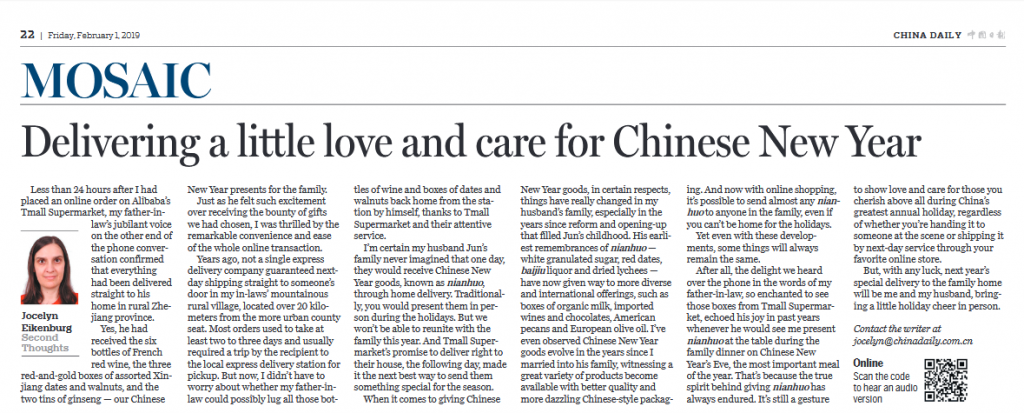
Delivering a Little Love and Care for Chinese New Year – Pub’d in China Daily

China Daily just published my latest monthly column Delivering a little love and care for Chinese New Year.

Here’s an excerpt from the piece:

Less than 24 hours after I had placed an online order on Alibaba’s Tmall Supermarket, my father-in-law’s jubilant voice on the other end of the phone conversation confirmed that everything had been delivered straight to his home in rural Zhejiang province.

Yes, he had received the six bottles of French red wine, the three red-and-gold boxes of assorted Xinjiang dates and walnuts, and the two tins of ginseng — our Chinese New Year presents for the family.

Just as he felt such excitement over receiving the bounty of gifts we had chosen, I was thrilled by the remarkable convenience and ease of the whole online transaction.

Years before, not a single express delivery company guaranteed next-day shipping straight to someone’s door in my in-laws’ mountainous rural village, located over 20 kilometers away from the more urban county seat. Most orders used to take at least two to three days and usually required a trip by the recipient to the local express delivery station for pickup.

But now, I didn’t have to worry about whether my father-in-law could possibly lug all those bottles of wine and boxes of dates and walnuts back home from the station by himself, thanks to Tmall Supermarket and their attentive service.

I’m certain my husband Jun’s family never imagined that one day, they would receive Chinese New Year goods, known as nianhuo, through home delivery. Traditionally, you would present them in person during the holidays. But we wouldn’t be able to reunite with the family this year. And Tmall Supermarket’s promise to deliver right to their house, the following day, made it the next best way to send them something special for the season.

You can read the full column here — and if you like it, share it!

Putting Heartbreak Behind Me in Moving to China – Pub’d on WWAM BAM

The group blog WWAM BAM just published my piece Putting Heartbreak Behind Me in Moving to China. Here’s an excerpt:

Years ago, when I made the serendipitous – and seemingly accidental – decision to come to China, I actually had a fresh start in mind after I signed on to teach for a year at a university.

My college years ended with an explosive breakup so devastating that I spent weeks in counseling trying to sort out exactly what had happened and why I had ended up with this wreckage of a relationship. It helped some when the counselor told me she suspected my ex was bipolar, which then explained a lot of the erratic behavior I hadn’t understood.

But that summer before I left, it was also a great comfort to me that I had China to look forward to. Even though I hadn’t explicitly chosen the opportunity as a means to sidestep my heartbreak back home, it nevertheless offered a golden chance for me to put this nightmare of a relationship behind me and move forward in a new direction.

Ironically, I had even built up China in my mind as this kind of “post-relationship retreat”, where I would get a reprieve from all matters of the heart and finally recover, particularly in light of what someone had told me about China.

To read the full post, head on over to WWAM BAM. And if you like it, share it!

Study of Foreign Women/Chinese Men Seeks Online Survey Participants

Are you a foreign woman or Chinese man in a foreign-Chinese couple in mainland China? Aliza Warwick, a researcher at Peking University’s Yenching Academy, just came out with an online survey that you could take (only takes 10-15 minutes) to help support her exploration of intercultural marriages. Here’s some background on her research:

Data from the Chinese government show that the number of marriage between foreigners and Chinese citizens in mainland China has been rising rapidly in the past several decades since China’s opening up. However, no demographic data are released about the individuals in theses marriages, such as where the foreign spouse is from originally, the ages of the individuals in the marriages, or their educational and occupational backgrounds. Anecdotes from the media hardly provide a clearer picture and instead often serve to fuel stereotypes. This questionnaire seeks to address this information gap and shed some light on this growing population of intercultural couples. The survey is part of a larger research project focused on intercultural marriage in mainland China by a Masters student at Peking University’s Yenching Academy.

You can learn more by clicking on this link for the survey, which provides further background information on the research. And if you’d like to participate, you can do so anonymously online.

Additionally, if you have further questions about the research, you can contact Aliza via email at [email protected] or via WeChat at aliza23.

Photo credits:
Models: Justin Zhang, fitness coach and Youtuber (IG: NoobStrength) and
Angelina Bower, beautiful fashion model (IG: musicloveandlies)
Photographer: Ana Hudson (WhiteChocolatePlayer)

Caution! Chinese New Year Is Coming: Why You Should Be Careful Ahead of the Holidays

Chinese New Year is the most wonderful time of the year for Chinese people, a holiday marked by joyful family reunions, feasts and traditional festivities.

But there’s a flip side to the coming holiday season: It’s also the time of the year when people should exercise additional caution.

A coworker of mine provides a typical example why. Recently, she needed to run to the bank and decided to rent a shared bicycle, which required using her smartphone to scan a QR code on it, which of course let any would-be thieves see her high-end phone. Because she felt rushed in a busy area, she didn’t pay much attention in the process. But after arriving at the bank, she suddenly realized that someone had stolen her smartphone — which very likely happened as she was distracted and getting ready to pedal away.

(She even told me, later on, that she should have been more careful, given that Chinese New Year is approaching.)

This kind of thing is more likely to happen in the weeks leading up the holidays, a time when thefts and other related crimes spike (so much so that a Tencent-backed news outlet devoted an entire article in Chinese to exploring why thieves are so rampant during Chinese New Year).

But it’s not just pickpockets you have to worry about.

Over the years, I’ve often heard my Chinese mother-in-law warn me to be more vigilant as Chinese New Year approaches, because it’s a time when more burglaries occur. In her village, people have had everything from valuables to crisp stacks of renminbi bills disappear after break-ins. (That’s why my in-laws always aim to have someone stay at home at all times during the holiday season.)

Why does so more crime take place in the holiday lead-up?

First of all, China experiences a huge migration of people during this time, with a rise in people carrying money and valuable gifts, providing more opportunities for thieves in places like crowded train stations and airports, and packed public transport around town (such as subways and buses).

Because so many people leave their homes and apartments for travel, this also creates more chances for burglars as well.

Add to this the fact that the holidays also come with a lot of pressure. People are expected to bring something home (like money or gifts) and appear successful before friends, family and peers. That includes crooks too, and anyone else less ethically inclined in society. So they have extra motivation to get out there and take advantage of the potential bounty that the Chinese New Year period brings.

Still, it’s good to know that China (a country that’s largely still very safe) isn’t the only place where the holidays demand more awareness when it comes to public safety.

After all, look at this advice from the Los Angeles Police Department ahead of the Christmas holidays, which includes the following words:

The holiday season is always a special time of year. It is also a time when busy people become careless and vulnerable to theft and other holiday crime. We can never be too careful, too prepared or too aware.

Or this information from the University of Alabama – Birmingham before the Christmas holidays:

During the holidays, the potential for thefts and robberies increase. More people are out and about, and they are carrying more money than during other times of the year.

Wherever you happen to be celebrating the holidays, here’s hoping your Chinese New Year is a safe one.

What do you think?

Photo credit: Paul via Flickr.

Should Foreigners Who Marry Chinese Also Learn the Language?

If you’re a foreigner with a Chinese spouse or loved one, should you learn some Chinese? Even just at a conversational level? Do we have an obligation to do so because we’re intimately connected to this country and culture?

This idea came to mind while pondering my own past, and first steps, in China many years ago, a time when I began dating a local Chinese man in Zhengzhou and couldn’t speak a word of Mandarin. He and I eventually broke up after six months, yet during our relationship, his presence in my life served as a spark to prod me into learning (along with other more practical reasons, such as being more independent). Deep down, a part of me felt that because I loved him, I should make an effort to study his language, even if that simply meant mastering the most basic conversational phrases.

Ironically, he didn’t encourage my efforts, suggesting my afternoon tutoring sessions were just a waste of time. Of course, he said this late in our relationship, which means it potentially reflected the growing rift between us, more than his genuine thoughts on the subject. Nevertheless, some people out there would agree with him – and I’ve met some or even heard about them, including those who have lived many years in China and, yes, have Chinese spouses.

Most people who argue against learning Chinese turn to two primary arguments: One, that it’s too difficult, and two, that it’s not necessary anyhow.

We all know Chinese remains notoriously difficult to learn. A few months ago, during a business trip at a conference, Chinese academics from some of the most celebrated institutions in China admitted to me in private conversations just how challenging the country’s official language is. Still, nobody says you need to emerge as the next Da Shan, have absolutely perfect tones, or reach the highest level in the HSK. Merely choosing a more reasonable “conversational” level can make the task more doable and less daunting. (That’s exactly what I did when I began learning Mandarin.)

I found an entire article devoted to why foreigners in China often don’t learn Chinese, and it adds an explanation unique those who speak English: “The main reason why more expats don’t speak much Chinese is this: we don’t need to learn it. China caters to English speakers.” This would fall under the “not necessary” arguments many put forth, including that their job doesn’t require it or the employer provides a translator.

For those of us with a Chinese spouse, our loved ones from China invariably end up helping with all sorts of errands, even if you can speak Chinese. It makes sense for a number of reasons, including the fact that they understand how to conduct business much better than we do because it’s their native country and culture. But of course, this gives the foreigner less motivation to learn – and bolsters the “not necessary” side of the argument.

Still, you could argue there’s a “need” for foreigners with a Chinese spouse. Given we already have an intimate relationship with the country, we’re going to encounter the language for the rest of our lives through family. When you can’t communicate with your spouse’s parents or grandparents or other relatives, it’s that much harder to forge a meaningful bond with them and makes holidays with Chinese family more challenging.

Besides the two usual arguments – “too hard” and “not necessary” — an additional barrier exists among cross-cultural couples. Whatever language you use while falling in love with someone becomes the language you prefer to use for communication (see The Relationship Between Language and Falling in Love). For those foreigners who start a relationship with their future spouses in English or another non-Chinese language, this serves as a psychological barrier to trying out their fledgling Chinese with their loved ones. Still, it doesn’t mean you can’t learn; you just might need to find yourself a supportive tutor or a language school or university program to fulfill your goals, instead of relying on your spouse, who might not be the best teacher anyhow. (See my post Why It’s a Really Bad Idea to Teach Your Spouse Your Language.)

So, let’s consider all of these factors together.

#1: Chinese may be difficult, but you can set a more reasonable goal (such as learning a set of useful conversational phrases) to put learning within your reach.

#2: While Chinese might not be a requirement for work or even running errands, foreigners with Chinese spouses may need to know some Chinese because they’ll encounter the language for the rest of their lives, through family.

#3: Foreigners who never spoke Chinese before with their spouses might feel challenged to learn, but they can choose to find tutors or language programs to study, instead of their spouse.

Ultimately, foreigners with Chinese spouses have a really strong excuse for learning – family. And they can overcome the barriers, if they set a reasonable goal and recognize their spouses can’t always be teachers.

So perhaps we shouldn’t ask the question, “Should foreigners with a Chinese spouse learn the language?” Instead, maybe it’s time we start talking about how to learn – and when.

What do you think? Do you agree that foreigners with a Chinese spouse should learn the language?

Photo credit: Kevin Dooley

Best of 2018 in Posts, Photos on Speaking of China

As we bid 2018 farewell, I’m taking a look back over the past year by sharing the best pics from my photo essays as well as posts on the blog.

Before we get to those photos, let’s review the top five posts on Speaking of China by views:

#5: “She Liked Having Threesomes”: Chinese Men Open up About Dating Foreign Women on Vice.cn. This past summer, I ran a four-part series of English translations of a Chinese-language article where Chinese men opened up about dating foreign women on Vice.cn. And this first installment got a lot of people talking. But don’t miss the second, third and fourth pieces as well, all worth a read!

#4: 11 Critically Acclaimed AMWF Movies Worth Watching. 2017 saw the release of two critically acclaimed movies that happened to feature an AMWF (Asian Male, White Female) pairing – The Big Sick and Columbus. That inspired me to compile an entire post reviewing the many great art house and independent films over time that have opened to rave reviews from critics and audiences alike, and included AMWF couples in the story.

#3: Chinese Men Can’t Date White European or American Women? Chinese Overseas Students Weigh In. In early summer, my husband happened to share a post from Chinese overseas students sharing their thoughts on an issue I’ve pondered here on the blog previously. I translated that Chinese-language article into English, adding some of my own analysis.

#2: Guest Post: I Got Divorced in China, and What Happened in My Marriage Is More Common Than You Realize. This post from guest author Alex, who shares some of her divorce story, pulls back the curtain on a common issue for marriages in China.

#1: Olympic Speedskater Shaolin Sandor Liu Has a Cool China Connection Beyond His Chinese Father. The 2018 Winter Olympics also introduced audiences around the world to a rising star in speedskating – Shaolin Sandor Liu. And this post, detailing his fascinating connection to China, has become a favorite during a year that saw Liu clinch a gold medal, the first-ever for Hungary, in the 5,000 meter speedskating relay.

Now, I’d like to share a sampling of some photos shared throughout the year in photo essays.

Wishing all of you a Happy New Year, wherever you are in the world!

Marriage Reform Empowers People to Follow Their Hearts – Pub’d on China Daily

China Daily just published my latest column, a version of the speech I delivered a few weeks ago, titled Marriage reform empowers people to follow their hearts. Here’s an excerpt from that piece:

On a summer day in 2004, a young Chinese man and a young woman from the United States walked up to a stage draped in burgundy velvet curtains, before the red national flag and the red-and-gold national seal of China at an office in Shanghai. They stood to the side as a government representative-a 30-something woman with a floppy ponytail-asked them to remain faithful and respectful to one another, to care for their parents, to support each other, and to maintain harmony in the family. Then they signed two small red books on the podium, and held those books up beside their smiling faces, as photographers snapped away and the young government representative beamed. By the powers granted her by the People’s Republic of China, the couple became legally married.

That was the day my husband Jun and I registered our marriage, a moment we had envisioned ever since January of that same year, when he had proposed to me over the phone. But none of this-the proposal, and the subsequent marriage registration-would have happened in 2004 without a very significant change that took place in China on Oct 1, 2003.

On that date, a reform of China’s Marriage Law took effect, abolishing a previous requirement: approval by your employer or work unit to register your marriage. In Shanghai, this change applied to students too, like Jun, who was in a graduate program at the time. The prior regulation had barred us from even considering marriage for a simple reason-universities would not permit it.

Thanks to this reform of the Marriage Law, we could move forward to register our marriage without concern over any impact on Jun’s graduate studies.

The only approval that mattered in the process was our own.

We weren’t the only ones that year who took advantage of the change. According to data from the National Bureau of Statistics, 2004 stood out as a boom year for marriage registrations across the country, with 8.67 million couples tying the knot, a rise of nearly 7 percent over 2003. At the time, it represented the largest year-on-year increase in marriage registrations in China since 1986.


You can read the full piece here online. And if you like it, share it!

P.S.: Yes, that photo above was taken the day my husband and I registered our marriage!

Christmas Tree a Symbol of Love, Acceptance Across Cultures – Pub’d on China Daily

Recently, China Daily published my holiday-themed column Christmas tree a symbol of love, acceptance across cultures. Here’s an excerpt:

My old Christmas tree-the very one I bought years ago at a Hangzhou supermarket-was the last thing I expected to find in my in-laws’ storage room in their rural Zhejiang home.

My husband Jun and I had just moved back to China after spending years in the United States, my home country. We had decided to stay at the family home during our transition back to life in China, which just happened to overlap with the start of the Christmas season.

While I recognized we probably couldn’t “deck the halls” with the same flair as my family had done in the US, I still longed for that one holiday necessity-a Christmas tree.

The last time we had owned an artificial tree in China, we lived in a small apartment in Shanghai, where it always occupied a place of importance in our living room every Christmas. But before moving to the US, we had left the tree behind with Jun’s family, like many other possessions we could never have packed because of the limited space in our luggage.

I knew his parents, frugal by nature, cherished the many practical household items we had passed on to them. Yet, if there was one thing I felt certain they had already jettisoned from our Shanghai days, it was the old Christmas tree. After all, they hadn’t grown up celebrating the holiday, and I had never glimpsed a single Christmas decoration in their rural home.

Why would they hold onto something that ostensibly had no obvious place or purpose in their rural Chinese lives?

So after moving back to China, when I brought up with my husband the idea of having a Christmas tree, I had assumed it would lead to talk of taking the bus to the largest supermarket in the county, sure to have a corner dressed in tinsel, filled with everything from rosy-cheeked plastic Santas to artificial evergreens of all sizes covered in shiny baubles and twinkling lights.

Instead, hours later, my husband poked his head into the bedroom, to bring great news of a package he and his parents had pulled out of one of the storage rooms: my old Christmas tree.

You can read the full piece here — and if you like it, share it! 

Wherever you are, here’s wishing you a very Merry Christmas and a Happy New Year!

A photo of the Christmas tree we used during our Shanghai days.

The 6 Pluses (and Minuses) of Christmas in China

Christmas is coming, and once again, I’ll be celebrating the holiday in China, the sixth consecutive year since moving here in 2013. Over the years, I’ve vacillated between loving the holidays here and longing for a Christmas just like those I used to know back in America.

So as I began pondering the forthcoming holidays, I began thinking of some of the positives and negatives of spending Christmas in China, a country that doesn’t celebrate the holiday. And inspired by the 12 Days of Christmas, I actually came up with a total 12 of them (six pluses, six minuses). So here goes!

The Pluses:

#1: You can celebrate the holiday on your own terms, and not feel as if you have to conform to the expectations of your family, friends or neighbors. That means having the freedom to create new traditions and expectations (including creating a Christmas with Chinese characteristics), and also being inspired by how people in China celebrate the holiday.

#2: You are spared the onslaught of Christmas ads urging you to buy, buy, buy — sometimes even in late October — which can feel overwhelming and exhausting.

#3: You can often find great joy in sharing Christmas with those new to the holiday, introducing your family or country’s unique traditions to them. (See 3 Joys of Celebrating Christmas With Someone Who Didn’t Grow Up With It)

#4: You can score inexpensive, yet charming, Christmas decorations on Taobao to deck out your place, as China remains a major producer of Christmas decorations for the entire world. (I once snapped up a cute Christmas tree on the platform for the RMB equivalent of around $3, complete with a star, ornaments and even twinkling lights.)

#5: You’re liberated from the usual crazy Christmas calendar, brimming with events, parties and activities every single week and/or weekend, since most of your friends, family and workplaces don’t celebrate the season. That means you can enjoy a more chill holiday season at your own pace.

#6: Since Christmas isn’t a holiday in China, the shops are always open and services available on Dec 25, which potentially opens up all sorts of great possibilities for celebrating (and getting that last-minute gift).

The Minuses:

#1: You may miss family, friends and neighbors and get a case of the “Christmas blues” being far away from loved ones. If you’re like me, you might just discover the true meaning of the song “White Christmas”.

#2: You generally won’t get Christmas off if you work or go to school, forcing you to be in the classroom or office on a day when you’d rather be home.

#3: It may never “look a lot like Christmas” if you don’t live in a large urban area in China, as you won’t likely encounter many decorations or Christmas trees around the neighborhood.

#4: Celebrating Christmas just like back home can get expensive. If you do live in a large urban area in China that includes foreigners, but you’re on a limited budget, you might feel chagrined to find you cannot afford to attend the “expat Christmas dinners” and other parties that come with a hefty price or entrance fee. You might also balk at the pricing for hard-to-find foods or ingredients only sold at select upscale markets or online stores.

#5: You might not like how locals choose to interpret Christmas or celebrate it, compared to your cultural or national traditions (such as giving out Christmas Eve Apples, or taking the holiday as an opportunity for romance).

#6: You may struggle to find the same style of Christmas decorations that you remember from back home, despite the enormous amount of offerings on Taobao. Your favorite decorations might be made in China, but not sold to people here.

If you’ve ever spent Christmas in China (or another country that doesn’t celebrate) or know someone who has, what do you think are the pluses and minuses of that?

Here’s hoping you have a very happy holiday season, wherever you are in the world!

P.S.: If you liked this, check out my earlier post The Ups and Downs of Spending Christmas Abroad (in a Country That Doesn’t Celebrate It).

Seeing Christmas Through the ‘Apple’ of China’s Eyes – Pub’d on WWAM BAM

The group blog WWAM BAM! just published my post Seeing Christmas Through the ‘Apple’ of China’s Eyes. Here’s an excerpt:

The other day, while browsing Alibaba’s Tmall, the online giant’s popular virtual shopping center, I happened upon a Christmas item that I had never seen before: gift boxes for Christmas Eve Apples.

They had the kind of charming little Christmas trees, Santas, reindeer, snowmen and holiday greetings you would expect to find on cards or boxes at, say, a Hallmark store. Except you wouldn’t find such a product on any shelves of a Hallmark store. Never in America had I encountered boxes made explicitly for apples that you present on Christmas Eve — because no such tradition existed in my home country.

Yet, based on the stats for this online store in China, over 100,000 people have already ordered sets of 50 from them just this month. And that store has plenty of company, with tens of others vying to gain business from young people who want the perfect little box for their Christmas Eve Apples.

I had known for some years that China turned Christmas Eve into a time for giving apples, particularly among young, urban people (even though it’s not a tradition in any Western country that celebrates Christmas). But I didn’t realize you even needed special boxes for the apples!

It stood as proof of just how far the tradition has integrated itself into the lives of young, urban Chinese — that it had spawned an entire industry of packaging to support the custom.

You can head on over to WWAM BAM to read the rest of the piece. And if you like it, share it!

P.S.: If you’re looking for gift-giving ideas this holiday season for someone in China, yes, I’ve recommended apples — but you can also see other suggestions at my classic post on gift-giving in China.