Interview with Alex Tizon on His Memoir “Big Little Man: In Search of My Asian Self”

If this blog was a course and you were one of my students, there’s one book that would be at the top of your assigned reading list: Big Little Man by Alex Tizon.

Big Little Man: In Search of My Asian Self

Subtitled “In Search of My Asian Self”, Alex Tizon’s new memoir deftly covers many of the popular topics I’ve written about on this blog. Yellow fever? Check. The challenges of Asian men in the dating world? Check. Hollywood’s harmful stereotypical portrayals of Asian men? Check. The myth that Asian men have small penises? Check. Discrimination against Asians (especially Asian men)? Check. Asian male role models that make us proud? Check. Big Little Man considers just about everything about Asian masculinity in the West in one fantastic book, which is one of the reasons I adore it.

But what I love most about Big Little Man is how Tizon tells the story. He’s painfully honest about his own struggles with things such as identity and feeling inferior in an America that has traditionally marginalized Asian men. He also keeps you turning the pages with his superlative writing and storytelling skills, which is where his journalist credentials especially shine through (Tizon received a Pulitzer Prize for his work in 1997).

Ultimately, this is a memoir I’ll cherish for years – and chances are, you will too. You must read Big Little Man. And if you’re like me, you’ll want to peruse its compelling pages again and again.

I’m thrilled to introduce you to Big Little Man and Alex Tizon through this interview.

Alex Tizon
Alex Tizon

During his 20 years as a journalist, Tizon worked first for the Seattle Times and then the Los Angeles Times. A graduate of the University of Oregon and Stanford, he now teaches journalism at the University of Oregon. You can learn more about him and his writing at AlexTizon.com.

In this interview with Alex Tizon, I asked him all about Big Little Man – from what it was like writing about yellow fever and his own insecurities about penis size, to what he thinks it’s going to take for Asian men to be seen as desirable romantic partners.

—–

You offer one of the most devastating critiques of Western men with yellow fever seeking Asian women that I’ve ever read. While you acknowledge at the end of the book that you’re now more accepting of these relationships, for a time this phenomenon actually angered you. How did it feel to revisit your past feelings on this issue?

It didn’t feel very good. It felt terrible, actually. And the feeling wasn’t limited to just this phenomenon. The writing process itself is painful to me, and when you combine it with the probing and remembering that were required to tell the story, the whole enterprise at times seemed too much to bear. Remembering the sense of exile that I felt as a young man actually recreated the feeling of exile. Remembering the indignation I felt upon seeing rich old white men buying the affections of impoverished 15-year-old prostitutes in the Philippines filled me once again with anger and resentment, and I walked around that way. It put me in a snarly mood. I wasn’t fit to be around people. I withdrew and took a lot of naps. I really hope my next book won’t be such a torture.

In your memoir, you courageously confront the pernicious “small penis” stereotype of Asian men in part by sharing your own very personal and intimate experiences. When I was reading this section of your book, I almost often felt as if I was sneaking a peek at your diary! What was it like writing so honestly about something most men would never dare to discuss?

People are surprised to hear that it wasn’t that difficult to do, really. There were sections of the book that were much harder to conceptualize and write about. If I were thirty years younger, I might not have been able to write about this topic because of adolescent ego and vanity that are still so powerful at that age. But I’m in my 50s, with a respectable record of romances, and am happily married. I’ve sufficiently proven myself, at least in my own mind. My insecurities have moved on to other areas.

The challenge in writing the penis chapter was to do it in a way that elevated the discussion, at least a little, from the junior high locker room level to something that addressed the symbolism of the subject. I don’t know if I succeeded. My wife thought the chapter was extraneous and a little puerile. In my defense, I was more interested in exploring what the penis represents in the various mythologies about race. It would be incomplete to talk about the Asian male experience without addressing the idea of his mythically small penis, just as it would be incomplete to talk about the black male experience without addressing his mythically large one. These myths exert social force. Both myths are hollow, of course. “Asian” covers too many people over too large a swath of geography, as does “black” or “African.” The riotous diversity in those swaths! When you make simplistic generalizations about such immense sections of humanity, you’re bound to be wrong half the time. Nevertheless, the myths endure.

You devote an entire chapter to exploring Asian men in American TV and the movies, from the embarrassing stereotypes to “yellowface”. It’s one of the most comprehensive takes on this subject that I’ve encountered. How do you feel about the state of the Asian man in American movies and TV for this year?

There are promising signs. ABC will have two primetime comedies this fall starring Asian leads, including one, Selfie, in which actor John Cho plays a lead role, and some predict a romantic lead role. We’ll have to wait and see if that pans out. There’s Steven Yeung on The Walking Dead, and Daniel Dae Kim in Hawaii Five-O; both of those are supporting roles but good ones.

Cultural habits are hard to break, though. One show on TBS, 2 Broke Girls, that was called by the New Yorker as “so racist it’s baffling,” features an Asian male character straight out of KKK central casting: a diminutive, sexless, bumbling, language-challenged restaurant owner who is a constant butt of jokes, and he takes it like a true spineless loser. He’s the 2014 version of Lloyd Lee on Entourage, and Hop Sing on Bonanza. White America needs at least one per generation to remind itself that, oh yeah, this is what we think of Asian men. Chop Chop!

A few weeks ago, I watched a movie called Edge of Tomorrow in which the lead character was played by Tom Cruise. I like Tom Cruise. But the movie was based on a Japanese graphic novel, written by a Japanese author, in which the lead character is Japanese. There’s another movie coming out soon – same situation, based on a novel out of Japan, but the lead role was given to blonde, green-eyed Garrett Hedlund, who I’m sure is a terrific actor. When Hollywood starts casting Asian men in roles originally conceived as Asian men by writers who are also Asian men, then I’ll know we’re making real progress.

Regarding your romantic life as a young man in college, you wrote, “My sense was female eyes did not see me…I was undesirable.” The three distinguished young Asian men you profile in your book, who you single out as examples of progress, also admit to challenges of dating at universities where most women are white. What do you think it’s going to take for Asian men to be seen as desirable partners?

Time. And a re-positioning of the world order, which is happening as we speak. Desirability in men is so often tied to power. As Asian nations and diasporas, and Asian Americans, both male and female, continue to accrue power – economic, social, political, corporeal – the more appealing they’ll become, and the more influence they’ll have in affecting ideals of beauty and desirability, which will be redrawn in their likeness. It’s a matter of time. Of course I’m talking about historical time: decades and generations rather than weeks and months.

While your entire book is an incredibly fascinating portrait of Asian manhood, I especially enjoyed your chapter on the Chinese concept of Wen Wu (文武) as it relates to masculinity: “For the past two thousand years in China, you could not be merely a tough guy to be considered an ideal man. You also had to be scholarly, poetic, and wise. The manliest of men were philosopher-warriors, and more philosopher than warrior. A cultivated mind was more highly esteemed than big biceps or deft swordsmanship.” How did it feel to discover this tradition of masculinity, and that it had such a long history?

It really put in place a missing piece of the puzzle for me. But it was more a sense of re-discovering it rather than discovering it. Because I grew up with it in my family, only I didn’t realize it at the time. We didn’t have the language for it, nor sufficient knowledge of our own history. But when I realized that the dynamics of our family, specifically the ones that shaped my father and brothers, were part of an old tradition of masculinity (I like the way you put that: a tradition of masculinity) that went back to the ancient Chinese, whose teachings influenced the whole continent, it made sense of things I’d been trying to figure out. It also liberated me in a very real way. I was freed to be the man that I was raised to be.

You write briefly about your first marriage to a white woman, which ended in divorce. You stated, “I don’t believe our ethnic and racial backgrounds played a huge role in our breaking apart, but they may have played a role.” How much do you think ethnic and racial backgrounds matter in relationships?

I have to believe that it will matter in different ways and in different intensities for different couples. I can really only speak to my own experience, and I’m more and more believing that I underestimated the influence, on a subconscious, molecular level, of our families or, as I put it in the book, our clans. I think the Emerson quote I use in the book, that we’re each a quotation from all our ancestors, is true. The wider the gulf between our ancestors, the greater the potential for disconnect in present-day relationships.

But I also know of a few interracial and interethnic marriages that are as solid as any I’ve encountered. They make it work. They do the impossible work of bridging impossibly wide gulfs. And let’s face it, the gulf between men and women everywhere and in all times can seem impossibly wide. But these couples seem to have what it takes for any couple of any background to last a long time: humility, deep friendship, an ability to create a spark now and then in some area of life. A little luck doesn’t hurt either.

You write about initially feeling uncomfortable with being lumped together with all the different ethnic groups from Asia under one label (“Oriental” when you were growing up, and “Asian” today), as if Japanese and Filipino is “the same thing”. At the end of your book, you state, “For the time being, and until we collectively move on to more enlightened ways of identifying ourselves, I guess I am an Asian guy.” What do you think would be a more enlightened way to identify ourselves?

Almost anything other than “Asian” or “Black” or “White” would be more enlightened. Nationality or ethnicity or geographic location would be an improvement. Perhaps the more specific the better. I am a fisherman from the Pacific Northwest of the North American continent. When I traveled to my mother’s home province in the Philippines in the early 1990s, I was enchanted to meet people who identified themselves, not as Filipinos or even as Tarlacenos (from Tarlac Province), but as people of such-and-such mountain or such-and-such river. They harkened from a very specific place, and identified themselves accordingly.

I’m watching the HBO series Game of Thrones, which is roughly based on medieval Europe, and I love the way the characters identify themselves with these very long, compound sentences: I am Alexander of House Tizon, Son of the First Men, Subject of the Seven Gods of Hodor, Squire for the Protector of the Realm, Native of the Andals and Ally of the Cebuano Fishers of the Black Sea, etc. I mean, it gets a little long-winded but it’s so eloquent and beautiful and rich, and so multidimensional. Wouldn’t it be great if we did the same in identifying ourselves. It might require the creation of a new language and a new tradition. Might it actually enrich our experience? Because what we name ourselves, I believe, profoundly affects how we see ourselves as individuals, and in turn how we conduct our lives. “I’m Black” or “I’m White or “I’m Asian” seems to open the door to such a limited reality – small and ridiculously vague at the same time.

Among some Indian tribes in New Mexico, there are over a hundred words for sunlight. There’s a word for the light that peeks over a hill in the morning. There’s a word for the light as it moves behind a particular kind of cloud. There’s a word for the sun just as it disappears below the horizon, and so on. You have to believe that their experience of the sun had more dimensions to it, was richer, and more poetic and precise. If we can figure out how to identify ourselves in ways as textured and layered and nuanced, we’ll have done a kindness and maybe come closer to the enlightened approach I hint at in the book.

—–

A huge thank you to Alex Tizon for enlightening us all about Big Little Man through this interview! For more information about Tizon and his writing, you can visit his website AlexTizon.com (where you can also find links to him on social media sites). You can purchase Big Little Man at all major online retailers including Amazon.com.

Interview with JT Tran & Alice about New E-Book “Online Dating For Asian Men”

It’s true — online dating is unfair to Asian men.

But try telling that to the high-powered exec in Shanghai who e-mailed me a few months back, saying he didn’t have time for anything else but finding women on the Internet. Some guys are busy and online dating — even if it is racist — is better than nothing.

Or does it have to be that way?

What if Asian men could improve the online dating odds? What if there was a way for them to achieve results that could match or surpass those of white men?

That’s what JT Tran (aka “The Asian Playboy”) and Alice Zindagi of ABCs of Attraction are promising in their new e-book Online Dating For Asian Men: The Scientific Method to Dating Girls Faster, Easier and With Less Rejection.

10617357_910374102310877_2103488337_n

I sat down with JT and Alice to learn more about their e-book, from why they’re calling it “revolutionary” to some of the online dating tips they’ve uncovered. (Disclosure: JT Tran is one of the advertisers on my site.)

—–

You’ve called your online dating experiment “revolutionary” when it comes to online dating. How is it revolutionary?

ALICE: Our experiment is revolutionary because the dating world almost always fails to acknowledge the difficulties of dating for minority communities, especially Asian men. Everyone knows that dating when you’re a tall, handsome white guy who looks like a carbon copy of Channing Tatum or Bradley Cooper is basically playing the game on easy mode and that being short or different is practically an online death sentence. But the majority in America have grown up with white privilege and they don’t realize that having a different race requires a different approach, especially when the media emasculates Asian men. You can see the direct result in every online dating study ever done that shows Asian men are universally the least responded and contacted group of men out there. OK Cupid did a study that showed AMs receive a lowly 22% response rate with Asian women responding even LOWER to Asian men than they did to other races. There are numerous products and services out there designed to help men improve their online dating game, but Asian men have been almost entirely left out of that equation. Until now that is.

JT: I’ve actually always avoided online dating and discouraged all my clients to stay away from it as well. Online dating was so slanted against Asian men that I felt that it was completely pointless to even try. It’s far easier and more enjoyable to meet real women in real life. However, I would get literally hundreds of emails every year from my fans who desperately wanted internet dating help. I resisted until Alice showed me the pet project that she had started on. And from there it exploded into the monstrous research project that you see before you: over 3000 messages sent, over 60 profile pictures tested, and a dozen profile descriptions written. We finally cracked the code and were able to achieve results that not only matched Caucasian male response rates, but also in some cases, SURPASSED THEM. If you had asked me if it was possible for AMs to completely conquer online dating and beat every guy out there, I would have said that was impossible. But not now.

Where did you get the idea for this online dating experiment?

ALICE: The idea initially surfaced when the Creepy White Guys tumblr made the rounds on Facebook in 2013. It’s basically a collection of screenshots from some of the creepiest white men with yellow female fever. I wanted to see if I could provoke the same results, so I created my own set of profiles but I didn’t encounter any racism until I made specific mention of having an Asian male preference. What was more interesting than the racist creeps, however, was the fact that Asian men were nonexistent in the absence of an Asian preference, but they flooded the inbox when they discovered a girl with a stated preference for Asian men. It was then that I realized this could potentially be a problem for Asian men in online dating if the only women they were contacting were Asian women and the rare non-Asian woman with a stated preference for AMs.

JT: All credit goes to Alice. Once she showed me what she had started, I gave her carte blanche to crack the internet dating code. I directed her to a perform a series of experiments using control profiles (White Males) and Asian profiles (one of them being mine). We also experimented with attractiveness level (Athletic, Average, Nerdy) and 9 types of openers. After a while, it took on a life of its own and became this massive undertaking. I was not only surprised with some of the data we were getting, but also really excited that some of the results were bearing fruit and showing me that internet dating for Asian men was not hopeless at all.

Alice of ABCs of Attraction.
Alice Zindagi of ABCs of Attraction.

Could you share with us some of your results? What surprised you the most?

ALICE: In general, the global response rates (that is, the averages from every kind of opener we tested combined into one number) were higher for white profiles than for equivalent Asian profiles. We expected this. But what we found to be interesting was that profiles of men who bordered on being nerdy or even fobby did better than profiles of average men. When we took the fobby men and cleaned them up with better haircuts, styling, and poses, their results were actually lower. These results indicate that, at least now, being a bit nerdy can be an advantage, which is a huge godsend for a chunk of the Asian male population. With the increasing acceptance of many elements of typically nerdy or fobby subculture and fashion, such as gaming and even heavy glasses, this is less surprising.

JT: A great many things surprised me. There were certain things I had assumed would make for a better online dating experience. For example, the most successful type of pictures wasn’t what I had originally thought: that of a well-dressed man in his profile picture or being surrounded by women. Neither scored very well. Or the type of openers (i.e. email conversation starters) that worked the best also surprised me. Using my own profile, I could at best only achieve a 30% success rate (equal to a white male). But when combined with the most optimized picture, optimized profile, and optimized email opener, I got a 40% response rate! Almost 200% more than the average 22% that Asian men get. When combined with the success rate of asking her out and getting her number (date template of which is included in the book), I could realistically GET A DATE EVERY SINGLE DAY FOR A WEEK by only working at it for an hour.

Can you give us a preview of one or two pieces of advice you’re offering men?

ALICE: Don’t try too hard to be sexy. It’s true that men who are classically handsome are going to have better results than men who aren’t. If you look like Takuya Kimura, you’ll get better results than William Hung. That’s just the way the genetic lottery is played and there isn’t much you can do about it. While you should make an effort to change the things you can, like your hair or fashion, when you try too hard you can often forget to be you and might lose some of the charm or quirks that draw women to you. If you’re not classically attractive, it’s not profitable to focus too much on your looks. That’s why it’s better to emphasize how interesting you are and give girls a different perspective. A picture of you rock climbing, dominating a basketball court, or wrestling a grizzly bear speaks more volumes than a bathroom selfie showcasing your $200 KPop haircut.

JT: Don’t try to have extended conversations online. I discovered that once a woman started to respond to my emails, I could easily get her number within about 3 emails and setup a date. Anything more than that risked getting lost in the friend zone or, even worse, risked you getting Catfished (a scam artist who intentionally targets Asian men because of our reputation for spoiling women). Any real emotional and romantic connection will come from when you go on your first date with her. It’s a lot easier than you think to ask for her phone number and go on the first date.

JT Tran (aka "The Asian Playboy") of ABCs of Attraction.
JT Tran (aka “The Asian Playboy”) of ABCs of Attraction.

Many of the men who read my blog are not native English speakers and therefore when they write to women online, their English isn’t going to be perfect. How much do you think that matters to women in online dating?

ALICE: Proper English is only important to a certain degree. If your grammar and vocabulary are so bad that you have to use Google Translate to construct a sentence in English because you don’t actually speak it, then you might have a problem and I would recommend taking a break from online dating to pursue an English class. But there’s nothing wrong with not typing perfectly. If anything, some girls can be intimidated by perfectly written English. It can make you look like you’re trying too hard and can put the pressure on her to match your perfection. Errors and mistakes are fun. People like emoticons. People don’t waste time with perfect punctuation if it’s not an essay for school. You have too much time on your hands if you do. As long as a girl can understand what you write, she’s not going to care if it’s written perfectly.

JT: This is why I think meeting people in person is so much better for Asian men because you can communicate with someone using just your body. About 33% of my clients are ESL so I’m not going to teach them useless verbal routines in order to hold a conversation with a girl. Instead, he can communicate with her using his body and subcommunication. Having said that, however, there are templates in Online Dating For Asian Men: The Scientific Method to Dating Girls Faster, Easier and With Less Rejection that they can use. There are screenshots and even transcripts of conversations that go from initial contact to getting her number that anyone can use regardless of their English skill level.

Where can people buy a copy of your e-book?

JT: They can pick up a copy right here online.

—–

Thanks so much to JT and Alice for this interview about Online Dating For Asian Men: The Scientific Method to Dating Girls Faster, Easier and With Less RejectionTo learn more about their work, visit the ABCs of Attraction website.

Guest Post: Lessons in Korean cuisine from my Korean ex

Just because you break up with your boyfriend doesn’t mean you have to break up with his cuisine too.

Sveta and her Korean boyfriend parted ways several years back but she continues her love affair with the spicy flavors he once introduced to her — flavors that she never expected to crave. It’s amazing how a relationship, even when it’s over, can influence you in delightfully positive ways!

Have a delicious story worth sharing on Speaking of China? Visit the submit a post page to learn how to have your post published here.

—–

(photo by Alpha via Flickr.com)

Recently I went to a Korean restaurant with a Chinese friend. I had a craving for a spicy Korean dish called Ddeokbokki which includes sliced rice noodles, fish cakes and vegetables, and is flavored with a sauce called Gochujang. My Chinese friend ordered a mild dish with pork, while I ordered Ddeokbokki.

As the cooks were making our meals, I wondered, Did they think that I ordered the mild pork while my friend ordered the spicy Ddeokbokki? The servers even assumed I couldn’t use chopsticks — they handed me Western-style utensils when they brought the food to our table — and they weren’t the only ones.

“Do you know how to use chopsticks?” my Chinese friend asks me.

“Yes,” I reply as I pick them up and dig right into the Ddeokbokki, to the astonishment of my friend.

I break the egg and spread it over the dish, just like I learned how to do years before. Later on, I pick up a small piece of fish cake called odang, which was covered in red sauce, and encourage my friend to try it. “It’s really good.” I’ll bet nobody in that restaurant imagined that I would introduce my friend to Ddeokbokki.

As I continue eating Ddeokbokki, I have to laugh at how much my tastes have changed. Who would have thought that a girl who couldn’t stand spicy food before 2008 now craves Korean food and even likes it? If you had told me in my early twenties that I would learn to love Korean cuisine, I would have shot you an incredulous look before launching into the many reasons I wouldn’t enjoy Korean food. After all, the Russian cuisine I was raised on — salads, potatoes, vegetables, chicken and beef — never included spicy foods like Ddeokbokki.

(photo by Anna Lee via Flickr.com)

But then in January of 2008, I met Elliott, an international student from South Korea — a man who I ended up dating until September 2010. While we ate a lot of American food when we were together, Elliott also started introducing me to spicier Korean cuisine. He even taught me how to use chopsticks because his apartment didn’t have any forks or spoons.

It took me a long time to get used to the spiciness of Korean food. At first, when he would make spicy ramen noodle soup, the inside of my mouth felt like it was on fire and I needed to have lots of water to quench my thirst. Sometimes I wasn’t even able to finish the soup. But despite that, I kept on trying it. Finally, on this one day in March 2010 when I was eating this spicy noodle soup, I mentioned to Elliott that it was a little bland and even added kimchi to the broth. He laughed and told me that I was behaving just like a Korean! That was the moment I realized I had truly fallen in love with Korean food forever, beyond all of my expectations.

I am reminded of the Yiddish saying “Humans make plans while God laughs,” which means that things never turn out the way you expect them too. That includes the foods you come to love and even crave in life, like a little Ddeokbokki.

Svetlana is a book review blogger and enjoys reading unique literature as well as discovering AM/WF books. Her blog has something for everyone. She is still single.

—–

Speaking of China is always on the lookout for outstanding guest posts and love stories! If you have something you’d like us to feature, visit the submit a post page for details — and then submit yours today.

Guest Post: AMWF Couples – A Canadian Perspective

Sometimes, one good turn — in this case, a great guest post — deserves another! Fred’s post Are Interracial Couples of Asian Men & Western Women Really That Rare? A Field Report from Hong Kong encouraged Maria Deng to do observations of her own in Mississauga, Canada. Thanks to Maria for submitting her report!

Feel inspired to write something for Speaking of China? Check out my submit a post page for details.

—–

As a white female who recently married an Asian male, I have become intrigued with AMWF couples. I’m also an avid follower of Speaking of China and enjoyed a guest post by Fred titled Are Interracial Couples of Asian Men & Western Women Really That Rare? A Field Report from Hong Kong, where he noted the presence of AMWF couples during a trip to Hong Kong. So I asked Jocelyn about completing a study of the presence of AMWF couples in Mississauga, Canada and she agreed to post the article.

I want to thank Fred and Jocelyn for inspiring me to conduct my own study of AMWF couples.

Maria and Joey - engagement photo
Maria and her husband Joey during their engagement photo shoot in May 2014.

Aside from my husband and me, there are two other couples that I personally know of in AMWF relationships. One is a close friend of mine, whom I set-up with my husband’s friend. She is Canadian with Macedonian heritage, while he hails from Thailand. The other couple is made up of two Canadians — her background is English/Irish and his is Chinese. They both currently reside in Mississauga, with one couple married and the other dating.

I decided to conduct this study over a period of one month. The study began on April 19, 2014, and ended on May 19, 2014. Unfortunately, I was only able to write about two days of viewing as those were the only days when I noticed AMWF couples during my travels. Each date includes the place where I observed the AMWF couples, their actions, and my perceptions of them.

Photo 2
Square One Shopping Centre, located in Mississauga, Ontario, Canada. This shopping centre served as a popular site for AMWF couples during Maria’s study.

Day 1: April 19, 2014

My husband and I were at Square One Shopping Centre, the largest mall in Mississauga. At this mall, I observed four AMWF couples.

  • Couple #1: The first couple I saw was walking through the mall holding bags. They were walking side by side, while laughing about something. They seemed to be enjoying each other’s company. They were quite young, possibly in their late teens/early twenties.
  • Couple #2: The second couple I saw was also walking through the mall. They were an older AMWF couple, most likely in their mid-late forties. They were smiling, while enjoying each other’s company (or so it seemed).
  • Couple #3: The third couple I saw was quite young, possibly in their late teens. The young woman was holding the young man’s arm. They seemed to be quite intimate in terms of their body language. They then departed at the entrance of a jewelry store. As they departed, they kissed each other passionately on the lips. They didn’t seem to mind the stares that they received as they looked to be very much in love. The young woman was holding a bag of food in her hand as she walked away.
  • Couple #4: The last couple that I saw was in a popular department store called Target. I was in the changing-room when I noticed a middle-aged man coming in and asking his wife, who was trying on an outfit, if she needed a different size. She seemed grateful to have his assistance, thanking him more than once.

Day 2: May 10, 2014

My husband and I were dining at a Korean restaurant in Mississauga called The Owl of Minerva. We were dining with my husband’s mother and father. I noticed one AMWF couple during the entire time that we were at the restaurant.

  • Couple #1: The only couple that I saw was sitting at a table behind us. They seemed to be very interested in each other, holding each other’s hands while they spoke with the young man’s mother and sister, who were also dining with them. The couple looked to be in their mid-late twenties, possibly just recently married.
Maria and Joey on their wedding day in June 2014.

During my one month of observation, I only noticed five AMWF couples. I found this to be quite low as I would have expected to see more in a larger city like Mississauga. However, I am grateful for the couples I did see as I was able to observe their behaviour and consider the nature of their relationship. That being said, in comparison to Fred’s study of AMWF couples in Hong Kong, those found in Mississauga were similar in numbers, being slightly higher than the six noted by Fred. In total, we noted eight AMWF couples in Mississauga over the one month of observation (including me and my husband as well as the two couples we know personally).

Unfortunately, since I was focusing solely on AMWF couples, I neglected to include the number of WMAF couples that I had noticed. I will say it was much higher than the AMWF couples that I had noted above. Fred’s post nicely reveals the number of WMAF couples compared to the number of AMWF couples.

A comic of how Maria and Joey's love story began, displayed at the venue where their wedding was held.  Both were drawn by the ever talented Jasmine from Japan-aholic! ()
A comic of how Maria and Joey’s love story began, displayed at the venue where their wedding was held.
Both were drawn by the talented Jasmine from Japan-aholic.

Of course, the sighting of AMWF couples all depends on time and place. Before this study took place, my husband and I dined at a popular Chinese restaurant in Mississauga called Summit Garden. We would attend Dim Sum (点心) in the mornings with my husband’s parents and friends. We often noted many other AMWF couples: some young, some old. We were pleased to see that AMWF couples, like us, do exist. Although AMWF couples will never be as numerous as WMAF couples, we are out there and we are proud!

What do you think of this article? Have you noticed many AMWF couples in your part of the world? 

Maria Deng currently resides in Mississauga, Canada with her husband Guangjie (Joey), who originally hails from Guangzhou, China. She loves reading about AMWF relationships, and looks forward to writing more about her experiences being married to a Chinese man. 

—–

Speaking of China is always on the lookout for outstanding guest posts and love stories! If you have something you’d like us to feature, visit the submit a post page for details — and then submit yours today.

Debunking the “Model Asian” Myth: Five Ways Asian-Americans Still Face Discrimination (Pub’d on HIPPO Reads)

Debunking the “Model Asian” Myth on HIPPO Reads

Last week passed in a huge blur as July entered my life, along with a lot of new things that will keep this blogger SUPER busy through the entire month! That’s why I’ve been late to tell you about an article published in late June that I’m sure will resonate with many of you: Debunking the “Model Asian” Myth: Five Ways Asian-Americans Still Face Discrimination.

The accomplished Kaitlin Solimine (she’s also a contributor to the new anthology How Does One Dress to Buy Dragonfruit) asked me a few months back about doing a piece for HIPPO Reads, a website known for “Real World Issues, Academic Insights.” Originally, it all started when I shared an article about the bias against Asian students in academia (one of the most shocking findings from a recent Wharton School study) and she brought up doing a guest post for HIPPO Reads. So I said, “Sure, I’ll do it.”

Well, the article soon morphed into something far beyond the problems that Asians face in higher education in America, and now offers a more comprehensive snapshot of the many ways Asians just aren’t getting ahead in America (despite the “model minority” label Americans love to attribute to Asians).

Here’s a snippet of the article:

In April 2014, the public was collectively shocked when University of Pennsylvania’s Wharton School unveiled the results of a study examining racial gender biases in faculty mentoring. This finding particularly struck a chord: “We see tremendous bias against Asian students and that’s not something we expected. So a lot of people think of Asians as a model minority group. We expect them to be treated quite well in academia, and at least in the study and in this context we see more discrimination against Indian and Chinese students than against other groups.”

For most of the American public, such a finding was confounding. After all, for many Americans, it seems Asians reign at elite colleges and universities and go on to live the American dream. Eugene Volokh, for example, in this Washington Post piece, points to the overrepresentation of Asians at the Silicon Valley behemoth of Google as an example of “how the Asians became white.”

Statistics can be deceptive, just like our own stereotypes about Asians in America. If Americans think Asians have truly made it—or even have an unfair advantage—perhaps it’s time to think again:

Read the entire article right now. If you love it, by all means share it around! And as always, thanks for reading!

Double Happiness: How one “foreign student turned party boy” found love in New Zealand

Jo and Kane (photo courtesy of Kane Gu)

When it comes to the love stories I’ve shared here, a lot of readers ask me, “Where are the Asian men?” Well, I’ve got a treat for you this Friday — the story of how Kane Gu, a self-described “foreign student turned party boy” snagged himself one special lady in New Zealand. 

Thanks so much to Kane for this submission!

Want to be like Kane and have your guest post or story published on Speaking of China? Check out my submit a post page for details.

—–

It is true that love can be found in the most unusual places, or in my case, two islands in the middle of the South Pacific Ocean.

I first arrived on the Kiwi shores 11 years ago at the age of 17. You could say that I fit the archetypal image of a young Asian international student: young, anxious and being the only child of the family. At the peak of New Zealand’s campaign in promoting its education system abroad, I was but one of the tens of thousands of students who left mainland China to study here. However, having lived and gone to school in Texas prior to my arrival also conditioned me better than most for my new life here.

Seven years later, after finishing school and tertiary education, I landed a job I was happy with. And with a few failed relationships thrown into the mix, I — the once clueless foreign student turned party boy — was anything but a stereotypical Chinese male. I had dated Aussie, British and of course Kiwi girls. Years of exposure granted me a social circle of almost exclusively Kiwis, and that meant, sadly, regularly consuming rather large quantities of the happy juice. My first attempt at a serious relationship was with a young Kiwi lass. We dated for one year before moving in together and things quickly turned sour because of things beyond my control. We called it quits just before we reached the two-year mark.

Having sunken into such low spirits, I in turn partied even harder than before. No amount of alcohol could alleviate the feeling of a terrible loss. I was such a mess and thoughts of returning home were already lingering in the back of my mind.

Time went slowly as the wound healed. Christmas came once again and I was invited to a friend of a friend’s party as usual, except this time, it proved to be the turning point of my life. There she was in an elegant pink dress, my future wife to be: tall, curvy and with long blonde hair. We had our eyes on each other instantly and my feeling was apparently shared by a few other guys at the party too. A little competition for her affections had started but it didn’t bother me for long because I won. As the drinks got flowing, we got talking. After expressing a mutual interest in each other, things quickly fell into place. We chatted all night and had so much in common that every sign was pointing in the right direction.

Things went great for two months, then came the hard times. Because of earthquakes combined with issues in regards to my visa, we both lost our jobs. Arguments started to flare, tensions were high but the mutual support never ceased. We had found a soulmate in each other and these tough times forged us into a stronger couple. We always believed there was light at the end of that tunnel, however long that tunnel might be, and we would make it through holding each others’ hands. When everything eventually took a turn for the better, we made the decision to move away from Christchurch to get Jo’s career on track again. Life in Auckland turned out to be very fulfilling for us, and we soon become engaged. Jo had the opportunity to return to Xi’an with me for a month in 2012. She was adored by my parents who started referring to her as their “xifu” even though we weren’t married yet.

With our four-year anniversary coming up at Christmas this year, our now one year old daughter will be joining our celebration. We have also planned a second visit to my parents in China this October, where our wedding will also take place.

Looking back now, it almost feels like things have always been this way. We found our missing puzzle piece in each other, even though we were once kept thousands of miles apart. Sometimes love just comes so naturally as though it had all been decided for you. The distance, the cultural differences and the color of our skin didn’t matter. Maybe that’s exactly what we Chinese call “yuanfen”.

Kane Gu found his true love in Aotearoa, the land of the long white cloud.

—–

Speaking of China is always on the lookout for outstanding guest posts and love stories! If you have something you’d like us to feature, visit the submit a post page for details — and then submit yours today.

Guest Post: 7 of the Best Things about being married to a Non-Native English Speaker

I’m so thrilled to share this fantastic guest post from Grace Mineta of Texan in Tokyo, one of my favorite AMWF blogs. If you haven’t discovered her blog, you’re missing out on one of the best reads in the blogosphere. Thanks so much to Grace for this outstanding submission!

Want to be like Grace and have your voice featured on Speaking of China? Visit my submit a post page for details.

—–

The fact that my husband is a native Japanese speaker is part of the reason we get along so well.

I have a small confession to make – my partner and I look nothing alike. For one, he’s a man and I’m not. So his hair is closely shaved, while my is long and flowing; his muscles, feet, and hands are larger than mine. But those aren’t the differences people usually notice. My husband is Asian (from Japan) and I am white (from Texas).

无标题

And like most Japanese people, he is not a native English Speaker. The first time he really took an English class was in cram-school, trying to get into college.

Fast forward six years and his English is advanced enough to quite literally charm my family into letting him marry me and whisk me off to Japan. And aside from not quite being able to understand what the characters from BBC’s Sherlock are saying without subtitles (mostly because he can’t understand British English), my husband Ryosuke doesn’t have any problems with English.

It’s totally not weird to walk in on him pouring over the Steve Job’s Biography (in English) while taking extensive notes (in Japanese) on how to become a “more awesome person, like Jobs.”

But he is not a native English speaker.

And I really, really love the fact that he is not a native English speaker because:

1. He never gets onto me for my atrocious spelling.

A large part of my income comes from my blog, “Texan in Tokyo.” I write about interracial marriage, living in Japan as a foreigner, and other “neat” things about Japan.

But, as commenters point out time and time again, I cannot spell to save my life. I also have problems with grammar.

I was hanging out with a friend yesterday and we were semi-talking about my blog. I brought up the spelling mistakes, and she was just like “Yeah, they’re everywhere, but at least you know you have horrible spelling and grammar. Some people have absolutely no idea.”

I understand it is somewhat shameful for a blogger to not be able to type up even a short, simple post without extensively relying on Microsoft Word Spell-Check… but hey. That’s me.

Even when typing the title for this section, I spelt atrocious like “attrocious.”

But Ryosuke never gets onto me for spelling or grammar.

And I used to think it was because his English wasn’t advanced enough to be able to point out mistakes in English, but it is. If he wanted to, he could do it. He just chooses not to. Or, more specifically, he chooses not to correct my grammar and my spelling.

He loves me. I love him. He doesn’t correct my spelling/grammatical mistakes and I don’t correct his various mistakes (unless it’s for a professional purpose, essay, or cover letter). It is glorious.

2. I could listen to his accent all day

Back in high school, I used to be all on board with “British and French accents are the sexiest things in the world.” Not anymore. Of course, British and French accents are still attractive (as are African accents, I’ve come to realize), but Ryosuke’s accent takes the cake.

Ryosuke’s classically Japanese accent is the most adorable and sexiest thing in the entire world. I could just listen to him talk all day. In fact, I would be able to listen to him talk all day if only I could learn to shut up every once and a while…

[For more, check out: Asian Man/White Woman Relationships- The Good, the Bad, and The Ugly]

3. It is very easy to condition my husband to say the things I like.

When you’re learning another language, you have a tendency to parrot the people around you. For instance, if you are learning English and your friend always says “awesome” to everything, you might start saying “awesome” to everything too.

I like certain words over other words. I think the way the words “fantastic,” “fabulous,” “futile,” “phenomenal,” and “thrilling” roll of the tongue. (Now that I’m writing them out, I realize I might have a fetish for words that begin with an “f”.)

Ryosuke’s vocabulary closely mirrors my own. He calls me fabulous, says my writing is fantastic, my attempts to get him to watch “New Girl” with him are futile, my eyes are phenomenal, and hanging out with me is thrillingly fantastic. He doesn’t have the same kind of attachment I have for English words. To him, anything works. And gradually, over time, his vocabulary has been filled with fantastically wonderful words that I like.

In a similar manner, my speech closely resembles his when I speak Japanese. It used to make my college professor so angry – she thought Ryosuke was “ruining my pretty Japanese.” He probably did.

But that’s what happens when you spend extensive amounts of time with someone. You begin to mirror their mannerisms – especially speech. Now, both Ryosuke and I sound like socially awkward (but somewhat sophisticated) adults when we speak English and like comedic 15 year old boys when we speak Japanese.

4. We get to make up our own words.

The benefit of always learning new words in a foreign language is that it is surprisingly easy to slip in some new, invented words, just for fun. Ryosuke and I often switch between Japanese and English when we talk – and so we’ve come up with a whole list of words that are a mix between the two languages, conveying something that is difficult or complicated to explain.

For example “Sappuri” means “Surprisingly Samui (cold).” We use it when it’s a lot colder outside than we expected. Or the wind is surprisingly cold.

5. We always have our own language to fall back on.

Between our made up words and the constant switching between English and Japanese, Ryouske and I have our very own language. And having your own language is an important tool that facilitates intimacy and closeness – even when you’ve spent the last three days in close proximity with family.

We don’t have to censor what we say around my family and his family – because if it’s a serious concern, awkward question, or inappropriate (or funny) comment, we can use our partner’s language.

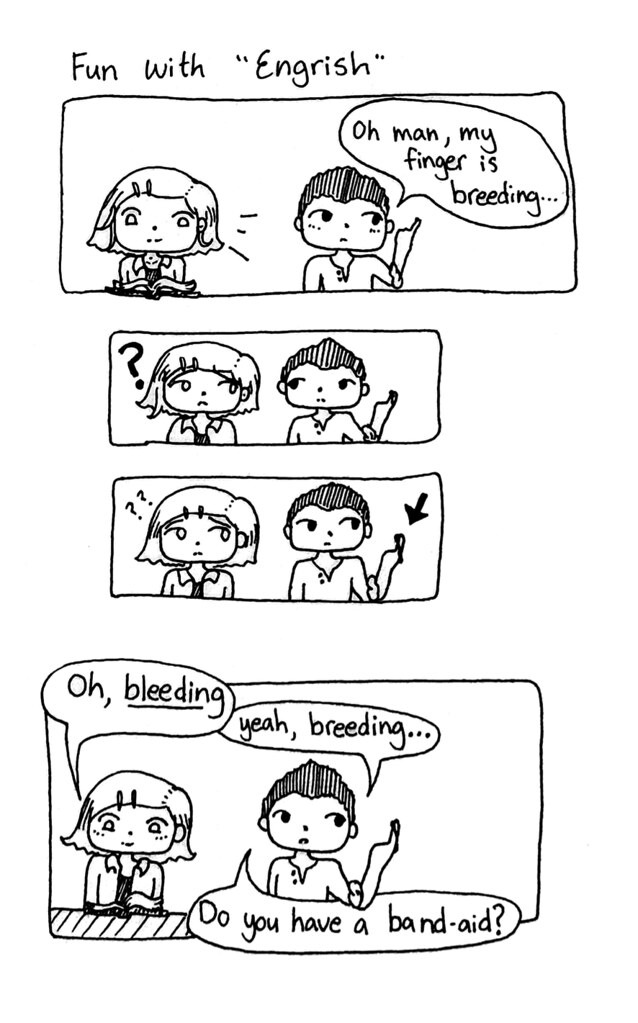
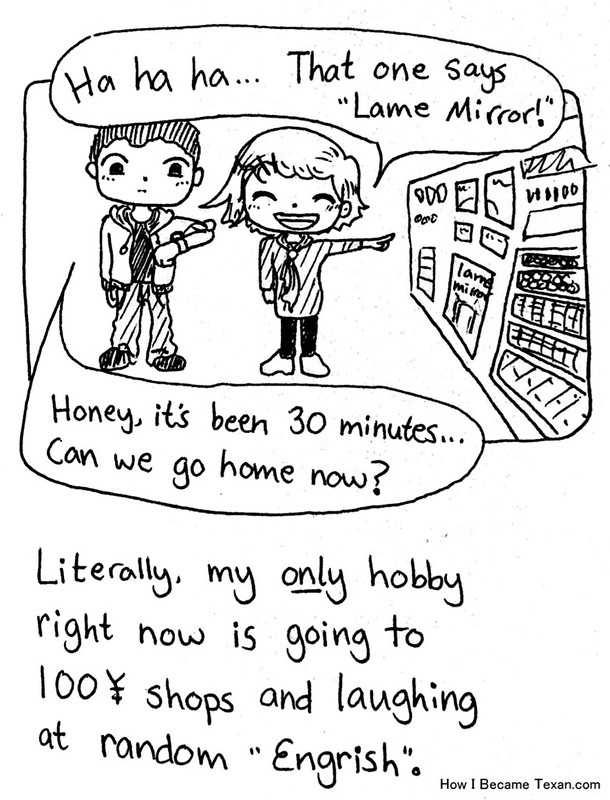
6. Our “Spot the ‘Engrish’” Games have a whole other side to them.

One of my favorite things to do is go to the 100yen shops (like the Japanese equivalent of a $1.00 shop, but much cooler and much less sketchy than American dollar stores) and laugh at the misplaced “Engrish” on the products.

Ryosuke enjoys the game as well. We will drive around all afternoon chatting, finding funny English, and eating peach jelly.

However, Ryosuke is also good at explaining why certain things ended up the way they did. He adds a whole extra level to the game – because as a native Japanese speaker who learned English, he can understand why native Japanese speakers who do not understand English write the things they do.

7. When we argue, we don’t get caught up in exactly what the other person is saying.

Our arguments aren’t a “he said, she said” battle. Of course he says socially unacceptable things while we fight – and in the beginning, I used fly off the handle at some of the socially unacceptable things he said.

Now we’ve learned to focus more on what the other person is feeling, rather than what they say. Our arguments are a “safe space” where you don’t have to worry about the other person freaking out if you accidentally say the wrong thing.

[For more, check out: Fighting – Things My Japanese Husband and I Culturally Disagree About]

It’s not fair to Ryouske to fight with complicated words and hidden meanings. We have to be very clear. And oddly enough, that has helped us both be much more honest when it comes to disagreements. He doesn’t have to worry about accidentally saying the wrong thing and I don’t have to worry about loaded up my words with hidden meanings.

Being married to a non-native English speaker is incredibly fun and always interesting. This cross-cultural relationship has opened me up to a whole new way to look at “language,” itself – which is kind of fitting because I write so much.

But then again, I’m partial because I am terribly in love with my husband.

Grace Mineta is a blogger, freelance writer, and fashionista in Tokyo. Married to her college sweetheart, Ryosuke, she spends most of her time hiking, drawing comics, and trying to navigate life as the American wife to a Japanese businessman.

—–

Speaking of China is always on the lookout for outstanding guest posts and love stories! If you have something you’d like us to feature, visit the submit a post page for details — and then submit yours today.

Guest Post: The privilege of stereotypes about cross-cultural couples in China

(photo by Angela Sevin via Flickr.com)

We’ve all heard about yellow fever and the associated stereotypes. So what happens when you’re a Western man dating or married to an Asian woman and you’re supposedly living the stereotype?

That’s the heart of this thoughtful guest post by Gerald Zhang-Schmidt, who is married to a Chinese woman. 

You may remember Gerald from years back when he collaborated with me to write about stereotypes of Chinese-Western couples. He also submitted a question about changing your name in China that’s become one of my top 10 most popular posts (and incidentally, he was the one who ended up changing his name!). 

Want to follow in Gerald’s footsteps and have your voice heard on Speaking of China? Check out my submit a post page for details.

—–

Maybe I just shouldn’t care.

It’s my own fault, after all. I’ve known Jocelyn, at least via Speaking of China, for years and read of her thoughts and travails with great interest. The way that Chinese society puts everyone into place, in their gender roles and in gendered expectations about behavior and the course of a life has fascinated me.

How could you not be fascinated? While public displays of affection are still viewed askance in many places, the requirements for an ideal partner are proudly and straightforwardly proclaimed in ‘marriage markets’? (“Westerners” may also see these advertisements as superficial and appalling, but one could just as well call them honest.)

How about a place where the women are portrayed as if they would prefer (and be preferred by) foreigners over their own men, whereas the men hardly even seem to stand a chance with anyone anymore? That’s where I’m caught squat in the middle. Speaking of China is all about the rarity of foreign woman – Asian man couples, draws readers because of that same rarity, and has lots of issues to talk about. Meanwhile I’m living all of those other, wicked, dominant, problematic positions.

I mean, according to all the talk about white male privilege – and its experience – I must clearly be privileged. I’m not supposed to talk, for it just reflects my attempts at staying on top and maintaining my privileged position. As the WM part of a WM-AF (white male – Asian female) relationship, I’m living the stereotype. “Oh my, clearly one of those guys with an Asian fetish and one of those stupid and/or calculating women dumb enough to fall for him.”

The privilege of being in a majority is that you’re questioned less. As a friend recently put it, “you are given more second chances.” For the same reason, though, you are also less visible — for better and worse. You don’t have to explain yourself nearly as much as the unusual Western (or other) woman who marries an Asian man or the lucky Asian man who was able to attract a Western woman. Because they are considered unusual, they attract attention. They get questioned. They have to explain themselves and live with the puzzled looks. But, they also get much-visited blogs and book deals for their memoirs. And so, they have a need, but also get a chance, of explaining themselves. In breaking the mold, they are viewed askance, but also as avant-garde.

Try getting a book deal for the story of a ‘stereotypically normal’ WM-AF relationship, when “everyone knows” (a favorite phrase of the Chinese students I was teaching) that it’s all just about the Asian woman looking to better her situation and the Western male with yellow fever.

Such observations of upsides and downsides all too quickly devolve into nothing but discussions of who’s got it worse or better, “the culture of shut-up,” as it was recently called. So who does have it better? The one in an extraordinary situation beyond usual stereotypes, yet facing more scrutiny because of it? Or the one barely noticed because the situation is so stereotypical, no one even bothers wondering?

It’s similar to how feminism and stereotypes are discussed in general terms rather easily, but then suddenly turn personal and get vicious, until the discussion turns into something that has nothing to do with them. The likes of a “sure, there is a privilege to being a white male, but *I* am hardly privileged (or do you see me becoming rich just so?)” even as the systemic difficulties of the not-privileged (and advantages of the privileged) certainly are there, or the “yeah, I’m all for feminism, I like strong women” from men, as if feminism were all about strength, let alone one person’s likes.

But that’s not what I want to discuss. I don’t want to discuss anything, really. I just want to provide my observations and make a humble suggestion. Relationships, be they romantic or otherwise, will always be influenced by ethnic, cultural, and other backgrounds and the views they give rise to. But relationships are, at heart, not between ethnic groups, not between social groupings, nor even between men and women. They are between individual people.

The trouble starts when we don’t want to see individual people and individual situations, and don’t suspend judgment. When we see someone who fits into a stereotypical opinion and immediately think we have a handle on who they are.

We should remember that we tend to not even understand ourselves half as well as we may think we do.

Gerald Zhang-Schmidt is an ecologist and cultural anthropologist who spent three years living in China, and now resides with his wife in his native Austria where he writes about the ecology of happinesschili peppers and being at home in the world.

—–

Speaking of China is always on the lookout for outstanding guest posts and love stories! If you have something you’d like us to feature, visit the submit a post page for details — and then submit yours today.

What’s the big deal about Asian men and bags?

(photo by James Creegan via Flickr.com)

There’s one topic in the foreign blogosphere in China and Asia that I just don’t understand. Why do people make such a big deal about Asian men carrying certain bags?

For those of you who missed the hoopla, the complaints fall into two different camps:

#1. Why do Asian men carry their girlfriends’ or wives’ purses? It makes them look effeminate, unmanly and/or “whipped”.
#2. Why do Asian men carry “manbags” or “man-purses”? It makes them look effeminate, unmanly and/or “whipped”.

Note that while the two complaints are slightly different, the conclusion is essentially the same. In other words, if a guy does one or the other (or, god forbid, both!), he is forever exiled out of the kingdom of masculinity.

I’ve lived a total of almost six years in China and have seen my share of Chinese men carrying their girlfriends’ or wives’ purses — or sporting what some might label as a “manbag” of their own. But I’ve also experienced them on a personal level through my marriage to a Chinese man.

Whenever my husband and I go out shopping, he always offers to carry my shopping bags…and, at times, he might even hold my own bag or purse for me. I never thought of him as “less than a man” just because he did that. To me, it just seemed like gentlemanly behavior — like opening a door or pulling out your seat for you, a simple way to show he cares for you. And besides, whenever we shop, I’m the one who’s usually rifling through the clearance racks and dashing in and out of the fitting rooms more than him, and I’m the one with the list of stores to hit and things to buy. Honestly, it’s nice to have someone to take care of the bags so my hands are free to sift through the shelves and racks without worrying about forgetting or losing the bags. (I am, after all, incredibly absent minded!)

As for so-called “manbags”, my husband’s oldest brother just bought him a brown leather bag as a gift. It was square and had a sturdy shoulder strap. My husband ultimately wasn’t interested in it (he’s prefers backpacks or computer bags) but neither of us judged his brother for the gift.

What I’ve learned from my experiences is this — there is no such thing as a universal definition of what it means to be a man. Different countries and cultures have different ideas of what men should and should not do. So we shouldn’t automatically assume that our country’s definition of “how to be a man” applies everywhere around the world.

We shouldn’t assume that when an Asian man carries a woman’s bag or purse for her, or carries what some label as a “manbag”, he’s somehow not a man. Maybe it’s not something you or the men in your life would do, but that doesn’t mean it’s wrong. So why should anyone make a big deal about it?

Personally, I love the fact that, here in China, men can carry all kinds of bags without thinking, “Will this compromise my masculinity?” Sadly, that’s not true in the US, my home country. For all of the talk about freedom and being yourself in the US, our definition of masculinity is frighteningly restrictive.

Ultimately, the measure of a man is not in what bag he has under his arm or on his shoulder. It’s about who he is as a person. And you’ll never know that from a casual glance on the street.

For everyone who still insists that carrying a woman’s bag/bags for her or toting a so-called “manbag” undermines your manhood, let me ask you this. Who told you so? Where is it written that “Thou shalt not carry thy woman’s bag/bags or carry a so-called ‘manbag’”? And why is it okay for men to carry certain bags, like laptop bags or backpacks, but not others?

No good answers to those questions? Exactly. 😉

P.S.: For further reading on a similar topic, read this post by Grace of Texan in Tokyo titled Things I Love About Japan: Men can wear Pink Running Shoes without being Labeled “Gay”.

Are interracial couples of Asian men & Western women really that rare? A field report from Hong Kong

13884802641_19d8617078_z
A few years back, Fred shared his inspiring story of how he found the love of his life in Brazil. But last year, he really stirred up the conversation about interracial dating in China when he reported his experience in trying to set up his Chinese nephew with American women (to date, the post has generated 196 comments!).

Well, Fred returned to Hong Kong earlier this month and decided to do an informal “study” so to speak. Specifically, he wanted to know whether interracial couples of Asian men and Western women were really as rare as I had written before. Keep in mind that this is not a scientific sampling by any means — it was simply one person’s observations during a vacation in the city.

So what’s the verdict on interracial dating between Asian men and Western women in Hong Kong? Read on to find out! And thanks so much to Fred for filing this report! 😉

—–

When I first sought to date Western women over 14 years ago, I found that it was often a lonely experience because I rarely encountered couples of Asian men and Western women (hereinafter “AM/WW”). I could not consult with anyone except my full brother who himself was married to a White woman and so I had tremendous difficulties bouncing ideas between couples of my equal.

On the other hand, I saw plenty of couples of Western men and Asian women (hereinafter “WM/AW”) like my younger sister and her husband. Often times, I did not find the advice useful or applicable when I consulted with WM/AW couples.

After I chose to marry a White Brazilian woman, two primary questions still remained in my mind:

1) Why are there so many more WM/AW pairings as compared to AM/WW?
2) What are the statistics? (i.e. how many WM/AW pairings versus how many AM/WW pairings can be seen in a typical geographical area given a typical day or week?)

I found Jocelyn’s website and read On the Rarity of Foreign Women and Chinese Boyfriends/Chinese Husbands in China. I felt she did an excellent job explaining why AM/WW pairings are so rare. Among the reasons that she gave were stereotypes held by Chinese men against Western women and by Western women against Chinese men, the media (i.e. portraying Asian male as asexual and lacking masculinity), Western perceptions of the relative physical size of a certain intimate part of Chinese men that makes it unattractive to Western women, etc.

However, there are no statistics on the number of WM/AW versus AM/WW pairings. There were some statistics I read once from the Shanghai Marriage Bureau showing the number of marriages between Chinese men and foreign wives compared to Chinese women and foreign men. However, they did not account for the couples that are not married and dating but nevertheless still a couple.

Jocelyn wrote in her article that it was not uncommon to see an expat walking hand-in-hand with a Chinese (or other ethnically Asian) girl. But neither Jocelyn nor any source told me the numbers. So, I decided to investigate the matter further. In order to answer question number 2 above, I decided to take the matter into my very own hands. I was also curious to see if Jocelyn was really right when she averred that AM/WW pairings are rare. I wanted to prove or disprove her article.

If AM/WW pairings are so rare as she wrote, then how rare are they? What is the proportion of WM/AW over AM/WW pairings?

So, I decided to take the matter into my own hands and do my very own personal investigation. My White Western wife and I, along with my two children, were heading to Hong Kong between April 2, 2014 and April 12, 2014 for a brief vacation to visit my half brother and half sister and their families and to do some sightseeing. So I made it a top priority during that trip to use my very own eyes to count how many WM/AW couples we saw compared to AM/WW couples. Every day I brought a sheet of paper and a pen with me, and I drew a vertical line in the middle. On the left side of the paper I wrote the heading “WM/AW Team” and on the right side I wrote the heading  “AM/WW Team”. Then every time I saw either a WM/AW couple and/or AM/WW couple, I would mark a vertical stroke on the corresponding side of the paper. On the fifth stroke, I would mark it as a horizontal stroke. I would continue counting this way until my return to the US. This would be like a game for me; it started when I first entered the plane in the Los Angeles International Airport and would end when I returned to LAX International.

(Please note that my personal study is by no means scientific as it is not done by random sampling or any type of representative sampling method. It was purely my personal daily observation not predicated on any scientific basis whatsoever.)

My team was “AM/WW” and when I entered the airplane on April 2, 2014 en route to Hong Kong I wrote a stroke on the right side of the paper (i.e., one point for AM/WW team) as my wife and I constituted a AM/WW couple. So, our team was immediately leading the game by one point versus zero for the WM/AW team. “Hurray for us!” I said to myself filled with confidence that our numbers may not be so rare after all, contrary to what Jocelyn wrote.

Well, guess what? My team’s lead was very short lived.

No sooner after landing at the Hong Kong International Airport, the other team WM/AW immediately scored 3 points and now the score was 3 to 1. As time passed between April 2, 2014 and April 12, 2014 the score was skewed more and more in favor of the WM/AW team. In fact, when I visited my half-brother and his side of the family, I had discovered that on his side of the family his youngest of the two daughters is engaged to a White European man (Arnold) from France, and they are both living and working in Hong Kong. Furthermore, Arnold’s father, another White man from France, divorced his French wife many years ago, moved to Hong Kong, and now is dating and living with an Asian woman in Hong Kong. It seemed that the WM/AW pairings are incredibly ubiquitous, just as Jocelyn wrote. Well, all of my hopes of winning the game were dashed.

So, here is the final score from Hong Kong between April 2, 2014 to April 12, 2014:

1) AM/WW Team: 6 couples (including me and my wife)

2) WM/AW Team: 114 couples

We lost the game quite badly.

I guess Jocelyn was ultimately right when she wrote On the Rarity of Foreign Women and Chinese Boyfriends/Chinese Husbands. Couples of Asian men and Western women really are rare.

P.S.: Please note that Hong Kong is considered quite Westernized. If the AM/WW couples are so rare in Hong Kong, I can only imagine how rare they must be if we conducted this study in mainland Chinese cities such as Guangzhou, Shanghai and Beijing.

Fred practices employment law in Torrance, California.

—–

Do you have a “field report”, guest post, or even love story about Asian men and Western women that’s worth sharing? Submit yours today!